Key takeaways
- A GEO tool with built-in content generation closes the loop: it finds the prompts where you're invisible, drafts content to fill the gap, and tells you whether the content got cited.
- Many tools that advertise content features are SEO writers with a GEO label. The test is whether the writing is grounded in real prompt data and citation data.
- Match content to prompt intent. Promptwatch Data shows product pages and landing pages earn about 39% of ChatGPT citations, so a generic blog post is often the wrong format.
- Plan for refreshes. Product and how-to pages lose half their citations in roughly 2.5 months, and news in about 5 weeks.
- Pricing and entry-plan limits change often. Check each vendor's pricing page before buying, and look at which AI engines are included at the price you'll actually pay.
What "built-in content generation" should actually mean
Most GEO tools started as monitors. You type in prompts, they run them against ChatGPT, Perplexity, and Google AI Overviews, and you get a visibility score. That's useful for about a week. Then someone asks "so what do we do about it?" and the dashboard has no answer.
That gap is why the category now splits into three camps:
- Pure monitors, which report mentions and citations and stop there.
- AI writers with a GEO label, which produce articles quickly but run on SEO methodology, with no real prompt-demand data behind them.
- Visibility platforms with a content engine, where the writing is driven by the gaps the tracking data finds, and the published pages are tracked afterwards.
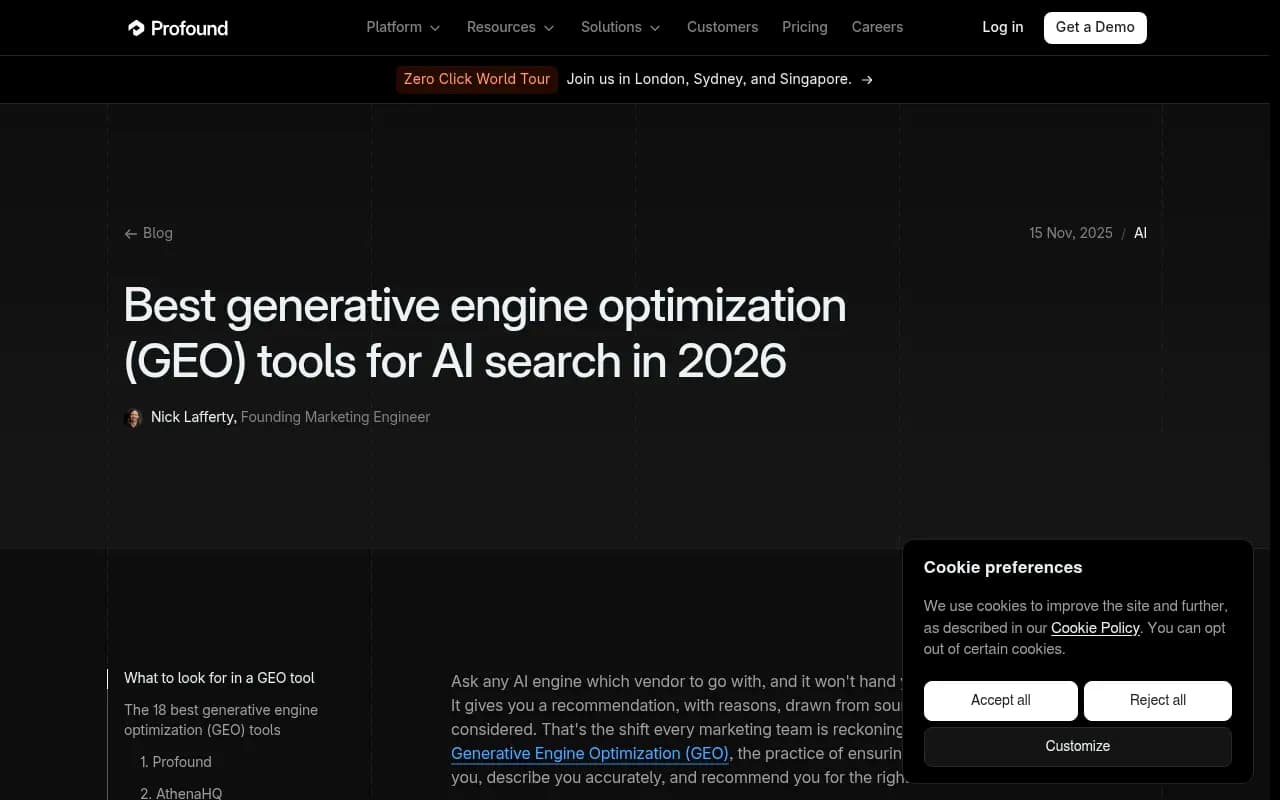
The third camp is what you want if content is the bottleneck. Even the vendor-authored roundups in the market admit the weakness of the second camp. Profound's own comparison guide criticizes Writesonic for running content on SEO methodology with no real prompt-demand data and no loop between content and visibility. That's a competitor talking, so take it with salt, but the criticism is structurally fair for any writer that doesn't see citation data.
What the data says your content should look like
Before comparing tools, it's worth knowing what AI engines actually cite, because a content generator is only as good as the formats it produces.
According to Promptwatch's data on ChatGPT citations by content type (Sep 28 to Oct 4, 2026), product pages are the most cited type at 22.4% of classified citations, and landing pages follow at 16.8%. Listicles get 13.6%, how-tos 8.7%, comparisons 5.9%, and news 5.7%.
It shifts with intent:
- Commercial prompts like "best CRM for small businesses": product pages (26.0%), landing pages (20.6%), and listicles (15.0%) make up most of the citations, and comparisons rise to 7.9%.
- Informational prompts: how-tos (10.7%), docs (8.5%), and articles (7.7%) all earn more than they do overall.
- Branded prompts: product pages (23.3%) and landing pages (22.8%) dominate, with reviews and FAQ pages getting a bigger slice.
So a tool that only spits out 1,500-word blog posts is aiming at a minority of what gets cited. A good content engine should be able to produce comparison pages, FAQ content, and updates to existing landing pages, not just new articles.
Then there's decay. Promptwatch's content half-life study tracked pages ChatGPT cited on July 6, 2026 for 90 days. After 60 days, ChatGPT still cited 69% of landing pages and 67% of docs, but only 55% of product pages and how-tos, which reach their half-life at 74 to 77 days. News pages lose half within 36 days. If a tool generates content but has no refresh workflow, you're signing up for a treadmill.
How to evaluate a GEO tool's content features
I'd ask six questions on any demo call:
- Where does the topic list come from? Real prompt volumes and citation gaps, or a keyword tool underneath?
- Does it write in the format AI cites (comparison, FAQ, product page), or only blog posts?
- Can it publish to your CMS, or do you copy and paste?
- Is there a brand knowledge base, so drafts don't invent facts about your product?
- Does it track the published page afterwards: crawled, cited, clicked?
- What does the entry plan include? Content credits, article caps, and AI engine coverage are often tiered, and some engines are locked behind enterprise contracts.
Question five is the one most tools fail.
Quick comparison
| Tool | Content approach | Closes the loop with tracking? | Best for |
|---|---|---|---|
| Promptwatch | Content Agent, content gap analysis, Content Refresh, CMS publishing | Yes: crawler logs, citations, and AI traffic per page | Teams that want monitoring and execution in one place |
| Writesonic | High-volume AI article writer with GEO tracking | Partial | Teams prioritizing content volume |
| Profound | Content agents on credits (enterprise tier) | Yes | Large enterprises with compliance needs |
| AthenaHQ | Automated schema and entity tagging, Action Center | Partial | On-page GEO at scale |
| Relixir | GEO platform with AI content generation | Partial | Teams wanting one GEO platform with writing built in |
| Geoptie | Unlimited audits, recommendations, and content on the entry plan | Partial | Smaller teams on a budget |
| Gauge | Monthly article allotment on top of tracking | Partial | Teams buying high prompt volume |
| AirOps | Content workflow automation for GEO | Limited | Content ops teams |
| Semrush | Content tooling bolted onto an SEO suite | Limited | Teams already living in Semrush |
That table is a map, not a verdict. Features and plan limits move quickly in this category, and I haven't verified current pricing for every tool here, so confirm on each vendor's site.
The tools worth a look
Promptwatch
Promptwatch is the one I'd start with if you want the whole chain, because the content work is driven by the tracking data rather than sitting next to it. It runs prompts against the real interfaces of ChatGPT, Google AI Overviews, Google AI Mode, Gemini, Perplexity, Copilot, and others, and its content gap analysis maps your pages against the prompts AI answers so you can see what's missing.

The content side has a few layers. The Content Agent (Business and Enterprise plans) plans, writes, and publishes against your visibility gaps, with a publishing calendar, a monthly budget, and a review inbox where you approve, edit, or decline drafts, or let it run hands-off. Content Creation writes a single article from a brief that pulls in your brand details, Google results, news, internal links, and YouTube transcripts. Content Refresh shows git-diff-style updates for existing pages, which matters given the decay numbers above. A Knowledge Base and Brand Book keep drafts factual and on-tone.
Publishing goes straight to WordPress, Webflow, or Framer. After that, the page is tracked through IP-verified AI crawler logs, citation data, and visitor analytics, and underperformers come back as items on the Action Board. That last step is what separates it from writers that publish and forget. Crisp, for example, reported 2x higher conversion rates from AI traffic than from traditional channels and scaled to 5 to 10 articles per day.
Caveats: the automated Content Agent is on Business ($579/mo) and up. Essential ($95/mo) and Professional ($245/mo) include content gap analysis, and Professional adds 5 AEO articles. Agency plans don't include AEO articles or the Content Agent. Check promptwatch.com/pricing before you commit.
Writesonic
Wriesonic is the volume play. Its Article Writer handles research, internal linking, and FAQ generation, and it has added GEO tracking so you can see visibility alongside what you publish. Third-party rankings in the research I reviewed put it near the top for content production.
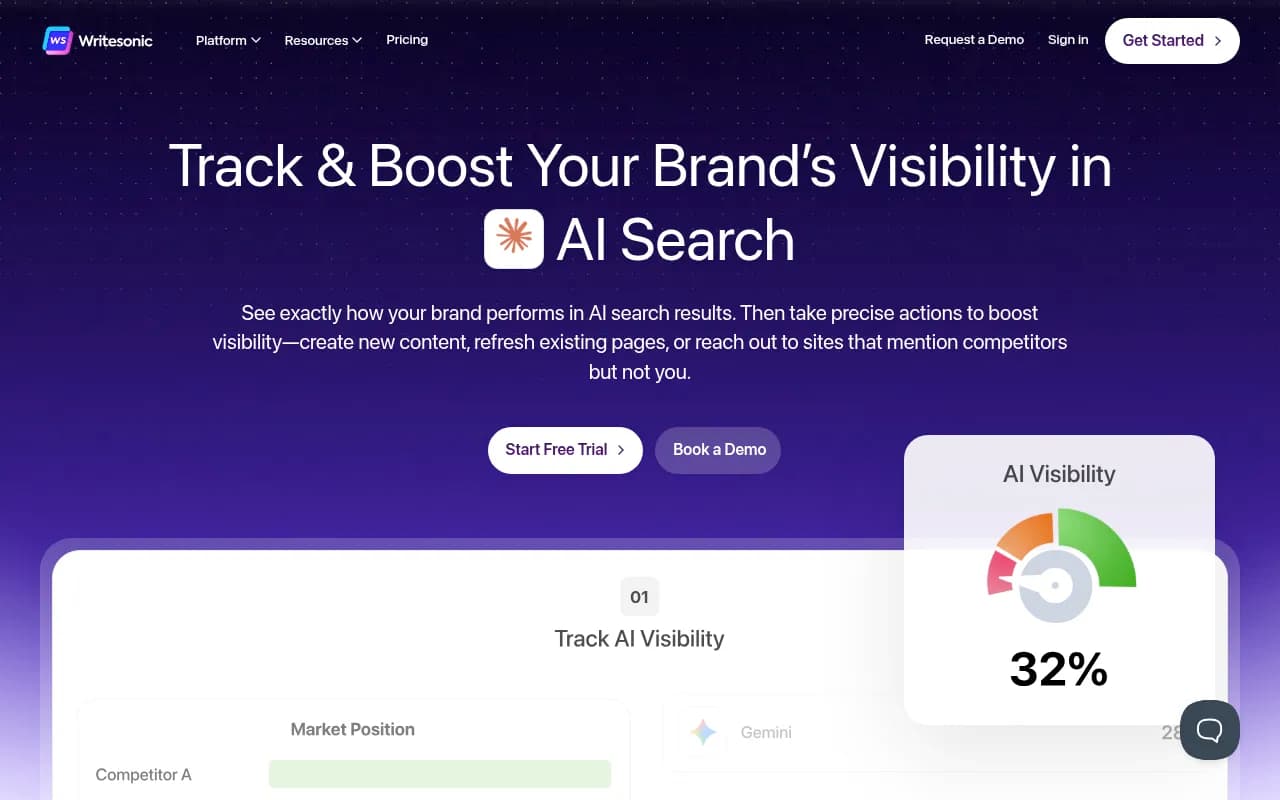
The trade-off is the one flagged earlier. If the topics come from SEO keyword logic rather than prompt demand and citation data, you can publish a lot of content that AI engines never touch. It's a reasonable pick if your team already has a content strategy and needs a faster pen.
Profound
Profound is an enterprise platform with strong tracking across many engines and countries. Content agents exist, but according to the comparison data I reviewed, they run on credits at the Enterprise level, so it's not a cheap way to get content generation.
If you have compliance requirements and a big team, it belongs on the shortlist. If you just want a writer that's wired to visibility data, it's likely more platform than you need.
AthenaHQ
AthenaHQ's strengths are automated schema and entity tagging and an Action Center that turns visibility data into next steps. The criticism from the same comparison is that recommendations often need real editing before use, and that prompt volume relies on an estimation model it doesn't disclose.

It's more of an on-page optimization tool than a drafting tool, which is fine if your problem is structure rather than words.
Relixir
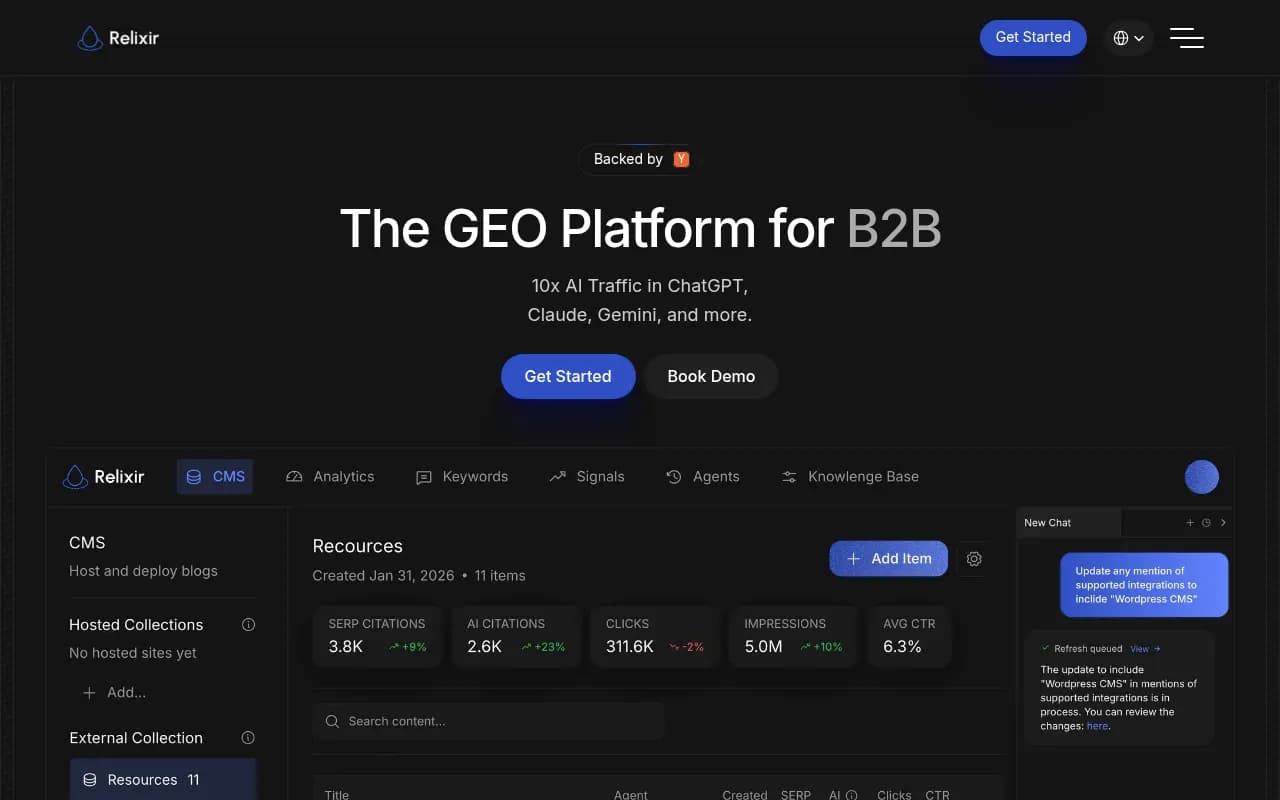
Relixir describes itself as an all-in-one GEO platform with AI content generation and analytics. It's the kind of tool worth trialing against your own prompts to see whether the drafts are grounded in anything.
Geoptie
Geoptie ranks itself first in its own roundup, so apply the usual discount to that. What's interesting is the entry-plan promise: unlimited audits, recommendations, and content from $49/mo, per its own listing. If the content quality holds up, that's an unusually low bar to entry for a small team.
Gauge
Gauge targets teams that want high daily prompt volume, and its listed entry plan includes 18 articles per month. That's a straightforward way to get tracking and a content allotment bundled together.
AirOps
AirOps is a content workflow automation platform that has moved into GEO. It's strong for teams that want to build repeatable content pipelines, but it starts from the content side, so you'd want to feed it your visibility data from somewhere else.
Semrush
Semrush is a traditional SEO suite that has added AI visibility tracking and content tools. If your team already works in Semrush every day, adding its AI features is the low-friction option. Expect a fixed prompt set and shallower AI-specific data than a dedicated platform.
Monitoring-only tools that you'd pair with a writer
Some popular tools deliberately skip content. Peec AI is a good multilingual tracker with recommended actions but no content generation. Otterly.AI is cheap and simple. Ahrefs Brand Radar is monitoring only, as listed in the roundups I reviewed.



Pairing one of these with a separate writer works, but you take on the integration job yourself: you have to carry the gap list from the tracker into the writer, publish, then go back to the tracker and see whether anything changed. That manual loop is exactly what the integrated tools try to remove.
A practical workflow, whichever tool you choose
- Build a prompt set of 50 to 150 prompts across commercial, informational, and branded intent.
- Pull the gap report: which prompts mention competitors but not you, and which of your pages are never cited.
- Choose the format by intent. Comparison and product pages for commercial prompts, how-tos and docs for informational ones, FAQ and review content for branded ones.
- Generate drafts with your brand facts loaded in. Edit every draft. An AI-written page with a wrong spec or price will get cited with the wrong spec or price.
- Publish, then confirm AI crawlers actually reached the page. Crawler logs make this concrete.
- Re-check at 30 and 60 days, and refresh anything trending down.
Also check your technical foundations first. If AI crawlers are blocked or erroring on your site, no amount of generated content will help. Weekly site audits and crawler logs catch this early.
Where to find more options
The category is crowded, with dozens of platforms. For a wider scan of GEO platforms, the directory at bestgeosoftware.com is a good place to compare, and for AI-first rank tracking specifically, ai-rank-tools.com covers that niche.
Which one should you choose?
- You want tracking, content, publishing, and attribution in one product: Promptwatch.
- You need cheap, high-volume drafts and already know your topics: Writesonic or Geoptie.
- You're an enterprise with compliance needs and budget: Profound.
- You're deep in an existing suite: Semrush's built-in features.
- You want best-of-breed tracking and will write elsewhere: Peec AI or Otterly.AI plus your preferred writer.
Whatever you pick, run a two-week trial on your own prompts. Judge the tool by one thing: whether a page it helped you publish shows up as a citation a month later. Everything else on the feature list is secondary to that.