Key takeaways
- Banks need more from a GEO tool than a visibility score: audit logs, security certifications, multi-market tracking, and a way to turn findings into reviewed, compliant content.
- ChatGPT leans heavily on product and landing pages (about 39% of citations combined, per Promptwatch Data, Sep 28 to Oct 4, 2026), so your rate, fee, and product pages matter more than your blog.
- Monitoring-only dashboards are the most common disappointment. Pick a platform that also shows crawler access, traffic, and content gaps.
- Promptwatch, Profound, Conductor, BrightEdge, seoClarity, and Evertune are the realistic enterprise shortlist. They differ mostly in how much they help you fix problems, not just see them.
- Agencies can help, but the public agency rankings are vendor-authored. Treat them as leads, not verdicts.
Why banks have a different GEO problem
A retailer that gets mentioned wrongly by ChatGPT loses a sale. A bank that gets described wrongly can end up with a compliance issue. That is the real difference. Ask an assistant "what is the best checking account in Dallas?" or "which bank has the lowest mortgage rates for first-time buyers?" and the answer is a synthesized recommendation built from sources you do not control. Wrong APRs, outdated fees, a competitor's product described as yours: all of it happens in public, at scale.
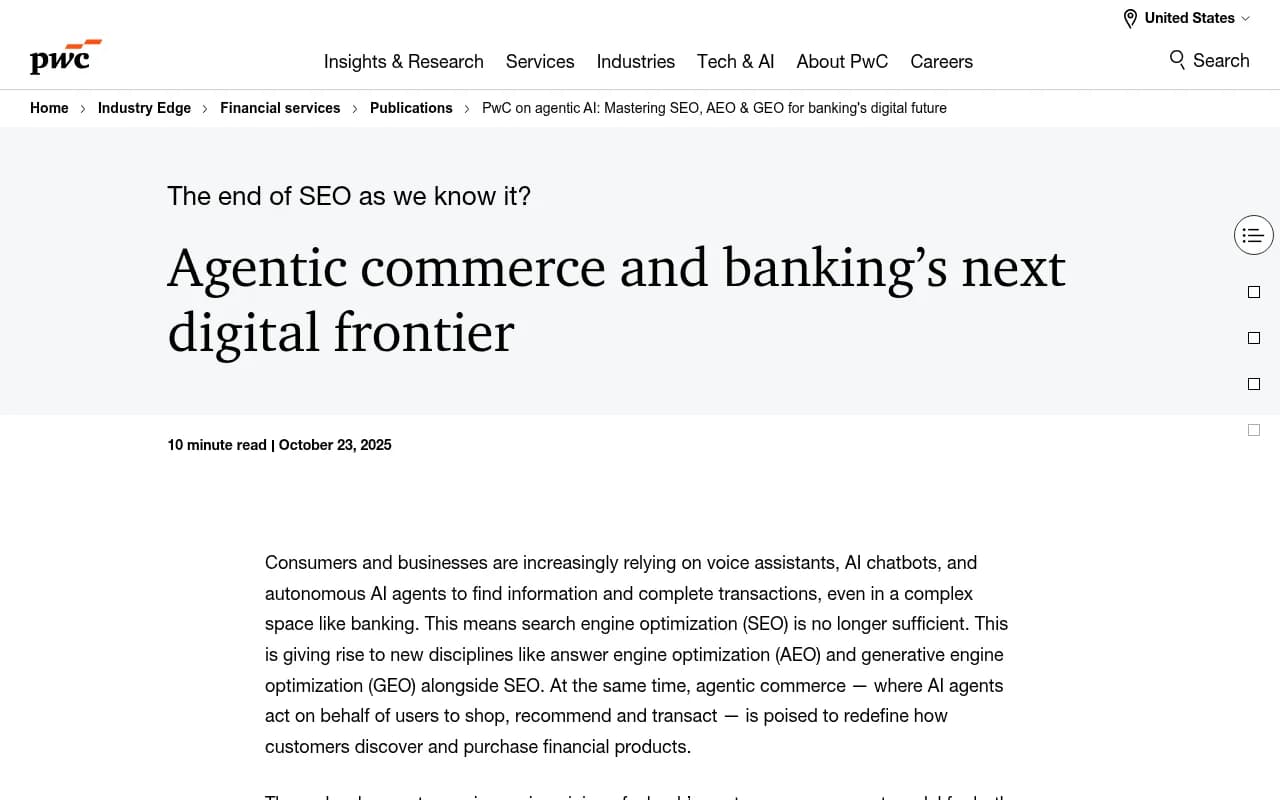
PwC's piece on agentic commerce and banking makes the same point from the strategy side. Customers and businesses increasingly use assistants and agents to find and compare financial products, and the goal is to become the source AI platforms cite or recommend. SEO is still needed. It just is not sufficient.
So what should a bank actually buy? Here is how I would think about it.
What enterprise buyers in financial services should require
Most GEO tool comparisons are written for SaaS marketers. A bank's procurement and risk teams ask different questions. This is the checklist I would hand to a CMO before any demo.
Security and governance
Expect a security review. Look for ISO/IEC 27001 certification, GDPR compliance, SSO, role-based access, and an audit log that records every change and where it came from (dashboard, API, or an AI agent). If a tool lets an AI agent publish content, you need to know who approved it.
Real-interface data, not only API calls
Answers in the ChatGPT or Google AI Overviews interface can differ from what the underlying API returns. For a bank, the interface is what customers see. Ask vendors how they collect responses, and whether they cover multiple countries and languages. Many banks operate across several markets, and a monitor that mixes them is useless.
Claim-level accuracy
A visibility score tells you if you are mentioned. It does not tell you what AI says. For regulated products you want to see the individual claims ("no monthly fee", "highest savings rate") and flag the wrong ones. Few tools do this well.
Crawler and access visibility
If AI bots cannot read your rate pages because of a WAF rule or a JavaScript-heavy calculator, no content strategy will help. IP-verified AI crawler logs separate an access problem from a content problem. Most competitors lack this.
A workflow that ends in action
A dashboard that reports a score and stops is a reporting expense, not a growth channel. You want prioritized actions, content briefs, and a review step that fits compliance sign-off.
Local and multi-location tracking
Branch-driven banks and credit unions live on "near me" queries. Tracking from exact coordinates matters more than most people expect.
What the data says about where to focus
Finance-specific citation data is thin. Promptwatch's catalog covers healthcare, travel, software, and automotive but not banking, so I will not invent figures. What we do have is general ChatGPT behavior, which still tells you where to point your effort.
According to Promptwatch Data on ChatGPT citation share by content type (Sep 28 to Oct 4, 2026):
- Product pages made up 22.4% of citations and landing pages 16.8%, together about 39%.
- On commercial prompts ("best X for..."), product pages hit 26.0% and landing pages 20.6%. Listicles and comparisons add more, so those four types cover almost 70% of commercial citations.
- On branded prompts, reviews were 5.6% of citations, more than three times their overall share.
Translate that to a bank: your checking, mortgage, and card pages are what get cited. Keep rates, fees, and eligibility complete and factual. Get into the "best of" roundups. Collect reviews on sites your category trusts. Publish a real FAQ page.
Two more facts shape planning. News pages lose half their citations in about five weeks, while landing pages and docs hold on for months (ChatGPT content half-life). So rate-change press posts decay fast, but evergreen product pages compound. And ChatGPT cites about 5 sources per answer while Google AI Overviews and Perplexity cite about 10 (average sources per response), so you should measure each surface separately instead of averaging them.
One more caution on social sources. In Promptwatch's data for Sep 28 to Oct 4, 2026, ChatGPT drew just 0.46% of citations from social platforms while Google AI Overviews drew 12.2% (social media citations by AI model). A bank's Reddit and YouTube presence matters for Google surfaces much more than for ChatGPT.
Enterprise GEO tools compared
| Tool | Strongest at | Fix and publish workflow | Crawler logs | Best fit |
|---|---|---|---|---|
| Promptwatch | End-to-end: monitor, trace, act, measure | Content Agent, Action Board, CMS publishing | Yes, IP-verified | Banks wanting to close the loop |
| Profound | Enterprise monitoring | Limited | Not a core feature | Large brands prioritizing monitoring |
| Conductor | SEO and AEO in one enterprise suite | Content and workflow tools | Limited | Teams already on Conductor |
| BrightEdge | Enterprise SEO with AI visibility | Strong SEO workflow | Limited | Existing BrightEdge shops |
| seoClarity | Enterprise SEO plus AI tracking | SEO-centered | Log analysis available | Large SEO teams |
| Evertune | Enterprise GEO at scale | Analytics focus | No | Fortune 500 brand measurement |
This table reflects positioning, not a hands-on test of every product, and features change. Confirm each against the vendor's current documentation.
The shortlist in detail
Promptwatch
Promptwatch is the one I would put first for a bank that wants more than a dashboard. It tracks ChatGPT, Google AI Overviews, Google AI Mode, Gemini, Perplexity, Copilot, Claude, Meta AI, and others through the real interfaces, per country and language. That matters for multi-market banks. It is ISO/IEC 27001 certified and GDPR compliant, and Business and above plans include an audit log, which answers two of the first questions a risk team asks.

Three features fit banking specifically. Brand Narrative pulls out the individual claims AI makes about you and competitors, grouped by themes like Pricing, Features, and Reputation. Fact Check lets you mark a claim Accurate or Inaccurate, then finds the pages on your own site that state it, so you know which page is teaching the model something wrong. AI crawler logs (Agent Analytics) show whether GPTBot, ClaudeBot, PerplexityBot and others can actually read your rate pages. Local GEO/SEO targeting pins monitors to exact coordinates for branch queries.
On the action side, the Action Board prioritizes work and the Content Agent plans, writes, and publishes to WordPress, Webflow, or Framer, with a review inbox so compliance can approve before anything goes live. Visitor analytics then show whether AI sends traffic and conversions. Crisp saw 2x higher conversion on AI traffic using this loop (case study).
Pricing: Business is $579/mo and includes the Content Agent, Fact Check, state and city tracking, local targeting, and the audit log. Agencies run Kick-off $199, Growth $399, or Scale $799. Enterprise adds SSO and a white-label portal. Confirm at promptwatch.com/pricing. There is a 7-day free trial, and a free AI visibility report for a quick baseline. Head-to-head: Promptwatch vs Profound.
Profound
Profound is the best-known enterprise monitoring product and is widely used by large brands. It is strong on tracking and reporting. Where it tends to fall short, based on how it is positioned, is the execution side: no agentic content workflow, no ChatGPT Shopping, and a higher price. If your team already has a content operation and only needs measurement, it is a reasonable choice.

Conductor
Conductor publishes AEO/GEO benchmarks for the financials industry, which is useful context if you want to see how your visibility compares with market leaders. I did not verify what is inside that benchmark, so open it yourself before relying on it. As a platform, it makes sense when your SEO team already lives in Conductor and wants AI visibility inside the same suite.
BrightEdge and seoClarity
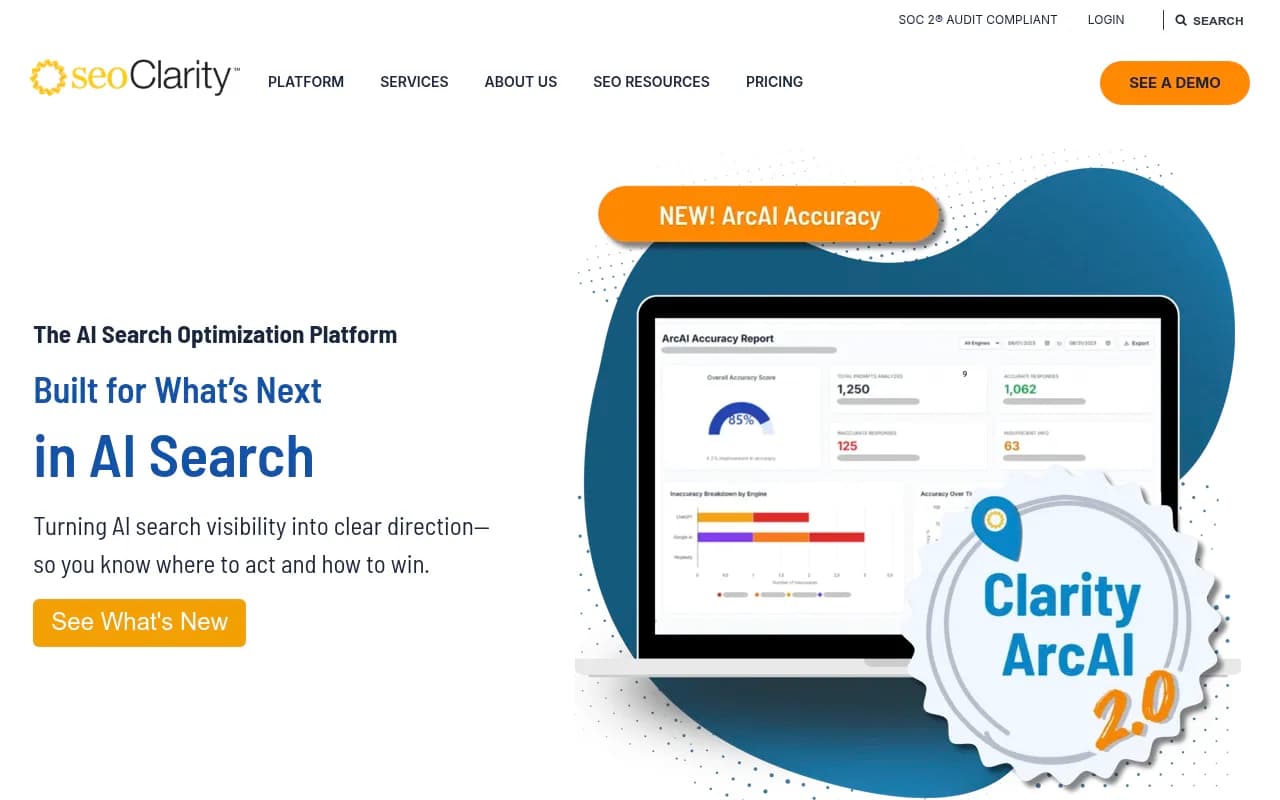
Both are classic enterprise SEO platforms that have added AI search visibility. That is a strength if you want one vendor and one contract for traditional and AI search, which procurement teams often like. The tradeoff is depth: AI-specific data is typically shallower than in a purpose-built platform.
Evertune
Evertune positions itself as enterprise GEO for Fortune 500 brands. It suits large brand teams that want measurement at scale. Check how it handles workflow and regulated-content review before committing.
Others worth a look
Bluefish AI, Brandlight, and Scrunch also target enterprise buyers. See Promptwatch vs Scrunch for one comparison. For a wider list, the GEO software directory is a good place to browse.

Do you need an agency instead?
Some banks do. Regulated content takes legal review, and that is a people problem a tool does not solve. First Page Sage publishes a ranking of financial services GEO agencies scored on factors including compliance review process and FINRA and SEC familiarity, and ScaleTheory has a fintech agency list.
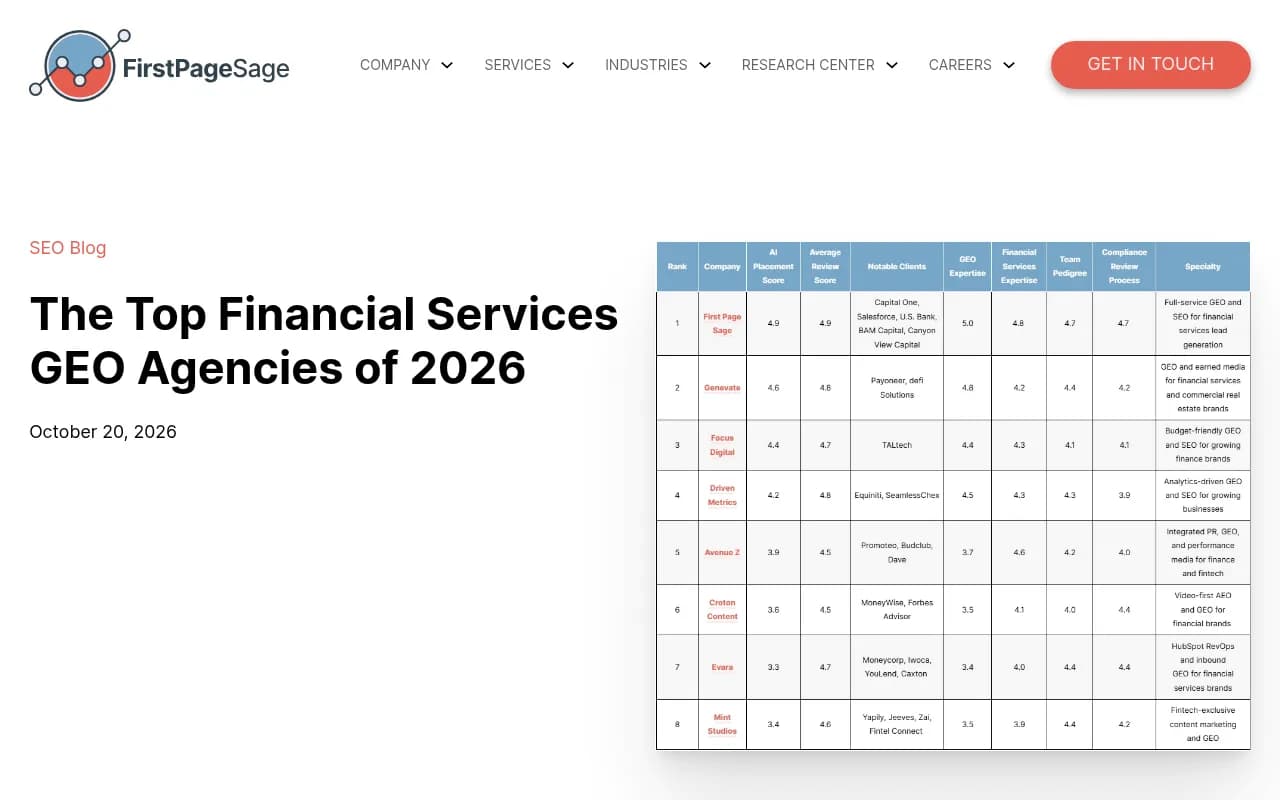
Be skeptical. Each list ranks its own publisher first, and the scores are proprietary. Use them for names to interview, then ask for client references in your segment. Onely's research found that AI engines themselves split the financial services agency question by segment, such as enterprise banks versus fintech startups versus advisors, and asked for budget and firm type before answering. That is a decent hint for your own search: define your segment first.
If you want an agency that pairs strategy with a platform, 1001 SEO Media covers technical SEO, content, and generative engine optimization, and uses Promptwatch for AI visibility. Whichever way you go, insist on transparent reporting and no long lock-in.
How to run a 30-day pilot
- Build a prompt set by product and persona. Include branded prompts, "best X" commercial prompts, and competitor comparisons. Split retail, small business, and wealth clients.
- Run it per market. One monitor per country and language. Do not mix.
- Audit claims. List every claim AI makes about your rates, fees, and eligibility. Mark the wrong ones.
- Check crawler access. Confirm AI bots reach your product and rate pages. Fix blocks first.
- Fix the top three pages. Complete the specs, add an FAQ, update stale numbers, and route copy through compliance.
- Measure again. Watch citations and AI-referred conversions, not only mentions. If you want to learn more about how to attribute traffic, the attribution guide is a good start.
A useful rule when reading results: low share of voice means a coverage problem, a late position is a prominence problem, and mentions without citations to your own domain point at content or crawlability. See the metrics overview for definitions.
Questions to ask every vendor
- Do you collect from the real consumer interface, and in which countries?
- Can I see what AI claims about my rates and mark claims wrong?
- Do you provide IP-verified crawler logs?
- Is there an audit log and SSO? Which certifications do you hold?
- Who approves content before it publishes?
- How often can monitors run, and what does a response cost me?
Bottom line
If you only need benchmarking and already have a content engine, Profound, Conductor, or Evertune can work. If you already run BrightEdge or seoClarity, adding their AI modules keeps procurement simple. If you want to find wrong claims, fix the pages behind them, route copy through review, and prove the traffic arrived, Promptwatch covers the full loop in one product, which is why it leads this list for banks. Start with the free report, baseline your top five products, and decide from real data.