Key takeaways
- At 20+ articles a month, a tracker that only reports mentions is not enough. You need a tool that connects visibility data to specific pages, tells you what to refresh, and ideally helps produce the fix.
- Content ages differently by type. Per Promptwatch Data, news pages lose half their ChatGPT citations within 36 days, while landing pages and docs stay cited far longer. Your refresh schedule should reflect that.
- Four things matter most for high-volume teams: page-level tracking, content gap analysis, CMS publishing, and crawler or traffic data that proves a page was read.
- Pricing varies a lot, from about $29/month for basic monitoring to several hundred dollars for platforms with content workflows. Verify everything on vendor pricing pages.
Why high-volume teams need different tools
A team publishing two posts a month can get away with a spreadsheet and a free AI visibility check. A team publishing 20 or more cannot. Once you have 240+ articles a year, the questions change. Which of them are actually cited? Which fade after five weeks? Which prompts have no page at all? And are you spending your budget on formats AI engines even use?
Most AI visibility tools were built to answer one question: was my brand mentioned? That is useful for a CMO dashboard. It is much less useful for an editor who has to decide what to write on Monday.
So this guide is organised around the content workflow, not around feature lists. I will cover what the data says about what gets cited, what to demand from a tool, and which options fit which team.
What the data says about what gets cited
Before picking a tool, it helps to know what you are trying to move. Two Promptwatch Data reports are directly relevant to a content calendar.
Content types ChatGPT cites
In Promptwatch's ChatGPT content type data (Sep 28 to Oct 4, 2026), product pages were the most cited type at 22.4% of classified citations, followed by landing pages at 16.8% and listicles at 13.6%. How-tos got 8.7%, comparisons 5.9%, and news 5.7%.
The split changes with intent. For commercial prompts like "best CRM for small businesses", product pages, landing pages, listicles and comparisons make up almost 70% of citations. For branded prompts, reviews earn 5.6%, more than three times their overall share.
For a content team, the practical read is simple. If your 20 monthly articles are mostly general thought-leadership posts, you are producing the formats AI engines cite least. Mix in comparison pages, "best of" roundups, FAQ sections and docs-style pages.
How long content stays cited
The content half-life report tracked every page ChatGPT cited on July 6, 2026 for 90 days. After 30 days, 78% of landing pages and 76% of docs were still cited. Product pages, reviews and how-tos reached half-life at 74 to 77 days. Listicles held 60% at day 60. News was the weak spot: half the pages were gone after 36 days.
This matters for volume. Publishing 20 news-style posts a month means you are constantly running to stand still. Publishing durable assets and scheduling refreshes for how-tos and listicles around the 60-day mark compounds instead.
Sources per response differ by engine
Promptwatch's average sources per response data (dated September 2025, so treat it as directional) showed ChatGPT citing about 5 sources per answer, Google AI Overviews about 10, and Perplexity almost exactly 10. Measure each engine separately, because the competition for a slot differs.
What to demand from a tool at 20+ articles a month
Here is the checklist I would use.
- Page-level tracking. Not just brand mentions, but which of your URLs get cited, for which prompts.
- Content gap analysis. A map of prompts AI answers that none of your pages cover. This is your editorial calendar.
- A way to act. Briefs, drafts, refresh suggestions, or direct CMS publishing. Otherwise the insight sits in a dashboard.
- Proof of crawling and traffic. AI crawler logs and AI-referred visitor analytics tell you whether a new page was read and whether it produced visits.
- Multi-engine coverage. ChatGPT, AI Overviews, AI Mode, Perplexity, Gemini and Copilot at minimum.
- Pricing that scales with prompts, not seats. Content teams are bigger than SEO teams.
Tools that stop at item 1 are fine for reporting. Tools that reach item 4 are the ones that change what you publish.
Comparison of the main options
Prices below come from vendor listings and third-party roundups and some are self-reported, so confirm on each pricing page before buying.
| Tool | Strength | Content workflow | Starting price (verify) | Best for |
|---|---|---|---|---|
| Promptwatch | Tracking plus crawler logs, traffic, content agent | Content gap analysis, Content Agent, CMS publishing, Action Board | From $95/mo (free tier available) | Teams that want one loop from insight to published page |
| TMX Visibility | Citation tracking tied to article optimization | Built-in AI assistant, Information Gain, draft review | From $199/mo | In-house content teams refreshing existing articles |
| KIME | Nine engines, sentiment, agentic executions | Agentic executions, MCP and API | From EUR 99/mo | Marketing teams and agencies wanting coverage plus action |
| Frase | Write, optimize, publish, monitor loop | SEO and GEO scoring, Content Guard for decay | Check vendor | Writers who optimize as they draft |
| Profound | Enterprise depth, agency mode | Mostly monitoring | Enterprise pricing | Large brands with dedicated budgets |
| Otterly.AI | Low-cost monitoring | None | From $29/mo | Small teams that only need tracking |
| Semrush | AI toolkit inside an SEO suite | Existing Semrush content tools | Check vendor | Teams already on Semrush |
The tools, in more detail
Promptwatch
Promptwatch is the one I would look at first for a team at this volume, mainly because it covers the whole chain rather than one link. It tracks real ChatGPT, AI Overviews, AI Mode, Gemini, Perplexity and Copilot interfaces, then goes into territory most trackers skip: IP-verified AI crawler logs, AI-referred visitor analytics, and page-level tracking.
For a content team, the useful parts are content gap analysis (your pages mapped against the prompts AI answers), the Action Board (a prioritised GEO to-do list), and the Content Agent on Business plans, which plans, writes and publishes to WordPress, Webflow or Framer with a review inbox. Content Refresh gives diff-style updates for older pages, which fits the half-life findings above. Crisp, for example, scaled to 5 to 10 articles a day with it and reported 2x higher conversion from AI traffic than from traditional channels.
Pricing runs from a free Explore tier (ChatGPT only, 10 prompts) through Essential at $95/month to Business at $579/month. The automated Content Agent and AEO article allowances sit in Professional and Business, so a 20+ article team will likely land there. Check promptwatch.com/pricing.

TMX Visibility
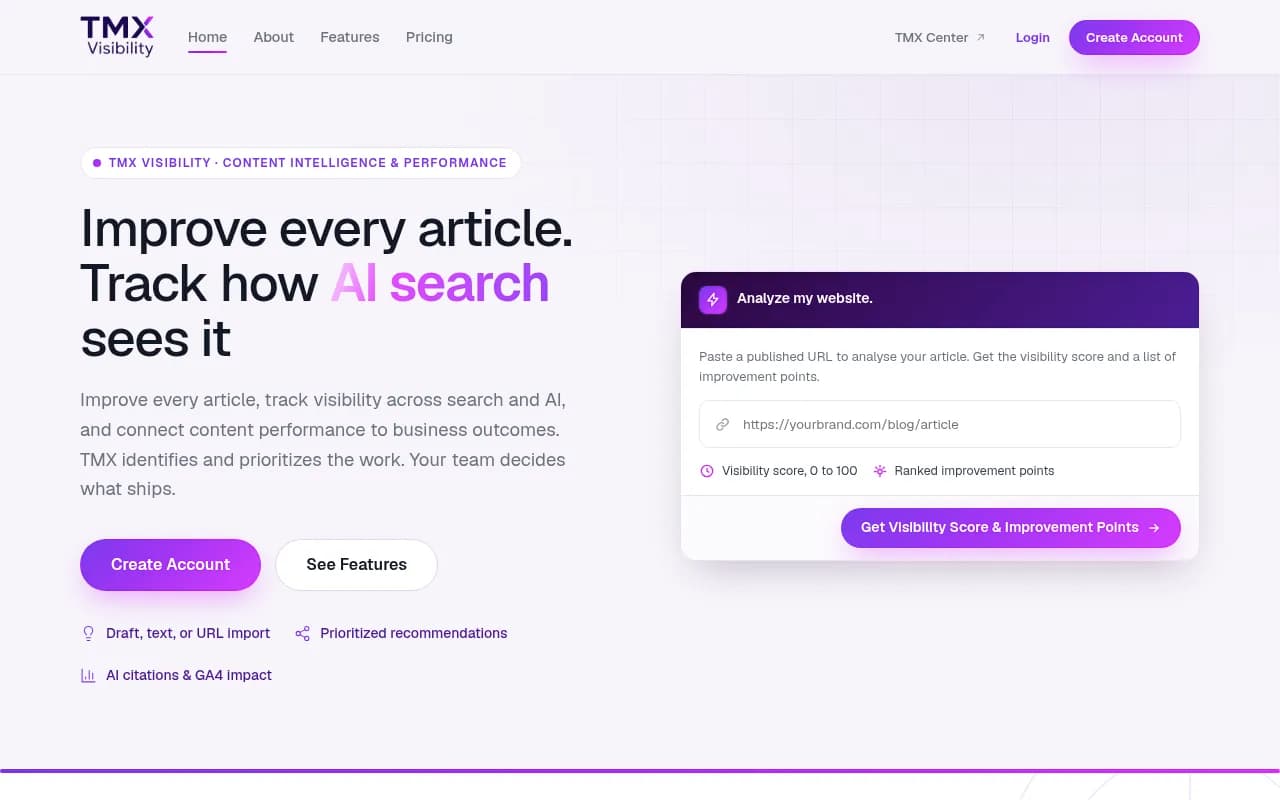
TMX Visibility is aimed squarely at in-house content teams. Its AI Live Tracking shows whether each existing article is cited, and for the ones that are not, a built-in assistant guides the writer through fixes. The Information Gain feature pushes writers to add proprietary data and expert input so the piece differs from generic AI-written content. Paid plans start at $199/month per the vendor. It is narrower than a full platform, but the article-by-article workflow suits editors.
KIME
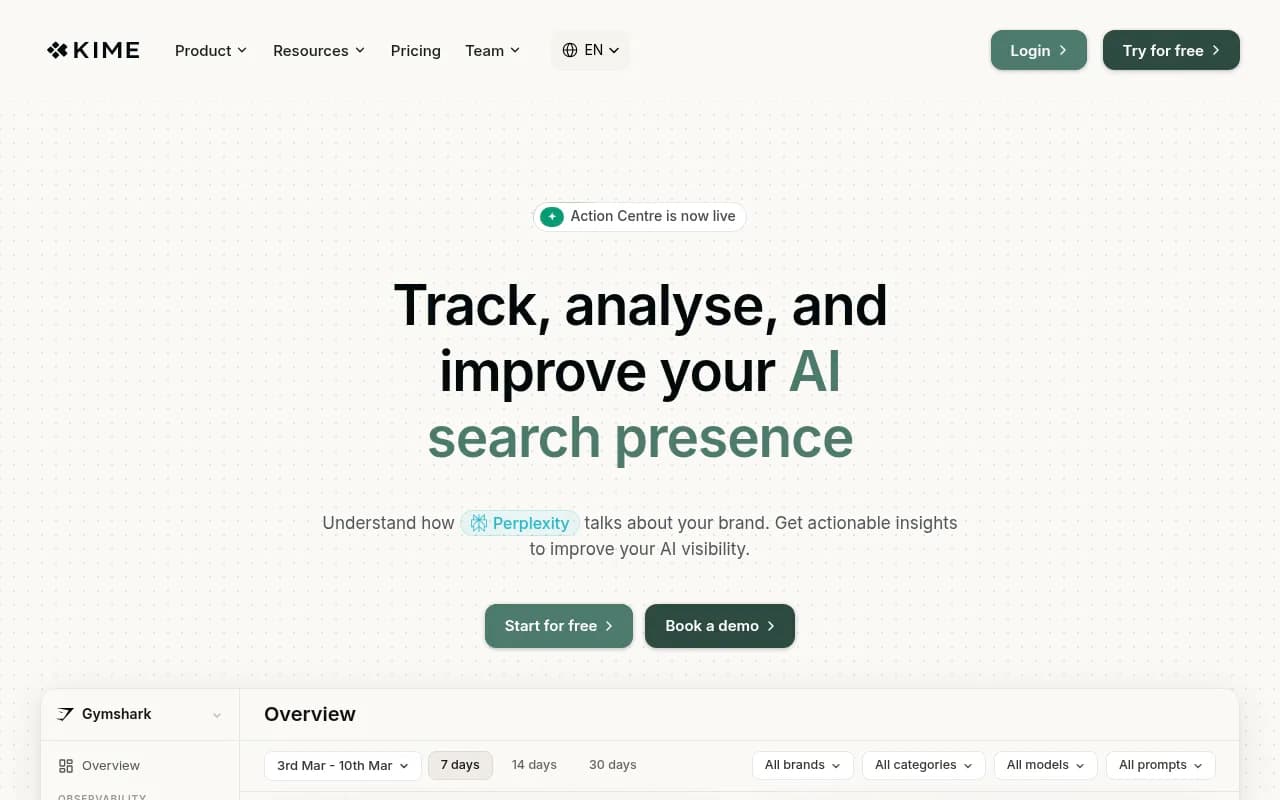
KIME tracks nine engines, reports sentiment, and includes agentic executions with an MCP and API. It prices from EUR 99/month with no per-seat fees, according to its own listicle. Note that KIME's published ranking puts itself first, so read that comparison as vendor material. Agentic executions are capped per plan.
Frase
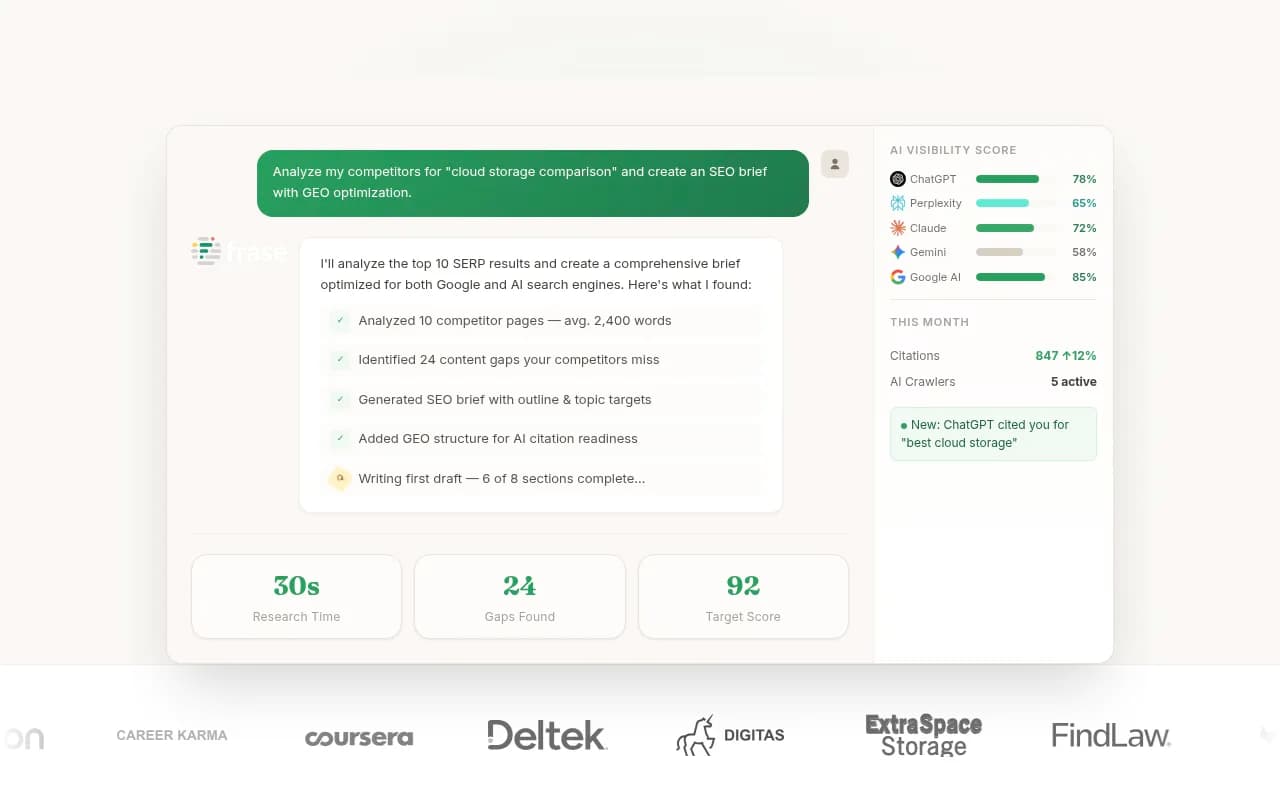
Frase is closer to a writing tool that added monitoring. It scores drafts for SEO and GEO, has share-of-voice alerts, and Content Guard flags decayed pages. If your writers live in a content editor all day, that is a comfortable fit, though its monitoring depth will not match a dedicated platform.
Profound and Scrunch

Both target enterprise budgets. Profound has agency mode with pitch environments. They are strong monitoring platforms, but for a mid-sized content team the price and the lack of content execution are the main drawbacks.
Otterly.AI

The cheap option, from about $29/month. Fine if your need is a simple tracker and you handle briefs and writing elsewhere. You will not get crawler logs or content generation.
Semrush and other suite options
If Semrush is already your daily driver, its AI visibility toolkit reduces tool sprawl. The trade-off is shallower AI-specific data than a dedicated platform. You can compare more options in the GEO software directory at bestgeosoftware.com.
Pairing visibility tools with content tools
Visibility tools tell you what to write. You still need something to write and optimize it. Teams at this volume often combine a platform with an optimizer such as [tool:surfer-seo] or [tool:clearscope], or a research tool like [tool:marketmuse]. If the visibility platform already includes content generation, you can skip some of this and cut the tool tax small teams complain about. One roundup of small-team tooling claims marketers spend about 40% of their time managing tools, and that figure comes from a vendor blog, so treat it as a rough signal rather than a benchmark.
A workflow that works at 20+ articles a month
Here is a setup I would actually run.
- Weekly: review content gaps. Pick the prompts with high volume and no page, and turn them into briefs. Aim for comparisons, listicles and landing-style pages first.
- Per publish: check crawler logs within a few days to confirm AI bots reached the page and got no errors.
- Day 30 to 60: look at citation data per page. Anything that never got cited gets a rewrite or a merge.
- Day 60 to 75: refresh how-tos, reviews and product pages before they hit half-life.
- Monthly: compare AI-referred visits and conversions against organic. This is what justifies the budget.
News-style posts are the exception. Expect them to fade in roughly five weeks and plan them as short-term traffic, not as assets.
How to choose
- You need reporting only: Otterly.AI or a similar low-cost tracker.
- You live in Semrush: try its toolkit first, then reassess.
- You mostly refresh existing articles: TMX Visibility or Frase.
- You want insight, content production, publishing and proof in one place: Promptwatch.
- You are an enterprise with a big budget and monitoring needs: Profound or Scrunch.
Before paying for anything, run a free check. Several tools offer a no-login scan of how ChatGPT, Gemini and Perplexity describe your brand, which gives you a baseline in minutes. If you want to go further across the category, the AI rank tracking directory at ai-rank-tools.com lists many more.
Mistakes to avoid
- Buying on prompt count alone. A cheap tool with 200 prompts and no page-level data will not tell you what to fix.
- Treating every format as equal. The citation data above shows clear winners.
- Ignoring crawl access. If AI bots are blocked or erroring, no amount of content helps.
- Trusting vendor "best of" lists at face value, including the ones that rank the publisher first.
Bottom line
At 20+ articles a month, the deciding factor is whether a tool closes the loop between what AI says and what your team publishes next. Pick one that shows page-level results and helps you act on them, and schedule refreshes by content type rather than by gut feel.