Key takeaways
- Non-branded queries (category, problem, and comparison prompts) are where most AI-driven purchase decisions begin -- and most brands aren't tracking them at all.
- Traditional SEO tools won't show you this data. You need a dedicated AI visibility platform that lets you define custom prompts and track citations across multiple LLMs.
- Only 11% of domains are cited by both ChatGPT and Perplexity, so cross-platform monitoring isn't optional.
- Monitoring alone isn't enough. The platforms that move the needle combine gap analysis, content generation, and crawler tracking into one workflow.
- Promptwatch is the only platform in 2026 rated as a "Leader" across all evaluation categories, covering the full loop from finding gaps to creating content to tracking results.
The problem with branded-only tracking
Most teams, when they first set up AI visibility monitoring, do the obvious thing: they track their own brand name. "What is [Company]?" "Is [Company] good?" "How does [Company] compare to [Competitor]?"
That's fine as a starting point. But it misses the majority of the opportunity.
Think about how a real buyer behaves. They don't start by asking about you. They start by asking about their problem. "What's the best way to manage multi-location inventory?" or "Which tools help B2B SaaS teams track AI search visibility?" They're not looking for you specifically -- they're looking for a solution, and they'll find whoever AI models decide to recommend.
That's the non-branded query problem. If you're not showing up in those answers, you're invisible at the exact moment a buyer is forming their shortlist. And unlike Google, where you can at least see your ranking position, AI search gives you no signal at all unless you're actively tracking it.
According to data from Nobori.ai's AI Search Visibility Statistics 2025 report, B2B companies tracking AI search visibility jumped from 8% to 47% in a single year. But 53% still aren't monitoring at all -- and of those who are, most are only watching branded mentions.
The brands winning in AI search in 2026 are the ones who figured out that non-branded, category-level, and problem-level prompts are where the real volume lives.
What "non-branded query tracking" actually means
Before getting into tools, it helps to be precise about what we're tracking. There are three types of prompts that matter here:
Category prompts -- queries where a buyer is comparing options. "Best tools for AI search visibility." "Top platforms for GEO." "Which LLM monitoring tools are worth paying for?" These are high-intent, high-volume, and highly competitive. If your brand isn't mentioned in these answers, you're not on the shortlist.
Problem prompts -- questions buyers ask before they know a product category exists. "How do I know if AI is sending traffic to my site?" "Why isn't my brand showing up in ChatGPT?" "How do I track what AI says about my competitors?" These are earlier in the funnel, but they're also where you can establish authority before competitors do.
Comparison prompts -- queries that pit specific tools against each other. "[Tool A] vs [Tool B]." "Alternatives to [Competitor]." These are worth tracking even when your brand isn't named, because the AI's answer shapes perception of your entire category.
A good AI visibility platform lets you define all three types, run them across multiple LLMs on a regular schedule, and tell you whether you're being cited, mentioned, or ignored.
Why this is harder than it sounds
The challenge with non-branded tracking is scale. If you're monitoring branded queries, you might have 10-20 prompts. Non-branded tracking can easily mean hundreds of prompts across dozens of topic clusters -- and you need to run them across ChatGPT, Perplexity, Google AI Overviews, Gemini, Claude, and others, each of which behaves differently.
There's also the prompt engineering problem. Writing prompts that actually reflect how real buyers search is a skill. Too broad and you get noise. Too narrow and you miss the actual queries driving decisions. Most SEO teams don't have this muscle yet.
And then there's the "so what" problem. Even if you know you're not showing up for "best AI visibility tools for B2B SaaS," what do you do about it? Most monitoring tools leave you here -- staring at a gap with no clear path to closing it.
The platforms worth paying for in 2026 are the ones that address all three of these challenges.
The platforms that actually handle non-branded tracking
Here's an honest look at what's available, organized by what they're actually good at.
Full-stack platforms (track + act)
These tools go beyond monitoring. They help you identify which non-branded prompts you're missing, understand why, and create content to close the gap.
Promptwatch is the most complete option in this category. Its Answer Gap Analysis is specifically built for the non-branded use case: it shows you which prompts competitors are visible for that you're not, down to the specific content your site is missing. You can then use its Content Agents to generate articles, listicles, and comparisons grounded in real prompt data and citation analysis -- not generic SEO filler. The crawler logs show you when AI agents visit your pages and when those visits convert to citations, which closes the loop between publishing and results.

It monitors 10 AI models (ChatGPT, Perplexity, Google AI Overviews, Google AI Mode, Claude, Gemini, Meta/Llama, DeepSeek, Grok, Mistral, Copilot) and tracks real user-interface behavior rather than just API outputs -- which matters because the answers users actually see can differ from what the API returns. Pricing starts at $99/month for the Essential plan (1 site, 50 prompts, 5 articles) up to $579/month for Business (5 sites, 350 prompts, 30 articles).
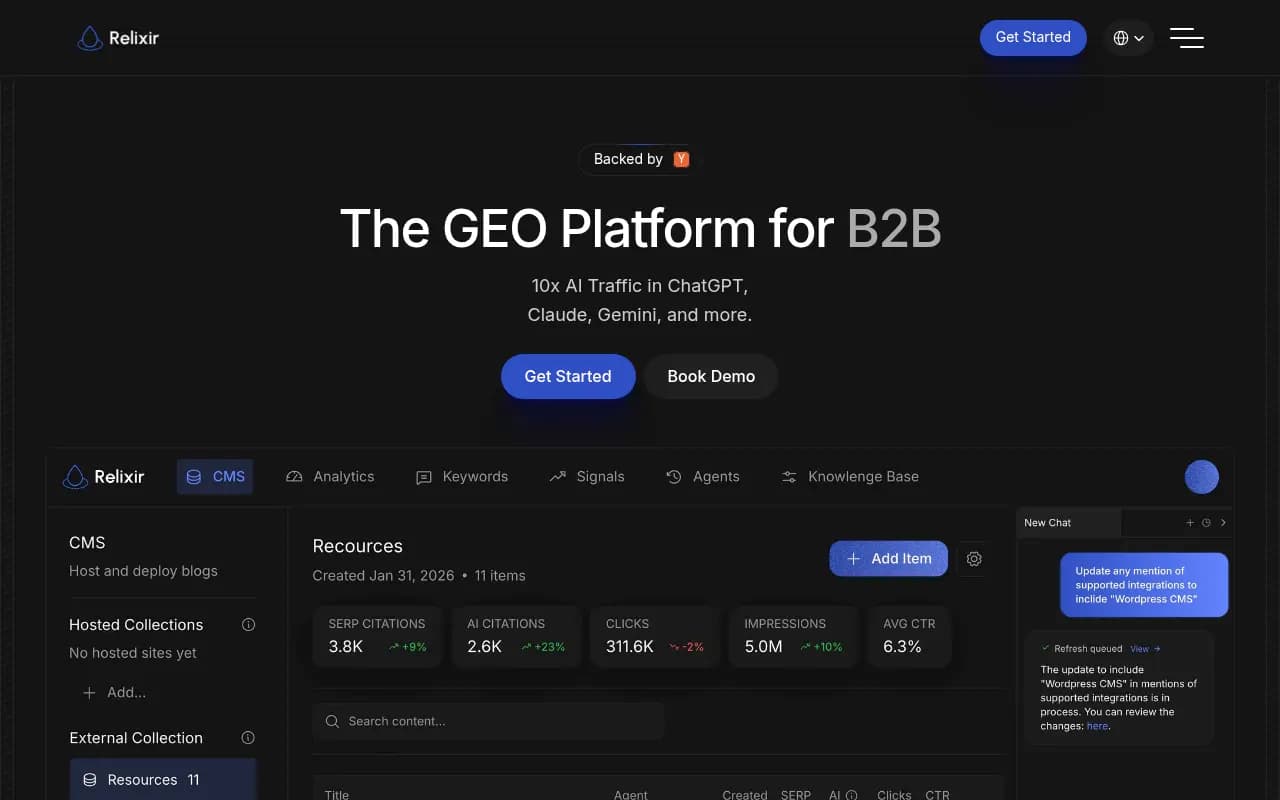
Relixir is another platform that combines monitoring with content generation. It's worth evaluating if you want an all-in-one GEO workflow.
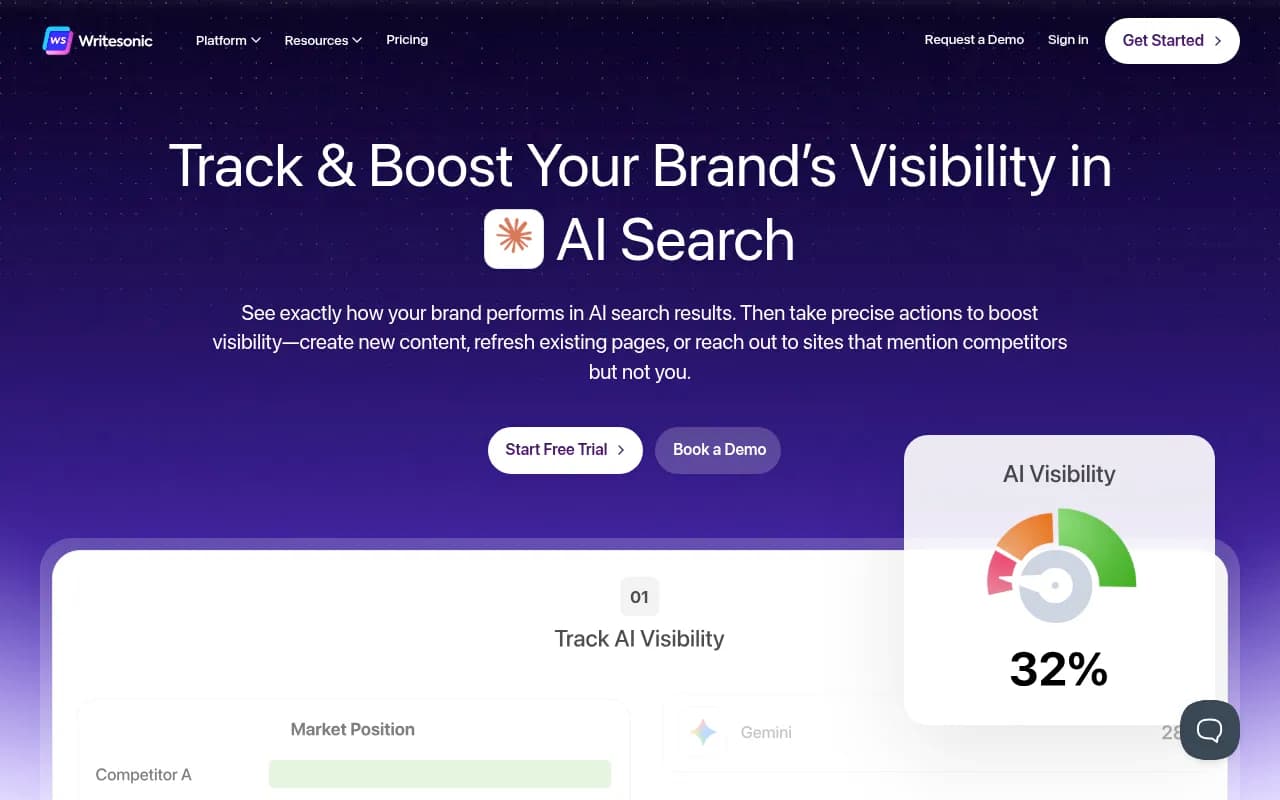
Writesonic has expanded its AI search visibility features and now includes tracking alongside content optimization tools.
Monitoring-focused platforms
These tools are good at showing you where you stand but leave the "what to do about it" question largely unanswered. They're useful if you already have a content team that can act on the data.
Otterly.AI is one of the more accessible options for teams getting started. It handles prompt tracking across major LLMs at a reasonable price point, though it lacks crawler logs, content generation, and traffic attribution.

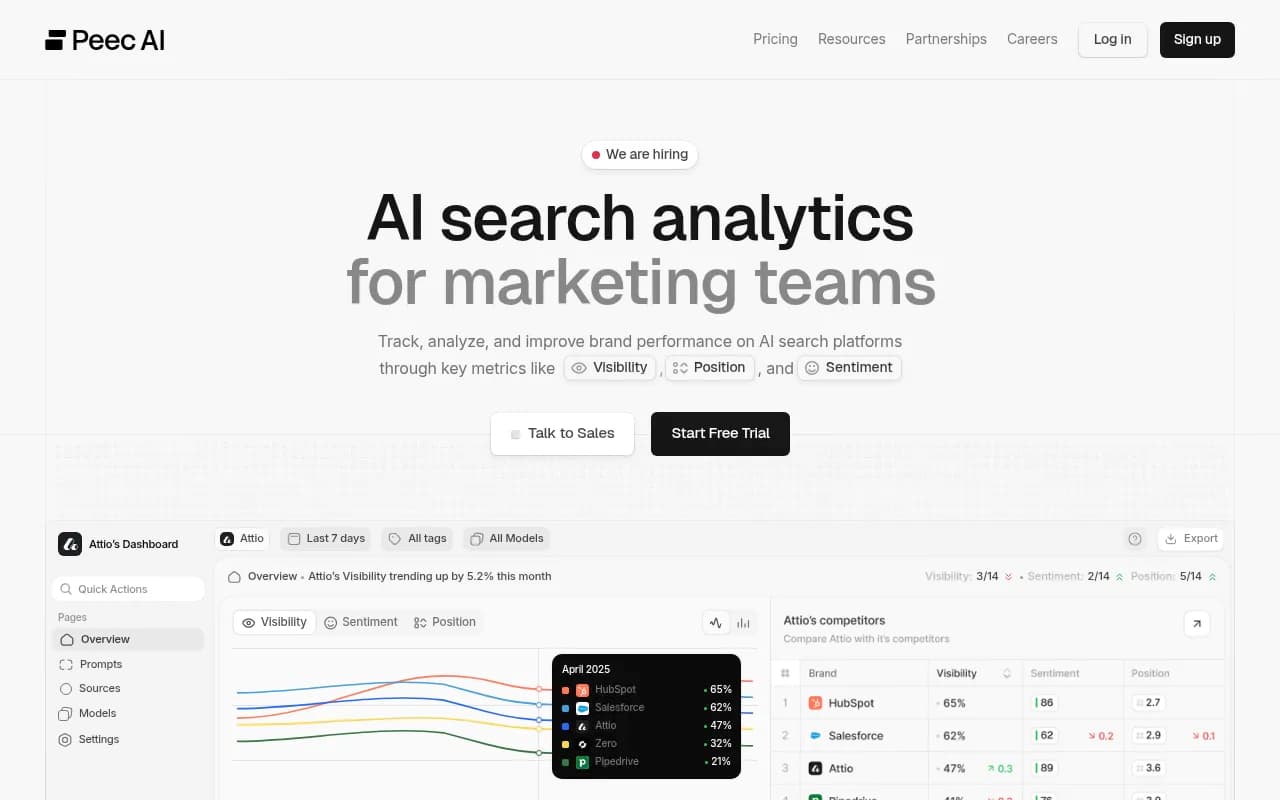
Peec AI covers the monitoring basics well. Good for teams that want clean data without a lot of complexity, but you'll need other tools to act on what you find.
Profound is a stronger enterprise option with solid analytics. The price point is higher, and it doesn't have content generation built in, but the depth of monitoring data is good.
AthenaHQ covers 8+ AI search engines and has a clean interface. Like most monitoring tools, it stops at the data layer.
SE Ranking's AI visibility module is worth considering if you're already using SE Ranking for traditional SEO -- it adds AI monitoring without requiring a separate tool subscription.
Scrunch AI focuses specifically on AI assistant monitoring and has decent competitor comparison features.
LLM Pulse is a lighter-weight option for teams that want basic cross-LLM tracking without a lot of setup.
Mentions.so focuses specifically on brand mention tracking in AI search, which can be useful as a supplementary signal.
Enterprise and agency-oriented platforms
Evertune is built for Fortune 500 use cases -- deep analytics, custom reporting, and a focus on large-scale brand monitoring.
Bluefish AI positions itself as an enterprise GEO platform with strong visibility features.
Search Party is more agency-oriented and works well for teams managing multiple client accounts, though prompt metrics and content gap analysis are limited.
Search Party
Goodie AI targets enterprise GEO with a focus on structured data and entity optimization.
Feature comparison: what to look for
When evaluating any platform for non-branded query tracking specifically, these are the capabilities that matter:
| Capability | Why it matters for non-branded tracking |
|---|---|
| Custom prompt creation | You need to define category and problem prompts, not just branded ones |
| Prompt volume / difficulty scoring | Helps you prioritize which non-branded prompts are worth winning |
| Multi-LLM monitoring | Different AI engines cite different sources; you need cross-platform data |
| Competitor visibility comparison | Shows who's winning the non-branded prompts you're missing |
| Answer gap analysis | Identifies the specific content gaps driving your invisibility |
| Content generation | Lets you act on gaps without switching tools |
| Crawler / agent logs | Shows when AI bots visit your pages and which ones they cite |
| Traffic attribution | Connects AI visibility to actual site visits and revenue |
| Query fan-outs | Shows how one prompt branches into sub-queries you might be missing |
Here's how the main platforms stack up:
| Platform | Custom prompts | Multi-LLM | Gap analysis | Content gen | Crawler logs | Traffic attribution |
|---|---|---|---|---|---|---|
| Promptwatch | Yes | 10 models | Yes | Yes | Yes | Yes |
| Profound | Yes | Yes | Limited | No | No | No |
| Otterly.AI | Yes | Yes | No | No | No | No |
| Peec AI | Yes | Yes | No | No | No | No |
| AthenaHQ | Yes | 8+ models | No | No | No | No |
| SE Ranking | Yes | Yes | No | No | No | No |
| Evertune | Yes | Yes | Limited | No | No | Limited |
| Relixir | Yes | Yes | Yes | Yes | No | No |
| Search Party | Yes | Limited | No | No | No | No |
How to build a non-branded prompt set
The tool is only as good as the prompts you feed it. Here's a practical framework for building a non-branded prompt set that actually captures buyer behavior.
Start with the problem layer
Write down the top 5-10 problems your product solves, phrased the way a buyer would ask them before knowing your product exists. If you sell AI visibility software, that might be: "How do I know if ChatGPT is recommending my competitors?" or "Why isn't my brand showing up in AI search results?"
These prompts tend to be lower competition and higher intent. Winning them early builds authority that carries over to category-level queries.
Move to the category layer
These are the "best [category] tools" and "top [category] platforms" prompts. They're more competitive but also higher volume. Examples: "Best AI visibility platforms for B2B SaaS," "Top GEO tools for marketing teams," "Which LLM monitoring tools are worth it in 2026?"
Aim for 10-20 category prompts that cover the main ways buyers describe your space.
Add comparison prompts
Even when your brand isn't named, comparison prompts shape category perception. Track "[Competitor A] vs [Competitor B]" queries to understand how AI models frame your competitive landscape. If you're not being mentioned in these answers, you're not part of the conversation.
Validate with real data
Tools like Promptwatch include prompt volume estimates and difficulty scores, which lets you prioritize. Don't try to win everything at once -- start with high-volume, lower-difficulty prompts where you have existing content that could be optimized.
The action loop: from gap to citation
Finding out you're invisible for non-branded queries is only useful if you do something about it. The workflow that works looks like this:
- Run your prompt set across LLMs and identify where competitors appear but you don't.
- For each gap, look at what content the AI is citing. Is it a competitor's blog post? A Reddit thread? A third-party review site? This tells you what type of content to create.
- Create content that directly answers the prompt. Not generic category content -- specific, structured answers to the exact question the AI is trying to answer.
- Publish and monitor. Track when AI crawlers visit the new page, and when that visit converts to a citation.
- Repeat for the next gap.
This is the loop Promptwatch is built around. Most monitoring-only tools stop at step one, which means you're paying for data you can't act on.
A note on Reddit and YouTube
One thing most teams overlook: AI models don't only cite brand websites. They cite Reddit threads, YouTube videos, review sites, and forum discussions heavily -- sometimes more than official brand content.
For non-branded queries especially, a Reddit thread where someone recommends your tool can drive more AI citations than your own blog. Tracking which external sources are driving citations in your category (and which aren't mentioning you) is a capability worth looking for. Promptwatch includes Reddit and YouTube insights specifically for this reason.
Which platform should you use?
It depends on where you are in the process.
If you're just getting started and want to understand your current AI visibility before committing to a full platform, Otterly.AI or Peec AI are reasonable starting points. Low cost, easy setup, enough data to understand the landscape.
If you're ready to move from monitoring to optimization -- meaning you want to close the gaps you find, not just document them -- Promptwatch is the most complete option available. The combination of Answer Gap Analysis, Content Agents, and crawler logs covers the full workflow without requiring you to stitch together multiple tools.
If you're an enterprise team with complex reporting needs and a dedicated content team that can act on data independently, Profound or Evertune might fit better, though you'll need a separate content workflow.
The honest answer is that most teams underestimate how much work sits between "we have data" and "we're winning non-branded prompts." The platforms that help you close that gap are worth the higher price point.
Final thought
The buyers who don't know your name yet are the ones who matter most for growth. They're forming opinions right now, in AI-generated answers, and the brands that show up in those answers are building a pipeline that traditional SEO metrics will never capture.
Tracking non-branded queries isn't a nice-to-have in 2026. It's the difference between being on the AI-generated shortlist and being invisible to the majority of buyers who start their research in ChatGPT or Perplexity rather than Google.