Mentions.so Review 2026
Tracks brand mentions and visibility across AI chatbots and search engines with real-time monitoring.
Summary
- Monitoring-only tool -- tracks brand mentions across 8 AI models but lacks content generation, AI crawler logs, and traffic attribution that Promptwatch offers
- Strong sentiment analysis and competitor comparison features with daily updates
- AI traffic analytics included in all paid plans, showing which AI models drive actual visits
- Pricing starts at free (25 prompts, 3 LLMs) up to $579/mo for agencies (300 prompts, all LLMs)
- Best for brands and agencies focused on monitoring AI visibility, but not optimizing content for it

Mentions.so launched in 2024 as a brand monitoring tool built specifically for the AI search era. While traditional SEO tools track Google rankings, Mentions.so tracks something different: how often ChatGPT, Claude, Perplexity, and other AI models actually mention your brand when users ask questions. The premise is simple -- if AI chatbots are becoming the new search engines, you need to know when you're showing up in their answers and when you're not.
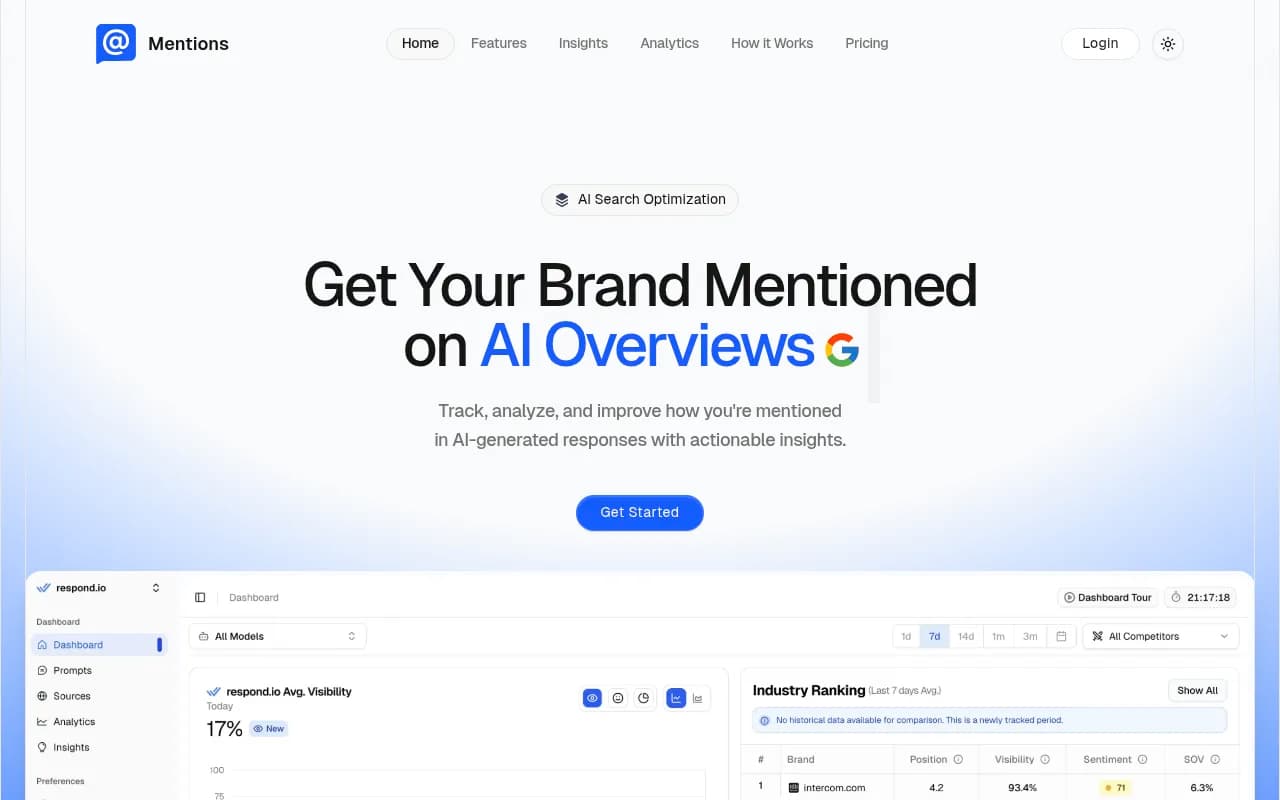
The tool monitors 8 AI models: ChatGPT, Claude, Gemini, Perplexity, Google AI Overviews, Grok, DeepSeek, and Meta AI. You add prompts (questions users might ask), and Mentions.so queries each model daily to see if your brand gets mentioned. The dashboard shows mention frequency, sentiment, and how you compare to competitors. It's a straightforward monitoring setup -- no content optimization, no gap analysis, just tracking.
Who this is for
Mentions.so targets three groups: in-house marketing teams at mid-sized companies (50-500 employees) who want to track brand perception in AI, SEO consultants who need to add AI visibility to client reports, and digital agencies managing multiple brands. The sweet spot is brands that already have decent traditional SEO but are now wondering "are we showing up in ChatGPT?"
It's not for early-stage startups with zero brand presence -- you need existing content and some authority for AI models to mention you in the first place. It's also not for teams that want to actively improve their AI rankings. Mentions.so shows you the data but doesn't help you fix gaps or create content that ranks better. If you're invisible in Claude, the tool will tell you that, but it won't tell you what content to write or which pages to optimize.
Core monitoring features
The main dashboard shows a weekly performance chart with mention counts per AI model. You can see which models mention you most often, how sentiment trends over time (positive/neutral/negative), and where you rank compared to competitors. The competitor comparison is one of the stronger features -- you add up to 5 competitor domains and see side-by-side mention percentages for each prompt. If Teachable gets mentioned 67% of the time for "best online course platforms" and you're at 28%, you see that gap immediately.
Sentiment analysis runs on every mention. The tool categorizes responses as very positive, neutral, or negative based on how the AI model describes your brand. This is useful for reputation monitoring -- if Claude starts describing your product negatively, you'll catch it in the daily report. The sentiment tracking is more reliable than traditional social listening because AI responses are structured and consistent, not random user comments.
Prompt management lets you add custom prompts or use AI-suggested ones. The AI prompt generator analyzes your domain and suggests questions users might ask. For a CRM tool, it might suggest "What's the best CRM for small businesses?" or "How do I integrate a CRM with my email platform?" You can accept or reject each suggestion. Once prompts are added, they run daily across all tracked models.
The "What AI Says" feature shows the actual text of each AI response. You can click into any mention and read the full answer ChatGPT or Perplexity gave, with your brand highlighted. This is helpful for understanding context -- sometimes you're mentioned but in a negative comparison, or buried at the end of a long list. Seeing the raw output helps you understand how AI models actually talk about you.
AI traffic analytics
This is where Mentions.so goes beyond pure monitoring. The tool includes a tracking snippet you add to your website (similar to Google Analytics). It detects when visitors arrive from AI chatbots and attributes traffic to specific models. The analytics dashboard shows total AI traffic, breakdown by model (ChatGPT vs Claude vs Perplexity), and which pages AI users land on most often.
The traffic data connects back to mention tracking. If you see a spike in ChatGPT mentions for a specific prompt, you can check if that correlates with increased traffic from ChatGPT. This closes the loop between visibility and actual business impact. Most competitors (Otterly.AI, Peec.ai, AthenaHQ) don't offer traffic attribution at all -- they show mentions but can't prove those mentions drive visits.
One limitation: the traffic tracking relies on referrer data and user-agent detection, which isn't always accurate. Some AI traffic shows up as direct or gets misattributed. The numbers are directional, not precise. Still, it's better than nothing, and it's the only way to measure ROI from AI visibility efforts.
Insights and recommendations
Mentions.so provides "tailored insights" on Pro and Business plans. These are automated suggestions based on your mention data. For example: "Your mention rate dropped 15% in Gemini this week. Consider updating content about [topic]." Or: "Competitor X is mentioned 40% more often for [prompt]. Review their content strategy."
The insights are basic pattern recognition, not deep analysis. They flag changes and gaps but don't tell you specifically what to do. You won't get "write an article about X" or "optimize page Y for keyword Z" -- just high-level observations. This is the biggest gap compared to Promptwatch, which includes Answer Gap Analysis (shows exactly which prompts competitors rank for but you don't) and an AI writing agent that generates content optimized for AI citations.
For teams that just want awareness, the insights are fine. For teams that want to actively improve their AI rankings, they're not enough. You'll need to do your own content gap analysis and optimization work.
Integrations and workflow
Mentions.so is a standalone web app with no integrations. There's no API, no Zapier connection, no way to export data to other tools. You can download CSV reports, but that's it. This makes it hard to incorporate into existing SEO workflows or client reporting dashboards. Agencies using Looker Studio or Data Studio for client reports will need to manually copy data over.
The lack of integrations also means no connection to Google Search Console, no Reddit or YouTube tracking (which influence AI model training), and no way to sync with content management systems. You're working in a silo. This is fine for small teams doing quick checks, but limiting for agencies or enterprises with complex reporting needs.
Pricing breakdown
Starter plan is free: 25 prompts, 6,000 AI responses per month, daily updates, 1 site, unlimited seats, tracks 3 LLMs (you pick which ones), includes AI traffic analytics. This is enough to test the tool and track a handful of core prompts. The 3-LLM limit means you'll probably choose ChatGPT, Claude, and Perplexity -- the most popular models.
Pro plan is $249/mo (or $199/mo annual): 50 prompts, 12,000 responses, 5 sites, tracks all 8 LLMs, includes tailored insights. This is the plan most small businesses and consultants will land on. The jump from 3 to 8 models is significant -- you get full coverage of the AI landscape.
Business plan is $579/mo (or $463/mo annual): 100 prompts, 24,000 responses, 10 sites. Same features as Pro, just higher limits. This fits mid-sized companies tracking multiple brands or product lines.
Agency plan is $579/mo (or $463/mo annual): 300 prompts, 72,000 responses, unlimited sites, white-labeled reporting (coming soon), early access to beta features. The unlimited sites make this the only viable option for agencies managing 10+ clients. The white-label reporting isn't live yet, which is a problem -- agencies need to rebrand reports before sending them to clients.
Compared to competitors: Mentions.so is cheaper than Profound ($599/mo) and Scrunch ($499/mo) but more expensive than Otterly.AI ($149/mo) and Peec.ai ($199/mo). The pricing is reasonable for what you get, but you're paying for monitoring, not optimization. Promptwatch starts at $99/mo and includes content generation, crawler logs, and gap analysis -- more value for teams that want to improve, not just track.
What's missing (compared to Promptwatch)
Mentions.so is a monitoring tool, not an optimization platform. Here's what it doesn't have:
- No content gap analysis: You can see when competitors get mentioned more often, but not which specific prompts they rank for that you don't. Promptwatch's Answer Gap Analysis shows exactly which questions your competitors answer but you don't, so you know what content to create.
- No AI content generation: Mentions.so doesn't help you write content that ranks in AI. Promptwatch includes an AI writing agent that generates articles optimized for AI citations, grounded in 880M+ citation data points.
- No AI crawler logs: You can't see when ChatGPT, Claude, or Perplexity crawlers visit your site, which pages they read, or errors they encounter. Promptwatch provides real-time crawler logs so you can fix indexing issues.
- No Reddit or YouTube tracking: AI models are heavily influenced by Reddit discussions and YouTube content. Promptwatch surfaces relevant threads and videos that shape AI recommendations. Mentions.so ignores these channels entirely.
- No prompt volume or difficulty scoring: You don't know which prompts are high-value or winnable. Promptwatch provides volume estimates and difficulty scores so you can prioritize the right prompts.
- No query fan-outs: You can't see how one prompt branches into related sub-queries. Promptwatch maps these connections so you understand the full prompt landscape.
- No page-level citation tracking: Mentions.so tracks brand mentions, not which specific pages get cited. Promptwatch shows exactly which URLs AI models reference, so you know what's working.
The bottom line: Mentions.so tells you when you're invisible. Promptwatch tells you why and helps you fix it.
Strengths
- Clean, simple dashboard that's easy to understand without training
- AI traffic analytics included in all plans, even the free tier
- Competitor comparison is straightforward and visual
- Sentiment tracking catches reputation issues early
- Daily updates keep data fresh
- Free plan is generous enough to actually use
Limitations
- Monitoring-only -- no content optimization or gap analysis
- No integrations, API, or export options beyond CSV
- Insights are surface-level pattern recognition, not actionable recommendations
- No Reddit, YouTube, or social media tracking
- No AI crawler logs or indexing diagnostics
- White-label reporting for agencies isn't live yet
- Limited to 8 AI models (missing some emerging LLMs)
Bottom line
Mentions.so is a solid monitoring tool for brands that want basic AI visibility tracking. If your goal is "I just want to know if ChatGPT mentions us," it does that well. The competitor comparison and sentiment tracking are useful for reputation management. The AI traffic analytics are a nice bonus that most competitors don't offer.
But if you're serious about improving your AI rankings -- not just tracking them -- you'll hit the tool's limits quickly. There's no content gap analysis, no optimization recommendations, no crawler diagnostics, and no way to understand why you're invisible in certain models. You'll know you have a problem, but you won't know how to fix it.
For teams that want to actively optimize for AI search, Promptwatch is the stronger choice. It costs the same or less (starting at $99/mo vs Mentions.so's $249/mo Pro plan) and includes Answer Gap Analysis, AI content generation, crawler logs, Reddit/YouTube tracking, and page-level citation data. Mentions.so is a dashboard. Promptwatch is a platform.
Best use case for Mentions.so: You're a marketing manager at a mid-sized B2B SaaS company, you already have decent SEO, and you want to add "AI visibility" as a metric in your monthly reports without changing your workflow. You're not ready to invest in full AI search optimization yet -- you just want awareness.
Similar and alternative tools to Mentions.so