Key takeaways
- Classic rank trackers (Semrush, AccuRanker, AWR, Wincher, SE Ranking) bill per keyword. AI visibility tools (Otterly, LLM Pulse, Searchable and others) bill per prompt. You can't compare the headline prices directly.
- In a Rankability study with prices observed October 16, 2026, covering 100 daily prompts across three engines took $97 to $189 per month. That works out to roughly $0.97 to $1.89 per prompt per month, which is my arithmetic from their table.
- "From" prices usually cover 15 prompts or require yearly billing. Entry plans like Otterly Lite ($29 for 15 prompts) do not cover a serious workload.
- Advanced Web Ranking charges 7x the units for daily tracking, so its cheap-looking keyword count shrinks fast.
- Semrush tracks AI Overviews only inside a paid subscription, so the real cost is the whole plan, not an add-on.
Why per-keyword pricing is a messy way to compare
I went into this expecting a tidy table. It isn't one. Vendors count different things: keywords, prompts, credits, checks, or "responses." Some count a keyword once a week. Others count it once a day. Some bundle AI Overview detection into normal position tracking, and others sell it as a separate module.
So the honest question isn't "what does each tool cost?" It's "what does one tracked query, checked as often as I need, cost me per month?" That is what this guide works out.
There is also a technical reason AI Overview tracking costs more than classic rank tracking. According to Promptwatch Data on average sources per response, AI Overviews cite about 10 sources per answer, roughly double ChatGPT's ~5. A tracker that extracts URL-level citations has far more to capture per query than one that records a single position.
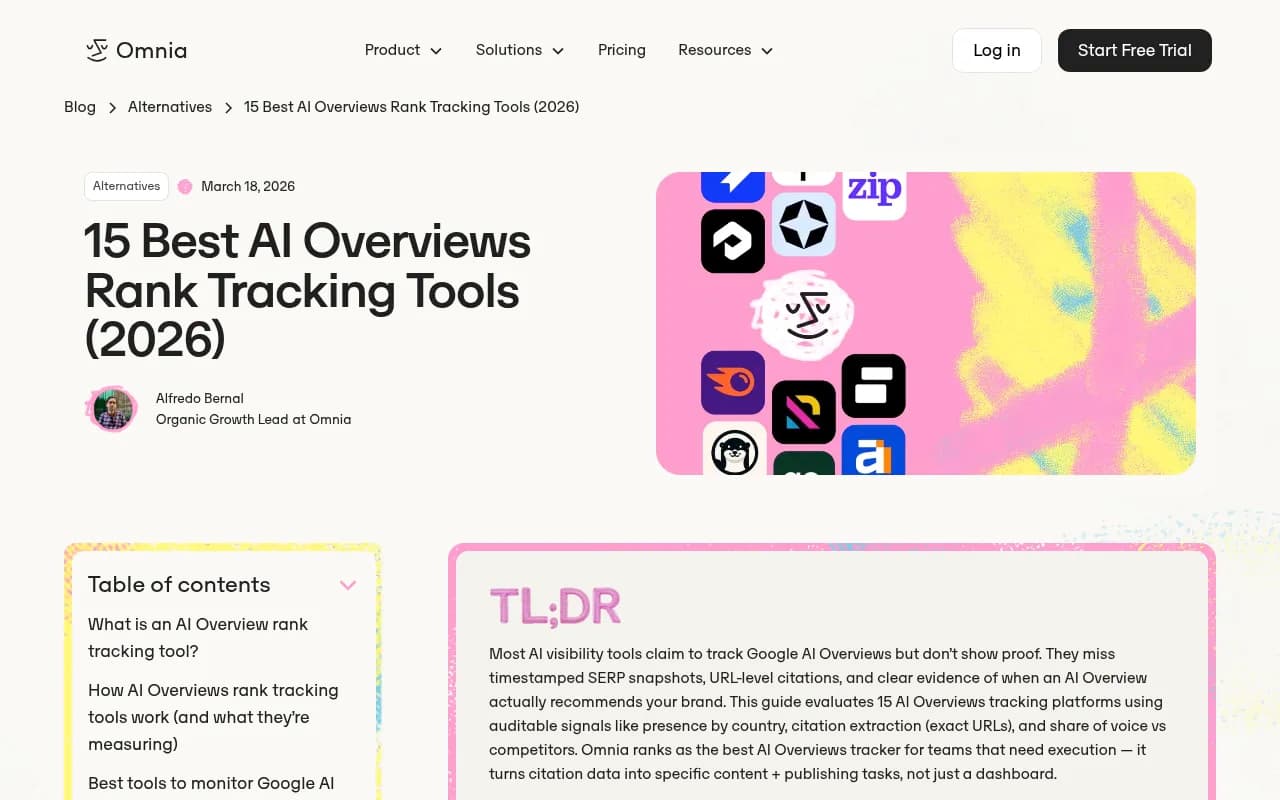
The Omnia comparison above makes a fair point about proof: before paying, check whether a tool stores timestamped SERP snapshots and exact cited URLs, or just gives you a vague visibility score.
Two pricing models you need to separate
Per-keyword (classic rank trackers)
Semrush, AccuRanker, Advanced Web Ranking, Wincher and SE Ranking sell keyword allowances. AI Overview presence is usually a feature attached to the keywords you already track. You pay for the keyword and get the AI Overview flag, and sometimes the cited sources.
Per-prompt (AI visibility tools)
Otterly.AI, LLM Pulse, Searchable, Rankscale and similar tools charge per prompt, often across several engines at once. A prompt here is a natural-language question, not a short keyword, and each one may be run on ChatGPT, Perplexity and AI Overviews. That multiplies the cost.
The 10 tools and what they cost
Figures below come from the vendors' published plans as reported in the research notes. Confirm on each pricing page, because plans change.
1. Semrush
Semrush charges Pro at $139.95/mo (500 tracked keywords, 5 projects), Guru at $249.95/mo (1,500 keywords, historical data, multi-location) and Business at $499.95/mo (API, white-label), with about 17% off annually. Per keyword that is roughly $0.28 on Pro and $0.17 on Guru. The catch, per the Omnia piece: AI Overview tracking in Position Tracking needs a paid Semrush subscription, so small teams pay for the whole suite.
2. SE Ranking
SE Ranking lists Core at $129/mo ($103.20 billed annually) and Growth at $279/mo ($223.20 annually). Rankability notes that Core currently includes 100 daily AI prompts. An AI Search add-on also appears on the pricing page at about $89/mo ($71.20 on annual). Of the classic trackers, this is the one that bundles AI prompts most plainly.
3. Ahrefs Brand Radar
Ahrefs runs Starter at $29/mo, Lite $129, Standard $249, Advanced $449 and Enterprise $1,499 (annual-only), with roughly 17% off yearly. A LinkedIn roundup puts Ahrefs Brand Radar at about $199 per month at the top of its range for AI Overview tracking. Rank tracking sits inside a larger data suite, which is great if you already use the backlink data and wasteful if you don't.

4. AccuRanker
AccuRanker charges Professional at $224/mo for 2,000 keywords (about $0.11 per keyword), Expert at $764/mo for 10,000 keywords (about $0.08), and custom pricing from 25k keywords. Billing annually saves 10%. It is the cheapest per keyword here for daily refresh, and it advertises AI CTR and AI search volume data.
5. Advanced Web Ranking
Advanced Web Ranking sells Pro at $139/mo (7,000 keywords), Agency at $279/mo (14,500) and Enterprise at $699/mo (35,500), with unlimited users and projects and 10% off annual. Read the fine print though: one keyword equals one weekly query unit, and daily tracking costs 7x the units. Daily on 7,000 units means about 1,000 keywords, which is about $0.14 each. Still reasonable, but not the $0.02 the headline suggests.
6. Wincher
Wincher starts around $49/mo (from 500 keywords, up to 10 sites, 1 user), Business is about $89/mo (from 1,000 keywords) and Agency about EUR 319/mo (from 5,000 keywords). Two months are free on annual billing. That's roughly $0.10 per keyword on the entry plan.
7. Otterly.AI
The LinkedIn roundup cites Otterly at $29 per month as the low end. In Rankability's workload test, Otterly Lite ($29) covers only 15 prompts, which is under $2 each but too small to be useful. Otterly Standard at $189 covers 100 daily prompts.

8. LLM Pulse
LLM Pulse's Daily Growth plan costs EUR 149 for 150 prompts, or about EUR 1 per prompt per month, which is the cheapest per-prompt figure in the study's qualifying list.
9. Searchable
Searchable Pro is $125 for 100 prompts across the study's workload, about $1.25 per prompt.
10. Rankscale
Rankscale's Pro plan is $99/mo, and Essentials is $17/mo but billed yearly only, per the October 16 observation. Verify what each plan includes in prompts before you count it as comparable.
Side-by-side cost table
Cost per unit is my own arithmetic from published plan prices and counts. It ignores annual discounts.
| Tool | Entry/reference plan | Unit | Allowance | Approx. cost per unit/month |
|---|---|---|---|---|
| Semrush | Pro, $139.95 | Keyword | 500 | ~$0.28 |
| SE Ranking | Core, $129 | Prompt (AI) | 100 daily prompts | ~$1.29 |
| AccuRanker | Professional, $224 | Keyword | 2,000 | ~$0.11 |
| AWR (daily) | Pro, $139 | Keyword | ~1,000 daily (7,000 units) | ~$0.14 |
| Wincher | Starter, ~$49 | Keyword | 500 | ~$0.10 |
| Otterly.AI | Standard, $189 | Prompt | 100 | ~$1.89 |
| Otterly.AI | Lite, $29 | Prompt | 15 | ~$1.93 |
| LLM Pulse | Daily Growth, EUR 149 | Prompt | 150 | ~EUR 0.99 |
| Searchable | Pro, $125 | Prompt | 100 | ~$1.25 |
| Rankscale | Pro, $99 | Prompt | Not verified | n/a |
The trap is obvious once it's in a table. A $0.11 keyword and a $1.25 prompt aren't the same thing. A keyword on a classic tracker gets you one AI Overview presence check, once a day at best. A prompt on an AI visibility tool may run across three engines.
A fair benchmark: 100 daily prompts across three engines
Rankability's study used one brand, one country, and 100 daily prompts across ChatGPT, Perplexity and AI Overviews for 30 days. That is 100 x 3 x 30 = 9,000 checks per month. Plans that cover it, from their pricing comparison, include:
| Plan | Price per month | Prompts |
|---|---|---|
| Rankability Starter | $97 | 100 |
| SE Visible Basic | $99 | 200 |
| Geoptie Professional | $99 | 100 |
| Searchable Pro | $125 | 100 |
| Orchly Pro | $125 | 100 |
| Otterly Standard | $189 | 100 |
| LLM Pulse Daily Growth | EUR 149 | 150 |
Two caveats. Rankability is a vendor in its own comparison, so treat the ranking with some skepticism. And the study's 21 historical price records ranged from $20 to $3,000 a month with a $99 median, so the market is wide. Even so, the $97 to $189 band for this workload is a useful sanity check against a quote that comes in far above it.
Hidden costs that change the math
Daily versus weekly checks
AWR's 7x multiplier is the clearest example, but others cap daily refresh by plan. AI Overviews shift between runs, so weekly sampling gives you noisy data. If you care about presence rates rather than one-off snapshots, price the daily option.
Billing period
Two months free on Wincher annual, 17% off at Semrush and Ahrefs, 10% off at AccuRanker and AWR. Rankscale's Essentials only exists as a yearly plan. Always compare monthly-to-monthly first, then annual.
Suite lock-in
Semrush's AI Overview tracking needs the paid subscription. If you only want AI Overview data, a suite plan could cost you more than a prompt-based tool that does exactly that.
Citation extraction
Price differences sometimes reflect depth. A tool that only flags "AI Overview present" is cheaper to run than one that extracts roughly 10 cited URLs per answer and archives the SERP. According to Promptwatch Data from July 2026, listicles were about 18.0% of AI Overview citations, product pages 16.3% and how-tos 15.1%. If a tool can't show you which content types win citations for your queries, you're paying for a flag, not insight.
How to choose by situation
- Under 500 keywords, tight budget: Wincher or Semrush Pro. Expect to track keywords, not prompts.
- Thousands of keywords, daily refresh: AccuRanker is the cheapest per keyword in this set.
- Already paying for an SEO suite: use its AI tracking (SE Ranking Core, Semrush Guru) before adding another vendor.
- Brand monitoring across ChatGPT, Perplexity and AI Overviews: a per-prompt tool. Budget $100 to $190 per month for 100 daily prompts.
- Need to act on the findings, not just watch them: look at platforms that pair tracking with content work. Promptwatch tracks the real AI Overview and ChatGPT interfaces, shows citations and AI crawler activity, and has agents that write and publish content to close gaps. Plans start free, then $95/mo, so check promptwatch.com/pricing for current details.

For a wider shortlist, the GEO software directory at bestgeosoftware.com lists dozens more per-prompt tools.
A quick checklist before you buy
- Write your workload as prompts (or keywords) x engines x frequency. Ignore the headline number.
- Ask whether the headline price needs annual billing.
- Check whether daily is included or multiplies your units.
- Confirm whether you get URL-level citations and archived SERPs.
- Test the free trial on 20 of your real queries and compare the output against a manual search.
The cheapest tool per keyword is rarely the cheapest tool per useful answer. Price the workload you actually need, and the right option usually shows itself quickly.