Key takeaways
- ChatGPT visibility moves fast. Promptwatch Data shows average citations per search-enabled response fell about 27% within a day of the GPT-5.3 rollout on March 4, 2026, so a weekly check can miss the cause of a drop.
- Daily refresh is only half of it. You also need historical charts you can annotate against model releases.
- The seven tools below are Promptwatch, SE Ranking, Otterly.AI, ZipTie, Nightwatch, Profound and Advanced Web Ranking. They differ most in what happens after the chart.
- Pricing and refresh cadence change often. Confirm both on each vendor's pricing page before you buy.
Why daily refresh and history matter
A ChatGPT answer is not a stable ranking. The same prompt can differ by run, by model version and by locale. If you check once a week, you are sampling a moving target and guessing at the cause when the numbers move.
Here is a concrete example. Promptwatch's data on the ChatGPT citation drop shows that around the GPT-5.3 rollout on March 4, 2026, average citations per search-enabled response fell across GPT-5.3, GPT-5.4 and GPT-5-Mini. The average was about 6.4 sources the week before and about 4.7 to 4.9 by late March, roughly 27% fewer, with no recovery a month later. It happened within a day, not gradually.
If your visibility dropped that week, your content may not be the problem. Only daily data with a history lets you see that. The same goes for query behavior. Promptwatch's ChatGPT query fanout data shows average fanouts per response and query length shifting in steps tied to ChatGPT changes, and its site: operator report shows ChatGPT jumping from about 0.4% to about 17% of fanout queries using site: on August 8, 2026. Baselines move. You want a chart that shows it.
Three things to look for in any tool:
- A real daily run, not "daily" on one plan and weekly on the cheaper one.
- Retention long enough to cover at least a couple of model releases.
- A way to separate your change from an engine-wide change, for example by tracking citations per response next to your own visibility.
The seven tools at a glance
| Tool | Daily refresh | Historical trends | Beyond tracking | Best for |
|---|---|---|---|---|
| Promptwatch | Yes, monitors run daily | Yes, plus Citation Trends and A/B period compare | Content Agent, crawler logs, AI traffic analytics | Teams that want to fix gaps, not just see them |
| SE Ranking | Daily updates reported | Yes | Classic rank tracking in the same suite | Teams that want SEO and AI in one place |
| Otterly.AI | Check plan | Yes | Light monitoring | Agencies on a budget |
| ZipTie | Check plan | Yes | Optimization suggestions | Marketing leads who want clear next steps |
| Nightwatch | Check plan | Yes | Hybrid SEO and AI rank tracking | Data-driven agencies |
| Profound | Check plan | Yes | Enterprise narrative control | Large brands |
| Advanced Web Ranking | Check plan | Long SEO history | Google plus AI visibility | Established SEO teams |
Note the "check plan" entries. Vendor blog posts list refresh cadence loosely, and I could not confirm every tool's cadence and retention from official pricing pages. Treat those cells as questions for the sales page or trial.
1. Promptwatch
Promptwatch is the one I would start with if the goal is to act on what the chart says. Monitors are panels of prompts that run daily across the models, countries and languages you pick, and it reads the real ChatGPT interface rather than only the API, where answers and citations can differ.

For trend work, the useful pieces are the Visibility Score, Share of Voice and position metrics over time, Citation Trends (every citation classified by content type and source type, with first cited date, peak and decay), and an A/B chart to compare two periods. That last one is exactly what you need to compare before and after a model release.
What separates it from pure trackers is the layer under the chart. IP-verified AI crawler logs show whether ChatGPT bots are even reading your pages, visitor analytics show AI-referred traffic and conversions, and the Content Agent and Action Board turn gaps into drafted and published pages that are then tracked for crawls and citations. Plans start at $95/month for Essential, with a free Explore tier limited to 10 prompts on ChatGPT. Confirm current details at promptwatch.com/pricing.
If you want to compare it with other options first, the GEO software directory at bestgeosoftware.com lists most of the category.
2. SE Ranking
SE Ranking is a familiar rank tracker that added AI visibility. SitePoint's roundup lists it first for ChatGPT tracking and credits it with reliable daily updates. The appeal is having your Google positions and ChatGPT visibility in one project with one set of charts.
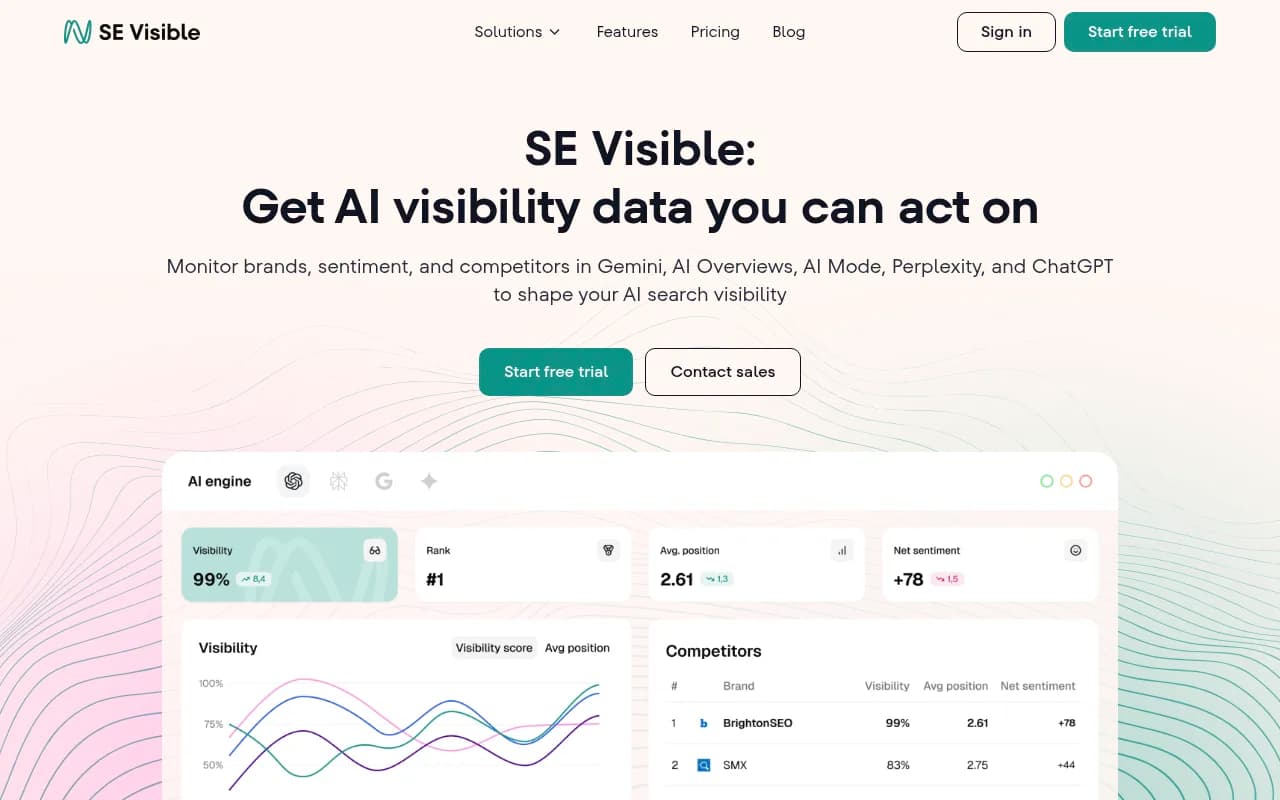
There is also a standalone product, SE Visible, focused on brand visibility and sentiment across AI engines.
The tradeoff is typical of suites. You get breadth and a tool your team already knows, but the AI-specific depth (crawler data, citation lifecycle, content execution) is thinner than in dedicated platforms.
3. Otterly.AI
Otterly.AI is the budget pick. KIME's comparison lists it from $29/month and positions it for agencies managing several brands. It tracks brand mentions and citations across engines and keeps a history so you can see movement.

It is a monitor. That is fine if your job is reporting, and less fine if you also need to know why you are missing from answers or what to publish next.
4. ZipTie
ZipTie leans on analysis. It goes deeper on individual answers and what to change, and KIME lists it from $69/month. If your stakeholder asks "so what do we do" after every chart, that framing helps.
5. Nightwatch
Nightwatch comes from classic rank tracking, which means its history and reporting habits are mature. It combines SEO and AI rank tracking, and the same KIME list shows $39/month plus an AI add-on. Check what the add-on includes for ChatGPT prompts and how often they run.
6. Profound
Profound is the enterprise option. It has strong monitoring and reporting, and it is priced accordingly at the high end. Listings show entry prices, but real enterprise deployments are quoted. It suits large brands that need governance and heavy volume.

Compared with Promptwatch, Profound is a monitoring-first product at a higher price point and without the same Reddit tracking or agentic execution.
7. Advanced Web Ranking
Advanced Web Ranking has more than 20 years of rank tracking behind it and now covers AI search visibility alongside Google. For teams that already keep years of SERP history, putting ChatGPT visibility in the same reporting is a real advantage.
It is less of a fit if you want content generation or crawler analytics bundled in.
How to choose
Pick by what happens after the chart
Any of these will show you a line going down. The question is what you do next. If you want content planning, publishing and a feedback loop, look at Promptwatch. If you want reporting only, Otterly.AI or Nightwatch may be enough. If you want one suite for Google and ChatGPT, SE Ranking or Advanced Web Ranking.
Check the details that vendors blur
- Is daily refresh on every plan, or only higher tiers?
- How many prompts and runs does the price actually cover?
- How long is history retained?
- Does it capture the real ChatGPT interface or API output?
- Does it record exact cited URLs, not just mentions?
- Can you set country and language?
Omnia's buyer guide makes a similar point about locale coverage and exact citation URLs. It is a vendor source, so use it as a checklist rather than a ranking.
Be skeptical of the numbers in listicles
Several "best tools" posts are written by tools that rank themselves first. One claims roughly 60% of organic traffic now comes from AI responses, with no source. I would not repeat that. Use your own AI-referred traffic numbers instead.
A simple weekly routine
- Track a fixed prompt set of 30 to 100 prompts that reflect buying questions, plus your brand and competitor comparisons.
- Annotate your chart with model release dates, for example March 4, 2026 for GPT-5.3.
- When visibility drops, check citations per response across the board before touching content.
- Look at which content types get cited. Promptwatch Data shows product pages as the most cited type in ChatGPT at 22.4%, and its content half-life report shows news losing half its cited pages within 36 days, so refresh time-sensitive pages first.
- Review the crawl side. If AI bots are hitting errors, no amount of content will fix it.
For more on how the category compares, the AI rank tracking directory at ai-rank-tools.com is a good place to browse. Promptwatch's full data hub is useful context for what is normal before you panic over a dip.
Bottom line
Daily refresh and long history are table stakes now, so use them to filter, then choose on what the tool lets you do next. Start a trial of two tools on the same 50 prompts for two weeks, and compare how each one handles a day when the numbers move. That tells you more than any feature table.