Key takeaways
- Scrunch has no public pricing, requires developer involvement for most recommendations, and doesn't generate content or build brand presence -- three reasons teams look elsewhere.
- The best alternatives split into two camps: monitoring-focused tools (good for tracking) and action-oriented platforms (good for actually improving AI visibility).
- Promptwatch is the only platform in this comparison rated as a leader across monitoring, content generation, and traffic attribution -- it covers the full loop from gap analysis to published content to revenue tracking.
- Pricing across alternatives ranges from ~$19/month (Passionfruit Labs) to enterprise custom (Profound, Evertune), so budget fit matters as much as features.
- AI model coverage varies significantly -- some tools only track ChatGPT and Perplexity, while others cover 10+ models including DeepSeek, Grok, and Mistral.
Why teams are leaving Scrunch in 2026
Scrunch built its reputation on technical AI readiness -- helping sites become more crawlable by AI engines through structured data, llms.txt files, and architecture audits. That's genuinely useful work. But it's not the whole picture.
The brands AI engines cite most consistently aren't just technically compliant. They publish authoritative content, accumulate brand mentions across the web, and build topical depth over time. A technically perfect site with nothing worth citing still won't appear in ChatGPT's answers.
Three specific frustrations keep coming up in community discussions:
Pricing opacity. Scrunch uses custom enterprise pricing with no published tiers. You can't evaluate cost-effectiveness without a sales call.
No content creation. Scrunch doesn't write anything, publish anything, or help build brand presence. Teams whose main problem is a content gap -- not a crawlability problem -- find it doesn't address their actual constraint.
Developer dependency. Most of Scrunch's recommendations require engineering involvement to implement. Teams without that bandwidth get insights they can't act on.
The result: a growing market of alternatives, some monitoring-only, some genuinely action-oriented. Here's how the best ones stack up.
The 10 best Scrunch alternatives in 2026
1. Promptwatch -- best overall for end-to-end AI visibility
Promptwatch is the most complete platform in this comparison. Where most tools show you data and leave you to figure out what to do with it, Promptwatch runs a full loop: find the gaps, create content to fill them, track whether it worked.

The Answer Gap Analysis shows exactly which prompts competitors rank for that you don't -- not just that a gap exists, but the specific topics and questions AI models want answered that your site doesn't cover. The built-in AI writing agent then generates articles, listicles, and comparisons grounded in 880M+ citations analyzed, prompt volume data, and competitor research. This isn't generic content -- it's engineered to get cited by ChatGPT, Claude, Perplexity, and others.
On the monitoring side: 10 AI models covered (ChatGPT, Perplexity, Claude, Gemini, Google AI Overviews, Google AI Mode, DeepSeek, Grok, Mistral, Copilot), real-time AI crawler logs showing which pages each model reads and how often, ChatGPT Shopping tracking, Reddit and YouTube citation tracking, and page-level visibility scores that connect directly to traffic attribution.
Pricing is transparent: Essential at $99/month (1 site, 50 prompts, 5 articles), Professional at $249/month (2 sites, 150 prompts, 15 articles, crawler logs), Business at $579/month (5 sites, 350 prompts, 30 articles). A free trial is available.
The honest limitation: the article generation quota on lower tiers means high-volume content teams may need the Business plan or above.
2. Profound -- best for enterprise teams with large prompt sets
Profound is a strong enterprise-grade platform with deep prompt tracking, competitive share-of-voice analysis, and solid multi-model coverage. It's built for teams managing large keyword sets across multiple brands.
Where it pulls ahead of Scrunch: it actually publishes prompt volume data and difficulty scores, which Scrunch notably doesn't. Where it falls short of Promptwatch: no built-in content generation, no Reddit/YouTube tracking, and no ChatGPT Shopping monitoring. It's a monitoring-first tool that requires you to bring your own content operation.
Pricing is custom, which puts it in the same boat as Scrunch on transparency.
Best for: enterprise marketing teams with dedicated content writers who need robust tracking infrastructure.
3. Otterly.AI -- best budget monitoring tool
Otterly.AI is the go-to recommendation for teams that need basic AI visibility tracking without spending much. It covers the core models (ChatGPT, Perplexity, Gemini) and gives you brand mention tracking and share-of-voice comparisons at an accessible price point.

The tradeoff is clear: Otterly is monitoring-only. No content generation, no crawler logs, no traffic attribution. It tells you where you're invisible but doesn't help you become visible. For teams that just need a dashboard to report upward, that's fine. For teams that need to move the needle, it's a starting point, not a destination.
Best for: small teams or agencies that need affordable tracking and handle content strategy separately.
4. Peec AI -- best for straightforward prompt monitoring
Peec AI covers ChatGPT, Perplexity, Gemini, and AI Overviews with clean reporting on brand mentions and competitor comparisons. The interface is simple enough that non-technical marketers can use it without training.
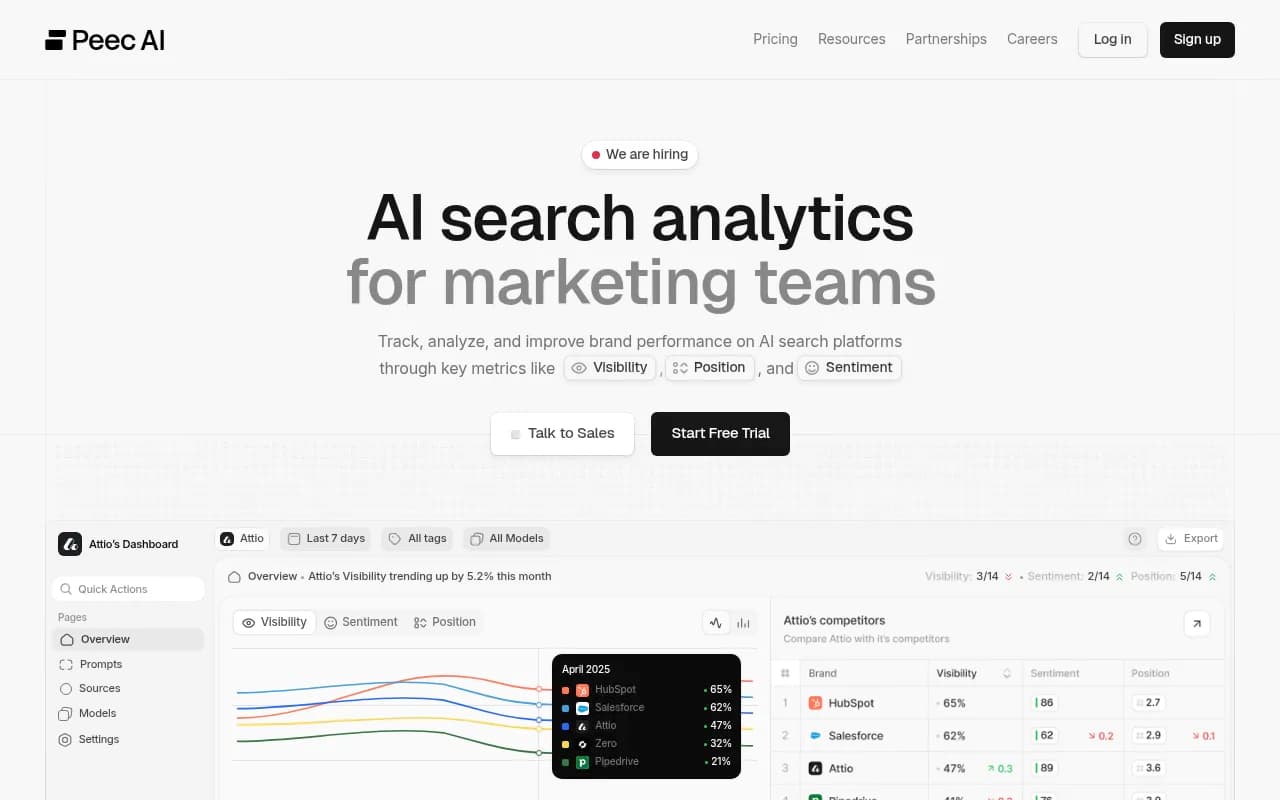
Like Otterly, it's fundamentally a monitoring tool. The prompt tracking is solid, but there's no content gap analysis, no writing tools, and no crawler visibility. It's a good fit for teams that want to check in on AI visibility weekly without building a full GEO operation.
Best for: marketing managers who need a simple, low-maintenance tracking tool.
5. Omnia -- best for URL-level citation intelligence
Omnia differentiates on citation transparency. Most tools tell you that a competitor is getting cited -- Omnia shows you which specific URLs are earning those citations, in which country, from which AI model. That level of granularity is genuinely useful for content strategy.
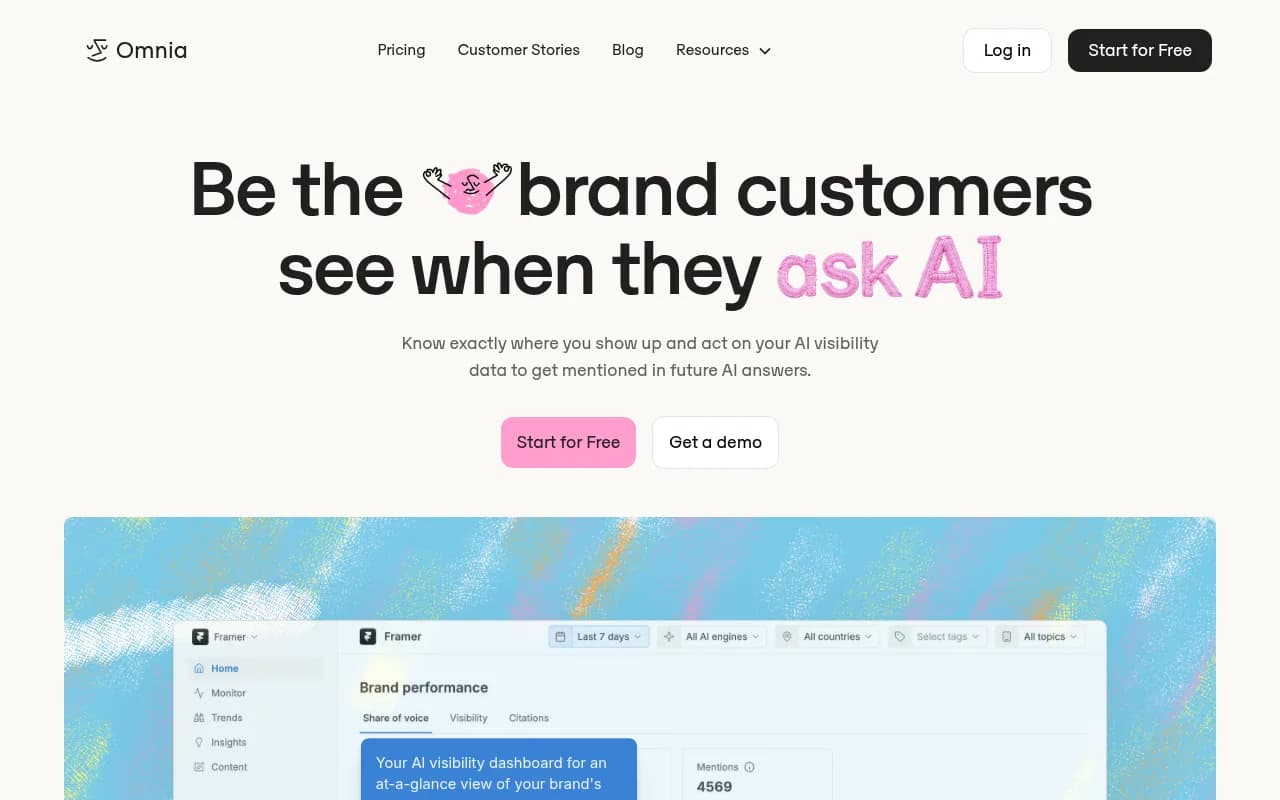
It also has an action layer: content briefs and placement targets based on citation data. It's not as automated as Promptwatch's writing agent, but it gives content teams a clear brief to work from.
The limitation is geographic depth -- country-level tracking requires real browser sessions, and coverage varies. Enterprise pricing applies.
Best for: growth teams at scale-ups that want to understand exactly which competitor content is winning citations and why.
6. ZipTie -- best for competitive intelligence depth
ZipTie focuses on the "why" behind AI visibility gaps. Its competitive analysis goes beyond showing that a competitor ranks for a prompt -- it surfaces the content signals and structural factors that seem to be driving those citations.
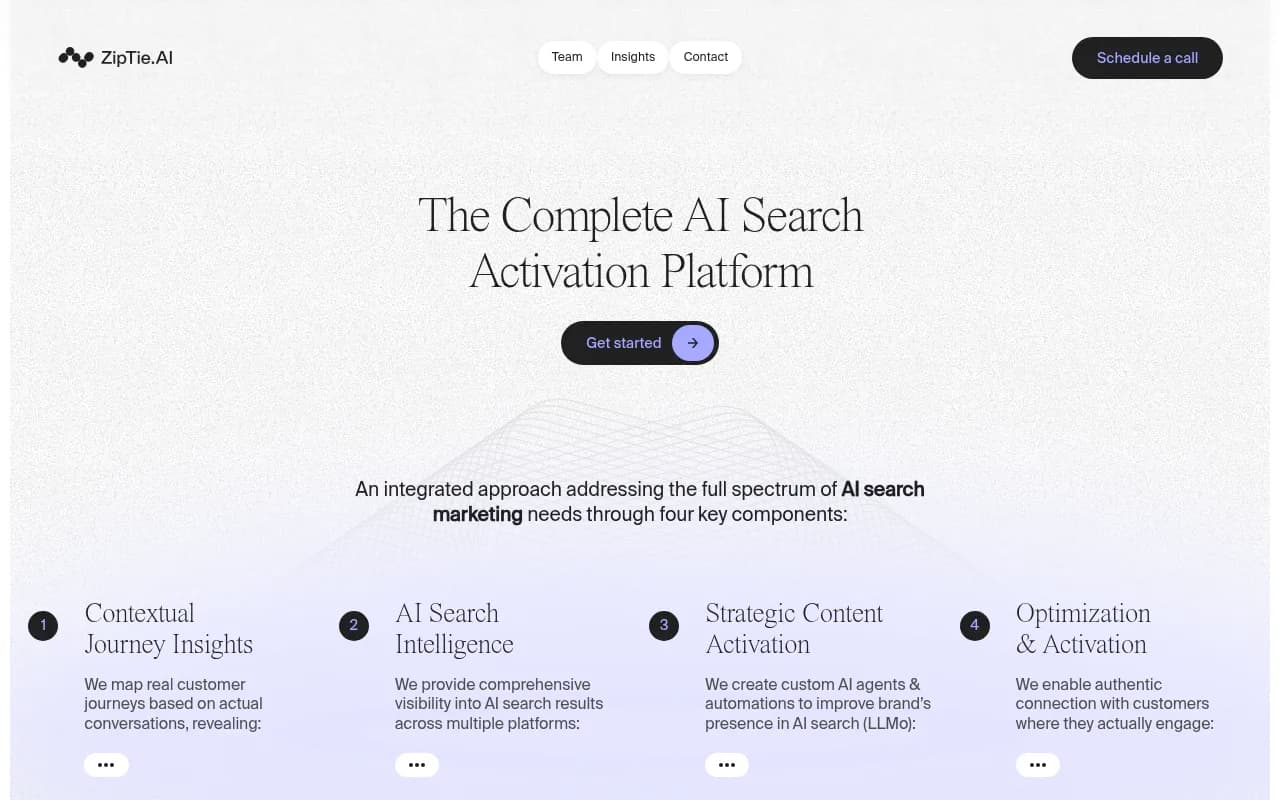
Transparency note: ZipTie publishes its own comparison guides and ranks itself first in them, which is worth knowing when reading their marketing. That said, the platform's competitive intelligence features are genuinely strong for teams that want to understand the mechanics of AI ranking, not just the outcomes.
Best for: SEO-savvy teams that want to analyze competitor content strategies in AI search.
7. Passionfruit Labs -- best for budget-conscious teams
Passionfruit Labs is the most affordable option in this roundup at $19-$99/month with unlimited user seats included. For small teams or agencies managing multiple clients, the per-seat pricing model of most competitors adds up fast -- Passionfruit sidesteps that entirely.
The tradeoff is feature depth. It's a newer platform and the monitoring coverage is narrower than enterprise tools. But for teams that need to get started with AI visibility tracking without a significant budget commitment, it's a reasonable entry point.
Best for: startups and small agencies that need multi-seat access without per-user pricing.
8. SE Ranking (SE Visible) -- best for teams already using SE Ranking for SEO
SE Ranking's AI visibility module (SE Visible) integrates AI search tracking directly into its existing SEO platform. If your team already uses SE Ranking for keyword tracking and site audits, adding AI visibility monitoring is a natural extension rather than a separate tool purchase.
The coverage includes ChatGPT, Perplexity, Gemini, and Google AI Overviews. It's not the deepest AI-specific feature set, but the integration value is real -- you get traditional SEO data and AI visibility data in one dashboard.
Best for: SEO teams that want to add AI visibility tracking without switching platforms.
9. Athena HQ -- best for monitoring-focused enterprise teams
Athena HQ covers 8+ AI search engines and has a clean enterprise interface. It's built for teams that want comprehensive monitoring across models without the complexity of a full GEO platform.

The honest assessment: it's a strong monitoring tool that stops there. No content generation, no crawler logs, no traffic attribution. For teams whose primary need is executive reporting on AI visibility trends, it works well. For teams that need to act on the data, it's incomplete.
Best for: enterprise teams that need multi-model monitoring for reporting purposes.
10. Gauge -- best for teams focused on prompt data quality
Gauge positions itself on data quality over quantity -- fewer prompts tracked, but with more reliable methodology using real browser sessions rather than API calls. The argument is that API-based monitoring can miss geographic and personalization variations that real users experience.
It's a niche positioning that resonates with teams that have been burned by inaccurate monitoring data. The feature set is monitoring-focused, without the content generation or optimization layers of more complete platforms.
Best for: research-oriented teams that prioritize data accuracy over feature breadth.
Feature and pricing comparison
| Tool | Pricing | AI models covered | Content generation | Crawler logs | Traffic attribution | Best for |
|---|---|---|---|---|---|---|
| Promptwatch | $99-$579/mo | 10+ | Yes (built-in) | Yes | Yes | End-to-end GEO |
| Profound | Custom | 8+ | No | No | No | Enterprise monitoring |
| Otterly.AI | Affordable | 3-4 | No | No | No | Budget tracking |
| Peec AI | Mid-range | 4 | No | No | No | Simple monitoring |
| Omnia | Custom | 6+ | Briefs only | No | No | Citation intelligence |
| ZipTie | Mid-range | 5+ | No | No | No | Competitive analysis |
| Passionfruit Labs | $19-$99/mo | 3-4 | No | No | No | Budget, multi-seat |
| SE Ranking | Bundled | 4 | No | No | No | SEO + AI combo |
| Athena HQ | Custom | 8+ | No | No | No | Enterprise reporting |
| Gauge | Mid-range | 4-5 | No | No | No | Data quality focus |
How to choose the right alternative
The decision mostly comes down to one question: do you need to track AI visibility, or do you need to improve it?
If tracking is the goal -- you want dashboards, share-of-voice reports, and executive summaries -- then Profound, Athena HQ, or Otterly.AI will serve you well at various price points. They're honest monitoring tools that do what they say.
If improving AI visibility is the goal -- you need to close gaps, create content that gets cited, and connect that work to revenue -- then the monitoring-only tools will frustrate you. You'll see the problem clearly but have no mechanism to fix it. Promptwatch is the only platform in this list that covers the full cycle: gap analysis, content generation, and traffic attribution in one place.
Budget is the other real constraint. Passionfruit Labs at $19/month and Otterly.AI are the entry points. Promptwatch's Essential plan at $99/month is the lowest price point for a platform that actually helps you act. Profound and Athena HQ require a sales conversation before you know what you're paying.
One more thing worth considering: AI model coverage. Some tools only track ChatGPT and Perplexity, which covers a lot of volume but misses Grok, DeepSeek, Mistral, and Copilot -- models that are growing fast in 2026. If your audience uses a range of AI tools, coverage breadth matters more than it did a year ago.
The bottom line
Scrunch is a legitimate tool for a specific problem: technical AI readiness. If your site has crawlability issues, broken structure, or missing llms.txt files, it addresses those. But if your AI visibility problem is that you're not publishing enough authoritative content, or that competitors are building more brand presence than you, Scrunch doesn't touch those levers.
Most of the alternatives in this list are monitoring tools with cleaner pricing than Scrunch but similar limitations on the action side. The meaningful difference is between tools that show you the problem and tools that help you solve it. Right now, Promptwatch is the clearest example of the latter -- it's the only platform here that takes you from "we're invisible for these prompts" to "here's the content we published, and here's the traffic it drove."
That's not a small distinction. In a market where most GEO tools are still dashboards waiting for someone to do the work, a platform that closes the loop is worth paying attention to.