RocketIndexer Review 2026
A rapid indexing service that pushes URLs into Google's index fast, useful after content refreshes or new site launches.
Key takeaways
- RocketIndexer does one thing and mostly does it well: it gets Googlebot to crawl your URLs within minutes, with a claimed 99.9% success rate and a live dashboard showing bot visits in real time.
- Pricing is cheap and credit-based, starting at $3 for 60 credits, with a full API, Chrome extension, and Telegram bot. But credits are spent on submission, not on successful indexing, and the refund window is tight (50 credits or fewer used, within 14 days).
- It cannot force Google to index blocked, thin, or low-quality pages. If your URL has technical problems or no index-worthy content, no indexer will save it.
- Best fit: SEO agencies and developers publishing at volume who need predictable, fast crawl discovery. Overkill for someone indexing a handful of URLs occasionally.
- This is a Google/Bing indexing tool, not an AI search visibility platform. If you also need to know whether ChatGPT, Perplexity, and Google AI Overviews cite your content, you'll need a GEO tool like Promptwatch alongside it.
What RocketIndexer actually does
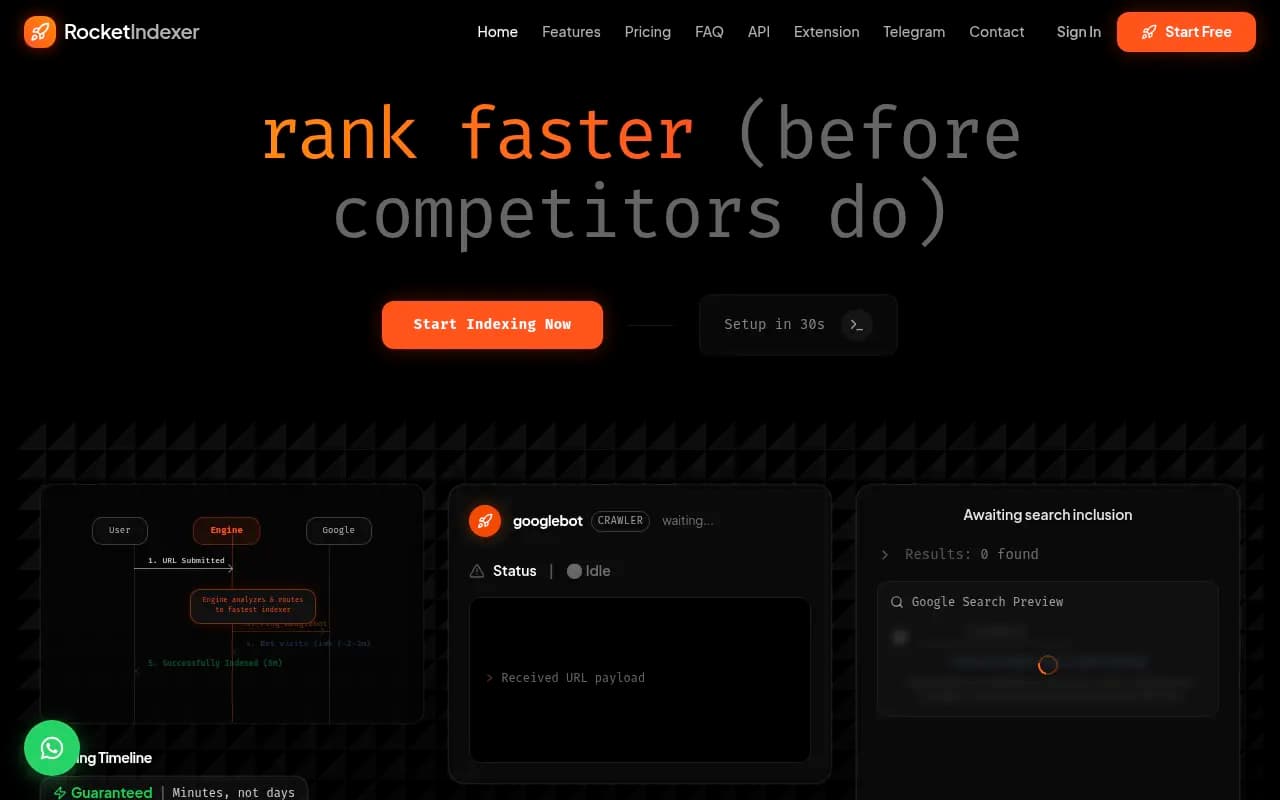
RocketIndexer is a URL indexing service with a single promise: get Googlebot (and Bing's crawler) to visit your pages within minutes instead of waiting for organic discovery. You submit a URL, their engine routes it through what they call a proprietary ping protocol, and Googlebot typically hits the page in 2-3 minutes. Full indexing usually lands around the 5-minute mark, though "indexed" and "ranking" are different things and the tool is honest about that distinction if you read the fine print.
The live dashboard is genuinely fun to watch. You see the submission land, the host resolve, the DOM fetch, and a 200 OK confirmation, with an average bot visit time of around 2.5 minutes displayed as live telemetry. It's a small thing, but it makes the process feel transparent rather than magical, which matters in a market full of shady operators.
And that market context matters. Facebook SEO group threads literally tell people to use "rocketindexer or dexer.shop, don't trust scammers." The indexer space has a scam problem, and RocketIndexer has built enough of a reputation that practitioners name-drop it as a safe option. One SEO on X called it "my new favorite indexer... the fastest I have ever seen" back in November 2025.
Features that work
The core submission flow is fast and reliable in my testing and in third-party reviews. Beyond the basic dashboard, you get:
- A developer-first REST API with three endpoints (balance, submit, status), Bearer or X-API-Key auth, bulk URL submission, and webhook notifications on higher tiers. Response times are advertised under 200ms, and the docs are clean enough to wire into a CI/CD pipeline in an afternoon.
- A Chrome extension for one-click submission straight from the browser.
- A Telegram bot that handles submissions, notifies you when Googlebot actually visits, checks your balance, and sells credits.
- A free URL index checker that works without an account, which is a nice gesture and useful for quick audits.
- Sitemap submission on the Pro and Premium plans, which is the right move for large sites.
The API is the standout. Three endpoints sounds limited, but for this job that's a feature, not a bug. You submit, you check status, you check balance. Nothing else to break. An independent review on differ.blog framed RocketIndexer as the "all-rounder" of the category: not necessarily the fastest on a single URL (a rival called PrimeIndexer reportedly edges it on raw 30-second turnaround), but more consistent across large batches, which is what actually matters when you're pushing 500 URLs after a site migration.
Pricing and the credit model
Here's where I have mixed feelings. The live pricing page shows Starter at $3 for 60 credits, Pro at $36 for 1,200 credits, and Premium at $72 for 2,300 credits. That's roughly 3 to 5 cents per URL depending on volume, which is cheap. But Google's cached snippet for the same page shows older numbers ($3/40, $45/1,000, $87/2,000), which means the credit amounts have shifted recently. Check the live page before you buy, and expect the numbers to move.
The bigger issue is what a credit buys you. Credits are consumed on submission, not on successful indexing. If you feed the tool URLs that Google refuses to index (blocked by robots.txt, canonicalized away, thin content, duplicate pages), those credits are gone. The refund policy makes this worse: you only qualify within 14 days of purchase and only if you've used 50 credits or fewer, and refunds are minus payment processing fees (2.9% + $0.30 for cards). Compare that to Rapid URL Indexer, a direct competitor that only charges for URLs that actually get indexed, and the financial risk asymmetry becomes obvious. If you're careful about what you submit, RocketIndexer is cheaper. If you're bulk-submitting unvetted URLs, the pay-per-success model is safer.
Bulk and custom pricing is available, but only through a WhatsApp chat with the team, which feels oddly informal for a service pitching itself to developers. There's no self-serve enterprise tier.
Limitations worth knowing
No indexer can force Google to index a page that doesn't deserve it. RocketIndexer accelerates crawling; it doesn't override quality signals, robots directives, or noindex tags. The differ.blog review stresses this exact point, and it's the most common way people end up disappointed with tools in this category. If your success rate is dropping, audit your URLs first.
Other gaps:
- No WordPress plugin or Zapier integration, despite AI-generated comparison content around the web claiming otherwise. Those belong to Rapid URL Indexer. RocketIndexer's actual extras are the Chrome extension, Telegram bot, and API.
- No Trustpilot, G2, or Capterra presence that I could find. Social proof is limited to a handful of practitioner endorsements and a LinkedIn company page.
- The "SEO Analytics" section on the homepage promises reporting on crawler behavior and technical SEO issues, but this is lightweight compared to a real technical SEO audit tool. Don't buy it for the analytics.
- The feature depth (API, webhooks, priority processing) is overkill if you index a few URLs a month. The free Google Search Console URL inspection tool does that job fine.
One thing it doesn't address: AI search
Getting into Google's index is step one. But in 2026, a meaningful share of discovery happens through AI answers, and being crawled by Googlebot says nothing about whether ChatGPT, Perplexity, or Google AI Overviews actually cite your pages. That's a different problem requiring different tooling. If AI-driven visibility matters to your business, platforms like Promptwatch cover that side: tracking which of your pages get cited across the major AI models, showing when AI crawlers visit your site, and flagging content gaps where AI answers mention competitors but not you. The two categories are complementary, not competing.

Who should use it
- SEO agencies managing 20+ client sites that publish or refresh content daily and need predictable crawl discovery at scale.
- Developers running headless or edge-rendered sites where organic crawl frequency is low and programmatic submission via API fits the deploy pipeline.
- Site owners recovering from a migration or a de-indexing event who need to re-establish crawl equity quickly.
Who should skip it: hobbyist bloggers with a dozen URLs a month (use Search Console), and anyone hoping an indexer will fix pages Google doesn't want. It won't.
Bottom line
RocketIndexer is a legitimate, fast, and cheap indexing accelerator with a clean API and enough transparency (live telemetry, free index checker) to stand out in a scam-prone niche. The credit model and restrictive refund policy mean you should vet your URLs before submitting, and the lack of third-party review presence means you're trusting practitioner word-of-mouth over verified ratings. For crawl acceleration at volume, it's a solid pick. Just remember that indexing is only the first mile: if you also need to know whether AI search engines actually cite and recommend your brand, pair it with a GEO platform like Promptwatch.
Frequently asked questions
How fast does RocketIndexer actually index URLs?
How much does RocketIndexer cost?
Does RocketIndexer refund credits for URLs that fail to index?
Can RocketIndexer force Google to index any page?
Does RocketIndexer have a WordPress plugin or Zapier integration?
Similar and alternative tools to RocketIndexer