Key takeaways
- Elmo's headline $29/mo price only tracks ChatGPT. If you want the multi-model coverage Promptwatch offers by default, you're looking at Elmo Basic ($99/mo), the exact same price as Promptwatch Essential ($99/mo). The "cheaper" framing mostly evaporates at the tier people actually need.
- Promptwatch is the only one of the two with AI crawler log analysis, sentiment tracking, geographic/social/shopping tracking, and built-in content generation with CMS publishing. Elmo doesn't attempt most of this, and doesn't pretend to.
- Elmo is open source (MIT license) and self-hostable for free forever. Promptwatch is closed-source SaaS only, with no way to inspect how its visibility scores are calculated.
- Elmo has a genuinely unique Query Fan-Out feature showing the exact search queries AI engines generate when expanding a prompt, plus unlimited seats and API access on every cloud plan, even the cheapest one.
- Promptwatch scales further upmarket, with a Business plan at $579/mo (5 sites, 350 prompts, 100M crawler-log entries) versus Elmo Business at $649/mo (5 brands, 350 prompts, no crawler logs).
- If you're technical, privacy-conscious, or want to run this under your own brand, Elmo wins. If you want a managed platform that also writes and publishes GEO content for you, Promptwatch wins.
Overview

Promptwatch is a hosted AI Search Visibility and GEO platform used by over 1,840 brands, including Duolingo, Yelp, and Typeform. It tracks brand mentions across ChatGPT, Claude, Gemini, Perplexity, and other AI engines, then goes further than most competitors by generating and publishing optimization content directly to your CMS. It scrapes actual AI user interfaces rather than relying solely on APIs, which it argues gives more accurate "what the user actually sees" data. Rated 4.7/5 on G2 from a small but consistently positive set of reviews.
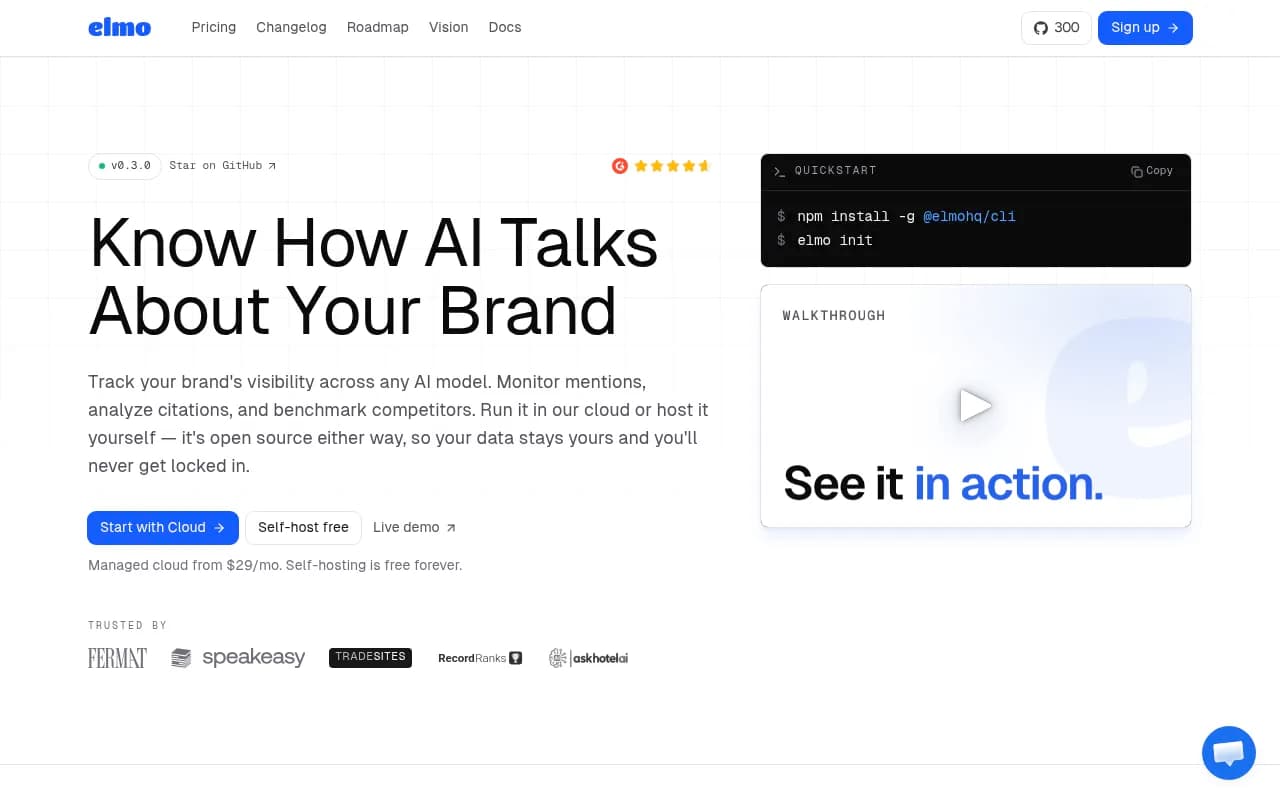
Elmo is an open-source, MIT-licensed AI visibility tracker you can self-host for free or run through Elmo's managed cloud starting at $29/mo. It covers the same core ground, ChatGPT, Claude, Gemini, Grok, Mistral, Perplexity, Copilot, DeepSeek, and both Google AI surfaces, via a mix of UI scraping and bring-your-own-key API access. Customers include Speakeasy and Fermat Commerce. It's built and maintained largely by a small team (GitHub handle jrhizor), with 339 stars and regular commits on its repo.
Side-by-side comparison
| Feature | Promptwatch | Elmo |
|---|---|---|
| Starting price | $99/mo (no free tier) | $0 self-hosted, $29/mo cloud (ChatGPT only) |
| Multi-model entry price | $99/mo (4 of 11 models) | $99/mo Basic tier (choose any 4 platforms) |
| Open source | No | Yes, MIT license |
| Self-hostable | No | Yes, via Docker Compose + CLI |
| Crawler log analytics | Yes, Professional+ | No |
| Sentiment analysis | Yes | No |
| Content generation | Yes, 5-30 AI-written articles/mo with CMS publishing | No (Opportunities module only recommends) |
| Query fan-out tracking | No | Yes, dedicated feature |
| Reddit/YouTube citation tracking | Yes | Not specifically featured |
| Shopping/Ads tracking | Yes (ChatGPT Shopping, Ads Radar) | No |
| Team seats | 1-5, plan-dependent | Unlimited on every cloud plan |
| API access | MCP available; gated by tier | Included on every plan, including Starter |
| White-label/agency | Agency plans available | Custom tier with SSO, custom domain |
| Free trial / free plan | 7-day trial, no free plan | Self-hosted is free forever |
Pricing comparison
| Plan | Promptwatch | Elmo |
|---|---|---|
| Free | None (7-day trial) | Self-hosted: $0 forever, unlimited prompts |
| Entry | Essential $99/mo (1 site, 50 prompts, 4 models) | Starter $29/mo (1 brand, 50 prompts, ChatGPT only) |
| Mid | Professional $249/mo (2 sites, 150 prompts, crawler logs) | Basic $99/mo (1 brand, 50 prompts, choose 4 platforms) |
| Growth | — | Pro $299/mo (2 brands, 150 prompts, premium grounded APIs) |
| Upper | Business $579/mo (5 sites, 350 prompts, 100M crawler-log entries) | Business $649/mo (5 brands, 350 prompts) |
| Enterprise | Custom | Custom/white-label, contract billing |
The apples-to-apples comparison is Promptwatch Essential ($99) vs Elmo Basic ($99), since that's where both actually cover a real multi-model set. Below that, Elmo's $29 tier is ChatGPT-only and isn't really comparable to anything Promptwatch offers.
Head-to-head deep dive
Data source: UI scraping vs APIs
Promptwatch scrapes the actual user-facing interfaces of ChatGPT, Gemini, AI Overviews, and others, arguing that API responses can differ from what real users see. Elmo does both: UI scraping for what ChatGPT users see, plus direct API/OpenRouter access with your own keys for other models. Elmo's hybrid approach gives you more control over cost and model selection, since you can bring cheaper API keys instead of paying for scraping infrastructure on every model.
Verdict: Elmo is more flexible here, Promptwatch is more consistent about methodology across all tracked models.
Openness and data ownership
This is the sharpest line between the two. Elmo is MIT-licensed, on GitHub, with 1,000+ commits and active maintenance. You can audit exactly how every visibility score and citation count is calculated, and run it on your own servers so no third party ever touches your prompts or brand data. Promptwatch is closed-source SaaS. You get a polished dashboard, but you can't see the calculation logic, and your data lives on Promptwatch's infrastructure.
| Factor | Promptwatch | Elmo |
|---|---|---|
| Source code visibility | Closed | Full source on GitHub |
| Self-hosting | Not available | Free, via Docker |
| Data residency | Vendor-controlled | Your own infrastructure (if self-hosted) |
| Vendor lock-in risk | Higher | Lower |
Verdict: Elmo wins outright for anyone who cares about data sovereignty or wants to verify the numbers before making budget decisions based on them.
Content generation and action
Here Promptwatch pulls decisively ahead. Its Professional and Business plans include automated AEO article generation (15-30 articles/month) with direct CMS publishing to Webflow, Framer, and WordPress, plus a Content Gap Analysis feature that maps your existing pages against what AI models are actually citing. Unified Actions turns all of this into a prioritized to-do list. Elmo's equivalent is its Opportunities module, which surfaces AI-generated recommendations ranked by impact, content to create, pages to refresh, sources to pitch, but stops at the recommendation. It doesn't write or publish anything for you.
Verdict: If content production is the point, not just measurement, Promptwatch is built for that job and Elmo isn't trying to be.
Crawler analytics and technical visibility
Promptwatch's Agent Analytics logs real AI crawler traffic (ChatGPTBot, ClaudeBot, PerplexityBot, and 400+ others) hitting your site, showing which pages get crawled, what errors show up, and the crawl-to-citation path per page. This is available from Professional up ($249/mo), with entry-level Essential missing it. Elmo has no comparable crawler log feature in its current feature set, based on its own site and the Elmo vs Promptwatch comparison it publishes.
Verdict: Promptwatch is the only option here if you need to see the "why" behind your visibility numbers at the crawler level.
Query fan-out and prompt intelligence
Elmo has a dedicated Query Fan-Out feature showing the exact search queries an AI engine generates when it expands a single prompt into dozens of web searches, plus a word cloud of the terms and a breakdown of how your original prompt gets rewritten. Promptwatch tracks prompt volumes and difficulty scores and has its own query fan-out data, but it's positioned more as supporting data inside the broader prompt intelligence feature than a standalone visualization the way Elmo presents it.
Verdict: Roughly comparable capability, Elmo just surfaces it more prominently as a feature in its own right.
Model and platform coverage
Both cover the major players: ChatGPT, Claude, Gemini, Perplexity, Grok, Mistral, DeepSeek, Copilot, and both Google AI surfaces. Elmo lists all of these plus Google AI Mode and AI Overviews explicitly on its homepage. Promptwatch tracks a similarly broad list but limits self-serve plans to 4 selected models out of the full catalog per project, unlocking more at higher tiers.
| Model | Promptwatch | Elmo |
|---|---|---|
| ChatGPT | Yes | Yes |
| Claude | Yes | Yes |
| Gemini | Yes | Yes |
| Perplexity | Yes | Yes |
| Grok | Yes | Yes |
| DeepSeek | Yes | Yes |
| Mistral | Yes | Yes |
| Copilot | Yes | Yes |
| Google AI Overviews/AI Mode | Yes | Yes |
Verdict: Coverage is close to identical on paper, the real difference is how many of these you get access to per dollar (4 selected models per project on Promptwatch vs choose-any-4 on Elmo Basic).
Team access and pricing structure
Elmo gives unlimited seats on every cloud plan, including its $29 Starter tier, and includes API access on every plan. Promptwatch caps seats at 1-5 depending on plan and gates API/BI connector access to higher tiers. For a small team that wants everyone in the dashboard without paying per seat, Elmo's structure is friendlier.
Verdict: Elmo, especially for agencies or teams with more than a couple of people who need dashboard access.
If your interest in either tool is really about growing organic traffic from AI search rather than just watching a dashboard, it's worth knowing there's a third category of tool that goes further on the content side. Promptwatch itself is one example, since beyond tracking it also runs Content Agents that plan, write, and publish GEO-optimized articles automatically, something neither Elmo nor most monitoring-only tools attempt.
Pros and cons
Promptwatch
Pros:
- Content generation with direct CMS publishing (Webflow, Framer, WordPress)
- AI crawler log analytics showing exactly how bots crawl and cite your pages
- Sentiment, geographic, social, and shopping tracking built in
- 4.7/5 on G2, used by 1,840+ brands including Duolingo and Yelp
- Content Gap Analysis and Unified Actions turn data into a prioritized to-do list
Cons:
- No self-hosting or open-source option, no way to audit the calculation logic
- No free plan, only a 7-day trial
- Seats and API access capped by plan tier
- Entry-level Essential plan misses crawler logs and other advanced features
Elmo
Pros:
- Fully open source (MIT license), self-hostable for free forever
- Unlimited seats and API access on every cloud plan
- Dedicated Query Fan-Out feature with prompt rewrite visibility
- Cheaper entry point if ChatGPT-only tracking is genuinely enough
- White-label/custom tier with SSO and custom domain for agencies
Cons:
- $29 entry tier is ChatGPT-only, not true multi-model coverage
- No content generation, only recommendations via the Opportunities module
- No crawler log analytics, sentiment analysis, or shopping/ads tracking
- Self-hosting requires Docker and CLI comfort, a real barrier for non-technical teams
- Smaller company footprint, no G2/TrustRadius presence to lean on for third-party validation
Who should pick which tool
Pick Promptwatch if you're a marketing team or agency that wants one platform to monitor AI visibility and then act on it, content generation, crawler logs, and CMS publishing included, and you're fine paying for a fully managed SaaS product.
Pick Elmo if you're technically comfortable, care about owning your data, or want to run a white-labeled AI visibility tool under your own brand without paying per-seat pricing. It's also the more sensible choice if your budget is tight and you're willing to self-host.
Pick something else entirely if neither monitoring-plus-content nor open-source self-hosting matters to you as much as raw model coverage breadth or a specific integration; the broader GEO software directory at bestgeosoftware.com is worth a scan before committing.
Final verdict
Elmo and Promptwatch measure similar things but solve different problems. Elmo is the honest, transparent, cheaper-if-you're-technical option for teams that want to see the code and own their data. Promptwatch is the more expensive but more complete option for teams that want visibility tracking to turn into actual published content and crawler-level diagnostics without touching a terminal. If you have a developer on staff and hate vendor lock-in, run Elmo. If you want a marketing team to open a dashboard on Monday and have new content published by Friday, Promptwatch is the one built for that.ement.wrote it. Follow every rule below.eady built for that.no changes needed.-- correct.dedges here. Done.-- fine.plete.esk.-- done.d.eaningful vs a real scale so it's fine.-- fine.--fine.-- fine.--done.--fine.--fine.--fine.--fine.--fine.--fine.--done.--done.--done.--done.--fine.--fine.--done.--done.--fine.--fine.--fine.--fine.--fine.--fine.--fine.--fine.--fine.--fine.--fine.--fine.--fine.--fine.--fine.--fine.--fine.--fine.--fine.--fine.--fine.--fine.--fine.--fine.--fine.--fine.