Key takeaways
- Elmo is MIT-licensed and free to self-host: no license fee, no per-seat cost, and you own the PostgreSQL database your visibility history lives in.
- Promptwatch is a managed, full-stack platform starting at $95/mo that goes beyond tracking into crawler analytics, content generation, and CMS publishing.
- Elmo's own comparison page admits Promptwatch has prompt volumes, sentiment analysis, AI crawler analytics, geographic tracking, and shopping tracking that Elmo doesn't.
- Elmo Cloud (managed hosting of the open-source product) starts at $29/mo but caps you at ChatGPT-only scraped once a day on that tier, well below what either self-hosted Elmo or Promptwatch's entry plan gives you.
- Pick Elmo if you want full control over your data and don't mind running infrastructure. Pick Promptwatch if you want the visibility data turned into actual optimization work, done for you.
Why this comparison even matters
AI visibility tracking got crowded fast. By late 2026 you've got dedicated AEO platforms, SEO suites bolting on AI layers, and now a genuinely different category: open-source, self-hosted trackers. Elmo is the clearest example of that last group, and it's worth taking seriously, not dismissing as a hobby project. It has 339 stars and over 1,000 commits on GitHub, with commits landing within days of this writing. That's an actively maintained tool, not abandonware.```
But "actively maintained open source" and "managed platform with a team behind it" solve different problems. This guide walks through where each one wins, where the marketing claims don't hold up under scrutiny, and which one actually fits your situation.
What Elmo actually is
Elmo is an open-source, self-hostable AI visibility platform. You deploy it with Docker Compose, manage it through a CLI (npm install -g @elmohq/cli then elmo init), and it stores everything in a PostgreSQL database you control, either bundled or your own instance. No third party holds your visibility history. No account required to get started.
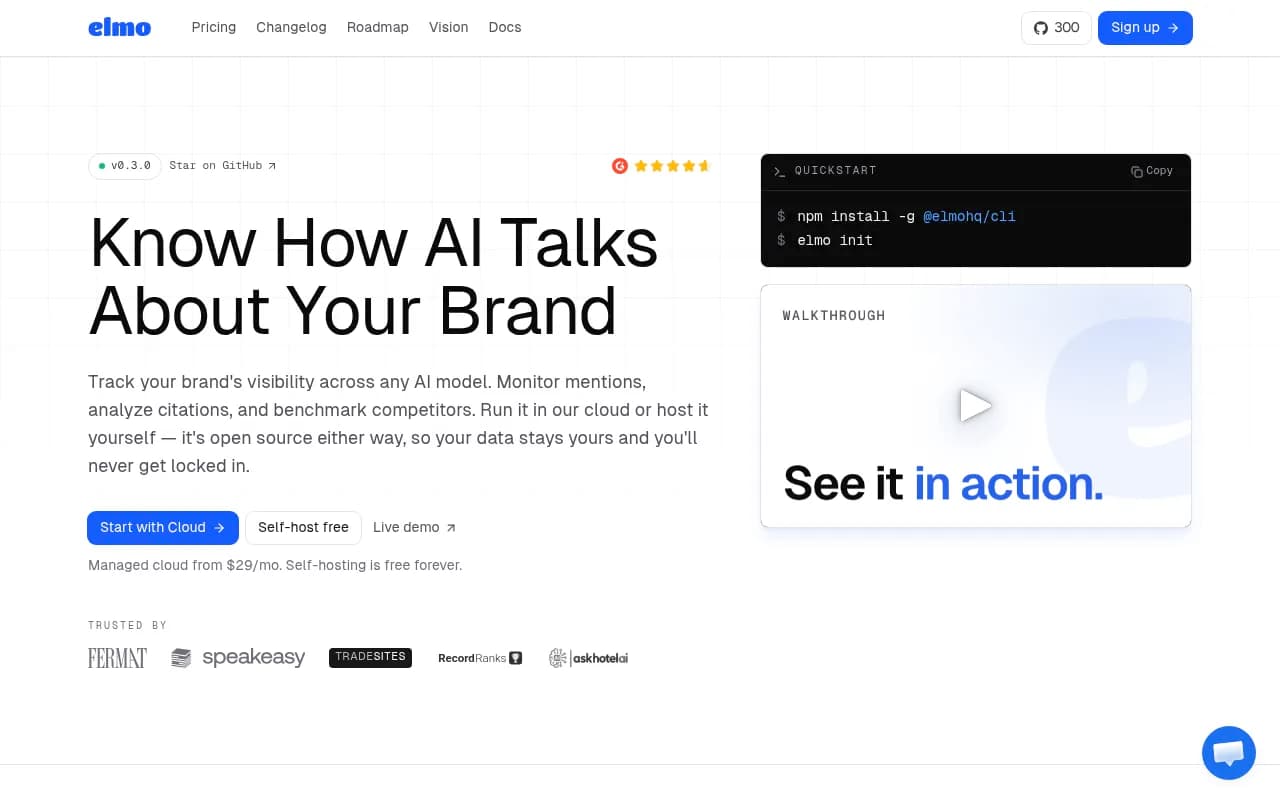
The core pitch is simple: self-hosting is free forever, with no license fee and no per-seat pricing. You only pay for your own server and whichever AI provider API keys you decide to plug in. That's a real, structural difference from every hosted competitor in this space, Promptwatch included.
Elmo's GitHub README lists a broad engine roster, ChatGPT, Google AI Mode, Google AI Overviews, Gemini, Perplexity, Copilot, Claude, Grok, Mistral, and more. Its own marketing narrows the "core" tracked set to five: ChatGPT, Claude, Perplexity, Gemini, and Google AI Overviews. Worth knowing the gap between the README ambition and what's reliably supported day to day.
If you don't want to self-host, Elmo Cloud is the managed version of the same product:
| Elmo Cloud tier | Price | Brands | Prompts | Platforms | Refresh |
|---|---|---|---|---|---|
| Starter | $29/mo | 1 | 50 | ChatGPT only | 1x/day |
| Basic | $99/mo | 1 | 50 | Choose 4 of 6 | 4x/day |
| Pro | $299/mo | 2 | 150 | Choose 4 of 6 | Adds premium LLM APIs 1x/day |
| Business | $649/mo | 5 | 350 | Choose 4 of 6 | 30 grounded pairings included |
Worth pausing on that Starter tier: $29/mo for ChatGPT-only tracking, scraped once a day, is a narrow slice of what "AI visibility" means in 2026. You'd want Basic at minimum to get any real multi-model coverage.
What Promptwatch actually is
Promptwatch is built around a different premise: monitoring tells you what happened, but somebody still has to fix it. Promptwatch's agents plan, write, publish, and prioritize the optimization work itself, rather than stopping at a dashboard.

On the live pricing page, Essential starts at $95/mo: one project, four models chosen from OpenAI/ChatGPT, Perplexity, Google, Claude, Gemini, Meta, DeepSeek, or Grok, 50 prompts, 6,000 responses, daily tracking, Agent Chat, MCP and API access, with a 7-day free trial. Professional at $245/mo adds a second project, 150 prompts, 5 AEO articles a month, and Agent Analytics (the AI crawler log data). Business at $579/mo adds Shopping Insights, Ads Radar, and state/city-level tracking, but requires a demo call rather than self-serve signup.
The data collection method matters here too. Promptwatch scrapes actual LLM user interfaces (ChatGPT, Gemini, AI Overviews, Perplexity, and so on) rather than relying purely on APIs, which can diverge from what a real user actually sees. That real-UI approach underpins its dataset of 26B+ analyzed citations, prompts, and responses.
Side by side: what each one gives you
Elmo's own comparison page (yes, self-published, so treat it as vendor-supplied) lays out where the two overlap and where they diverge:
| Feature | Elmo | Promptwatch |
|---|---|---|
| Multi-LLM tracking | Yes | Yes |
| AI visibility score | Yes | Yes |
| Citation analytics | Yes | Yes |
| Competitor benchmarking | Yes | Yes |
| Brand mention tracking | Yes | Yes |
| Data export / API | Yes | Yes |
| Open source, self-hostable | Yes | No |
| White-label / agency deployment | Yes | Yes (agency plans) |
| Prompt volume estimates | No | Yes |
| Sentiment analysis | No | Yes |
| AI crawler analytics | No | Yes |
| Geographic (country/state/city) tracking | No | Yes |
| Social media (Reddit/YouTube) tracking | No | Yes |
| Shopping tracking | No | Yes |
| Content generation + CMS publishing | No | Yes |
| Managed infrastructure, no ops | No | Yes |
That right column isn't small. Prompt volume and difficulty scoring tell you which prompts are worth chasing before you spend content budget on them. AI crawler analytics (Promptwatch calls this Agent Analytics) show you, per page, whether ChatGPTBot, ClaudeBot, PerplexityBot, or Meta's crawlers are actually reading your content, and where they hit errors, which is the piece most trackers, self-hosted or otherwise, simply don't have.
A quick note on the stats floating around
Elmo's comparison page cites Promptwatch as tracking "630M+ citations" across "5,700+ brands." Promptwatch's own live homepage currently says something closer to 1,840+ brands and agencies. Numbers like this move fast in a young category, and it's worth checking the primary source rather than trusting a competitor's comparison page for someone else's stats. Same goes for the G2 rating: Promptwatch's own badge shows 4.7/5, while an older search snippet floats 4.5 stars off 17 reviews. The 4.7/5 figure is the one that matches the live site.
Where self-hosting actually wins
I'll give Elmo credit where it's due, because the self-hosted argument is genuinely compelling for a specific type of team.
If you're privacy-conscious, or your legal team has opinions about where brand monitoring data lives, self-hosting removes the question entirely. Your prompts, your competitor data, your visibility history: all of it sits in a database you control. No vendor can raise prices on you overnight, and no vendor can shut down and take your historical data with them. You can also read the source code and verify exactly how a visibility score gets computed instead of trusting a black box.
If you're technical, already run your own infrastructure, and mostly want a lightweight signal ("are we showing up in ChatGPT and Claude, yes or no"), self-hosted Elmo for free is hard to argue against on price alone.
Where the managed platform wins
The problem is that most teams asking "are we visible in AI search" quickly need to ask a second question: "okay, so what do we do about it?" That's where the gap between a tracker and a full-stack platform becomes obvious.
Product pages are now ChatGPT's most-cited content type, at roughly a third of daily citations in July 2026, up from about 18% in March, according to Promptwatch's data on ChatGPT citation types over time. Listicles were the fastest-growing format within the same month. Knowing that trend is one thing. Doing something about it, rewriting product pages, publishing comparison content, and confirming AI crawlers actually picked it up, is a different job entirely, and it's the job Elmo doesn't attempt.
Same story with crawler behavior. OpenAI's share of verified AI crawler requests dropped from 94.8% to 79.8% between June and September 2026, per Promptwatch's AI crawler traffic report, meaning other providers are picking up real crawl share fast. If you're blocking the wrong bot in your robots.txt or CDN rules, you could be invisible to a provider that's quietly becoming a bigger deal. Elmo has no equivalent to Agent Analytics to catch this. Promptwatch does, and it's one of the features most competitors in the wider field skip entirely.
Which one should you actually pick
| If you're... | Go with |
|---|---|
| A solo developer or small team that wants a free, auditable ChatGPT/Claude signal and already runs infrastructure | Elmo (self-hosted) |
| An agency wanting white-label deployment on a tight budget, comfortable with DevOps | Elmo (self-hosted or Elmo Cloud) |
| A marketing team that needs to explain why visibility changed and act on it without hiring an engineer | Promptwatch |
| A brand that wants crawler-level diagnostics, content generation, and CMS publishing in one place | Promptwatch |
| An enterprise needing state/city tracking, Shopping Insights, and Ads Radar | Promptwatch (Business tier) |
Honestly, the two aren't perfectly interchangeable, which is what makes this comparison interesting instead of a straightforward "which is cheaper" exercise. Elmo is closer to a self-hosted analytics tool: reliable, free, and yours. Promptwatch is closer to hiring a small team that watches AI search for you and then does something about what it finds.
If your organization doesn't have a dedicated engineer to run Docker Compose updates, patch a self-hosted database, and babysit uptime, the calculus tips fast toward a managed platform regardless of price. And if content production is part of the ask, not just monitoring, Elmo simply doesn't compete: it has no content agent, no AEO article generation, no CMS integrations.
A broader look before you commit
Both Elmo and Promptwatch sit inside a much larger field now. Profound, Scrunch, Otterly.AI, Peec AI, AthenaHQ, and dozens of newer entrants all take different bets on pricing and feature depth. If you want to see the wider landscape before locking into either option, the GEO software directory at bestgeosoftware.com is worth a browse, and ai-rank-tools.com covers rank-tracking-specific tools if that's your narrower need.
One more data point worth knowing before you set up tracking of any kind: Reddit's share of ChatGPT Search citations collapsed from roughly 4% to 0.5% in mid-August 2026, per Promptwatch's Reddit citation data. If your visibility strategy leaned on Reddit mentions, that's a channel quietly losing weight in ChatGPT specifically, even as it may still matter elsewhere. Whichever tracker you pick, make sure it's actually watching the channels that still count.
For teams that decide they need more than tracking, meaning someone to actually execute the content and technical fixes AI visibility data points to, that's the kind of work 1001 SEO Media does day to day: technical SEO, content production, and GEO work built around exactly this kind of data.