Blogr.ai Review 2026
Researches, writes, publishes and optimizes content for SaaS, ecommerce and local SEO, grounding each article in current SERP data rather than stale training knowledge.
Key takeaways
- Blogr.ai is a genuinely end-to-end SEO content engine: it mines your Google Search Console data for title ideas, researches the live SERP, writes full articles in your brand voice, publishes to your CMS, and then keeps measuring the ranking impact of every piece it ships.
- The Search Console grounding is the smart part. Instead of inventing topics, it proposes titles from queries you already rank for at positions 8-20, which is where the cheapest ranking wins usually hide.
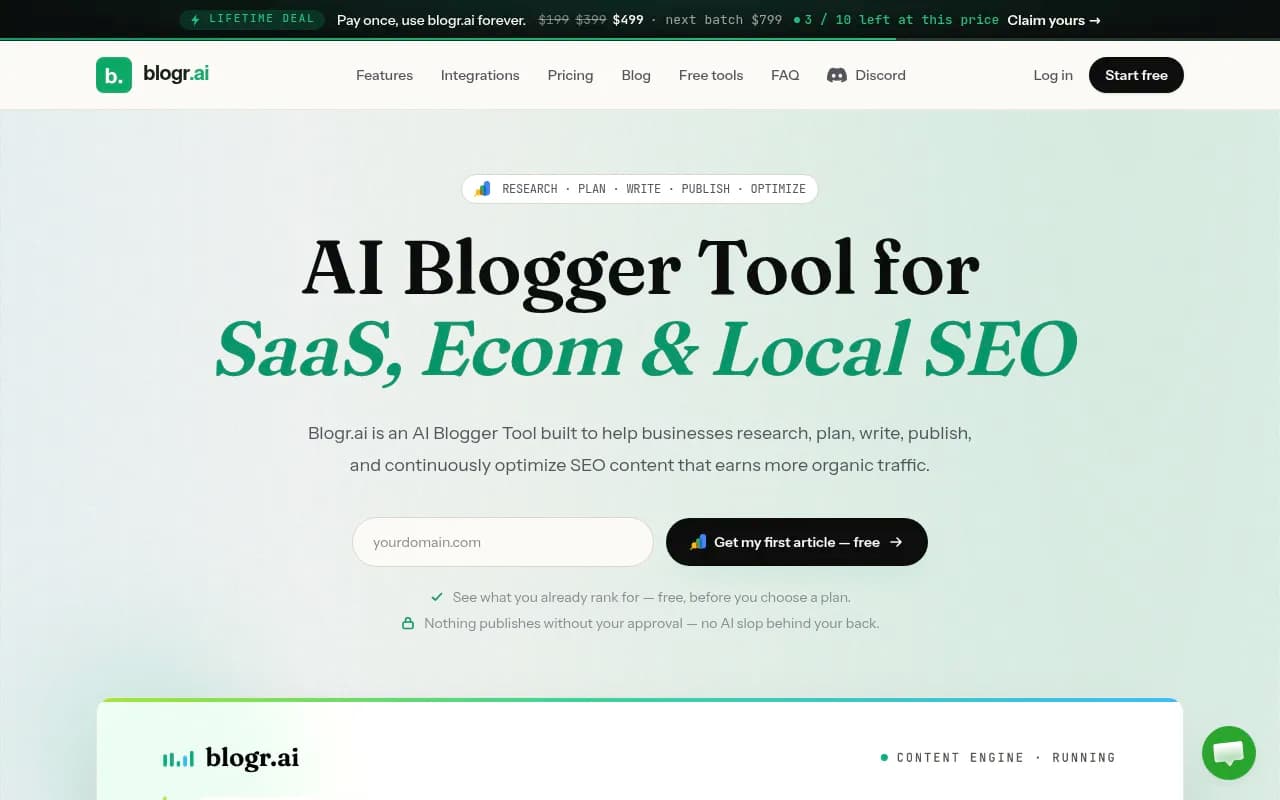
- Pricing is aggressive for what you get: $29/mo gets you 10 fully-produced articles a month, and the $499 lifetime deal (bring your own OpenAI or Claude key) is one of the more interesting offers in this category.
- It is a Google-first tool. There is no AI search visibility tracking, no citation monitoring in ChatGPT or Perplexity, and no off-page or backlink work. If your strategy now includes getting cited by AI assistants, you'll need a separate platform like Promptwatch for that half of the equation.
- Best fit: SaaS founders, small ecommerce teams, and local SEO operators who want a consistent publishing cadence without hiring writers. Less ideal for editorial teams who want deep manual control over every paragraph.
What Blogr.ai actually does
Most AI writing tools in 2026 still work like this: you type a keyword, they hallucinate an outline from stale training data, you edit for an hour, and you publish something that ranks for nothing. Blogr.ai takes a different angle, and it's the angle I'd want if I were a solo founder trying to grow organic traffic without a content team.
The whole product is built around a loop: research, plan, write, publish, measure, optimize. What makes the loop credible rather than marketing copy is that both ends are wired into Google Search Console. Titles don't come from a generic keyword database. They come from queries your site already appears for, sitting just off page one, plus your declared focus topics. You approve or decline each one. Nothing gets written without a yes from you, unless you flip on Auto Publish and go full hands-off.
That approval step matters more than it sounds. The failure mode of every "30 articles a month on autopilot" promise is AI slop quietly accumulating on your blog. Blogr.ai at least defaults to human-in-the-loop, and the company is explicit about it: nothing publishes behind your back.
The workflow, step by step
Setup takes about two minutes per the company's own estimate, and my read of the onboarding flow backs that up. You describe your brand, audience, and voice, connect Search Console (read-only, no tracking script on your site), and pick a publishing destination.
Then the daily rhythm begins. Blogr.ai keeps a queue of proposed titles stocked, each tagged with its source: "search console, pos 11" or "search console, rising." You approve the ones worth writing. From there, each approved title becomes a full article. The tool researches the current top-ranking pages first, extracts intent, entities, semantic keywords, and headings from them, and builds a content brief before writing a single sentence.
The live SERP analysis is the part I'd point to as the differentiator. The brief shows what the top three results cover, their word counts, heading structures, and, usefully, gaps. In their demo example for "best crm for startups," it flagged that nobody in the top results covered migration cost. That's the kind of specific, exploitable gap that generic AI writers never find because they never look at the actual SERP.
Finished articles ship with an SEO block (title, meta description), FAQ section, internal links pulled from your sitemap, schema markup (Article, FAQ, Organization, Local Business, Product, and others), and an AI-generated cover image. After publishing, Blogr.ai resubmits your sitemap to Google and emails you the live link.
The optimization flywheel
This is where most competitors stop and Blogr.ai keeps going. Every published article keeps reporting against Search Console: which queries it lifted, position changes, impression gains, click-through rate. The homepage shows a concrete example, an article that moved "best crm for startups" from #12 to #4 in 21 days with +620 impressions.
The tool then uses that data to propose improvements: expand sections that started ranking for extra keywords, strengthen pages getting impressions but no clicks, refresh content before it decays. This is the refresh-before-decay discipline that experienced SEO operators actually practice, and having it automated is worth something. It's the difference between a content tool and a content system.
Publishing integrations
WordPress (via plugin), Webflow (into CMS collections), Ghost, Shopify (store blog), Lovable, Directify, generic webhooks that POST articles as JSON, and a read-only REST API. That covers most realistic stacks. The webhook option is the quiet workhorse here; it means Blogr.ai can publish to essentially anything, including a custom CMS or a static site generator.
Pricing
- Solo: $29/mo, 1 tracked site, 10 articles per month
- Starter: $59/mo, 3 sites, 25 articles per month
- Pro: $99/mo, 10 sites, 60 articles per month
- Agency: $249/mo, 25 sites, 200 articles per month
- Lifetime: $499 one-time (next batch $799), unlimited articles with your own OpenAI or Claude API key, up to 10 tracked sites
All paid plans include a 7-day free trial, and yearly billing gives you two months free. Article quotas pool across sites on the multi-site plans, which is a sensible design for agencies.
The lifetime deal deserves comment. At $499 with a bring-your-own-API-key model, your ongoing cost is just OpenAI or Anthropic usage, which for a site producing 30 articles a month is likely $50-100 in tokens. That undercuts nearly every subscription competitor over a two-year horizon. The urgency marketing ("3 of 10 left at this price") is a bit theatrical, but the underlying economics are real. The catch: you're betting a one-time payment on a two-founder product staying alive and maintained. That's a risk, not a dealbreaker.
Who built it
Two founders, and they're refreshingly specific about their credentials. Serg Karakhanyan built and sold Directify ($135K) and grew Larafast ($80K), mostly through search. Connor Showler claims $3.8M in profit and 2M+ organic pageviews across ecommerce, affiliate, software, and services over ten-plus years. The product is clearly a codification of how they already grew their own products, which explains why the Search Console-first approach feels so coherent rather than bolted on.
Strengths and limitations
Strengths:
- Search Console-grounded title proposals mean you're chasing keywords with proven ranking potential, not invented topics
- Live SERP analysis with genuine gap detection before writing begins
- The full asset package per article: schema, FAQs, internal links, meta, cover image
- Post-publish measurement closes the loop that most AI writers leave open
- Honest, low pricing with an unusually good lifetime option
- Human-in-the-loop by default, with full automation as an opt-in
Limitations:
- It's entirely Google-centric. There's no tracking of how your content performs in AI search, no monitoring of whether ChatGPT, Perplexity, or Google AI Overviews cite your articles. The site gestures at this ("ranking articles are what AI assistants cite") but offers no data on it. If AI-driven traffic matters to you, you'd pair this with a visibility platform, and Promptwatch is the one I'd look at for citation tracking, AI crawler logs, and traffic attribution from AI platforms.
- No off-page capability at all. No backlink analysis, no outreach, no digital PR. Topical authority mapping helps, but links still matter.
- Article caps on subscriptions are real limits. 10 articles a month on Solo is a modest cadence for anyone serious about building topical authority quickly.
- The lifetime deal requires your own API key, so your real cost scales with output, and token pricing changes are outside their control.
- No mention of multi-language content support, which matters if you serve markets outside English.
- A two-founder team means support and roadmap depth are thinner than at funded competitors. Fine for the price, but worth knowing.
Who it's for
The clearest fit is the solo SaaS founder or two-person team that knows content matters, has connected Search Console, and simply cannot spare the hours for research-writing-publishing-refresh cycles. It's also strong for local SEO operators who need to spin up service pages and city pages across a dozen locations without writing each one by hand, and for small ecommerce brands that need buying guides and collection copy at volume.
Agencies managing 10-25 client sites get a workable whitebox workflow on Pro or Agency plans, though the pooled article quotas require some planning. If you're an editorial publication where voice and originality are the product, this isn't your tool; the output is competent SEO content, not distinctive journalism.
Bottom line
Blogr.ai is one of the more honest products in the AI content space. It doesn't promise magic. It promises a disciplined SEO workflow, the same one its founders used to grow their own products, executed automatically and measured against real Search Console data. The SERP-grounded briefs and the post-publish optimization loop are the two features that justify its existence over a plain AI writer, and the pricing makes trying it almost risk-free.
Its blind spot is the shift happening in search itself. Blogr.ai optimizes for Google rankings and stops there. If you also want to know whether your content is being cited by ChatGPT, Perplexity, and Google's AI features, and what traffic that drives, you'll want to run a dedicated AI visibility platform alongside it. Used together, that combination covers both the traditional flywheel and the new one. On its own terms, though, Blogr.ai does what it says, does it cheaply, and does it with a level of process discipline that most AI writing tools still haven't figured out.
Tags:
Frequently asked questions
How much does Blogr.ai cost?
Which platforms can Blogr.ai publish to?
Does Blogr.ai publish content automatically?
How does Blogr.ai decide what to write about?
Does Blogr.ai track visibility in AI search engines like ChatGPT or Perplexity?
Similar and alternative tools to Blogr.ai