Ryze AI Review 2026
Tracks ChatGPT visibility and then acts on it: the platform crawls your site, deploys on-page SEO fixes itself with approvals and scope you control, and can also run paid ads across Google, Meta, and other platforms.
Key takeaways
- Ryze AI is genuinely agentic: its agents audit ad accounts, find wasted spend, propose fixes, and apply them with one click or full approval-based automation. This puts it ahead of most "AI marketing" tools that stop at dashboards and suggestions.
- Pricing is refreshingly sane: a flat $89/month for Paid Ads Autopilot and $129/month for SEO Autopilot, never a percentage of ad spend. That alone makes it worth a trial for small and mid-sized advertisers.
- Its claim of being "the first AI to launch and optimize ads in ChatGPT" is a real differentiator for early movers in AI-native advertising.
- The GEO/AI visibility side is thin: it tracks ChatGPT and Perplexity visibility, but it lacks the AI crawler logs, visitor analytics from AI platforms, prompt volume and difficulty scoring, Reddit/YouTube citation tracking, and query fan-outs that a dedicated platform like Promptwatch offers.
- Best fit: SMB owners and performance marketers spending $3K–$50K/month on ads who want an always-on optimizer instead of a $5K/month agency retainer.
What Ryze AI actually is
Ryze AI, operated by Meow AI, LLC, sells itself as an "autonomous marketing engine," and for once that phrasing is closer to accurate than most. The platform has three agents: one for paid ads (Google, Meta, Microsoft, TikTok, LinkedIn, plus ChatGPT and Perplexity ads), one for SEO, and one for building and A/B testing landing pages. It also has an agency tier for managing hundreds of client accounts with bulk audits and white-label reporting.
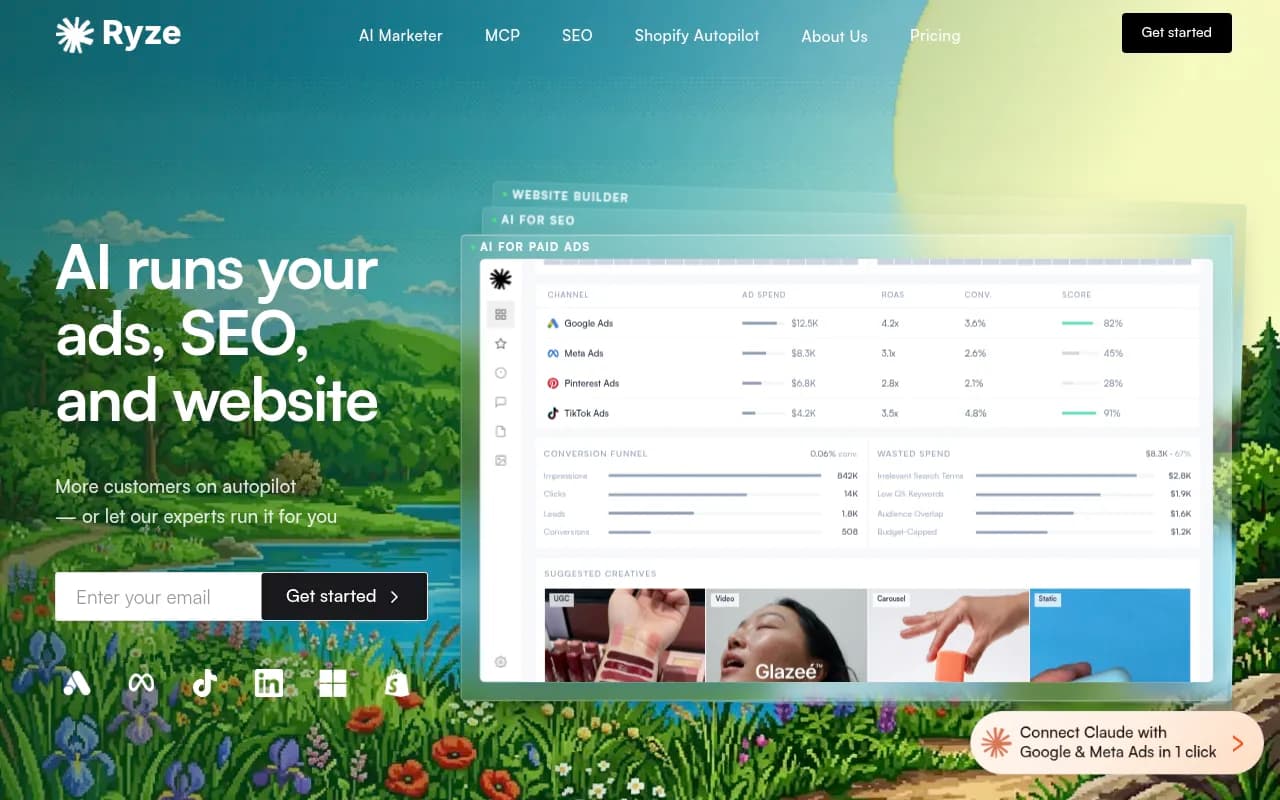
The core loop is the same across all three: connect your accounts via API, let the agents audit continuously, review their proposed actions, and approve or deny. A demo audit shown on their site walks through a Google Ads account spending $3,420/month, flags $412/month going to junk placements, $148/month burned on overnight ads with zero conversions, missing negative keywords, and a double-firing conversion pixel inflating bookings by roughly 15%. Then it offers a "Fix all 4 issues" button. That's the product in a nutshell.
I like this approach. Wasted spend detection is where AI agents earn their keep, and the specific, quantified recommendations ("exclude 34 junk placements," "add 38 exact negatives") are what a good human media buyer would actually do, not vague strategy fluff.
The paid ads side
This is the strongest part of the product. The ads agent does 24/7 performance audits, creative generation (UGC, video, carousel, static formats shown in the approval queue), bid and budget pacing, audience overlap detection, auction insights, and day/hour performance heatmaps. The "Wasted Spend" module breaks losses into categories like irrelevant search terms, low quality score keywords, audience overlap, and budget-capped campaigns.
The headline feature for 2026 is ChatGPT Ads management. Ryze connects to the ChatGPT Ads Manager and can launch and optimize campaigns there, alongside Perplexity ads. If you believe AI-native advertising becomes a real channel, being early here matters. Nobody has a playbook for ChatGPT ad optimization yet, and Ryze at least gives you tooling.
They also claim their model was fine-tuned over six months to outperform ChatGPT and Claude on marketing tasks, and that ex-Google and Meta engineers helped build it. I can't verify the model claim, and "we work with ex-platform engineers" is a line every PPC SaaS uses now, but the fine-tuning claim is at least testable in the 7-day free trial.
The SEO agent
The SEO agent runs continuous technical audits and applies fixes: broken internal links, schema markup on product pages missing structured data, image compression for Core Web Vitals, 404 redirects for pages with existing backlinks, title tag optimization, and internal linking from high-authority pages. Each fix shows an estimated impact ("+22% CTR," "+31 positions"), which I'd treat as directional rather than literal.
It also tracks visibility in ChatGPT and Perplexity search, which is where Ryze starts brushing up against dedicated GEO platforms. More on that below.
Pricing
Ryze's pricing model is its best argument: a flat monthly fee, never a percentage of ad spend.
- Paid Ads Autopilot: $89/month, 7-day free trial
- SEO Autopilot: $129/month
- Traffic Printer (full-service SEO): $599/month
- Ecom Autopilot (done-for-you ecommerce growth): $1,499/month
Billing discounts run 5% quarterly, 10% bi-annual, and 20% annual. Month-to-month with a money-back guarantee. Compare that to a typical agency at $1,000–$25,000/month or spend-tiered software, and the value for a $10K/month advertiser is obvious. The entry plan also includes a dedicated human strategist, which surprised me at $89/month, and makes me wonder how sustainable that is.
Strengths
- True agentic execution with an approval layer. You control scope: deny, approve, or let it run.
- Quantified wasted-spend analysis with concrete, applied fixes rather than recommendations you have to implement yourself.
- ChatGPT and Perplexity ad management, which almost nobody else offers yet.
- Flat pricing that doesn't punish you for scaling spend.
- Agency tier with bulk audits, white-label, and AI-generated client reports.
- Slack/Teams integration for reporting, plus a Shopify connection and an MCP-style Claude integration for one-click Google/Meta connectivity.
Limitations
- The GEO and AI visibility capability is a bolt-on, not a core competency. Ryze tracks visibility in ChatGPT and Perplexity, but that's where it ends. Compared to Promptwatch, which was purpose-built for AI search visibility, Ryze is missing several things that matter if AI-driven discovery is a real channel for you:
- No AI crawler logs or Agent Analytics, so you can't see when ChatGPTBot or GoogleOther actually visit your pages or what errors they hit.
- No visitor analytics or traffic attribution from AI platforms, so there's no measurement of whether AI visibility drives actual revenue.
- No prompt intelligence: no monthly search volumes, difficulty scores, or query fan-outs for the prompts you care about.
- No page-level citation tracking, citation trends by content type, or offsite mention tracking.
- No Reddit or YouTube citation insights, and no ChatGPT Shopping tracking or Ads Radar showing which competitors bid on your prompts.
- Only two AI models tracked versus Promptwatch's coverage of 10+ including Gemini, Claude, Grok, DeepSeek, Copilot, and Google AI Overviews.
- The fine-tuned model claim and "2,000+ clients" stat are unverifiable marketing. The press logos (WSJ, Forbes, Axios) are displayed without links to specific coverage.
- The autonomous website builder is a nice add-on but I wouldn't choose it over a real CMS or landing page tool if site quality matters.
- Estimated impact numbers on SEO fixes are optimistic and should be sanity-checked.
Who it's for
- SMB owners spending $3K–$30K/month on ads who can't justify an agency retainer but don't have time to babysit campaigns. This is Ryze's sweet spot, and the $89 price point is honest.
- Performance marketers running multi-channel accounts (Google + Meta + TikTok) who want one agent watching pacing, structure, and creative fatigue 24/7.
- Agencies managing many small accounts where per-account economics don't work with human labor; the bulk audits and white-label reporting are a real workflow.
- Ecommerce operators willing to pay $1,499/month for done-for-you growth across ads, SEO, and site.
Who should skip it: enterprises needing deep GEO intelligence, brands whose growth depends on organic AI visibility (Ryze's tracking there is surface-level), and anyone uncomfortable with an agent touching live ad accounts without supervision. Even with the approval layer, you need someone checking its work.
Bottom line
As an autonomous paid media and SEO automation engine, Ryze AI is legitimately interesting and priced fairly. The wasted-spend audits alone can pay for a year of subscription in a month, and the ChatGPT Ads capability is ahead of the market.
But if your goal is specifically to understand and grow how AI models cite and recommend your brand, Ryze only scratches the surface. For that job, Promptwatch is the stronger choice: it explains why you're visible through AI crawler logs, shows which pages and even Reddit and YouTube sources get cited, measures actual AI-driven traffic and conversions, and then closes the loop with content gap analysis and automated content publishing. Ryze manages your ads in AI channels; Promptwatch makes sure AI channels recommend you in the first place. Depending on where your growth gap is, that distinction decides which one you need.

Tags:
Frequently asked questions
What is Ryze AI?
How much does Ryze AI cost?
Does Ryze AI manage ads inside ChatGPT?
Does Ryze AI track AI search visibility?
Is Ryze AI good for agencies?
Can Ryze AI's agents make changes without my approval?
Who should use Ryze AI?
What integrations does Ryze AI support?
Similar and alternative tools to Ryze AI