Crayon Review 2026
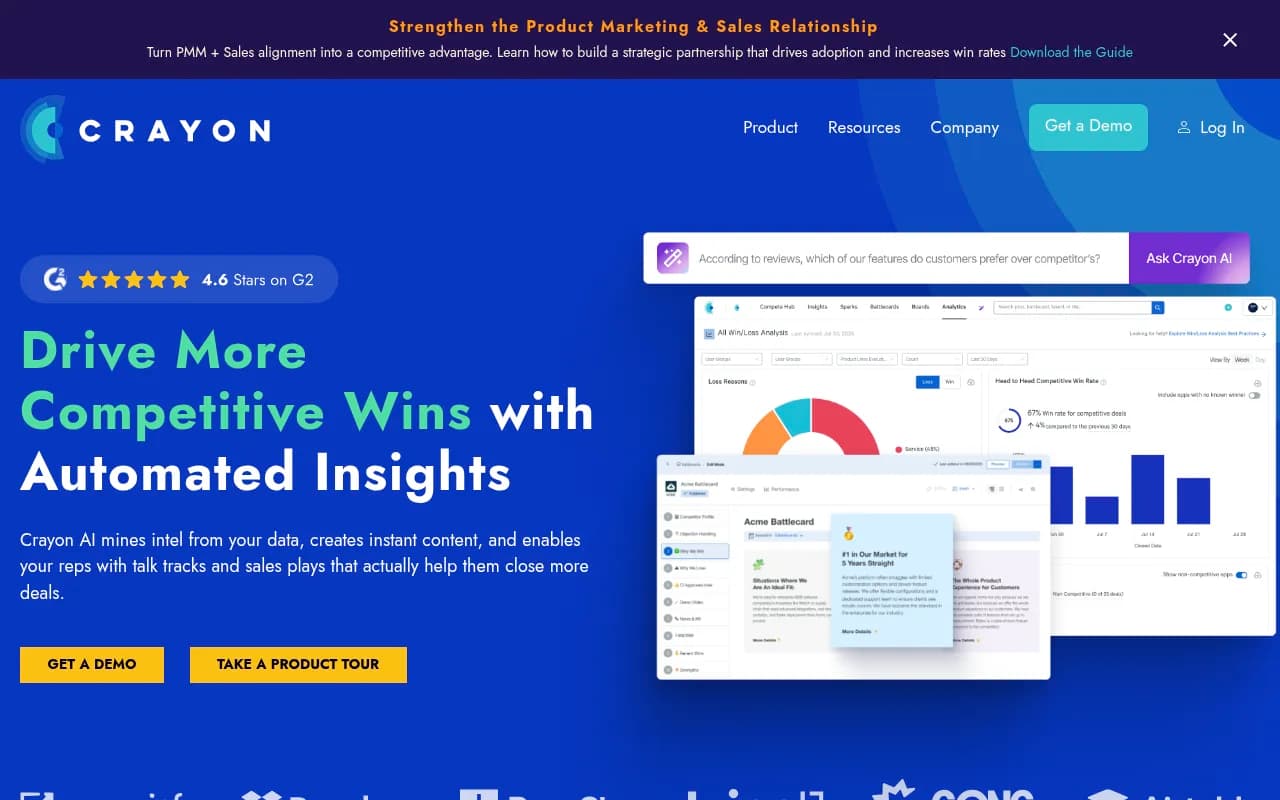
Tracks competitor moves across web, social, and review sites, delivering automated alerts and insights to inform GTM strategy and positioning.
Key Takeaways
- Automated competitor monitoring with AI-powered importance scoring and news summarization saves hours of manual research
- Sales enablement focus -- battlecards, talk tracks, and intel delivered directly in Salesforce, Slack, Highspot, and Microsoft Teams where reps already work
- Proven ROI with customers reporting 22-40% increases in competitive win rates and millions in influenced revenue
- Pricing is custom based on program needs -- no transparent pricing tiers available, requires sales conversation
- Best for B2B SaaS companies with active sales teams competing in crowded markets, not ideal for solo founders or small teams without dedicated CI resources
Crayon is a competitive intelligence platform built for B2B companies that need to track competitors and arm their sales teams with actionable intel. Founded to solve the problem of scattered competitor data and underutilized battlecards, Crayon monitors competitor websites, social media, review sites, news outlets, and other sources, then uses AI to surface the most important changes and package them into content that sales reps actually use. The platform is used by companies like ZoomInfo, Dropbox, DocuSign, Gong, and Airtable -- brands competing in markets where knowing what competitors are doing can make or break a deal.
The target audience is competitive intelligence managers, product marketers, and sales enablement leaders at mid-market to enterprise B2B SaaS companies. These are teams managing 5-20+ competitors, supporting sales orgs of 50-500+ reps, and dealing with the reality that most battlecards get created once and never opened again. Crayon is designed to fix that adoption problem by embedding intel where sellers already work and proving ROI with win/loss data.
Competitor Monitoring & AI Analysis
Crayon's core engine tracks changes across competitor websites, social media profiles, review sites like G2 and Capterra, news articles, job postings, and other public sources. Instead of dumping raw data into a feed, the platform uses AI to score each insight by importance and summarize lengthy articles into digestible takeaways. You start your day with high-priority insights delivered to your inbox -- no need to manually check 15 competitor websites or set up Google Alerts that flood you with noise.
The AI news summarization feature is particularly useful. When a competitor gets covered in TechCrunch or announces a funding round, Crayon distills the article into key points you can immediately share with your team. The importance scoring helps you triage -- a minor blog post update gets a low score, a new product launch or pricing change gets flagged as high priority. This filtering is what separates Crayon from basic web monitoring tools that treat every change as equally urgent.
Sparks (AI-Powered Research Queries)
Sparks is Crayon's AI feature that lets you run custom research queries across all the intel the platform has collected. Instead of manually searching through months of competitor updates, you ask Sparks a question like "What strategic moves has Competitor X made in the last quarter?" or "How are competitors positioning their AI features?" and it generates a summary with citations. You can schedule Sparks to run weekly or monthly, creating automated competitive briefings that keep your team informed without manual effort. This is especially valuable for marketing teams tracking narrative shifts or product teams monitoring feature releases.
Battlecards & Content Creation
Crayon's battlecard builder is where monitoring turns into enablement. Battlecards are structured competitive profiles that give sales reps everything they need to handle objections, position against competitors, and close deals. Crayon's battlecards include sections for competitor strengths, weaknesses, differentiators, common objections, talk tracks, and recent intel. The platform makes it easy to keep battlecards updated -- when Crayon detects a competitor pricing change or new feature launch, you can push that update to the relevant battlecard with a few clicks.
Battlecards live inside the tools your sales team already uses. Crayon integrates with Salesforce (showing battlecards directly on opportunity records), Slack (searchable via slash commands), Microsoft Teams, Highspot, Seismic, and other sales enablement platforms. This embedded approach is why Crayon customers report 40% increases in battlecard adoption -- reps don't have to leave their workflow to find competitive intel.
Beyond battlecards, Crayon helps you create announcements (internal newsletters highlighting recent competitor moves), competitive newsletters for broader distribution, and talk tracks that reps can use in discovery calls and demos. The content creation workflow is designed for speed -- you're not starting from scratch every time, you're pulling from the intel Crayon has already surfaced.
Sales Enablement & Compete Mode
Crayon's Compete product is the sales-facing side of the platform. Reps access battlecards via Salesforce, Slack, or the Crayon mobile app when they're in a competitive deal. The Salesforce integration is particularly tight -- when a rep marks an opportunity as competitive, Crayon surfaces the relevant battlecard and tracks whether the rep viewed it. This usage data feeds into the performance metrics that prove ROI.
The team leaderboard feature gamifies competitive selling by showing which reps have the highest win rates against specific competitors. Managers can use this data for 1:1 coaching -- if a rep is struggling against Competitor X, the manager can see their win rate, review which battlecards they're using (or not using), and provide targeted coaching. This closed-loop feedback between CI, enablement, and sales management is rare in competitive intelligence tools.
Win/Loss Analysis & Performance Metrics
Crayon's Measure product tracks competitive win rates, battlecard engagement, and influenced revenue. You can see which competitors give your sales team the most trouble, which battlecards are actually being used, and how battlecard usage correlates with win rates. The influenced revenue metric is particularly valuable for proving ROI to leadership -- it shows the dollar value of deals where a rep viewed a battlecard before closing.
The win/loss data helps you prioritize which competitors to focus on. If you're losing 60% of deals to Competitor A but only 20% to Competitor B, you know where to invest your research and enablement effort. The engagement data shows adoption gaps -- if only 30% of reps are using battlecards, you have an enablement problem to solve. Crayon customers like Cognism have used this data to demonstrate $6 million in influenced revenue in less than a year.
Integrations & Ecosystem
Crayon integrates with Salesforce (battlecards on opportunity records, win/loss tracking), Slack (searchable battlecards via slash commands, automated intel alerts), Microsoft Teams (same as Slack), Highspot (battlecards in sales content library), Seismic (same as Highspot), Gong (competitive call analysis -- Crayon can surface which competitors are mentioned in sales calls), and Chorus. The Salesforce integration is the most mature, with deep two-way sync for opportunity data and battlecard usage tracking.
Crayon also offers a Chrome extension for quick access to battlecards while browsing competitor websites, and a mobile app for reps who need intel on the go. The platform has an API for custom integrations, though most customers use the pre-built connectors. There's no public API documentation, so custom integrations require working with Crayon's team.
Pricing & Value
Crayon does not publish pricing on its website. Based on third-party sources and customer reports, pricing is custom and depends on the number of competitors tracked, the size of your sales team, and which modules you need (Analyze, Enable, Compete, Measure). Expect pricing to start in the mid-five figures annually for mid-market companies and scale up for enterprise deployments. This is consistent with other enterprise competitive intelligence platforms like Klue and Kompyte.
The lack of transparent pricing is a barrier for smaller companies or teams that want to evaluate cost before a sales conversation. Crayon is clearly targeting mid-market to enterprise buyers with budget and a dedicated CI function, not startups or solo product marketers. The ROI case is strong if you can show increased win rates or influenced revenue, but you need a sales org large enough to generate meaningful data.
Who Is It For
Crayon is built for competitive intelligence managers, product marketing managers, and sales enablement leaders at B2B SaaS companies with 50-500+ sales reps. The ideal customer is competing in a crowded market (5-20+ direct competitors), has a dedicated CI or PMM resource, and struggles with battlecard adoption or proving CI ROI. Companies like ZoomInfo, Gong, DocuSign, and Alteryx fit this profile -- they have the budget, the sales team size, and the competitive pressure to justify a platform like Crayon.
Crayon is less suited for early-stage startups (under 20 reps), companies in niche markets with only 1-2 competitors, or teams without a dedicated CI owner. The platform requires ongoing management -- someone needs to review daily insights, update battlecards, and train the sales team. If you're a solo PMM wearing 10 hats, Crayon might be overkill. You'd be better off with a simpler tool like Kompyte or even manual Google Alerts and a shared Notion doc.
Industries where Crayon shines: enterprise software, sales tech, marketing tech, HR tech, fintech, cybersecurity -- anywhere with complex B2B sales cycles and multiple competitors vying for the same deals. Industries where it's less relevant: consumer apps, e-commerce, agencies, consulting firms.
Strengths & Limitations
Strengths:
- AI-powered prioritization -- importance scoring and news summarization save hours of manual triage
- Salesforce integration -- battlecards on opportunity records and win/loss tracking in the CRM where sales leaders already live
- Proven ROI -- multiple case studies showing 20-40% win rate increases and millions in influenced revenue
- Embedded enablement -- battlecards in Slack, Teams, Highspot, and Seismic mean reps actually use them
- Sparks AI research -- automated competitive briefings that run on a schedule
Limitations:
- No transparent pricing -- you have to talk to sales to get a quote, which is frustrating for smaller teams evaluating options
- Requires dedicated CI owner -- the platform is powerful but not self-service; someone needs to manage it daily
- Limited international coverage -- monitoring works best for English-language sources; non-English competitor tracking is less robust
- No public API docs -- custom integrations require working with Crayon's team, not self-service
- Overkill for small teams -- if you have under 20 reps or only 1-2 competitors, simpler tools like Kompyte or manual tracking are more cost-effective
Bottom Line
Crayon is the best competitive intelligence platform for mid-market to enterprise B2B SaaS companies that need to track multiple competitors, enable large sales teams, and prove CI ROI with win/loss data. The combination of automated monitoring, AI-powered insights, embedded battlecards, and performance metrics solves the two biggest CI problems: staying on top of competitor moves and getting sales reps to actually use the intel you create. If you're a CI manager at a 100-person sales org competing against 10+ vendors, Crayon will save you hours of manual research and help you demonstrate millions in influenced revenue. If you're a solo PMM at a 15-person startup, it's probably too much platform for your needs -- start with Kompyte or a manual system and graduate to Crayon when you have the team size and budget to justify it. Best use case in one sentence: B2B SaaS companies with 50+ reps competing in crowded markets who need to turn competitor intel into sales wins at scale.
Tags:
Similar and alternative tools to Crayon