LinkedIn Marketing Solutions Review 2026
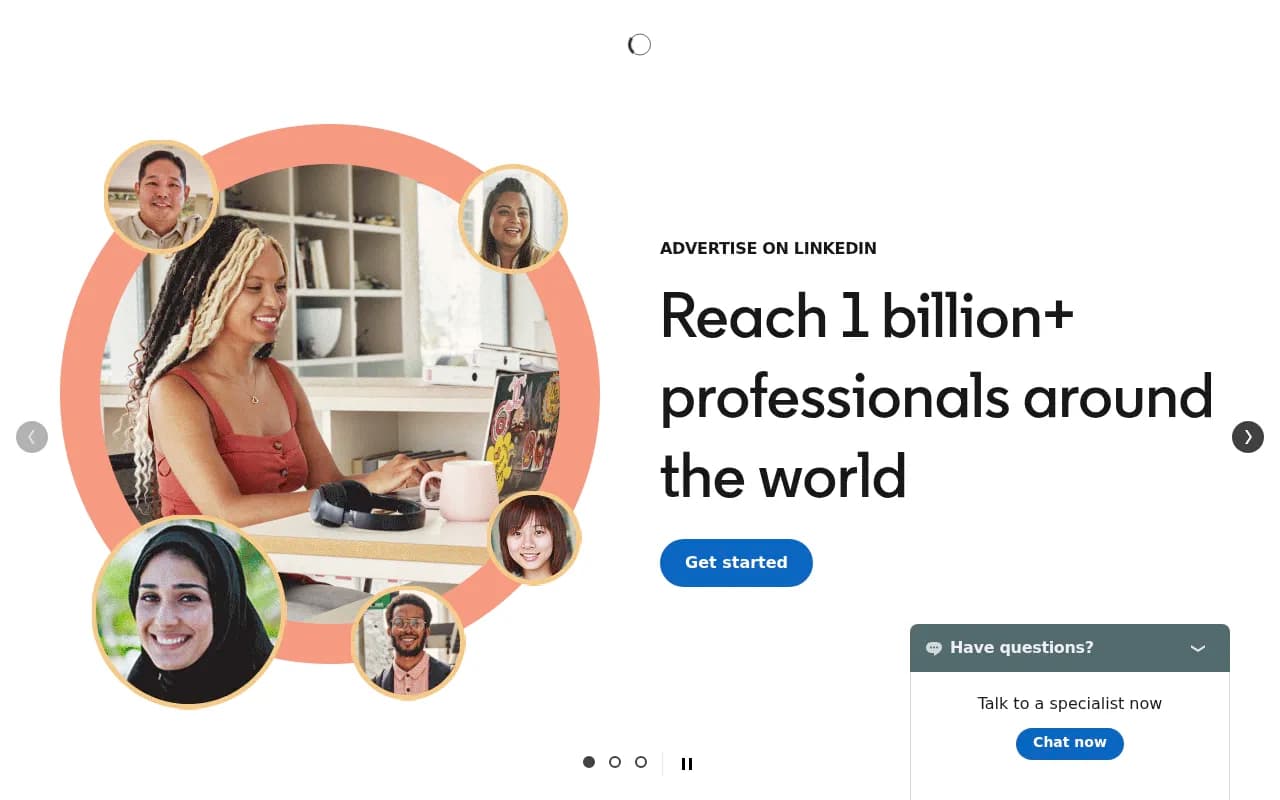
LinkedIn Marketing Solutions is LinkedIn's self-serve and managed advertising platform for B2B marketers. Target 1B+ professionals by job title, industry, seniority, and skills using Sponsored Content, Message Ads, Dynamic Ads, and Text Ads. Minimum $10/day budget.
Key takeaways
- LinkedIn Marketing Solutions is the go-to B2B advertising platform for reaching professionals by job title, company size, industry, and seniority -- targeting attributes no other social network can match at scale
- Costs are significantly higher than Facebook or Google Ads (CPCs often $5-15+), which makes it a poor fit for small budgets or consumer-facing brands
- Campaign Manager is capable but not the most intuitive interface -- expect a learning curve if you're coming from Meta Ads Manager
- Strong for lead generation, brand awareness, and account-based marketing (ABM) among enterprise and mid-market B2B companies
- Not a Promptwatch competitor -- this is a paid advertising platform, not an AI search visibility or GEO tool
LinkedIn Marketing Solutions is the advertising arm of LinkedIn, the Microsoft-owned professional network with over one billion members worldwide. It gives businesses a way to run paid campaigns directly inside the LinkedIn feed, inbox, and sidebar -- reaching an audience that is, by design, in a professional mindset. That's the core pitch, and it's a genuinely compelling one for B2B marketers who've grown frustrated with the noise and audience quality issues on Facebook or Instagram.
The platform has been around in various forms since LinkedIn launched self-serve ads in 2008, but it's matured considerably since Microsoft acquired LinkedIn in 2016 for $26.2 billion. Today it's a full-stack advertising solution covering everything from awareness campaigns to direct lead capture, with a self-serve interface (Campaign Manager) and a managed service option for larger spenders.
The target audience is squarely B2B: SaaS companies selling to enterprise buyers, professional services firms, recruiters, financial services brands, higher education institutions, and anyone else whose customer is a working professional rather than a general consumer. If you're selling project management software to CTOs or executive education programs to senior managers, LinkedIn is one of the few places you can actually find those people at scale and target them with reasonable precision.
Key features
Sponsored Content is the flagship ad format and the one most advertisers start with. These are native ads that appear directly in the LinkedIn feed -- on desktop, tablet, and mobile -- and look similar to organic posts. You can run single-image ads, video ads, carousel ads (multiple swipeable images), document ads (downloadable PDFs), and event ads. The feed placement means high visibility, and because the content looks native, engagement rates tend to be better than banner-style formats. LinkedIn also offers a "Thought Leader Ad" variant that lets you boost posts from individual employee profiles rather than company pages, which can feel more authentic.
Sponsored Messaging puts your message directly into LinkedIn's inbox. There are two sub-formats: Message Ads (formerly InMail), which are one-to-one style messages sent to a targeted list, and Conversation Ads, which use a branching structure to let recipients choose their own path through the content. Message Ads have a reputation for feeling intrusive if the copy isn't right, but when done well -- especially for event invitations or high-value offers -- they can generate strong response rates. LinkedIn only delivers Message Ads when a member is active on the platform, which theoretically improves open rates.
Dynamic Ads are personalized at scale using LinkedIn profile data. The most common variant is the Follower Ad (to grow your company page following) and the Spotlight Ad (to drive traffic to a URL). These automatically pull in the viewer's name, photo, and job title to create a personalized feel. They appear in the right-rail sidebar on desktop. The personalization is a nice touch, though some users find them a bit uncanny -- seeing your own face in an ad is attention-grabbing but can also feel slightly off.
Text Ads are the simplest and cheapest format: small pay-per-click ads that appear in the right sidebar on desktop. They're quick to set up and useful for testing messaging, but reach is limited since they don't appear on mobile and the sidebar gets less attention than the feed. For most advertisers, Text Ads are a secondary format rather than a primary one.
Audience targeting is where LinkedIn genuinely differentiates itself. You can target by:
- Job title (specific titles or title categories)
- Job function and seniority level
- Company name, company size, and industry
- Skills listed on profiles
- Education (degree, field of study, school)
- Member groups
- Geography (country, region, city)
- LinkedIn-specific behaviors (job seekers, recently promoted, etc.)
You can also upload contact lists or account lists for matched audiences, use website retargeting via the LinkedIn Insight Tag, and build lookalike audiences based on existing converters. The combination of first-party professional data and these targeting options is genuinely hard to replicate elsewhere.
Campaign Manager is the self-serve interface where you build, manage, and measure campaigns. It's organized around an objective-based structure (Awareness, Consideration, Conversions) similar to Meta Ads Manager. You set your objective first, then build your audience, choose your format, set your budget and bid strategy, and upload creative. The interface is functional but not particularly elegant -- it's improved over the years but still feels clunkier than Meta's equivalent. Reporting is decent: you get impressions, clicks, CTR, conversions, cost per conversion, and demographic breakdowns of who's actually seeing your ads.
Lead Gen Forms are a standout feature. When a user clicks a Lead Gen Form ad, a pre-filled form pops up with their LinkedIn profile data (name, email, job title, company, etc.). Because the data is pulled from their profile, completion rates are much higher than sending people to a landing page. You can download leads directly from Campaign Manager or connect to a CRM via integrations. For B2B lead generation campaigns, this is one of the most effective formats on the platform.
LinkedIn Audience Network extends your campaign reach beyond LinkedIn itself to third-party apps and websites. It's opt-in and can increase reach, but many experienced advertisers turn it off because the quality of placements outside LinkedIn is harder to control and often lower quality than in-feed placements.
Conversion tracking and analytics use the LinkedIn Insight Tag (a JavaScript snippet installed on your website) to track post-click and post-view conversions. You can set up custom conversion events, track revenue, and see which campaigns are driving actual business outcomes. LinkedIn also offers a Revenue Attribution Report that attempts to connect ad exposure to CRM pipeline data -- useful for enterprise advertisers who want to tie spend to closed deals.
Who is it for
LinkedIn Marketing Solutions works best for B2B companies with a clearly defined professional audience and a product or service with enough margin to justify the higher CPCs. The sweet spot is SaaS companies targeting mid-market and enterprise buyers -- think a sales enablement platform targeting VP-level sales leaders at companies with 200-2,000 employees, or a cybersecurity vendor targeting CISOs in financial services. These are audiences that are genuinely hard to reach on other platforms, and LinkedIn's targeting makes it possible to get in front of them specifically.
Professional services firms -- management consultancies, accounting firms, law firms, executive search agencies -- also get strong results, particularly with Thought Leader Ads and Sponsored Content that positions individual experts. Similarly, higher education institutions running executive MBA programs or professional certification courses find LinkedIn's education and seniority targeting invaluable for reaching the right candidates.
Who should probably look elsewhere: consumer brands, e-commerce companies, local businesses, and anyone with a daily budget under $50-100. The minimum daily budget is technically $10, but at that level you'll get very limited reach and data. Realistically, you need at least $1,000-2,000/month to run meaningful tests and gather enough data to optimize. Agencies managing multiple small B2B clients can make it work, but the economics are tough for very small advertisers.
Integrations and ecosystem
LinkedIn Marketing Solutions connects to a solid range of marketing and CRM tools:
- CRM integrations: Native integrations with Salesforce, HubSpot, Microsoft Dynamics 365, and Marketo for syncing leads from Lead Gen Forms directly into your CRM
- Marketing automation: Integrations with Marketo, Eloqua, and HubSpot for audience syncing and lead routing
- Zapier: Connects Lead Gen Form submissions to hundreds of other tools
- Google Analytics: You can pass UTM parameters through LinkedIn ads for tracking in GA4
- Adobe Experience Cloud: For enterprise advertisers using Adobe's stack
- Conversions API: A server-side integration option for more reliable conversion tracking that doesn't depend on browser cookies or the Insight Tag alone
The LinkedIn Insight Tag is the foundation of most tracking and retargeting setups. It's a single JavaScript snippet that goes on your website and enables website retargeting, conversion tracking, and demographic insights about your site visitors (which is actually a useful free feature -- you can see the job titles and industries of people visiting your site even if they don't convert).
There's no mobile app specifically for Campaign Manager, though you can access it via mobile browser. LinkedIn's main app does let you boost organic posts directly, which is a simplified version of Sponsored Content.
Pricing and value
LinkedIn Ads uses an auction-based pricing model with no fixed rates. You set a daily or lifetime budget and choose a bid strategy:
- Maximum delivery (automated bidding): LinkedIn optimizes bids to get the most results within your budget
- Cost cap: You set a target cost per result and LinkedIn tries to stay near it
- Manual bidding: You set your own maximum bid per click, impression, or send
In practice, CPCs on LinkedIn typically run $5-15 for most B2B audiences, with competitive niches (enterprise software, financial services, healthcare IT) often pushing $15-25+. CPMs (cost per 1,000 impressions) usually fall in the $30-80 range. Message Ads are priced per send, typically $0.20-0.80 per message depending on audience.
The minimum daily budget is $10, but as noted above, that's not a realistic operating budget for most campaigns. LinkedIn recommends at least $5,000 in initial spend to gather meaningful data.
There's no free tier for advertising, but LinkedIn does offer a free $100 ad credit for new advertisers periodically. The LinkedIn Insight Tag and demographic insights for website visitors are free to use.
Compared to Google Ads or Meta Ads, LinkedIn is expensive on a pure CPC basis. But the comparison isn't entirely fair -- the audience quality and targeting precision for B2B use cases is genuinely different. A $10 CPC that converts a VP of Engineering into a demo request is often better economics than a $1 CPC from a generic Google search that brings in unqualified traffic.
Strengths and limitations
What it does well:
- The professional targeting data is unmatched. No other platform lets you target by job title + company size + seniority + specific skills with this level of accuracy and scale
- Lead Gen Forms are genuinely excellent for B2B lead capture -- pre-filled profile data means completion rates that typically beat landing page forms by a significant margin
- The Insight Tag's free demographic reporting on website visitors is a useful tool even for advertisers not actively running campaigns
- Account-based marketing (ABM) capabilities are strong -- you can upload a list of target accounts and serve ads specifically to employees at those companies
- Brand safety is generally better than open web programmatic -- you're in a professional context, not next to random content
Where it falls short:
- Cost is the biggest barrier. LinkedIn is one of the most expensive digital advertising channels by CPM and CPC. Small budgets get eaten up quickly with limited data to show for it
- The Campaign Manager interface, while functional, lags behind Meta Ads Manager in terms of usability, bulk editing capabilities, and creative testing workflows
- Audience sizes can be surprisingly small once you layer multiple targeting criteria -- it's easy to over-target yourself into an audience of a few thousand people, which limits scale
- Attribution is imperfect. The Insight Tag relies on cookies and LinkedIn's own view-through attribution windows, which can inflate reported conversions. The Conversions API helps but requires technical setup
- Organic reach on LinkedIn has declined as the platform has grown, which means the line between "organic" and "paid" strategy requires more investment than it used to
Bottom line
LinkedIn Marketing Solutions is the right choice for B2B marketers who need to reach specific professional audiences -- particularly senior decision-makers at mid-market and enterprise companies -- and have the budget to support CPCs in the $5-15+ range. It's not a tool for everyone, and the cost structure means you need to go in with realistic expectations and a clear conversion goal.
Best use case in one sentence: running lead generation or brand awareness campaigns targeting specific job titles and company types in B2B markets where audience precision matters more than volume.
Tags:
Frequently asked questions
What is LinkedIn Marketing Solutions?
How much does LinkedIn advertising cost?
Who is LinkedIn Marketing Solutions best for?
What targeting options does LinkedIn offer?
What are LinkedIn Lead Gen Forms?
How does LinkedIn Marketing Solutions compare to Facebook Ads for B2B?
Similar and alternative tools to LinkedIn Marketing Solutions