Key takeaways
- Bluefish AI is a GEO-first platform built entirely around AI channel visibility and brand influence -- it has no traditional SEO capability. Botify is the opposite: a mature enterprise SEO platform that has added AI search monitoring on top of a deep technical foundation.
- If your team already has SEO covered and needs to own the AI channel specifically, Bluefish AI is more focused. If you want one platform for both traditional and AI search, Botify makes more sense.
- Neither tool is cheap. Bluefish AI is estimated at $4,000+/month; Botify starts around $30,000/year. Both require a sales call to get actual pricing.
- Botify has a significant edge in technical SEO: log file analysis, crawl analytics, JavaScript rendering, and no-code deployment via PageWorker. Bluefish has none of that.
- Bluefish AI goes deeper on AI brand influence -- it claims to show how AI "thinks" about your brand, not just whether you appear. That's a meaningful distinction for brand-heavy enterprise teams.
- Neither tool offers built-in AI content generation. If you want to close the loop from visibility gap to published content, you'll need something like Promptwatch alongside either platform.
Overview
Bluefish AI
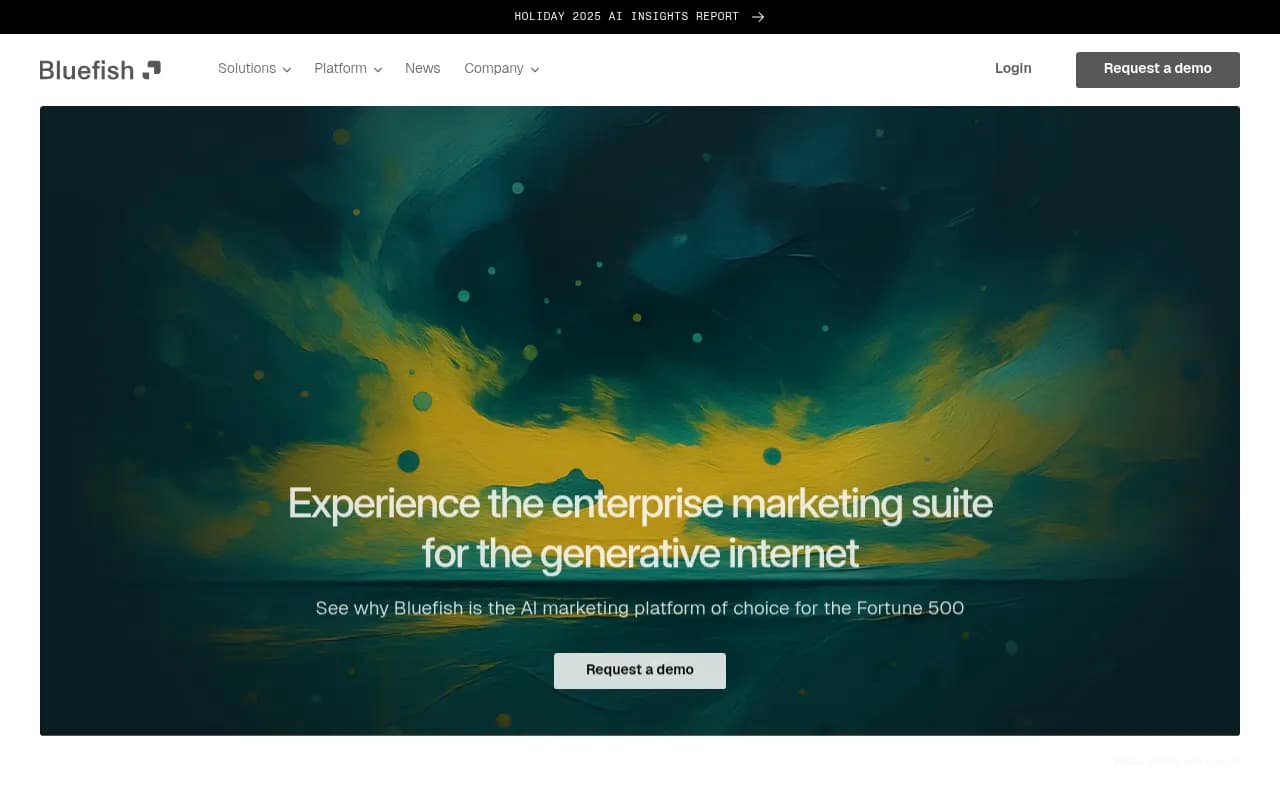
Bluefish AI positions itself as the enterprise GEO platform for Fortune 500 brands. The pitch is authority and influence in AI channels -- not just tracking whether you show up in ChatGPT or Perplexity, but understanding and shaping how AI models characterize your brand. Their "Collections" feature (launched early 2026) lets teams measure the ROI of marketing campaigns specifically in the AI channel, which is genuinely novel. The platform is demo-only, enterprise-only, and clearly built for large marketing teams with dedicated AI strategy budgets.
Botify
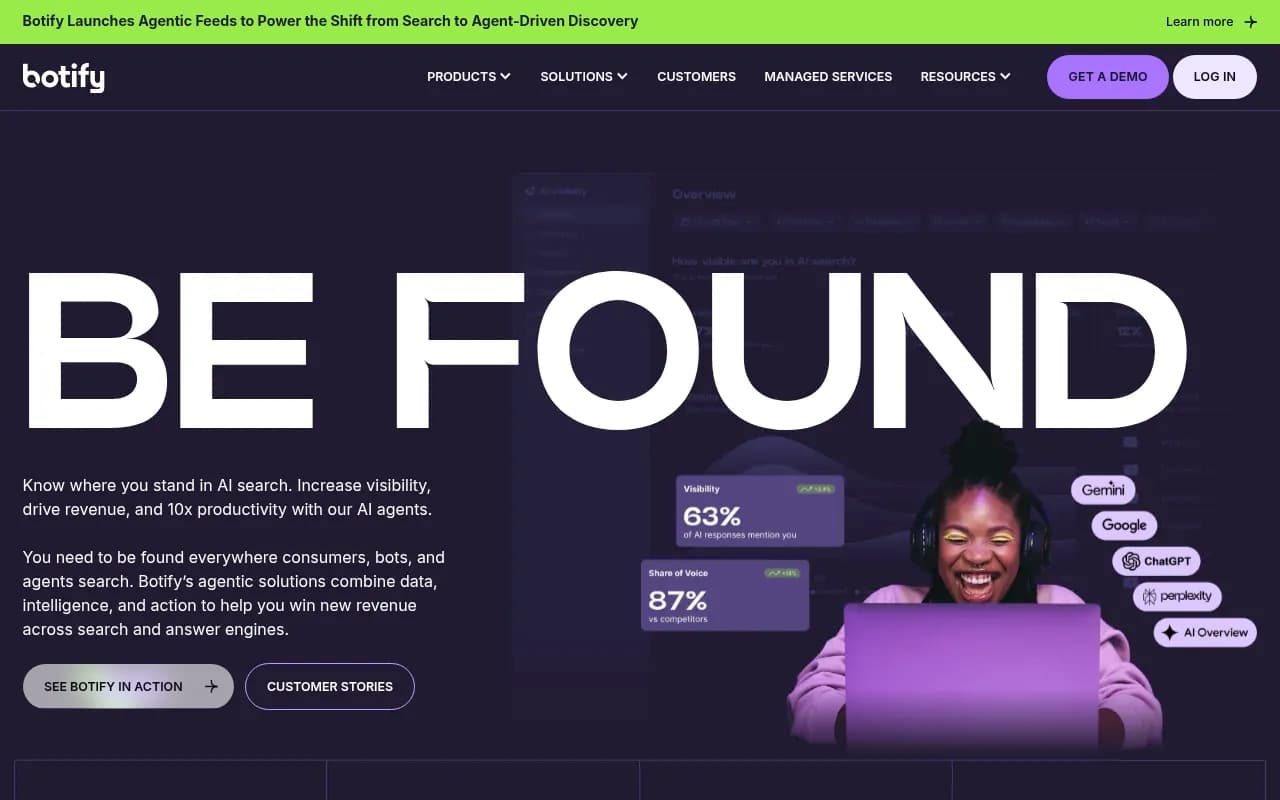
Botify has been around since 2012 and built its reputation on technical SEO for large, complex websites -- think e-commerce sites with millions of pages, media companies with deep content archives. In 2025-2026, they've made a hard pivot toward AI search, launching "Agentic Feeds" to help AI platforms discover and index your content, and adding GEO monitoring alongside their existing crawl and log analysis tools. Forrester named them a Strong Performer in their 2025 Wave. The core value proposition is still about making sure bots and agents can find your pages -- which is a different angle than Bluefish's brand influence story.
Side-by-side comparison
| Feature | Bluefish AI | Botify |
|---|---|---|
| Primary focus | GEO / AI brand visibility | Enterprise SEO + AI search |
| Technical SEO | None | Deep (crawl, logs, JS rendering) |
| AI model monitoring | Yes | Yes |
| GEO optimization | Yes (core feature) | Yes (newer addition) |
| Log file analysis | No | Yes (core feature) |
| Content generation | No | No |
| Agentic automation | Limited | Yes (Agentic Feeds, PageWorker) |
| AI commerce tracking | Yes | No |
| Brand sentiment in AI | Yes (deep) | Basic |
| Custom audience/persona targeting | Yes | Limited |
| No-code deployment tools | No | Yes (PageWorker) |
| API access | Yes (enterprise) | Yes |
| Free trial | No | No |
| Pricing model | Quote-based | Quote-based |
| Estimated entry price | ~$4,000+/month | ~$30,000/year |
| Target user | Brand/AI marketing teams | SEO teams at large enterprises |
| Forrester recognition | Not listed | Strong Performer (2025) |
Head-to-head feature deep-dive
AI visibility monitoring
Both platforms track brand mentions and citations across major AI models. But they frame it differently.
Bluefish AI goes beyond share-of-voice metrics. Their stated goal is helping marketers understand how AI "thinks" about their brand -- the sentiment, framing, and context in which AI models reference them. They also track AI commerce specifically, which matters for retail and CPG brands where ChatGPT Shopping and similar features are becoming real traffic drivers.
Botify's AI monitoring is solid but more utilitarian. It tells you where you appear, how often, and how that compares to competitors. Their February 2026 stat -- AI bot traffic grew 5.6x -- reflects their focus on the crawl and discovery side of AI visibility rather than the brand narrative side.
Verdict: Bluefish AI wins for brand-focused AI monitoring. Botify wins if you care more about crawlability and technical discoverability.
Technical SEO and site health
This isn't even close. Botify was built on technical SEO. Their crawl analytics can handle sites with hundreds of millions of pages. Log file analysis shows you exactly which pages Googlebot, GPTBot, ClaudeBot, and other crawlers are actually visiting -- and which they're ignoring. PageWorker lets SEO teams deploy on-page changes without engineering resources, which is a real operational advantage at enterprise scale.
Bluefish AI has no technical SEO capability. It's not trying to. If your team needs crawl diagnostics or log analysis, Bluefish isn't the answer.
Verdict: Botify, decisively.
GEO optimization and content workflows
Neither platform offers AI content generation -- a gap worth noting. What they do offer:
Bluefish AI has optimization workflows built around AI channel performance. Their "Collections" feature lets teams tie specific marketing campaigns to AI visibility outcomes, which is useful for proving ROI. They also offer custom audience and prompt targeting, so you can monitor how AI models respond to queries from specific buyer personas rather than generic searches.
Botify's GEO optimization is newer and more automation-focused. Agentic Feeds is designed to push your content directly into the pipelines that AI platforms use for discovery -- a proactive approach rather than reactive monitoring. It's a smart angle, but it's still early.
If you want to actually generate content that ranks in AI search, neither tool covers that. Platforms like Promptwatch fill that gap with AI writing tools grounded in real citation data.

Verdict: Bluefish AI for GEO depth and campaign measurement. Botify for automation and AI discoverability infrastructure.
Agentic automation
Botify has invested heavily here. PageWorker lets teams deploy SEO changes (meta tags, structured data, content updates) without touching the codebase -- a genuine time-saver for large teams. Agentic Feeds is their play for the shift from search to agent-driven discovery, essentially making your content machine-readable for AI agents.
Bluefish AI mentions automation of optimization workflows but is less specific about what that means in practice. Their strength is in the intelligence layer -- understanding what's happening -- rather than automated execution.
Verdict: Botify.
Enterprise readiness and security
Both platforms are built for enterprise. Bluefish specifically calls out passing infosec reviews "with ease," which matters for Fortune 500 procurement processes. Botify has been enterprise-grade since its founding and has the customer list (Ralph Lauren, Carolina Herrera) to back it up.
Both offer custom data segmentation, API access, and dedicated support. Neither has self-serve onboarding -- you're buying a managed platform, not a SaaS tool.
Verdict: Tie. Both are genuinely enterprise-ready.
Pricing and value
This is where things get murky because neither company publishes pricing. Based on available estimates:
| Plan | Bluefish AI | Botify |
|---|---|---|
| Entry point | ~$30,000/year | |
| Mid-tier | Custom | Custom |
| Enterprise | Custom | Custom |
| Free trial | No | No |
| Contract type | Annual (likely) | Annual |
Botify appears to be the more accessible entry point, though "accessible" is relative when you're talking $30K/year. Bluefish AI's $4,000+/month estimate puts it at the higher end of the GEO market. Both require a sales conversation before you see real numbers.
Pros and cons
Bluefish AI
Pros:
- Purpose-built for AI channel visibility -- deeper than most competitors on brand influence
- AI commerce tracking is genuinely differentiated
- Custom audience and persona targeting for more relevant monitoring
- Collections feature ties AI visibility to campaign ROI
- Strong enterprise security posture
Cons:
- No technical SEO capability whatsoever
- No content generation or gap analysis tools
- Pricing is at the high end of the market
- Limited public information about specific features -- heavy reliance on sales demos
- Smaller company with less track record than Botify
Botify
Pros:
- Best-in-class technical SEO: crawl analytics, log file analysis, JS rendering
- PageWorker for no-code deployment is a real operational advantage
- Agentic Feeds is a forward-looking play on AI discovery
- Forrester recognition adds credibility
- Longer track record with large enterprise clients
- Lower estimated entry price than Bluefish AI
Cons:
- GEO/AI monitoring is newer and less mature than Bluefish's
- No AI content generation
- Brand sentiment and influence tracking is basic compared to Bluefish
- Platform complexity can be high -- requires dedicated SEO resources to use well
- AI channel features feel bolted on rather than native
Who should pick which tool
Choose Bluefish AI if:
- Your team is specifically focused on AI channel strategy and brand influence
- You're a large consumer brand (retail, CPG, finance) where AI commerce and recommendations matter
- You already have technical SEO handled and need dedicated AI visibility tooling
- You need to prove AI channel ROI to leadership and want campaign-level measurement
Choose Botify if:
- You need both traditional SEO and AI search visibility in one platform
- Your site is large and technically complex (millions of pages, JS-heavy, frequent crawl issues)
- You want no-code deployment tools to ship SEO changes without engineering
- You're earlier in your AI search journey and need the technical foundation before the brand influence layer
- Budget is a constraint and you want more capability per dollar
Final verdict
These two tools are solving different problems. Botify is an enterprise SEO platform that has added AI search monitoring; Bluefish AI is an AI channel platform that has no interest in traditional SEO. The right choice depends entirely on where your team sits.
If you have a dedicated AI marketing team and the budget to match, Bluefish AI's depth on brand influence and AI commerce is hard to match. If you're an SEO team trying to future-proof for AI search without abandoning your existing technical workflow, Botify is the more practical choice -- and probably the cheaper one.
Neither tool will generate content for you or tell you exactly what to write to rank in AI search. That's a gap both leave open.