Key takeaways
- Apollo.io is the best option if you want outbound prospecting with a generous free tier and don't need full ABM orchestration -- it's a fraction of the cost.
- 6sense is the closest true competitor to Demandbase, with comparable predictive AI and intent data, but at similar (or higher) enterprise price points.
- ZoomInfo wins on raw data breadth and is better for teams that need contact intelligence across a wide market, though its ABM features are thinner.
- Cognism is the go-to for European compliance-first prospecting, with phone-verified data that beats most competitors on mobile connect rates.
- Bombora is the right pick if you already have an ABM stack and just need best-in-class intent data to plug in.
- LinkedIn Marketing Solutions is worth considering as a standalone B2B advertising channel if you want guaranteed professional audience targeting without the ABM platform overhead.
Demandbase is a serious platform. It connects advertising, sales intelligence, and account-based engagement in one place, uses AI to score buying groups, and gives revenue teams a single system to coordinate around. For large B2B enterprises with complex GTM motions, it genuinely delivers.
But it's also expensive -- starting around $18,000/year for small teams and scaling well past $300,000/year for enterprise deployments, plus $10,000–$50,000 in implementation fees. That's before you factor in the learning curve, the required buy-in across marketing, sales, and RevOps, and the time it takes to see ROI.
So people look for alternatives for a few reasons: the price is too high, the platform is more than they need, they want best-of-breed tools instead of an all-in-one, or they're specifically strong in one area (like outbound prospecting or intent data) where a specialist tool would serve them better.
Here's an honest look at the best alternatives in 2026.
The alternatives
Apollo.io
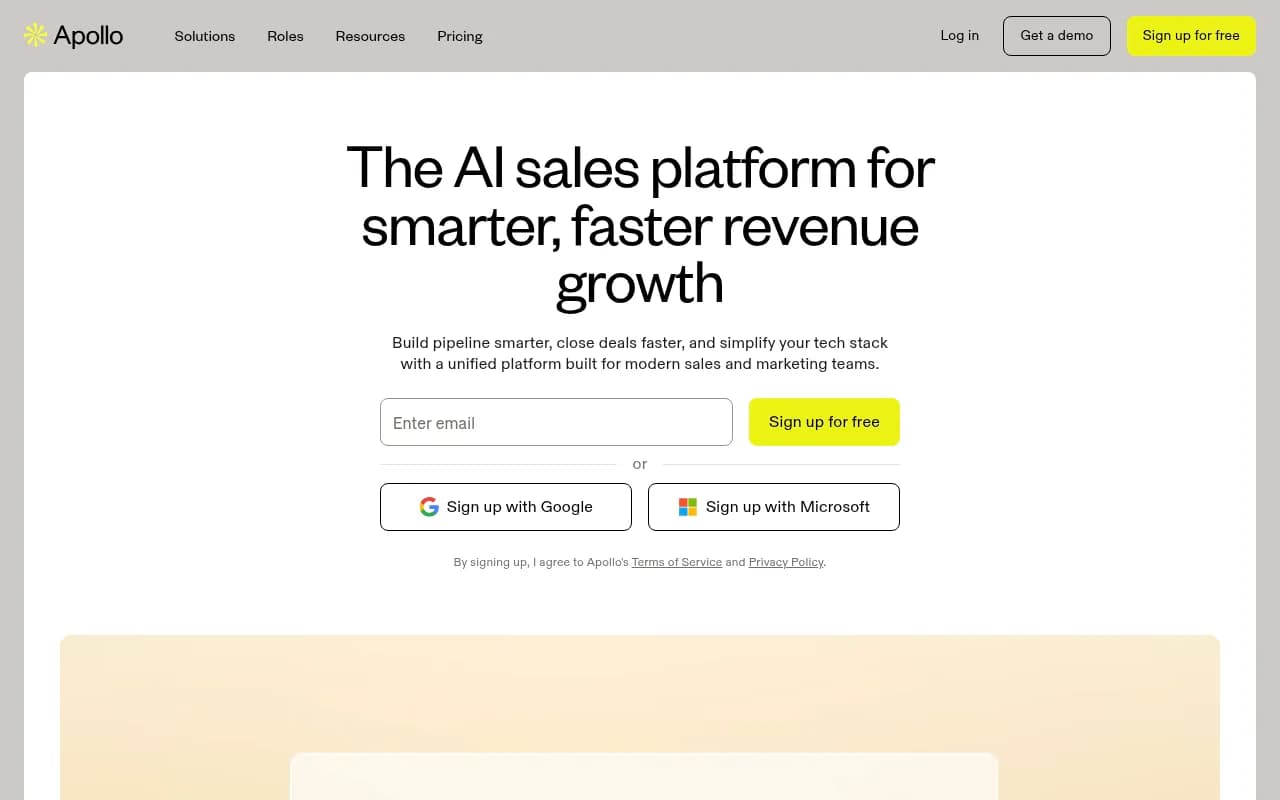
Apollo is probably the most popular Demandbase alternative for teams that don't need the full ABM orchestration layer. It's primarily an outbound prospecting and sales engagement platform -- you get a database of 230M+ contacts and 30M+ companies, email sequencing, a basic dialer, LinkedIn steps, and CRM sync, all in one place.
Where Demandbase is built around account-level orchestration and buying group signals, Apollo is built around individual rep productivity. The question it answers is: "Who should I reach out to today, and how?" Demandbase answers: "Which accounts should our entire GTM team be coordinating around?"
That's a meaningful difference. Apollo doesn't have Demandbase's depth of intent data, buying group AI, or advertising capabilities. You can't run programmatic ABM campaigns from Apollo. But for a lot of teams -- especially those in the $5M–$50M ARR range -- that's fine. They don't need it.
What Apollo does better than Demandbase: it's self-serve, it has a free tier, and it's dramatically cheaper. The Professional plan is $79/user/month. A team of five reps can get started for under $5,000/year. Demandbase would cost 3–10x that before you've even done anything.
Apollo's data quality has improved significantly over the past two years. Email accuracy is solid; mobile phone numbers are less reliable than Cognism's but better than they used to be. The sequencing tool is functional but not as sophisticated as dedicated tools like Outreach or Salesloft.
One honest limitation: Apollo's intent data is relatively basic compared to Demandbase or 6sense. You get some buyer signals, but not the predictive account scoring or buying stage modeling that makes Demandbase compelling for enterprise ABM.
Pricing: Free tier available. Basic $49/user/month, Professional $79/user/month, Organization $119/user/month (annual billing).
Best for: SMB and mid-market sales teams that need outbound prospecting at scale without the complexity or cost of a full ABM platform.
Clearbit
Clearbit is now part of HubSpot, which changes the calculus significantly. If you're already a HubSpot customer, Clearbit's data enrichment capabilities are now available natively -- you can enrich contact and company records in real time, identify anonymous website visitors, shorten forms, and score leads based on firmographic fit.
Compared to Demandbase, Clearbit is narrower in scope. It's a data enrichment and visitor intelligence tool, not a full ABM platform. You won't get advertising orchestration, buying group AI, or sales intelligence dashboards. What you get is very accurate firmographic data that feeds into your existing HubSpot workflows.
The visitor identification feature is genuinely useful -- it surfaces companies browsing your site that match your ICP, which lets you trigger outbound sequences or ad campaigns before a lead fills out a form. Demandbase does this too, but Clearbit's version is simpler and more accessible for teams that don't need the full GTM orchestration layer.
The HubSpot acquisition means Clearbit's standalone pricing is less clear than it used to be. If you're not a HubSpot customer, the value proposition is weaker. If you are, it's worth exploring as a lower-cost enrichment layer rather than a Demandbase replacement.
Pricing: Estimated from $45/month for 100 credits; custom pricing for enterprise. HubSpot customers may have access through their existing plan.
Best for: HubSpot-native teams that want real-time data enrichment and visitor intelligence without building a full ABM stack.
Cognism
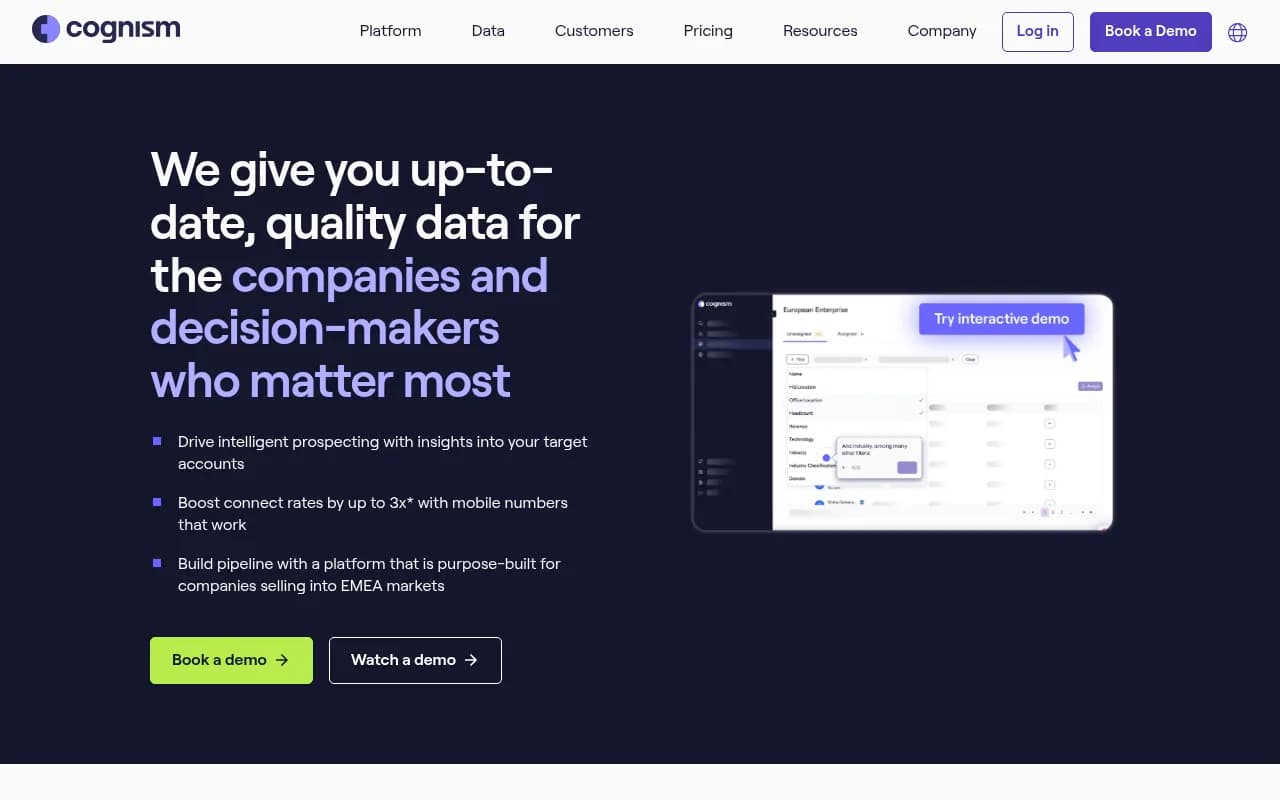
Cognism is the strongest alternative to Demandbase if your primary need is high-quality contact data -- especially in Europe. Their phone-verified mobile numbers (what they call "Diamond Data") consistently outperform competitors on connect rates. If your reps are doing cold calling into European markets, Cognism is hard to beat.
The platform covers sales prospecting, CRM enrichment, and intent signals. You can filter by firmographics, technographics, hiring signals, funding events, and intent topics. The data is GDPR and CCPA compliant by design, which matters a lot for European GTM teams who've been burned by other providers.
Compared to Demandbase, Cognism doesn't have advertising capabilities or the same depth of buying group orchestration. It's a sales intelligence and prospecting tool, not a full ABM platform. But it does integrate with most major CRMs and sales engagement tools, so it slots into existing stacks cleanly.
One thing Cognism does better than Demandbase: the data is more actionable for individual reps. Demandbase is built for coordinated GTM motions across teams; Cognism is built for reps who need to find the right person and reach them now.
Pricing: Custom. Essentials from ~$960/user/year, Professional ~$1,800–$3,000/user/year. Annual contracts required.
Best for: European B2B teams, compliance-sensitive organizations, and sales teams that prioritize phone-verified contact data over full ABM orchestration.
6sense
6sense is the most direct competitor to Demandbase. Both platforms use AI and intent data to predict which accounts are in-market, both offer advertising capabilities, and both are built for enterprise ABM. If you're evaluating Demandbase, you're almost certainly also evaluating 6sense.
The core difference comes down to philosophy and execution. 6sense's predictive modeling -- its "buying stage" AI that classifies accounts as Awareness, Consideration, Decision, or Purchase -- is genuinely impressive and often cited as its strongest differentiator. Demandbase's account scoring is competitive but less prescriptive about where accounts are in the buying journey.
6sense also has a stronger advertising product for some use cases, with more granular audience building and better integration with programmatic channels. Demandbase's advertising is solid but some users find 6sense's targeting more flexible.
The honest trade-off: 6sense is not cheaper than Demandbase. Small deployments start around $50,000–$120,000/year; enterprise deployments exceed $250,000/year. There's no free trial or self-service tier. Implementation is complex. If budget is the reason you're looking at Demandbase alternatives, 6sense is not the answer.
Where 6sense wins: predictive buying stage modeling, advertising flexibility, and a slightly more modern UI. Where Demandbase wins: some users find Demandbase's sales intelligence features more practical for day-to-day rep use, and Demandbase's data layer is well-regarded.
Pricing: Custom. Starting ~$50,000–$120,000/year for small deployments, $250,000+/year for enterprise.
Best for: Enterprise B2B companies that want a direct Demandbase alternative with strong predictive AI and are comfortable with similar price points.
ZoomInfo
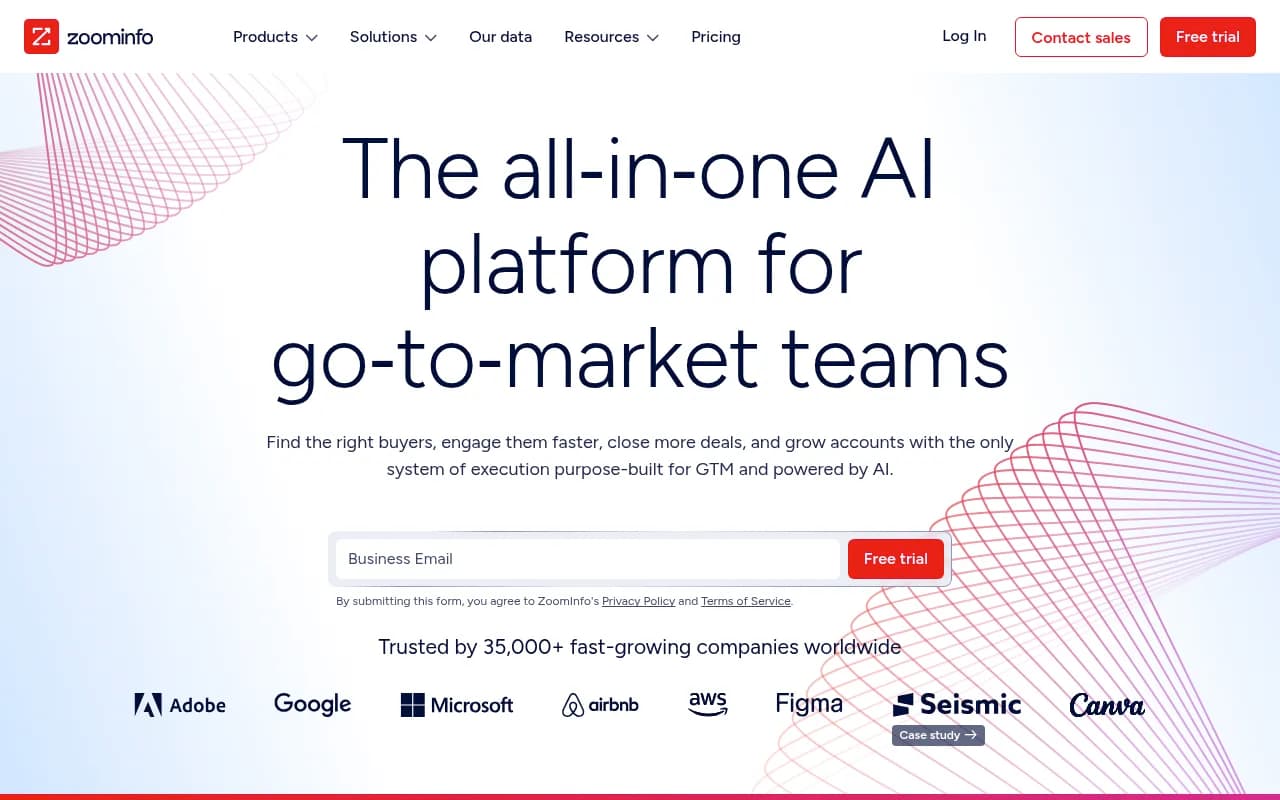
ZoomInfo is the 800-pound gorilla of B2B data. With 35,000+ customers and one of the largest contact databases in the industry, it's the default choice for many GTM teams. It covers prospecting, intent data, website visitor tracking, conversation intelligence (Chorus), and some ABM capabilities.
Compared to Demandbase, ZoomInfo's ABM features are thinner. The platform is stronger as a data and prospecting tool than as an account-based orchestration platform. If you're running sophisticated multi-channel ABM campaigns with coordinated sales and marketing plays, Demandbase is more purpose-built for that.
Where ZoomInfo wins: raw data coverage. For US markets especially, ZoomInfo's contact database is hard to beat on breadth. The intent data (powered by Bombora, which ZoomInfo licenses) is solid. The Chorus acquisition gives it conversation intelligence that Demandbase doesn't have natively.
One honest criticism: ZoomInfo's pricing has become increasingly opaque and aggressive. Many users report that renewal negotiations are difficult and that the platform bundles features you may not need. Data accuracy complaints have also increased as the database has scaled.
ZoomInfo does have a free trial, which Demandbase doesn't offer, making it easier to evaluate before committing.
Pricing: Custom. Basic plans around $75/user/month; advanced plans $3,000–$5,000+/user/year.
Best for: Teams that prioritize contact data breadth, especially in US markets, and want a single platform that covers prospecting, enrichment, and basic intent signals.
RollWorks (AdRoll ABM)
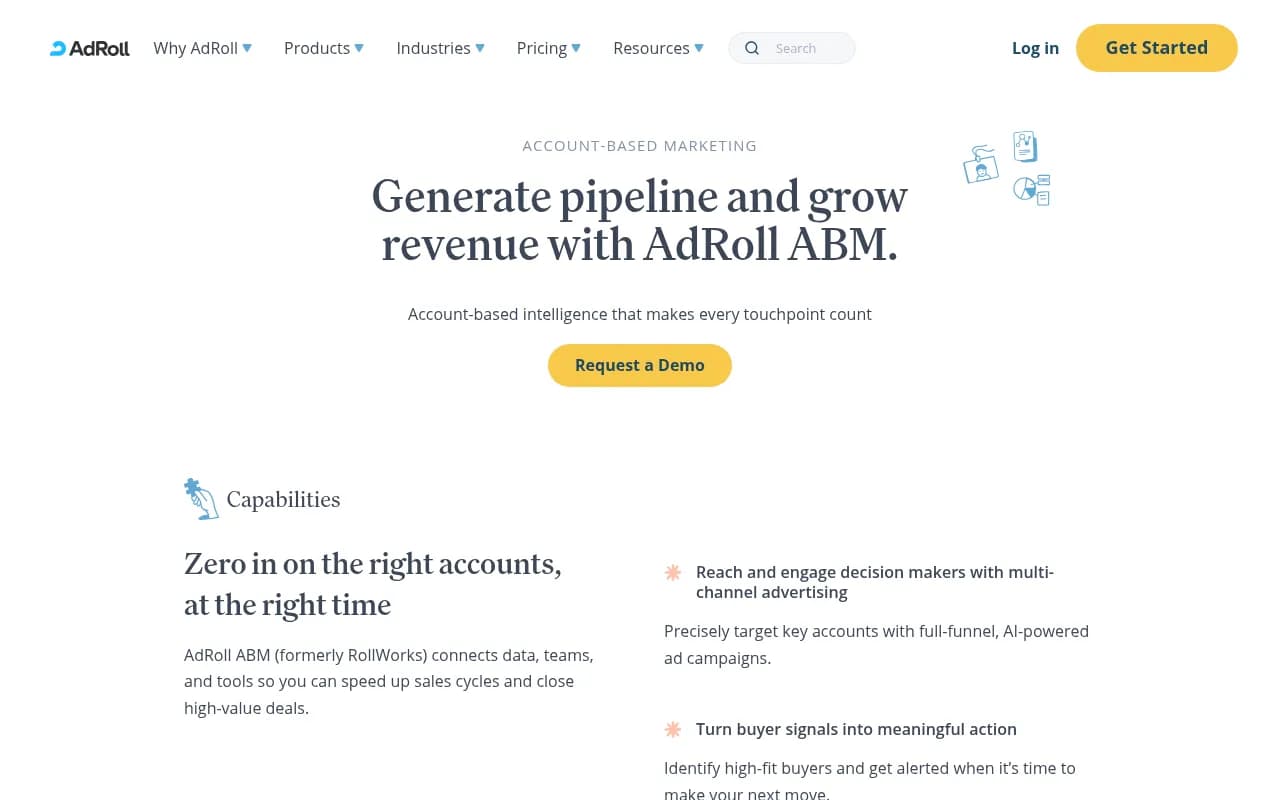
RollWorks, now rebranded as AdRoll ABM, is a mid-market ABM platform that's significantly more accessible than Demandbase in terms of price and complexity. It combines buyer intent data, account targeting, multi-channel advertising, and CRM integrations -- covering the core ABM use case without the enterprise overhead.
The platform is built on a foundation of 2.6 billion digital identities and integrates with Salesforce, HubSpot, and other major CRMs. The advertising capabilities are its strongest suit -- you can run display, social, and connected TV campaigns targeted to specific accounts and buying groups.
Compared to Demandbase, RollWorks is less sophisticated on the AI and predictive side. The account scoring is functional but not as nuanced as Demandbase's buying group intelligence. The sales intelligence features are also thinner -- it's more of a marketing-first platform.
The pricing is historically around $975/month at entry level, which is dramatically lower than Demandbase's floor. That makes it a realistic option for mid-market companies that want ABM capabilities without committing to enterprise-level spend.
Snowflake reportedly achieved a 50% new opportunity rate with existing customers using RollWorks, and a 75% increase in SDR-booked meetings -- so the results can be real, even if the platform is less complex than Demandbase.
Pricing: Custom pricing on request; historically from ~$975/month.
Best for: Mid-market B2B companies that want account-based advertising and buyer intent signals without the complexity or cost of enterprise ABM platforms.
Bombora
Bombora is different from every other tool on this list. It's not an ABM platform -- it's the intent data layer that many ABM platforms (including ZoomInfo) license and resell. If you want the source data rather than a repackaged version of it, Bombora is worth evaluating directly.
The Company Surge® product tracks content consumption across Bombora's Data Co-op of 18,000+ intent topics from thousands of B2B publishers. When a company's employees are suddenly reading a lot about "cloud security" or "ERP migration," Bombora surfaces that signal so you can prioritize outreach before competitors do.
Compared to Demandbase, Bombora doesn't have advertising, sales intelligence dashboards, or account orchestration. It's purely a data provider. But if you already have an ABM stack and you're unhappy with the intent data quality inside Demandbase or 6sense, plugging Bombora directly into your existing tools can be a meaningful upgrade.
Bombora integrates with most major CRMs, MAPs, and ABM platforms. The onboarding fees ($5,000–$20,000+) are real, and pricing is enterprise-only with no self-serve option.
Pricing: Custom enterprise pricing. Onboarding fees from $5,000–$20,000+.
Best for: Companies with an existing ABM stack that want best-in-class third-party intent data, or data teams building custom models that need raw intent signals.
Terminus (DemandScience)
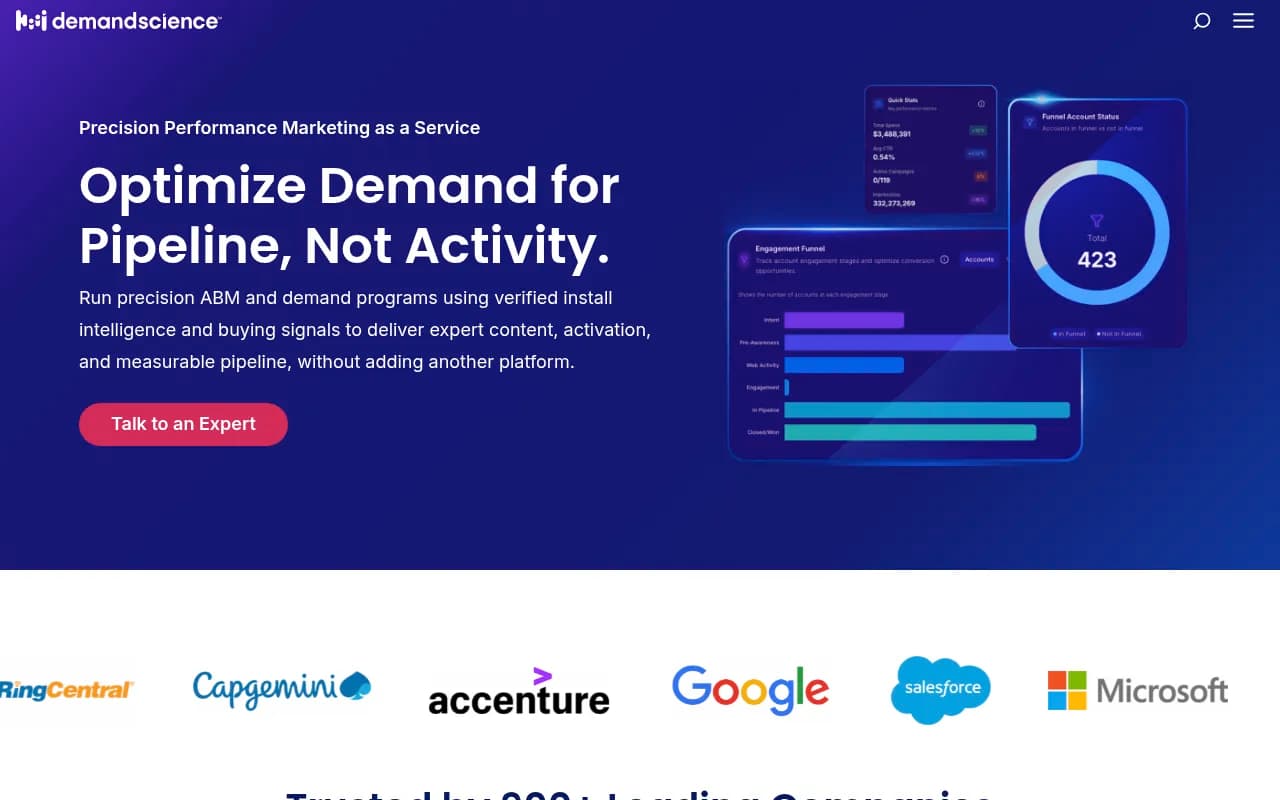
Terminus has gone through significant changes -- it's now part of DemandScience, which has expanded the platform to include content syndication, AI visibility, web personalization, and demand generation alongside the original ABM capabilities. The rebrand reflects a broader positioning as a B2B marketing intelligence platform rather than a pure ABM tool.
The core Terminus capabilities -- account-based advertising, buyer intent signals, multi-channel orchestration, and CRM integration -- are still there. The addition of content syndication and demand generation gives it a wider surface area than Demandbase for teams that want to combine ABM with content-led demand gen.
Compared to Demandbase, Terminus/DemandScience is less focused on the sales intelligence and buying group AI side. It's more of a marketing platform than a unified GTM platform. The recent rebrand and product expansion also means the platform is in a period of evolution, which can be a risk for buyers who want stability.
Pricing: Custom, typically mid-five to six figures annually.
Best for: Marketing-heavy teams that want to combine ABM advertising with content syndication and demand generation, and don't need deep sales intelligence features.
LinkedIn Marketing Solutions

LinkedIn is not an ABM platform, but it deserves a spot on this list because for many B2B companies, it's the most effective channel for reaching decision-makers -- and it doesn't require a six-figure platform commitment.
The targeting is genuinely unique. You can reach people by job title, seniority, company size, industry, skills, and LinkedIn group membership. No other advertising platform has this level of professional audience data. For B2B advertisers, that matters.
Compared to Demandbase, LinkedIn Marketing Solutions is just an advertising channel -- it doesn't have intent data, account scoring, CRM integration, or sales intelligence. But Demandbase actually runs LinkedIn ads as part of its advertising module. If you're paying for Demandbase primarily for its LinkedIn advertising capabilities, you're paying a significant premium for something you could access directly.
The honest limitation: LinkedIn CPCs are high, typically $5–$15+. At scale, it gets expensive quickly. And without the intent data layer that Demandbase provides, you're targeting based on professional attributes rather than in-market signals.
Pricing: Self-serve auction model. Minimum $10/day budget. No fixed monthly fee.
Best for: B2B teams that want to run targeted advertising to professional audiences without a full ABM platform, or as a channel complement to a lighter-weight ABM stack.
How to choose
The right alternative depends on what you actually need from Demandbase:
If you're leaving because of price and you primarily need outbound prospecting, Apollo.io is the obvious starting point. It's cheap, self-serve, and covers the core use case for most sales teams.
If you need full ABM orchestration and are willing to pay enterprise prices, 6sense is the closest true competitor. The platforms are genuinely comparable; the choice often comes down to which sales team you prefer working with and which UI your team finds more intuitive.
If data quality is the issue -- especially in Europe or for phone-verified mobile numbers -- Cognism is worth a serious look. It's not a full ABM platform, but the data is excellent.
If you want best-of-breed intent data to plug into your existing stack rather than replacing Demandbase with another all-in-one, Bombora is the right call.
If you're a mid-market company that wants ABM capabilities without enterprise complexity, RollWorks/AdRoll ABM is the most accessible option.
And if you're a HubSpot shop that just needs data enrichment and visitor intelligence, Clearbit is now native to that ecosystem and worth evaluating before committing to anything else.
Demandbase is a strong platform for the right buyer -- large enterprise, complex GTM motion, budget to match. For everyone else, one of these alternatives will likely serve you better at a fraction of the cost.