Terminus Review 2026
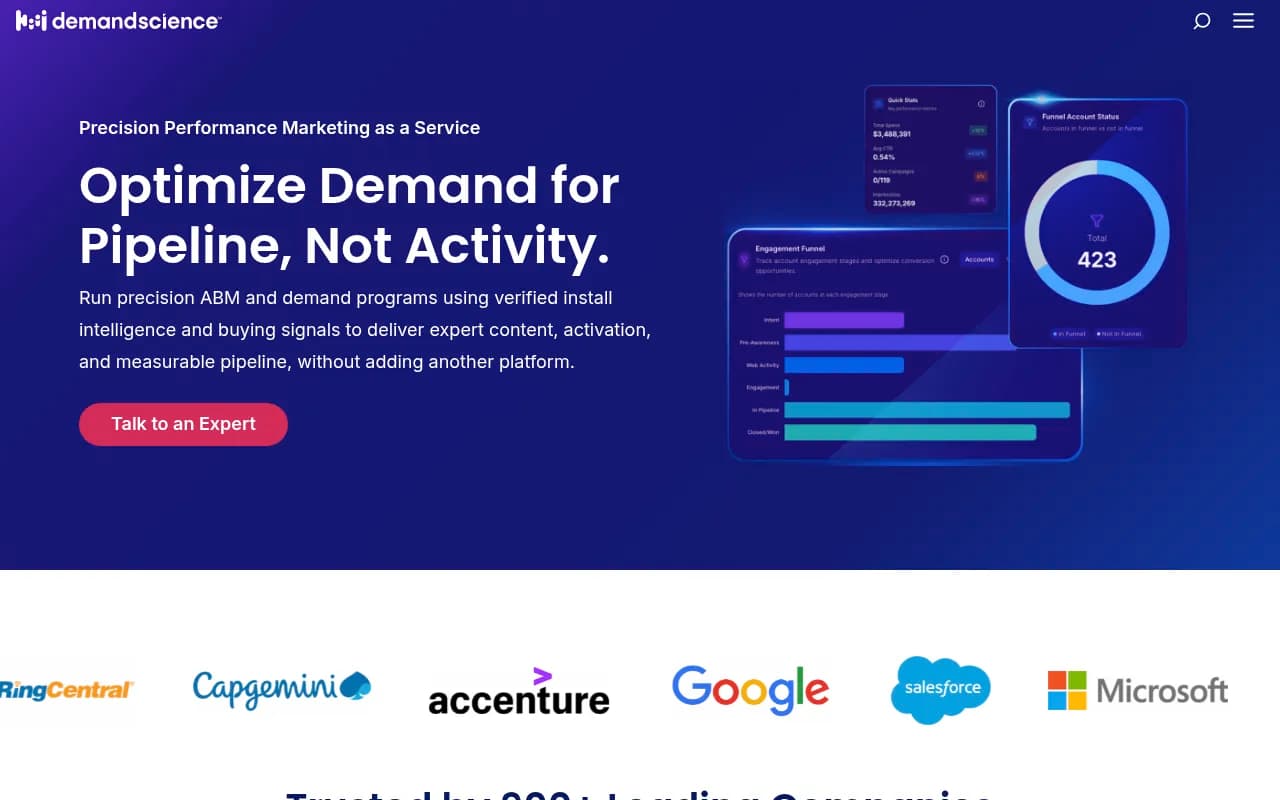
Terminus (now DemandScience) is a B2B account-based marketing platform combining verified buyer intelligence, multi-channel advertising, content syndication, and AI-powered orchestration to help marketing teams build measurable pipeline.
Key takeaways
- Terminus has been rebranded and absorbed into DemandScience, a broader B2B demand generation platform -- the terminus.com domain now redirects there
- Strong fit for mid-market to enterprise B2B marketing teams running account-based marketing (ABM) programs who want a managed-service approach rather than a self-serve tool
- The platform combines buyer intent data, content syndication, advertising, and email outreach under one roof, which reduces tool sprawl but also means you're buying a lot of things you may not need
- Pricing is not publicly listed and typically runs mid-five to six figures annually, making it a significant commitment for smaller teams
- Not a fit for small teams, early-stage startups, or anyone looking for a lightweight, self-serve ABM tool
Terminus started as a pure-play account-based marketing platform, one of the early entrants in the ABM space when the category was still being defined around 2014-2015. The original pitch was simple: instead of casting a wide net, target the specific accounts most likely to buy, and reach them with coordinated advertising across channels. That positioning resonated with B2B marketing teams tired of chasing volume metrics that never translated to revenue.
Over time, Terminus expanded well beyond display advertising into a broader go-to-market platform covering intent data, website visitor identification, email signature marketing, and chat. Then came the consolidation wave. Terminus was acquired and eventually folded into DemandScience, a demand generation company that had been building out its own stack of data, content syndication, and media services. Today, terminus.com redirects to demandscience.com, and what was once a standalone ABM tool is now one component of a much larger platform.
The target audience is B2B marketing teams at mid-market and enterprise companies, particularly those in technology, SaaS, and professional services. These are teams running structured ABM programs, managing significant ad budgets, and looking for a partner that can handle campaign execution rather than just provide software. DemandScience positions itself explicitly as a "precision performance marketing as a service" offering, which tells you something important: this is less a tool you operate yourself and more a managed program you buy into.
Key features
Ionic intelligence layer
Ionic is DemandScience's data and orchestration backbone. It combines verified buyer signals with AI to identify which accounts are in-market and route them into the right campaign tracks. The "verified" framing matters here because a persistent problem in B2B intent data is signal inflation -- 87% of organizations in DemandScience's own 2026 research report unreliable or inflated intent signals. Ionic is supposed to solve that by adding provenance to signals, meaning you can see where the data came from and how fresh it is. In practice, this means the platform can distinguish between a contact who downloaded a whitepaper three months ago and one who's actively comparing vendors right now.
Content syndication and demand generation
This is one of DemandScience's strongest capabilities, inherited from its pre-merger history as a content syndication network. The platform distributes your content (whitepapers, reports, webinars) across a publisher network to generate leads that match your ICP. Products like Propensity-Based Leads and In-Market Buyer Activation layer intent scoring on top of basic syndication, so you're not just getting names -- you're getting contacts with a demonstrated interest in your category. HQL/BANT qualification adds a human verification step where leads are screened against your criteria before delivery.
Multi-channel advertising
The advertising module handles media placement and management across programmatic display, social, and other digital channels. This traces directly back to Terminus's original ABM advertising roots. The platform targets at the account level, meaning ads follow the buying committee at your target accounts rather than individual cookies. Fraud rates are cited at 3% versus a claimed 20% industry average, which, if accurate, is a meaningful differentiator given how much B2B ad spend gets wasted on bot traffic.
Visitor ID (VID)
VID is the website intelligence product that de-anonymizes traffic. When a company visits your site, VID identifies the organization and maps the visit to known contacts or buying signals. This feeds back into the orchestration layer so that a spike in visits from a target account can trigger a campaign response automatically. It's a fairly standard capability in the ABM space -- 6sense, Demandbase, and Bombora all do versions of this -- but the integration with the rest of the DemandScience stack is the differentiator here.
Central (marketing intelligence hub)
Central is the reporting and attribution layer. It connects campaign activity across channels to pipeline outcomes, which addresses the core problem DemandScience's own research identified: 67% of marketing leaders say their dashboards show success while no revenue follows. Central is supposed to close that gap by tying signals, campaign spend, and pipeline data together in one view. Whether it actually solves attribution in a meaningful way depends heavily on your CRM and data setup, but the intent is right.
Labs (managed services)
Labs is the expert services team that runs campaigns on your behalf. This is a significant part of the DemandScience value proposition -- you're not just buying software, you're buying a team of demand generation specialists who manage execution. For marketing teams that are understaffed or don't want to build internal ABM expertise, this is genuinely useful. For teams that want full control over their campaigns, it can feel like a loss of autonomy.
AI Visibility
This is a newer addition to the DemandScience product suite, sitting under the Content-IQ umbrella. It's positioned around helping brands get found by both humans and AI search engines. The details are sparse on the website, but it appears to address the growing concern among B2B marketers about visibility in AI-generated answers and recommendations. This is a space where dedicated platforms go much deeper -- more on that in the limitations section.
Studio (content creation)
Studio handles content creation, translation, and creative production. It's a managed content service rather than a self-serve tool, covering written content, design, and localization. For companies running global ABM programs, having content production and translation under the same roof as distribution is convenient.
Web personalization
The web personalization product dynamically adjusts your website content based on the visiting account's profile, industry, or stage in the buying cycle. A visitor from a financial services firm sees different messaging than one from a healthcare company. This is table stakes for mature ABM programs but still underutilized by most B2B marketing teams.
Who is it for
The clearest fit is a B2B marketing team at a company with $50M+ in revenue, selling to other businesses, with a defined ICP and an existing ABM strategy they want to scale. Think a SaaS company with a $2M+ annual marketing budget targeting enterprise accounts in specific verticals, or a professional services firm running coordinated campaigns across a named account list of 500-2,000 companies. These teams have the budget to justify the investment and the complexity to benefit from a managed-service model.
DemandScience also works well for marketing teams that are resource-constrained relative to their ambitions. If you have two or three marketers trying to run what should be a ten-person program, the Labs managed services component can fill that gap. The tradeoff is cost and some loss of control over day-to-day execution.
Industries where it tends to perform well include enterprise software, cybersecurity, cloud infrastructure, financial technology, and professional services -- categories where deal sizes are large enough to justify the investment and where buying committees are complex enough that account-level targeting makes sense over individual lead generation.
Who should not use this: early-stage startups without a defined ICP, companies with deal sizes under $20K (the economics don't work), teams that want a self-serve tool they can spin up in a week, or anyone with a tight budget. The pricing model, which runs mid-five to six figures annually, is simply not accessible for smaller organizations. There are better options at lower price points -- HubSpot's ABM tools, RollWorks, or even LinkedIn's native targeting -- for teams that aren't ready for this level of investment.
Integrations and ecosystem
DemandScience integrates with the major CRM and marketing automation platforms you'd expect. Salesforce is the primary CRM integration, with HubSpot also supported. Marketing automation connections include Marketo and Pardot. These integrations matter because the platform's value depends on syncing account data, campaign activity, and pipeline outcomes back to your system of record.
The platform also connects to major ad networks for programmatic delivery, though the specifics of which DSPs are used aren't publicly detailed. For reporting, there's a Looker Studio integration mentioned in the broader DemandScience ecosystem.
There's no public API documentation readily available for the Terminus/DemandScience platform, which is a notable gap for teams that want to build custom workflows or pull data into their own BI tools. The managed-service model means most customers are relying on DemandScience's own reporting rather than building on top of the data themselves.
No mobile app is available, which is consistent with the platform's positioning as a campaign management and analytics tool rather than a field sales tool.
Pricing and value
Pricing is not publicly listed, which is common for enterprise ABM platforms but frustrating for buyers trying to do initial research. Based on available market data, Terminus/DemandScience typically costs in the mid-five figures annually for mid-market customers, scaling to six figures for enterprise deployments with full managed services.
The pricing structure appears to be contract-based rather than self-serve, with custom quotes depending on the number of target accounts, channels activated, content volume, and level of managed services engagement. There's no free trial or freemium tier.
For comparison, RollWorks starts around $975/month for basic ABM advertising, and 6sense's mid-tier plans run roughly $60,000-$100,000 annually. DemandScience is in a similar range to 6sense for comparable feature sets, though the managed-service component can push costs higher. The value case depends entirely on deal size and volume -- if you're closing $100K+ deals and the platform helps you close two additional accounts per year, the math works. If you're selling $10K deals, it almost certainly doesn't.
Strengths and limitations
Where it does well:
- The combination of content syndication, intent data, and advertising in a single managed program is genuinely differentiated. Most competitors make you stitch these together yourself.
- The HQL/BANT qualification layer on content syndication leads is a real quality improvement over raw syndication, which is notoriously noisy.
- The managed services model (Labs) is a legitimate advantage for under-resourced marketing teams who need execution capacity, not just software.
- The breadth of the platform -- covering demand, advertising, data, web, outreach, events, and content -- means you can consolidate vendors if you're currently running separate tools for each.
- Client results cited (417% pipeline boost, 141% of SQL goal) are specific enough to be credible, even if they represent best-case outcomes.
Honest limitations:
- The rebrand and consolidation from Terminus into DemandScience has created real confusion in the market. The product roadmap and feature set are harder to evaluate than they were when Terminus was a standalone company with a clear positioning.
- The AI Visibility feature is thin. For B2B brands that want to understand and improve their presence in AI search engines like ChatGPT, Perplexity, or Google AI Overviews, DemandScience's offering is surface-level. Dedicated platforms go much deeper on prompt tracking, citation analysis, content gap identification, and AI traffic attribution. If AI search visibility is a priority, this isn't the right tool for that job.
- No self-serve option means a long sales cycle before you can even evaluate the platform properly. For teams that want to test before committing, this is a real barrier.
- Pricing opacity makes budgeting difficult. You're going into a sales conversation without knowing if the product is even in your range.
- The platform's breadth can work against it -- if you only need one or two of the capabilities (say, content syndication and basic intent data), you're likely paying for a lot you won't use.
Bottom line
DemandScience (formerly Terminus) is a serious platform for B2B marketing teams running mature, well-funded ABM programs who want a managed-service partner rather than another tool to operate. The combination of verified buyer intelligence, content syndication, multi-channel advertising, and expert execution is genuinely useful for enterprise marketing teams with the budget to match.
Best use case in one sentence: a mid-market or enterprise B2B company with a defined ICP, a named account list, and a marketing team that wants to outsource ABM execution to a specialist partner rather than build the capability in-house.
Tags:
Frequently asked questions
What happened to Terminus -- is it still a separate product?
Who is DemandScience (Terminus) best suited for?
How much does Terminus / DemandScience cost?
What are the main features of DemandScience?
How does DemandScience compare to 6sense or Demandbase?
Does DemandScience have AI search visibility features?
Similar and alternative tools to Terminus