Bombora Review 2026
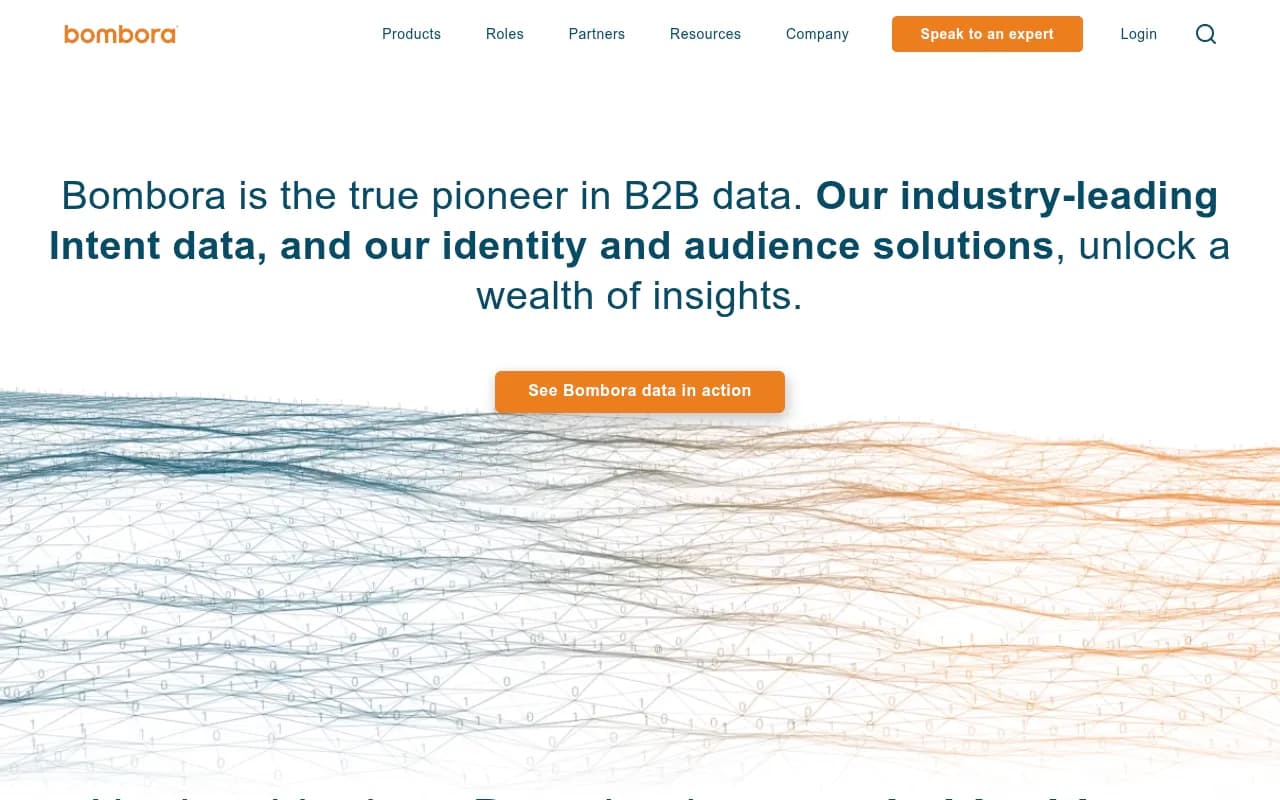
Bombora is the leading B2B intent data provider, offering Company Surge® intent signals, identity resolution, digital audience targeting, and campaign measurement. Built on an exclusive Data Co-op of 18,000+ intent topics from thousands of B2B publishers.
Key takeaways
- Company Surge® is the flagship product: Bombora's intent data identifies which companies are actively researching topics relevant to your product, letting sales and marketing teams prioritize outreach at the right moment.
- Data Co-op model is genuinely differentiated: 86% of the data in Bombora's Co-op is shared exclusively with Bombora, meaning competitors can't buy the same signals elsewhere.
- Bombora is a data provider, not a platform: It plugs into your existing CRM, MAP, and ad tools rather than replacing them -- which is a strength for tech-stack-heavy teams but a limitation if you want a self-contained workspace.
- Pricing is enterprise-grade and opaque: No public pricing; expect onboarding fees of $5,000-$20,000+ and annual contracts. Not a fit for small teams or startups.
- Best for mid-market to enterprise B2B companies running account-based marketing (ABM), demand generation, or sales development programs at scale.
Bombora is a B2B data company founded in 2014, headquartered in New York. It was built around a single insight: the best signal that a company is about to buy something is the content its employees are consuming right now. If a team at a target account is suddenly reading a lot of articles about "cloud security" or "HR software," that's a buying signal -- and Bombora captures it before the prospect ever fills out a form or talks to a sales rep.
The company's core product, Company Surge®, aggregates content consumption data from thousands of B2B publishers and media sites, then surfaces which companies are showing elevated interest in specific topics. That data feeds into sales prioritization, marketing campaigns, and ad targeting. Bombora has since expanded into identity resolution, digital audience building, and campaign measurement, making it a broader B2B data infrastructure play rather than a single-point solution.
The target audience is squarely enterprise and mid-market B2B: demand generation teams, ABM practitioners, sales development leaders, and revenue operations professionals at companies selling complex, high-value products. Clients include FedEx, Box, JLL, and TriNet. This is not a tool for a 10-person SaaS startup trying to find its first customers.
Key features
Company Surge® intent data
This is the product Bombora built its reputation on. Company Surge® scores companies on a scale based on how much their content consumption around a given topic has spiked above their baseline. A company reading 3x more content than usual about "endpoint security" is a very different prospect than one reading the same amount as always.
- Covers 18,000+ intent topics across B2B categories
- Scores are updated weekly, giving sales teams a rolling view of which accounts are heating up
- Signals can be filtered by topic cluster, industry, company size, and geography
- Designed to feed directly into CRM workflows (Salesforce, HubSpot) and sales engagement platforms (Outreach, Salesloft)
The key differentiator here is the Data Co-op. Bombora aggregates content consumption from thousands of B2B publishers -- think industry trade sites, professional media, and brand content hubs -- rather than scraping public web data or relying on keyword searches. 86% of that data is exclusive to Bombora, which means you're seeing signals that G2 Buyer Intent or TechTarget's Priority Engine can't replicate.
B2B Data Co-op
The Co-op is the infrastructure behind everything Bombora does. It's a consortium of thousands of B2B publishers, brand sites, and data providers who share anonymized content consumption data with Bombora in exchange for access to the resulting insights.
- 1,743 new B2B sources were added in 2024 alone
- The Co-op covers billions of consumption events analyzed every month
- Publishers benefit from audience insights; Bombora benefits from exclusive data access
- This model creates a network effect that's genuinely hard for competitors to replicate quickly
Identity resolution and enrichment
Beyond intent, Bombora helps companies identify and enrich anonymous website visitors. If someone lands on your site without filling out a form, Bombora can match them to a company record and layer in firmographic and intent data.
- Captures and activates first-party data
- Identifies anonymous site visitors at the company level
- Enriches visitor profiles with intent signals and firmographic attributes
- Feeds into marketing automation platforms for better segmentation
- Supports real-time campaign personalization based on visitor identity
Premium B2B digital audiences
Bombora packages its intent and identity data into audience segments that can be activated directly on ad platforms.
- Hundreds of prebuilt audience segments available out of the box
- Custom audience building based on Company Surge® intent signals or ABM target lists
- Omnichannel activation across LinkedIn, programmatic display, and other major ad platforms
- Particularly useful for teams running LinkedIn campaigns -- Hushly reported a 2x cost reduction using Bombora audiences on LinkedIn
Insights suite
A campaign measurement and analytics layer that sits on top of Bombora's data products.
- Measures digital advertising and campaign performance against intent signals
- Tracks website traffic and visitor engagement
- Visualizes buyer journey data and competitive performance
- Unites intent data, website visitor data, and engagement data in a single view
- Useful for revenue operations teams trying to connect top-of-funnel signals to pipeline outcomes
Market intelligence and competitive intelligence
Bombora's intent data can be used for more than just sales prioritization. It also surfaces market-level trends.
- Total addressable market (TAM) definition using intent signals
- Brand health monitoring based on topic consumption trends
- Competitive intelligence: see which topics your competitors' prospects are researching
- Buyer journey mapping based on content consumption patterns over time
Personalization signals
Intent data doesn't just tell you who to target -- it tells you what to say. Bombora surfaces the specific topics a target account is most interested in, which can inform:
- Campaign messaging and creative
- Sales outreach customization (Kazoo reported 2-3x reply rates using Bombora-informed outreach)
- Website personalization for known visitors
- Chatbot personalization based on visitor intent signals
Who is it for
Bombora's sweet spot is B2B companies with a defined ICP (ideal customer profile), a meaningful deal size, and a sales cycle long enough that knowing when a prospect is "in-market" actually matters. Think SaaS companies selling to enterprise IT buyers, financial services firms targeting CFOs, or HR tech vendors trying to reach CHROs. If your average deal is $50K+ and your sales cycle is 3-12 months, intent data can meaningfully change which accounts your team prioritizes.
Demand generation and ABM teams at mid-market and enterprise companies are the primary users. These are teams running account lists of hundreds or thousands of target accounts and trying to figure out which ones to activate now versus nurture. Bombora's weekly Surge scores give them a data-driven answer instead of relying on gut feel or recency bias in the CRM.
Sales development teams are a close second. SDRs using Bombora can prioritize outreach to accounts showing elevated intent rather than working through a static list alphabetically. The Kazoo case study (2-3x reply rates) is a good illustration of what this looks like in practice.
Who should not use Bombora: small B2B companies without a dedicated marketing or RevOps function, B2C companies (Bombora is explicitly B2B-only), and anyone looking for a self-contained platform. Bombora is data infrastructure -- it requires integration with your existing stack to deliver value. If you don't have Salesforce, HubSpot, or a marketing automation platform already in place, you'll struggle to operationalize the data.
Integrations and ecosystem
Bombora's positioning as "a data company, not a platform" means integrations are central to how it delivers value. The data is designed to flow into the tools your team already uses.
- CRM: Salesforce (native integration), HubSpot
- Sales engagement: Outreach, Salesloft
- Marketing automation: Marketo, Pardot, Eloqua, HubSpot
- Ad platforms: LinkedIn, programmatic DSPs, Google
- ABM platforms: Demandbase, 6sense, Terminus (Bombora data powers intent signals in several of these)
- Data enrichment: Integrates with enrichment workflows via API
The API is available for enterprise customers who want to build custom workflows or pull Bombora data into proprietary systems. This is common among larger organizations with data engineering teams.
Bombora does not have a native mobile app or browser extension -- it's a data layer, not a user-facing application. Most users interact with Bombora data through their CRM or marketing automation platform rather than through a Bombora interface directly.
Pricing and value
Bombora does not publish pricing. Based on third-party sources, onboarding fees alone range from $5,000 to $20,000+, and annual contracts are the norm. This is enterprise software pricing, full stop.
The lack of transparent pricing is a real friction point for teams evaluating the tool. You'll need to go through a demo and sales process before getting a number. That said, the ROI case is reasonably concrete: Cloudera reported a 50% decrease in cost per lead, and Hushly cut LinkedIn ad costs in half while improving performance. If those outcomes are even half-true for your use case, the math can work out.
There is no free tier and no self-serve trial. Bombora is not competing for the SMB market.
Compared to alternatives like TechTarget Priority Engine or G2 Buyer Intent, Bombora's Co-op model gives it a broader data footprint. 6sense and Demandbase bundle intent data into their ABM platforms, but they also use Bombora data as an input -- which tells you something about where Bombora sits in the ecosystem.
Strengths and limitations
What Bombora does well:
- The Data Co-op is a genuine moat. 86% exclusive data means the intent signals are not available from other providers, and the Co-op has been growing (1,743 new sources in 2024).
- 18,000+ intent topics is a large coverage area. Most competitors offer far fewer topics, which limits how precisely you can match signals to your specific product category.
- The ecosystem integrations are mature. Bombora data flows cleanly into Salesforce, Marketo, LinkedIn, and most major ABM platforms. It's been doing this long enough that the integrations are reliable.
- Proven enterprise outcomes. The case studies (Cloudera, Hushly, Kazoo) are specific and credible, not vague percentage claims.
Honest limitations:
- No self-serve access and no transparent pricing. Evaluating Bombora requires a sales conversation, which adds friction and time to the buying process.
- It's a data layer, not a workflow tool. Teams without a mature RevOps function or existing CRM/MAP infrastructure will struggle to operationalize the data. The value is real, but it requires setup.
- Intent data has inherent limitations. Company-level signals don't tell you which individual at the company is researching a topic, and elevated content consumption doesn't always translate to active buying intent. False positives are a real thing, and sales teams need to be trained not to treat every Surge score as a hot lead.
- Pricing is enterprise-only. There's no path for smaller B2B companies to access Bombora data without a significant financial commitment.
Bottom line
Bombora is the right choice for mid-market and enterprise B2B companies that have an ABM or demand generation program in place and want to prioritize accounts based on real buying signals rather than firmographic data alone. The Data Co-op gives it a data advantage that's hard to replicate, and the integrations with Salesforce, Marketo, and LinkedIn make it operationally practical for teams already running those tools.
Best use case: A B2B SaaS company with a $50K+ ACV selling to enterprise accounts, using Salesforce and Marketo, that wants to tell its SDR team which of its 2,000 target accounts to call this week.
Tags:
Frequently asked questions
What is Bombora?
What is the Bombora Data Co-op?
How much does Bombora cost?
What tools does Bombora integrate with?
Who should use Bombora?
How does Bombora compare to 6sense or Demandbase?
Similar and alternative tools to Bombora