RollWorks Review 2026
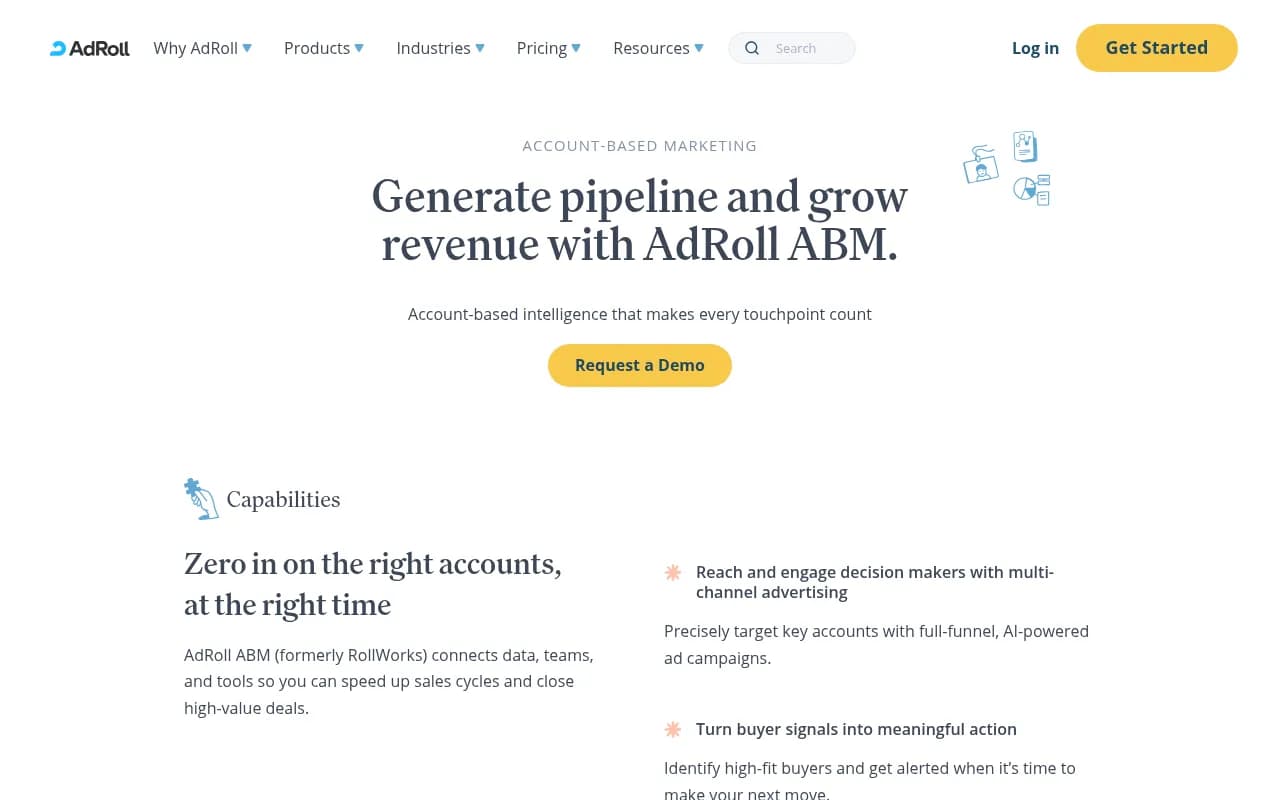
AdRoll ABM (formerly RollWorks) is a B2B account-based marketing platform combining AI-powered buyer intent data, multi-channel advertising, and CRM integrations to help marketing and sales teams identify, target, and convert high-value accounts.
Key takeaways
- AdRoll ABM (formerly RollWorks) is a solid all-in-one ABM platform for B2B teams that want buyer intent data and multi-channel advertising in a single tool
- Built on a database of 2.6 billion digital identities and 92 million contacts, the intent engine is genuinely one of the stronger data assets in the mid-market ABM space
- Pricing is not publicly listed, which makes it harder to evaluate without a sales conversation
- Best suited to mid-market B2B companies with dedicated marketing and sales teams; less ideal for very small teams or solo marketers
- Lacks AI search visibility features -- if your goal is to appear in ChatGPT, Perplexity, or Google AI Overviews, this tool won't help you there
RollWorks launched in 2018 as a standalone ABM product under NextRoll, Inc. -- the same parent company behind AdRoll, the well-known retargeting and display advertising platform. In 2024, NextRoll folded RollWorks into AdRoll under the unified brand "AdRoll ABM," consolidating the two products into a single application. The rebrand makes sense: RollWorks was always strongest when paired with AdRoll's advertising infrastructure, and the merger removes the friction of managing two separate platforms.
The core problem AdRoll ABM solves is one that plagues most B2B marketing teams: you know roughly who your ideal customers are, but you don't know which of them are actually in-market right now, and you're running campaigns that spray budget across accounts that aren't ready to buy. AdRoll ABM tries to fix this by combining a buyer intent and account intelligence layer with a demand-side platform (DSP) for multi-channel ad delivery. The pitch is that you can identify the right accounts, understand where they are in the buying journey, and then reach them with coordinated advertising across display, social, and streaming -- all from one place.
The target audience is B2B marketing teams at mid-market companies, typically in SaaS, financial services, or professional services, where deal sizes justify account-based approaches. Think a 10-50 person marketing org at a company doing $20M-$500M in revenue, running coordinated plays with an SDR or sales team. Snowflake is the flagship case study -- they reportedly achieved a 50% new opportunity rate with existing customers targeted via ABM, and a 75% increase in SDR-booked meetings. PitchBook cut CPC by 37.9% and accelerated their sales cycle by 14.9%. These are real, specific numbers, which is more than most ABM vendors offer.
Key features
Buyer intent and account intelligence (InIQ)
The platform's AI buyer insight engine, branded InIQ, is built on 2.6 billion digital identities and 92 million contacts. It surfaces accounts showing purchase intent signals, defines your ideal customer profile (ICP), and identifies "unknown" target accounts -- companies that fit your ICP but aren't yet in your CRM. In practice, this means you can upload your existing customer list, let InIQ model it, and get back a list of lookalike accounts that are actively researching solutions like yours. The quality of this data is one of the stronger differentiators in the mid-market ABM space, where most competitors either license third-party intent data (Bombora, G2) or build thin proprietary signals.
ABM Command Center
This is the operational hub of the platform. It tracks buyer signals in real time and surfaces recommended next actions: add a contact to your CRM, build a new account list, push a priority list to sales. The idea is to reduce the gap between "we see a signal" and "sales acts on it." For teams that struggle with marketing-to-sales handoff, this is genuinely useful. The Command Center also handles list management, letting you segment accounts by fit score, intent level, and funnel stage.
Multi-channel advertising (BidIQ)
AdRoll ABM's DSP, powered by BidIQ (a registered trademark of NextRoll), handles ad delivery across display, social media, connected TV, and streaming audio. You can run full-funnel campaigns that serve different creative to accounts at different stages -- awareness ads for cold accounts, retargeting for engaged ones. The integration with AdRoll's existing advertising infrastructure is a real advantage here: NextRoll has been running programmatic advertising since 2007, so the bidding algorithms and publisher relationships are mature. Competitors like Demandbase and 6sense have their own DSPs, but AdRoll's advertising heritage gives it a credible claim to ad performance.
ICP definition and account scoring
The platform lets you define your ICP using firmographic filters (industry, company size, revenue, geography) and then layers on behavioral and intent signals to score accounts. Fit scores and intent scores are separate, which is the right approach -- a high-fit account that isn't showing intent is a different play than a lower-fit account that's actively researching. You can use these scores to prioritize outreach, set bid adjustments, or trigger automated workflows.
CRM and data platform integrations
AdRoll ABM integrates with Salesforce, HubSpot, and other major CRMs to sync account and contact data bidirectionally. This means account scores and intent signals can flow into your CRM for sales visibility, and CRM data (deal stage, account owner, opportunity value) can flow back to inform campaign targeting. The platform also connects to data platforms like Snowflake (fitting, given the case study) for teams that want to pipe ABM data into their broader data stack.
Analytics and revenue attribution
The reporting layer ties campaign activity to pipeline and revenue, not just clicks and impressions. You can see which accounts moved from target to opportunity to closed-won, and attribute that movement to specific ABM touchpoints. The platform claims to create an average of 16% more opportunities for customers. Attribution in ABM is notoriously hard to do well -- most platforms either over-credit their own touchpoints or rely on last-touch models that miss the full picture. AdRoll ABM uses a multi-touch model, though the specifics of the attribution logic aren't fully transparent in public documentation.
Automated workflows and plays
The platform supports automated "plays" -- sequences of actions triggered by account behavior. For example: when an account's intent score crosses a threshold, automatically add them to a retargeting campaign and alert the assigned SDR. This kind of automation reduces the manual work of running ABM at scale and is particularly valuable for teams that don't have a dedicated ABM operations person.
Audience segmentation and contact targeting
Beyond account-level targeting, AdRoll ABM can target specific contacts within accounts -- reaching individual decision-makers and buying committee members with personalized ads. Given the 92 million contact database, the coverage is reasonably broad for North American B2B audiences. International coverage is thinner, which is worth noting for teams with significant EMEA or APAC pipeline.
Who is it for
AdRoll ABM fits best with B2B marketing teams at mid-market companies that have a defined ICP, a sales team to hand off to, and enough deal volume to justify account-based investment. The sweet spot is probably a company with 100-2,000 employees, an ACV of $15K-$200K, and a marketing team of at least 3-5 people. If you're a solo marketer or a very early-stage startup, the platform's complexity and cost will likely outweigh the benefits.
SaaS companies are the most obvious fit -- the case studies (Snowflake, PitchBook, Total Expert) are all software companies with complex, multi-stakeholder sales cycles. Financial services and professional services firms with similar deal dynamics are also good candidates. The platform is less suited to transactional B2B businesses with short sales cycles, where the overhead of ABM infrastructure doesn't pay off.
Teams that already use AdRoll for B2C or ecommerce retargeting and are expanding into B2B will find the transition relatively smooth, since the advertising infrastructure is shared. Teams coming from a pure intent data tool like Bombora or a pure ABM platform like Terminus may find the advertising capabilities more mature than what they're used to, but the intent data depth comparable.
Who should probably look elsewhere: very small teams (under 3 marketers) who need something simpler, companies with primarily SMB target accounts where ABM economics don't work, and international-first companies where the contact database coverage is weaker.
Integrations and ecosystem
AdRoll ABM's integration list covers the major bases for B2B marketing stacks:
- CRM: Salesforce, HubSpot (bidirectional sync for accounts, contacts, and opportunities)
- Marketing automation: Marketo, HubSpot Marketing Hub, Pardot
- Data platforms: Snowflake (native integration), and broader data warehouse connectivity
- Sales engagement: integrations with SDR tools to push priority account lists
- Analytics: Google Analytics, and internal reporting dashboards
The platform does not appear to have a public API for custom integrations, which is a limitation for teams with complex data workflows. There's no mention of a Zapier or Make integration, which would be useful for smaller teams without engineering resources.
There's no dedicated mobile app -- the platform is web-based. Browser extensions aren't part of the product. For a platform targeting enterprise and mid-market B2B teams, the absence of a mobile app is not a major gap, but it's worth noting.
Pricing and value
AdRoll ABM does not publish pricing on its website. The ad serving model uses dynamic CPM rather than CPC or CPA, which aligns costs with impressions rather than clicks -- a reasonable approach for brand and awareness campaigns but potentially harder to budget for teams used to performance-based pricing.
Based on third-party sources, RollWorks (now AdRoll ABM) historically offered tiered plans starting around $975/month for the Starter tier, with higher tiers (Standard, Professional, Ultimate) running into several thousand dollars per month. The rebrand to AdRoll ABM may have changed the packaging, and current pricing requires a demo conversation.
For comparison, Demandbase and 6sense both start at similar or higher price points, often $2,000-$5,000+/month for meaningful feature access. Terminus is in a similar range. AdRoll ABM has historically positioned itself as more accessible than the enterprise-tier ABM platforms, which is a reasonable value proposition for mid-market teams.
The lack of transparent pricing is a genuine friction point. If you're evaluating ABM platforms and need to build a business case internally, having to go through a sales demo just to get a number adds time to the process.
Strengths and limitations
What it does well:
- The combination of intent data and advertising in a single platform is genuinely useful -- most teams cobble this together from two or three separate tools
- The 2.6 billion identity graph and 92 million contact database is a real data asset, not just licensed third-party signals
- AdRoll's advertising heritage means the DSP and bidding infrastructure is mature and battle-tested
- The Command Center's recommended next actions reduce the gap between signal and sales action
- Case study results (Snowflake, PitchBook) are specific and credible, not vague percentage claims
Limitations:
- Pricing opacity makes it hard to evaluate without a sales conversation, which slows down the buying process
- International contact coverage is weaker than North American, limiting usefulness for EMEA-heavy pipelines
- No public API documentation found, which constrains custom integrations for technical teams
- The platform doesn't cover AI search visibility -- if your buyers are increasingly finding vendors through ChatGPT or Perplexity, AdRoll ABM has no tools to help you appear in those results. For that, you'd need a separate platform focused on GEO/AEO.
- Attribution methodology isn't fully transparent, which makes it harder to validate the ROI claims independently
Bottom line
AdRoll ABM is a credible, mature option for mid-market B2B teams that want buyer intent data and multi-channel advertising in one place, without paying enterprise-tier prices for Demandbase or 6sense. The advertising infrastructure is genuinely strong, the intent data is proprietary rather than just licensed, and the case studies are specific enough to be believable.
The best use case in one sentence: a 20-100 person B2B SaaS company with a defined ICP, a 3-6 month sales cycle, and a marketing team that needs to coordinate with SDRs on account prioritization and outreach.
Tags:
Frequently asked questions
What is AdRoll ABM (formerly RollWorks)?
Who is AdRoll ABM best suited for?
How much does AdRoll ABM cost?
What makes AdRoll ABM different from competitors like Demandbase or 6sense?
What CRM and marketing tools does AdRoll ABM integrate with?
Is there a free trial for AdRoll ABM?
Similar and alternative tools to RollWorks