Cognism Review 2026
B2B sales intelligence tool providing verified contact data, intent signals, and compliance-ready prospecting capabilities for revenue teams.
Summary
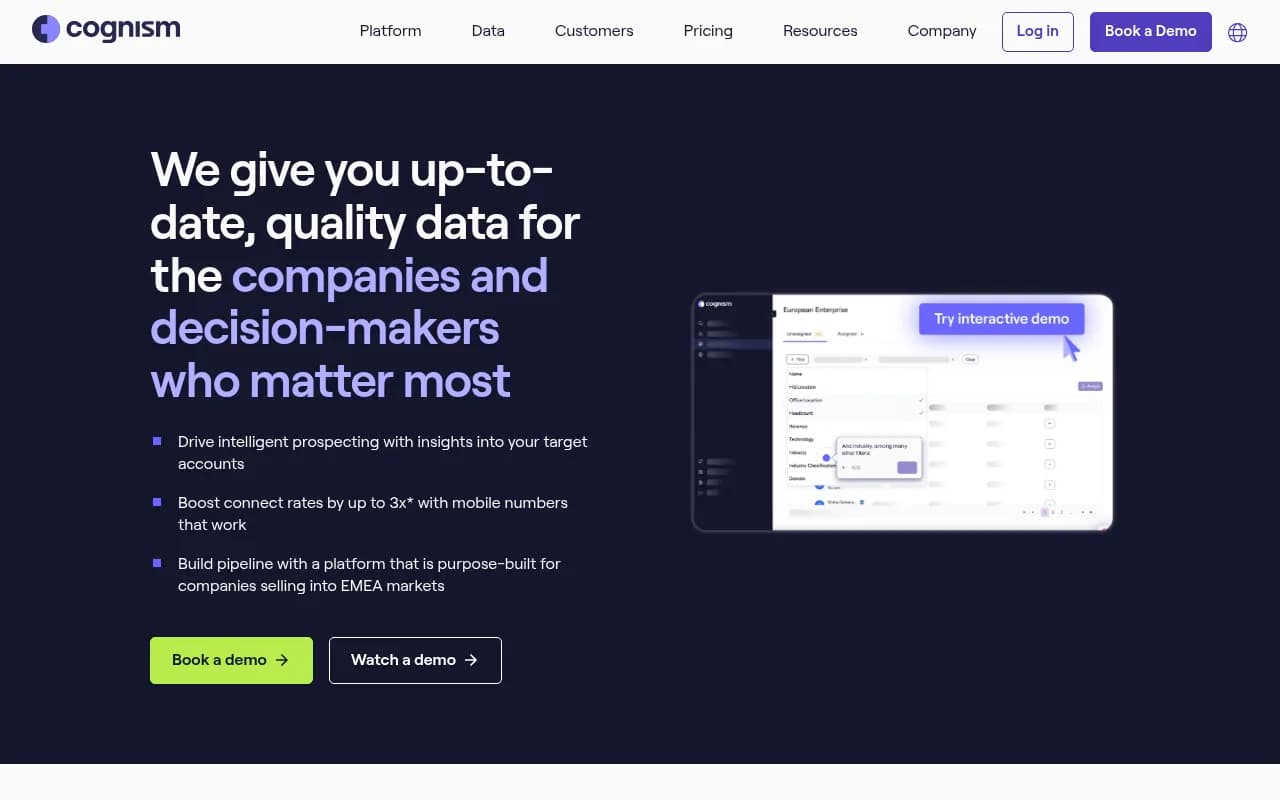
Cognism is a B2B sales intelligence platform built around one core promise: verified contact data that actually connects you to decision-makers. Founded in the UK, it has become the go-to data provider for companies selling into European markets, with 4,000+ customers including American Express, Gartner, KPMG, Notion, and Monday.com. The platform's standout feature is Diamond Data® -- phone numbers that are manually tested and verified by a human team before they reach your CRM. This isn't scraped data or algorithmic guesses. It's a verification process that results in connect rates up to 3x higher than competitors, according to the company's claims.
Cognism competes directly with ZoomInfo, Apollo.io, Lusha, and RocketReach, but positions itself as the superior choice for EMEA coverage and data compliance. Where ZoomInfo dominates North America, Cognism owns Europe. Where Apollo offers cheap credits, Cognism offers quality. The trade-off: Cognism is more expensive and requires custom pricing, which means it's aimed at mid-market and enterprise sales teams, not solo founders or small startups.
The platform launched in 2015 and has raised over $87 million in funding. It's headquartered in London with offices across Europe and the US. In 2026, it continues to expand its US coverage while maintaining its European strength.
Who Cognism is for
Cognism is built for B2B sales teams selling into Europe or targeting VP-level and C-suite decision-makers. If you're an SDR team at a SaaS company prospecting into the UK, Germany, France, or Nordics, this is the platform you evaluate first. If you're a revenue operations leader managing Salesforce data quality for a 50-person sales org, Cognism solves the "bad phone number" problem that kills productivity.
Specific personas who benefit most: SDRs and BDRs at tech companies with 20-200 employees, sales leaders at agencies prospecting into enterprise accounts, RevOps teams responsible for CRM hygiene and data enrichment, and marketing teams running ABM campaigns into EMEA markets. Cognism is particularly strong for companies in fintech, cybersecurity, martech, and professional services -- industries where reaching senior decision-makers is critical and compliance matters.
Who should NOT use Cognism: Solo founders or small teams (under 10 people) who need cheap per-contact pricing. Cognism doesn't publish pricing and requires demos, which signals it's not built for self-serve buyers. If you're prospecting primarily into the US and don't need European coverage, ZoomInfo or Apollo might be better fits. If you're doing high-volume, low-touch outreach where data accuracy matters less than volume, Cognism's premium pricing won't make sense.
Diamond Data® -- the core differentiator
Cognism's flagship feature is Diamond Data®, a phone verification process where human researchers manually test mobile numbers before they're added to the database. This is the opposite of how most competitors work. ZoomInfo, Apollo, and Lusha rely on algorithms and crowdsourced data to infer phone numbers. Cognism's team actually calls the numbers to confirm they're correct and belong to the right person.
The result: higher connect rates and fewer wasted dials. In case studies, customers report 300% increases in weekly dials (SingleStore), 50% increases in team performance (Lead Forensics), and significantly better data accuracy than ZoomInfo (User Evidence). The trade-off is coverage -- Cognism has fewer total contacts than ZoomInfo, but the contacts it does have are more reliable. For sales teams where time is money, this matters. An SDR making 80 dials a day with a 5% connect rate books 4 meetings. With a 15% connect rate (3x improvement), they book 12 meetings. That's the Diamond Data® pitch.
Diamond Data® is available for UK, US, and select European markets. Coverage is strongest in the UK, Germany, France, and Nordics. It's weaker in Southern Europe and emerging markets.
Sales Companion -- the prospecting interface
Sales Companion is Cognism's main user interface, a Chrome extension and web app that overlays contact data on LinkedIn, company websites, and your CRM. It works like this: you're browsing a prospect's LinkedIn profile, click the Cognism extension, and instantly see their verified mobile number, email, and recent company signals (funding, hiring, tech stack changes). You can export the contact directly to Salesforce, HubSpot, or Pipedrive with one click.
Key features within Sales Companion:
Recommended contacts: AI-powered suggestions for who to reach out to next based on your ICP, past successful outreach, and account signals. If you just closed a deal with a VP of Sales at a Series B SaaS company, Cognism will surface similar profiles at similar companies.
Signal data: Real-time alerts for hiring trends, funding rounds, leadership changes, and technology adoption. This is intent data without the "intent data" label -- it's behavioral signals that indicate a company might be in-market. For example, if a company just hired a Head of Revenue Operations, that's a signal they're scaling and might need your sales enablement tool.
One-click business summaries: AI-generated company overviews that pull in firmographic data, recent news, and key decision-makers. Saves you 10 minutes of research per account.
Persona builder: Define your ICP once (job titles, seniority, company size, industry, location) and Cognism will auto-populate lists of matching contacts. This is particularly useful for agencies managing multiple client ICPs.
Sales Companion integrates natively with Salesforce, HubSpot, Pipedrive, Outreach, Salesloft, and most major sales tools. The Chrome extension works on LinkedIn Sales Navigator, company websites, and Crunchbase. There's also a mobile app for iOS and Android, though most users stick to desktop.
Data-as-a-Service -- for RevOps and data teams
Data-as-a-Service (DaaS) is Cognism's enterprise offering for teams that want to enrich their CRM or data warehouse at scale. Instead of SDRs manually exporting contacts one by one, DaaS delivers bulk data via API or scheduled batch uploads. This is for RevOps teams managing Salesforce hygiene, marketing ops teams enriching Marketo records, or data teams building custom scoring models in Snowflake.
Two delivery methods:
Real-time API enrichment: Send Cognism a company domain or LinkedIn URL, get back verified contact data in milliseconds. Use this to enrich form fills, inbound leads, or CRM records as they're created.
Scheduled batch deliveries: Upload a CSV of target accounts, Cognism enriches it with contact data and signals, then delivers the file to your S3 bucket, Snowflake instance, or SFTP server. Run this weekly or monthly to keep your CRM fresh.
DaaS includes professional services support for custom integrations, data mapping, and compliance advisory. This is important because GDPR and CCPA compliance is complex -- Cognism's team helps you structure data flows to stay audit-ready. All data includes metadata showing when it was verified, which Do-Not-Call lists were checked, and whether consent was obtained.
DaaS pricing is custom and based on volume. Expect to pay $30,000-$100,000+ annually depending on contact volume and API call limits.
Signal data and intent intelligence
Cognism's signal data tracks hiring trends, funding rounds, leadership changes, and technology adoption across your target accounts. This is similar to Bombora's intent data or 6sense's account intelligence, but Cognism focuses on observable signals (job postings, press releases, LinkedIn updates) rather than content consumption patterns.
Specific signals tracked:
Hiring signals: New job postings, headcount growth, department expansions. If a company posts 5 sales roles in one month, they're scaling and might need your sales tool.
Funding signals: Series A/B/C rounds, acquisitions, IPO filings. Newly funded companies have budget and urgency.
Leadership signals: New C-suite hires, VP promotions, board appointments. New leaders bring new priorities and budgets.
Technology signals: New software adoptions, tech stack changes, domain migrations. If a company just adopted Salesforce, they might need Salesforce consulting or integrations.
Signals are surfaced in Sales Companion as real-time alerts and in the web app as filterable lists. You can set up saved searches like "Series B SaaS companies in the UK that hired a VP of Marketing in the last 30 days" and get a list of 50 accounts with contact data for the new VP.
Signal data is included in Professional and Business plans. It's not available on the entry-level Essentials plan.
Compliance and data privacy
Cognism is GDPR-compliant and checks more Do-Not-Call (DNC) lists than any competitor, according to the company. This matters if you're prospecting into Europe, where GDPR fines can reach 4% of global revenue. Cognism's data includes metadata showing which DNC lists were checked, when the data was last verified, and whether the contact opted in or out of marketing communications.
For US customers, Cognism is CCPA-compliant and provides audit trails for data sourcing. This is important for enterprise buyers with legal and compliance teams that scrutinize vendor contracts.
Cognism's data sourcing is a mix of public sources (LinkedIn, company websites, press releases), partnerships with data providers, and proprietary verification. The company doesn't disclose exact sourcing methods, but claims all data is legally obtained and compliant with local privacy laws.
Integrations and ecosystem
Cognism integrates natively with Salesforce, HubSpot, Pipedrive, Outreach, Salesloft, Groove, Apollo, and most major CRMs and sales engagement platforms. The Chrome extension works on LinkedIn Sales Navigator, company websites, Crunchbase, and AngelList. There's also a Zapier integration for connecting to 5,000+ apps.
API access is available on Professional and Business plans. The API supports contact lookup, company enrichment, and signal data queries. Documentation is available at developers.cognism.com. Rate limits and pricing vary by plan.
Cognism does not offer a public data export feature -- you can't bulk download your entire database as a CSV. This is intentional to prevent data reselling and maintain compliance. Contacts are exported one by one or via API.
Pricing and value
Cognism does not publish pricing on its website. You must book a demo to get a quote. Based on third-party sources and user reports, pricing is structured in three tiers:
Essentials: $960/user/year ($80/month). Email-only data, 125 lookups per user per month. No Diamond Data®, no signal data, no API access. This is the entry tier for small teams that only need emails.
Professional: $1,800-$3,000/user/year ($150-$250/month). Includes Diamond Data® mobile numbers, signal data, AI crawler logs, and state/city-level tracking. 150-300 lookups per user per month. This is the most popular tier for mid-market sales teams.
Business: $6,000+/user/year ($500+/month). Includes everything in Professional plus higher lookup limits (350+ per month), multi-site support, and priority support. For enterprise teams with 50+ users.
Agency and Enterprise plans are custom-priced and include Data-as-a-Service, API access, and dedicated account management. Expect $30,000-$100,000+ annually.
Annual contracts offer discounts (typically 10-20%). There is no free trial, but Cognism offers a 7-day money-back guarantee.
How this compares to competitors: ZoomInfo is similarly priced ($15,000-$30,000/year for a 5-person team). Apollo is cheaper ($49-$149/user/month) but lower data quality. Lusha is cheaper ($39-$99/user/month) but weaker European coverage. RocketReach is cheaper ($80-$150/user/month) but no phone verification.
Cognism's value proposition: you pay more, but you waste less time on bad data. If an SDR makes $60,000/year and spends 20% of their time dialing wrong numbers, that's $12,000 in wasted salary. Cognism's premium pricing pays for itself if it saves even 10% of that time.
Strengths
European coverage: Cognism has the best EMEA contact data of any provider. If you're prospecting into the UK, Germany, France, or Nordics, this is the platform to use. ZoomInfo's European data is weak by comparison.
Phone verification: Diamond Data® is a real differentiator. Manually verified mobile numbers result in higher connect rates and fewer wasted dials. This matters for high-touch sales where every conversation counts.
Compliance: GDPR and CCPA compliance is built in, with audit trails and DNC list checking. This is critical for enterprise buyers and regulated industries.
Signal data: Hiring, funding, and leadership signals are actionable and well-integrated into the prospecting workflow. Better than Bombora's intent data for European markets.
CRM integrations: Native Salesforce and HubSpot integrations are seamless. One-click export saves time and reduces manual data entry.
Limitations
Pricing transparency: No public pricing is frustrating. You must sit through a demo to get a quote, which adds friction for buyers who want to self-serve.
US coverage: While improving, Cognism's US data is still weaker than ZoomInfo's. If you're prospecting primarily into North America, ZoomInfo might be a better fit.
Lookup limits: Even on the Business plan, you're capped at 350 lookups per user per month. High-volume prospectors will hit this limit quickly. ZoomInfo and Apollo offer higher or unlimited lookups.
No free trial: The 7-day money-back guarantee is better than nothing, but a 14-day free trial would reduce buyer risk.
Limited self-serve: Cognism is built for sales teams with managers and processes. Solo founders or small teams that want cheap, self-serve access won't find it here.
Bottom line
Cognism is the best B2B contact data platform for companies selling into Europe. If you're a mid-market or enterprise sales team prospecting into the UK, Germany, France, or Nordics, and you need verified mobile numbers for VP-level and C-suite decision-makers, Cognism is worth the premium pricing. The phone verification process is real, the EMEA coverage is unmatched, and the compliance features are critical for regulated industries.
Best use case in one sentence: Mid-market B2B sales teams (20-200 people) prospecting into European enterprise accounts where reaching senior decision-makers on the phone is critical to closing deals.
If you're prospecting primarily into the US, consider ZoomInfo. If you need cheap, high-volume data, consider Apollo. If you're a solo founder or small team, consider Lusha or RocketReach. But if Europe is your market and quality matters more than cost, Cognism is the platform to buy.
Tags:
Similar and alternative tools to Cognism