Key takeaways
- Brand-specific prompts ("is Asana good for small teams") pull from a much narrower set of sources than organic prompts, so competitor results on them are skewed.
- Track competitors on organic and comparison prompts first. Keep brand prompts in a separate bucket and never blend them into one score.
- ChatGPT does not have rankings. Measure mention rate, position in the answer, cited URLs and which brands appear next to each other, across many prompts and repeated runs.
- A single run of a single prompt tells you almost nothing. Freeze your prompt list, run each prompt several times, and log the model and mode.
- Platform behavior can change overnight, so continuous monitoring beats one-off audits.
Why brand prompts mislead you
Say you want to know how strong a competitor is in ChatGPT. The obvious move is to type their name into the box and see what comes back. Do that and you will almost always conclude they are doing great. Of course ChatGPT talks about them. You named them.
That is the trap. A brand prompt tells you what ChatGPT knows about a company once it has been asked about that company. It tells you very little about whether a new buyer who has never heard of them will be pointed their way.
The numbers back this up. According to Promptwatch Data on unique domains per ChatGPT response (Sep 28 to Oct 4, 2026, responses with at least one citation), the source pool changes a lot by prompt type:
| Prompt type | Example | Cite 10+ domains | Cite 3 or fewer |
|---|---|---|---|
| Organic (no brand named) | best project management software for small teams | 52.5% | 4.5% |
| Brand-specific | is Asana good for small teams | 21.3% | 13.8% |
| Competitor comparison | Asana vs Monday.com | 49.1% | not reported |
For brand-specific prompts, 5 domains was the most common count (14.9% of responses), and 40.7% cited 5 or fewer. So when you look at a competitor through a brand prompt, you are looking at a small, skewed set of sources. Often that set leans toward the company's own site and a handful of review pages.
The practical takeaway: brand prompt results are useful for reputation checks and for seeing how ChatGPT describes someone. They are a poor proxy for competitive strength.
ChatGPT has no rankings, so define what you measure
Before building anything, drop the idea of a rank. A brand can sit first on Google and be missing entirely from ChatGPT's answer to the same question. ChatGPT is closer to a reputation engine than a sorted list. Answers also vary from run to run. A SparkToro study from January 2026 ran 12 prompts 60 to 100 times each across ChatGPT, Claude and Google AI and found high inconsistency in which brands were recommended.
So instead of "rank", track these signals:
| Signal | What it answers |
|---|---|
| Mention rate | In what share of runs is the brand named in the answer text? |
| Position in the answer | When the answer lists options, where does the brand land? |
| Cited URLs | Which exact pages get linked, yours and theirs? |
| Mention context | Recommended outright, compared, or mentioned with a caveat? |
| Co-mentioned brands | Who else shows up in the same answers? |
The outcomes combine in useful ways. Named but not cited means ChatGPT knows the brand but leans on other sources. Cited but not named means a page supports the answer while the brand itself is not recommended. Absent means neither, and you should look at who wins that prompt and which sources they rely on.
Step 1: Split your prompt set into three buckets
Write 20 to 100 prompts, phrased as questions a buyer would actually type, not keywords. Then sort them:
- Organic prompts. No brand named. "Best CRM for a 10-person agency." This is your main competitive signal.
- Comparison prompts. "Competitor A vs Competitor B" and "alternatives to Competitor A." These are crowded (about half cite 10 or more domains) and competitor sites often get cited next to yours.
- Brand prompts. One named brand. Keep these in their own report and treat them as a reputation check only.
Then freeze the list. Swapping prompts every month means you are measuring noise rather than change. If you add prompts, add them as a new cohort and do not mix them into the old trend line.
Step 2: Track competitors on organic prompts
This is where the real comparison happens. For each organic prompt, record every brand named in the answer, in order, plus every cited domain. After enough runs you get share of mentions per competitor, which is a much fairer picture than anything a brand prompt can give you.
A few habits make the data cleaner:
- Run each prompt several times. Three to five is the bare minimum for a manual check. The same prompt produces different answers on consecutive runs, and in some tests two answers to an identical prompt shared under a tenth of their sources.
- Run logged out or in a temporary chat so personalization and memory do not leak in.
- Keep the model, search mode and location fixed between runs. Changing any of them breaks comparisons.
- Log citations as carefully as mentions. A brand that is named but never cited is in a different position from one that is cited constantly.
- Save the raw response, not just your notes.
Organic prompts are crowded, so one prompt says little. The Promptwatch report makes the same point: measure across many organic prompts and look at where you appear in the response and how ChatGPT describes you, not only whether you are cited.
Step 3: Use brand prompts for what they are good at
Brand prompts are not useless. They answer different questions:
- How does ChatGPT describe this competitor? Strengths, weaknesses, pricing claims.
- Which sources does ChatGPT lean on when someone is evaluating them directly?
- Is there a sentiment problem or a factual error worth knowing about?
To see which sources ChatGPT relies on for a competitor, run the same kind of prompts for that competitor that you run for yourself. Then compare the source lists. Where a competitor is cited from a third-party review site or Reddit thread and you are not, you have found a gap you can actually act on.
Just label the data. A competitor scoring 100% mention rate on its own brand prompts is not a finding. It is a tautology.
Step 4: Read the source gap, not just the mention gap
The most useful competitor output is usually not who gets named. It is which pages and domains power the answers. Compare, for the same organic prompts:
- Domains cited alongside competitors but never alongside you
- Content types (comparison pages, docs, listicles, product pages) that win
- Third-party profiles, review sites and community threads that mention them
If you want the bigger picture on what ChatGPT tends to cite, Promptwatch's content type citation data shows product pages as the most cited type at 22.4% of citations (Sep 28 to Oct 4, 2026), followed by landing pages and listicles. For software categories specifically, the software citation report has GitHub, Microsoft's docs and G2 leading, with documentation and help centers earning the largest share.
In other words, your competitor's lead may come from a docs site or review profile, not from anything on their marketing pages.
Step 5: Watch for platform shifts that break your baseline
ChatGPT changes how it searches, sometimes overnight. On August 8, 2026, site:-scoped fanout queries jumped from about 0.4% to roughly 17% of all fanout queries, and average searches per response rose from about 1.08 to about 1.83. Fanout mappings built before that date went stale. The site: searches were added on top of generic searches rather than replacing them.
Why this matters for competitor tracking: if your trend line moves on one date for every brand in your set, that is probably the platform and not your competitor's content team. Annotate those dates. Promptwatch's query fanout data also shows fanouts per response sliding from 2.15 in December 2025 to about 1.84 by March 2026, so the retrieval behavior underneath your prompts is not static.
Do it manually first, then pick a tool
For a month, run it by hand. Take 10 to 20 prompts, run each several times in a logged-out session, and log mentions, list positions and cited URLs in a spreadsheet. It is tedious, but you learn which prompts are noisy and what you actually want from a tool.
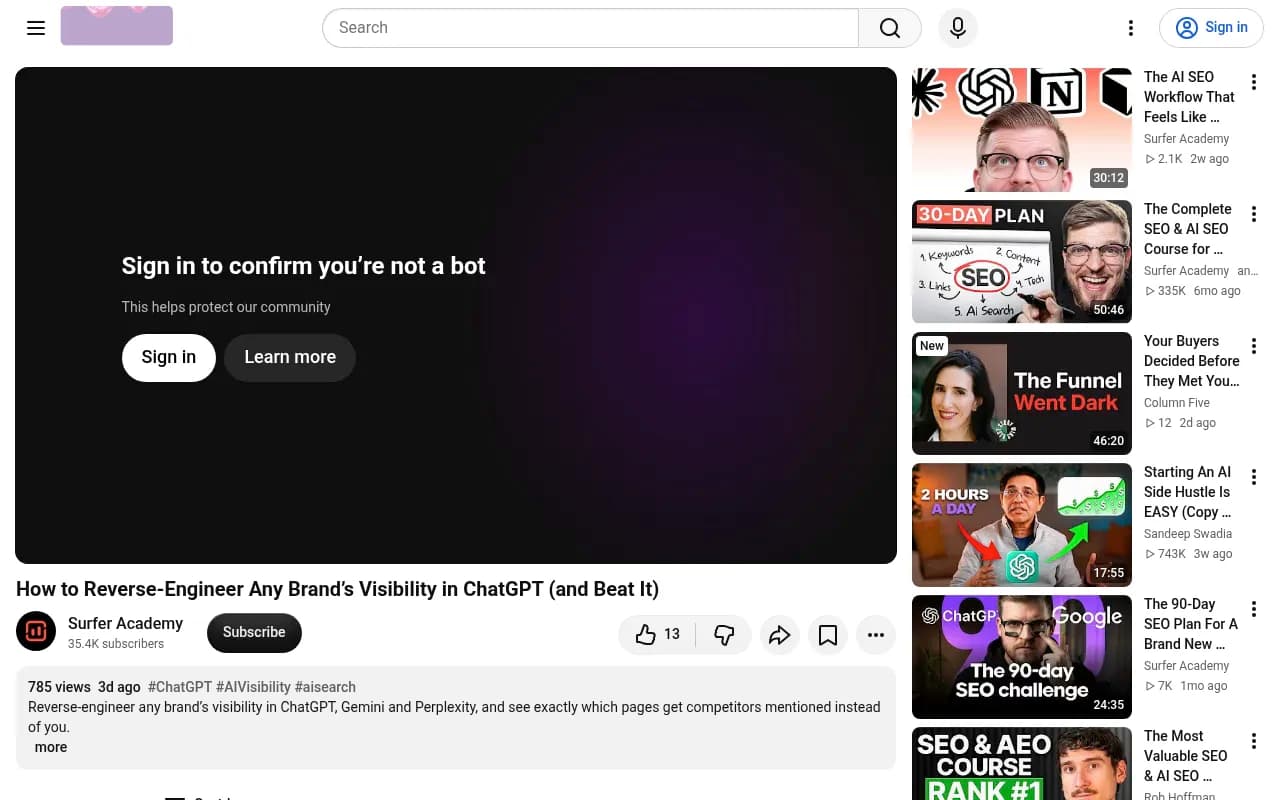
Surfer Academy's walkthrough on reverse-engineering a competitor's AI visibility is a decent companion here. It covers competitor mentions, sources and the mention gap.
Once the manual process hurts, move to a tracker. What to look for:
- Prompt type labels, so brand prompts never get blended into organic scores
- Repeated runs per prompt, not a single draw
- Citation capture with URLs, not only mention counts
- Competitor co-mention reporting
- History, so you can see changes over weeks
Tools worth a look
Promptwatch is the one I would start with if you want more than a dashboard. It monitors the real ChatGPT interface rather than only API output, tags prompts as organic, brand-specific or competitor comparison, and shows query fan-outs, citations and competitor sources side by side. It also covers the next step: content gap analysis and an Action Board for closing the gaps you find.

Otterly.AI is a lighter, lower-cost option for straightforward mention tracking.

Profound is aimed at enterprise teams that want deep monitoring.

Peec AI is monitoring-focused and fine if you only need the tracking half.

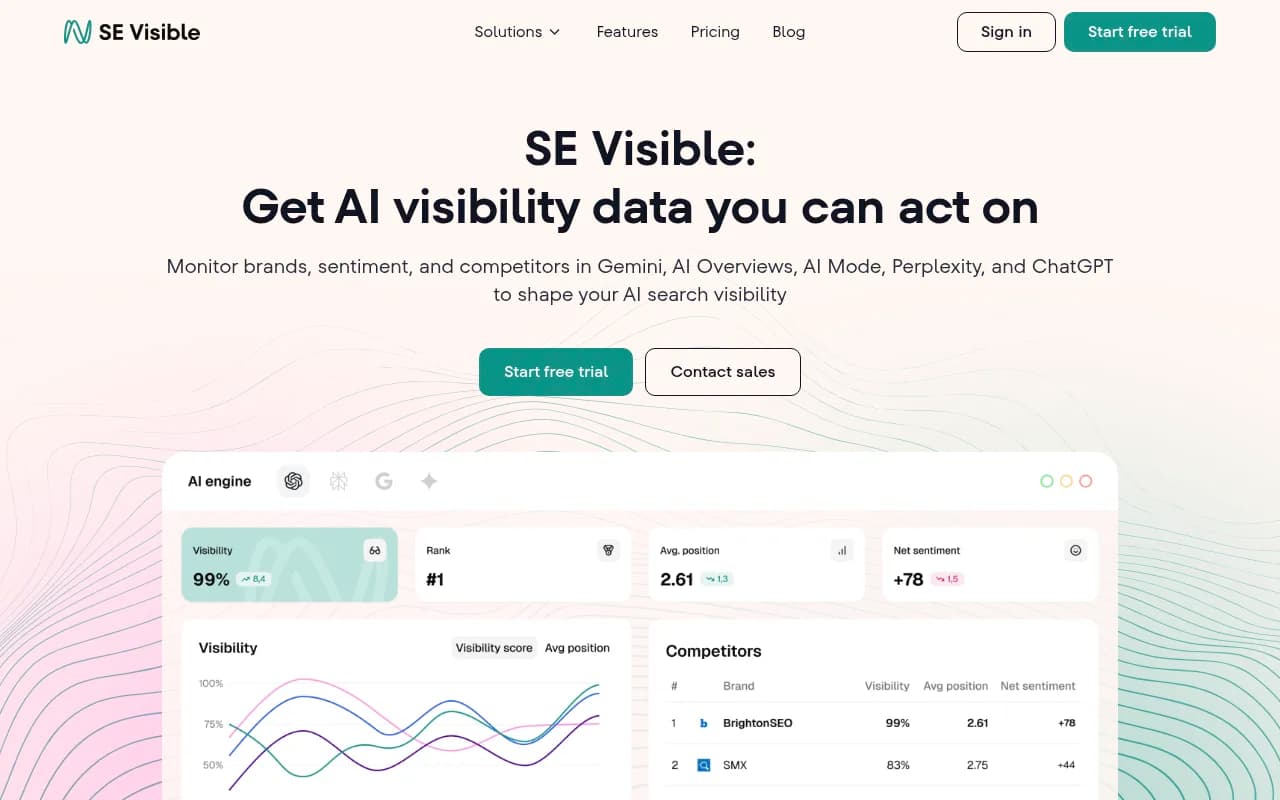
SE Visible, from SE Ranking, suits teams already living in that ecosystem.
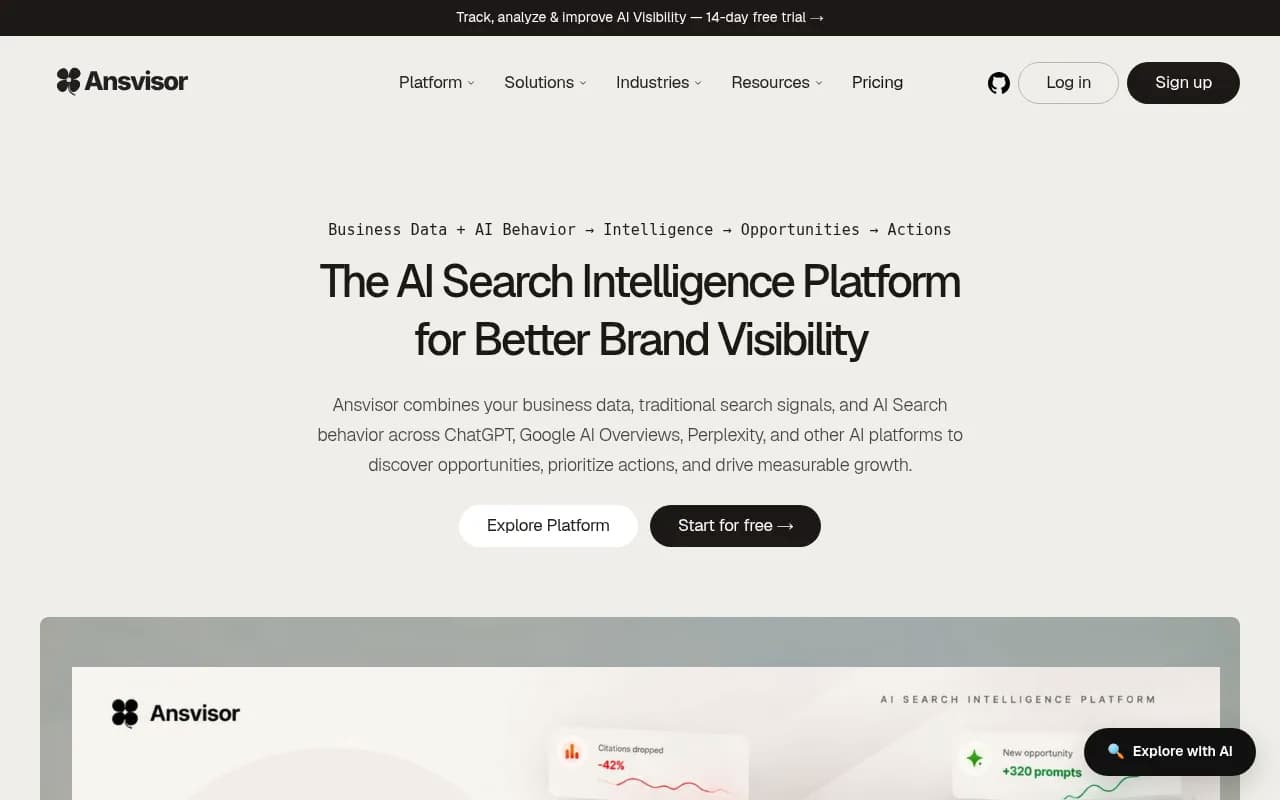
Ansvisor publishes a useful explanation of how ChatGPT rank tracking works and offers an open-source platform.
For a wider shortlist, the AI rank tracking directory and the GEO software directory list dozens more.
| Tool | Strength | Watch out for |
|---|---|---|
| Promptwatch | Real-UI tracking, prompt types, fan-outs, crawler logs, content actions | More to learn than a basic tracker |
| Otterly.AI | Affordable mention tracking | Limited beyond monitoring |
| Profound | Enterprise-grade monitoring | Higher price point |
| Peec AI | Clean monitoring | No optimization layer |
| SE Visible | Fits SE Ranking users | Narrower AI-specific depth |
| Spreadsheet plus manual runs | Free, teaches you the problem | Does not scale past about 20 prompts |
Check current pricing on each vendor's site before deciding, because plans change often.
A simple reporting layout that avoids the trap
Whatever you use, report three separate tables:
- Organic share of mentions per brand, with average position and cited domains. This is your headline.
- Comparison prompts: who gets recommended in head-to-heads, and which sources show up.
- Brand prompts: sentiment and description for you and each competitor, clearly marked as not a strength metric.
Never average the three into one number. The moment you do, the brand prompts (where everyone looks great) will inflate the score and bury the real differences.
Common mistakes
| Mistake | Why it misleads |
|---|---|
| Checking one prompt once | A single answer is one draw from a noisy distribution |
| Tracking only branded prompts | Overstates how often new buyers see a brand |
| Changing model, mode or location between runs | Breaks comparisons |
| Rewriting the prompt list monthly | You measure noise, not change |
| Ignoring citations | Misses the source gap that explains the result |
| Forgetting platform changes | Blames a competitor for something ChatGPT did |
What to do with the results
Once you can see a competitor's real organic visibility, the work is straightforward. Find the prompts where they appear and you do not. Look at which sources ChatGPT cites for those prompts. Then either publish the missing page type, earn coverage on the third-party sites doing the work, or fix crawl and structure problems on your own pages. Re-run the same frozen prompt set after a few weeks and see whether the gap moved.
If you would rather hand off the strategy and execution, an agency such as 1001 SEO Media works on AI search and GEO alongside traditional SEO. Either way, the rule stays the same: do not judge a competitor by what ChatGPT says when you ask about them by name.