Key takeaways
- Surfer SEO is the most literally grounded in search data: its Content Score is built from live NLP analysis of current top-ranking Google pages, and it has a free dedicated WordPress plugin.
- Scalenut matches Surfer's SERP-based optimization but adds AI search tracking (GEO Watchtower) and WordPress auto-publishing from its $89/mo Plus plan.
- WP SEO AI is not a self-serve tool at all. It's a managed service with a proprietary plugin, quote-based pricing, a 12-month minimum commitment, and no trial.
- None of the three grounds its content recommendations in what AI search engines actually cite. ChatGPT cites roughly 5 sources per response and increasingly favors product pages and listicles, per Promptwatch Data.
- If "grounded in search data" now includes AI search, you'll need a dedicated AI visibility platform alongside any of these three.
Every one of these three tools markets itself as data-driven. That word has quietly become meaningless. Surfer grounds its scores in Google's top 10. Scalenut grounds its drafts in the same SERPs plus some AI visibility tracking. WP SEO AI grounds itself in... a sales call, mostly, since you can't even see the price without booking a meeting.
So let's be specific. "Grounded in search data" can mean three different things in 2026: grounded in the classic Google SERP, grounded in what AI search engines actually cite, or grounded in nothing much beyond marketing copy. The gap between those matters more than any feature checklist, because the content formats AI engines reward have shifted hard over the past year. In July 2026, product pages made up roughly a third of ChatGPT Search citations, nearly double their share in March, while listicles kept growing as the fastest-rising format, according to Promptwatch's ChatGPT citation types data. A tool that only scores you against Google's top 10 is optimizing for a shrinking slice of search.
Here's how the three actually compare.
What "grounded in search data" should mean in 2026
For a decade, content tools meant one thing by data: scrape the top 10 Google results for your keyword, run NLP analysis on them, and tell you which terms to include. That's still a legitimate approach. Surfer built its business on it, and it still works for Google rankings.
But AI search changed the inputs. A few numbers worth internalizing before you evaluate any tool's claims:
- ChatGPT cites about 5 sources per web-search-triggered response, and Google AI Overviews cites around 10, per Promptwatch's average sources per response data. Compare that to a classic Google SERP with 10 blue links plus ads plus maps. The citation pool is small, and every slot is contested.
- ChatGPT's query fan-outs have changed shape. Average fanout queries per response fell from 2.15 in early December to exactly 1.0 by April 2026, and query length dropped from ~117 characters to ~53, per Promptwatch's query fanout research. Translation: AI search now runs terse, keyword-like sub-queries, so your headings should front-load entity and category terms, not read as conversational questions.
- Citation shares are volatile. Reddit's share of ChatGPT citations fell from 6.11% in May to 3.71% in June 2026, a ~40% drop in one month, per Promptwatch's ChatGPT citation share report. Any tool that claims a static formula for "what AI likes" is guessing.
With that framework in mind, here are the three contenders.
Surfer SEO: grounded in the Google SERP, deeply and honestly
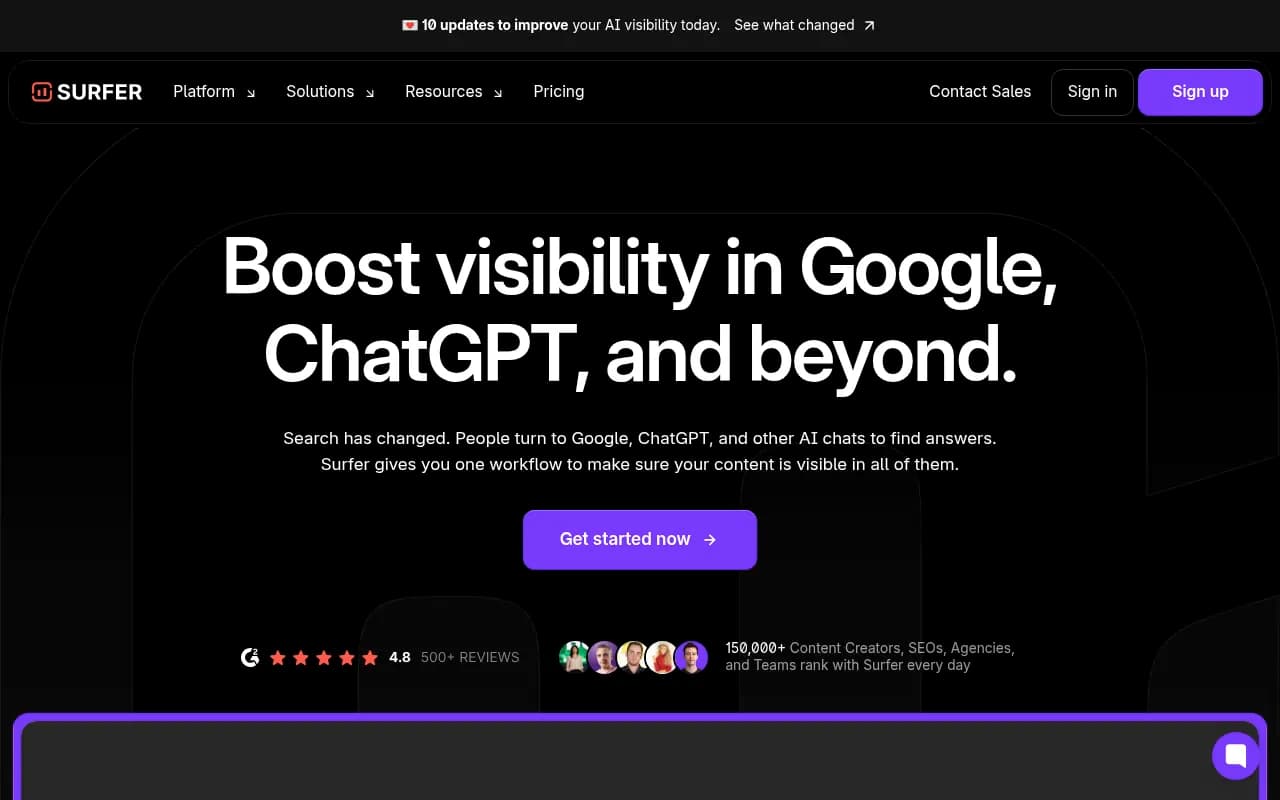
Surfer is the most transparent about what its data actually is. The Content Score evaluates structure, keyword usage, headings, and semantic relevance based on live analysis of what's currently ranking in Google. Its AI writer combines SERP analysis, NLP insights, and OpenAI models to draft articles that reference top-ranking competitors. There's no mystery about the grounding: it's the Google top 10, refreshed continuously.
That's a strength and a limitation. It's a strength because the score means something concrete, and because Surfer's optimization engine has real production history behind it. ClickUp, for instance, used the Content Editor to publish 150+ articles and grew blog traffic 85% in 12 months, per Surfer's own case study. Treat vendor case studies with appropriate skepticism, but that one is at least specific.
It's a limitation because Google's top 10 is no longer the whole search picture. Surfer knows this, which is why its pricing page now reads "Pricing & Plans for teams that want to win AI search — not guess it" and why it sells a separate AI Search Analytics add-on (listed around $158/month billed yearly) for tracking brand visibility across ChatGPT, Gemini, and similar engines. Note the word "add-on": the core plans and the AI visibility tracking are separate purchases. The AI grounding is bolted on, not built in.
For WordPress specifically, Surfer does something neither of the other two matches at this price point: a free, dedicated WordPress plugin listed on wordpress.org. You can edit content inside WordPress, publish directly, and see Google Search Console data without copy-pasting between tabs. If your workflow lives inside wp-admin, this matters more than you'd think.
Pricing runs roughly $99/mo for Essential (15 Content Editor credits) and $219/mo for Scale, with discounts on annual billing. Third-party sources vary slightly on exact figures, so check the live page before budgeting.
Scalenut: SERP grounding plus a genuine attempt at AI search

Scalenut covers the same SERP-and-NLP foundation as Surfer through its Cruise Mode article writer, Keyword Planner, and Content Optimizer. The optimization logic is comparable: analyze ranking pages, extract terms, score your draft. Independent reviewers consistently put the two tools in the same tier for optimization quality, with Surfer slightly ahead on scoring depth and Scalenut ahead on end-to-end workflow speed.
Where Scalenut differentiates is the AI search layer. GEO Watchtower monitors brand visibility and mentions across AI engines, and the Starter plan ($59/mo list) already includes 10 tracked prompts across ChatGPT and Google AI Overviews, plus 10 GEO articles per month. Social UpReach adds Reddit intelligence for finding brand-relevant conversations, which is a smart bet given how heavily AI engines leaned on Reddit through early 2026, even if that reliance is now shrinking.
The WordPress integration is good but gated. Auto-publish to WordPress (and Shopify) arrives on the Plus plan at $89/mo list, not on Starter. Once you have it, Scalenut's WordPress Publisher exports drafts, schedules posts, and uploads media to the WP Media Library with correct in-article placement. It's a real integration, not a glorified copy-paste.
One caution: Scalenut's own comparison page claims its $179/mo annual bundle replaces a Surfer stack costing $870/mo+. That's a vendor-authored number built by stacking Surfer's most expensive add-ons against Scalenut's mid-tier plan. Useful framing for understanding Surfer's à-la-carte pricing model, but not an independent benchmark.
WP SEO AI: a managed service wearing a plugin's clothes
Here's where the comparison gets structurally weird, and it's worth being blunt about it. WP SEO AI markets itself as the "world's first search visibility platform for WordPress," but it is not a tool you buy. It's a managed service. You get a proprietary plugin running six autonomous agents (competitor monitoring, keyword movement, content opportunities, and so on) plus a dedicated human Customer Success Manager. Their own copy says it: "You're not buying a tool. You're buying outcomes."
The grounding claims are actually the most ambitious of the three. The GEO workflow spans tracking AI crawler visits and referral traffic, monitoring visibility across ChatGPT, AI Mode, AI Overviews, Gemini, Claude, and Perplexity, analyzing query fan-outs and citation sources, and then optimizing content accordingly. One claim on their GEO page, that a page can rank poorly in Google yet still be heavily cited by ChatGPT and Perplexity if structured correctly, is genuinely true and matches what the citation data shows.
The problem is verification. There's no public pricing, no self-serve checkout, no free trial (their explanation: SEO takes months, so trials are meaningless), a 12-month minimum commitment, a separate startup fee for plugin installation and knowledge base training, and, as of their own pricing page, payment only by bank transfer. The Trustpilot rating floating around (4.8/5 from 221 reviews) is promising but hard to independently verify.
So is it grounded in search data? Probably, and more broadly than the other two, since it spans SEO, GEO, and even Google Ads. But you're being asked to sign a year-long contract on trust, with no way to test the engine first. That's a fundamentally different purchase decision than a monthly SaaS subscription you can cancel. For some businesses, the done-for-you model is exactly right. For anyone who wants to see the data before committing, it's a non-starter.
Head-to-head: what data does each tool actually use?
| Dimension | Surfer SEO | Scalenut | WP SEO AI |
|---|---|---|---|
| Core data grounding | Live Google SERP + NLP analysis | Live Google SERP + NLP analysis | Proprietary agents + human managers (opaque) |
| AI search data | Separate paid add-on (~$158/mo) | Included from Starter plan (10 prompts) | Central to the offering, but unverifiable pre-purchase |
| WordPress integration | Free dedicated plugin | Auto-publish from $89/mo Plus plan | Native plugin, installed for you |
| Pricing model | Self-serve SaaS, ~$99/mo entry | Self-serve SaaS, $59/mo entry (promos common) | Quote-based, 12-month minimum, invoice only |
| Trial | Yes | Yes | No |
| Who it's for | Writers and SEO teams who want scoring depth | Teams wanting one workflow from research to publish | Businesses outsourcing SEO/GEO entirely |
The trap none of them fully solves
There's a failure mode common to every score-driven content tool, and multiple independent reviewers keep flagging it. The RankUp team put it well: you stuff in the NLP terms, hit the word count, the score turns green, and the article still goes nowhere, because it reads like a SERP digest with no brand voice or original insight. A Reddit thread on AI SEO tools for WordPress echoes the same thing: Surfer was useful for structure, but the sites doing well still have actual humans making the content worth reading.

The second gap is subtler. Even Scalenut's AI tracking, the best of the three here, is monitoring-focused: it tells you whether you appeared in an AI answer. It doesn't tell you why, or fix it. Understanding why requires data these content tools don't surface, like which of your pages AI crawlers actually read, which third-party pages get cited when AI talks about your category, and how your content maps against the sub-queries AI engines generate. That's the gap a dedicated AI visibility platform fills. Promptwatch, for example, tracks crawler logs, citation sources, and query fan-outs alongside visibility, so you can see the full path from AI crawler visit to citation to traffic. If you're pairing a content tool with AI search data, that's the layer to add.

It's also worth checking what AI engines in your niche actually reward before trusting any tool's defaults. Google AI Overviews cited listicles at ~18% and product pages at ~16.3% in July 2026, with product pages overtaking listicles as the top format by month's end, per Promptwatch's AI Overviews citation types report. If your tool is churning out generic blog posts while AI engines in your category favor comparison pages and how-tos, the green score is lying to you.
Which one should you actually pick?
Pick Surfer SEO if writing quality is the bottleneck. The scoring depth is the best of the self-serve options, the WordPress plugin is free and genuinely good, and the ClickUp-style production workflows are proven. Accept that AI visibility costs extra, and decide whether the add-on is worth it for you.
Pick Scalenut if you want one subscription covering research, drafting, publishing, and basic AI tracking. It's the only self-serve option here that includes AI visibility monitoring at entry-level pricing, and the WordPress auto-publish on Plus removes a real workflow annoyance. Just budget for the $89/mo plan if WordPress publishing matters to you.
Pick WP SEO AI only if you're deliberately outsourcing. The offering is broad and the GEO claims are credible, but you're signing a 12-month invoice-only contract with no trial and no public pricing. That's a vendor relationship, not a tool purchase. Get references, negotiate a shorter initial term if you can, and treat the Trustpilot score as a starting point rather than proof.
Whichever you pick, add an AI visibility layer. All three tools are, at their core, still built around the Google SERP. The search behavior that's changing fastest, the part where citations go to a handful of sources per answer and query patterns shift month to month, is exactly the part none of them fully instrument. If you want to explore what that layer looks like, the directories of AI rank tracking tools and GEO software are good places to survey the options.
The verdict
On the literal question, which tool is most grounded in search data, Surfer wins for transparency and depth. Its scores come from a source you can verify: the live Google SERP. Scalenut ties on Google grounding and beats Surfer on AI search coverage per dollar. WP SEO AI claims the broadest grounding of all, but asks you to take that on faith through a year-long contract, which is its own kind of answer.
The honest conclusion, though, is that "grounded in search data" stopped being a single thing. Google's SERP and AI search engines reward different formats, cite different sources, and change at different speeds. The tools that will actually serve you in 2026 are the ones that acknowledge both, and right now that means a content tool for production plus a visibility platform for the AI side, rather than any single product promising to be grounded in everything.