Indexable Review 2026
AI-search-native platform where specialized agents plus a human strategist act as a full SEO and GEO department for brands.
Key takeaways
- Indexable is a managed, agent-based service: ten specialist AI agents run strategy, content, technical SEO, schema and outreach, while a human strategist approves what ships. Plans start at $500/month.
- Execution is the point. It covers the work that changes AI answers, not just a dashboard showing where you lose.
- It competes with Promptwatch on AI visibility, but it lacks a self-serve product, IP-verified AI crawler logs, visitor analytics for AI traffic, Reddit, YouTube and LinkedIn citation tracking, prompt volumes and difficulty scores, an Action Board and a free tier that Promptwatch offers.
- There is no free trial, no public integrations list and no independent reviews that I could find. Every call to action is "Talk to an Architect".
- Best for mid-market and enterprise teams that want to hand SEO and GEO execution to someone else. Weak fit for solo founders or teams that want to drive the tool themselves.
Indexable is a San Francisco company that sells SEO and generative engine optimization (GEO) as a bundle of AI agents supervised by a person. It was founded by Vijay Vasu, who describes himself as the first SEO hire for Uber Eats and later held SEO leadership roles at Zendesk and Williams-Sonoma. The homepage claims $1B+ in organic revenue across those roles. That figure is self-reported and I could not verify it, so read it as a credential rather than a proof point.
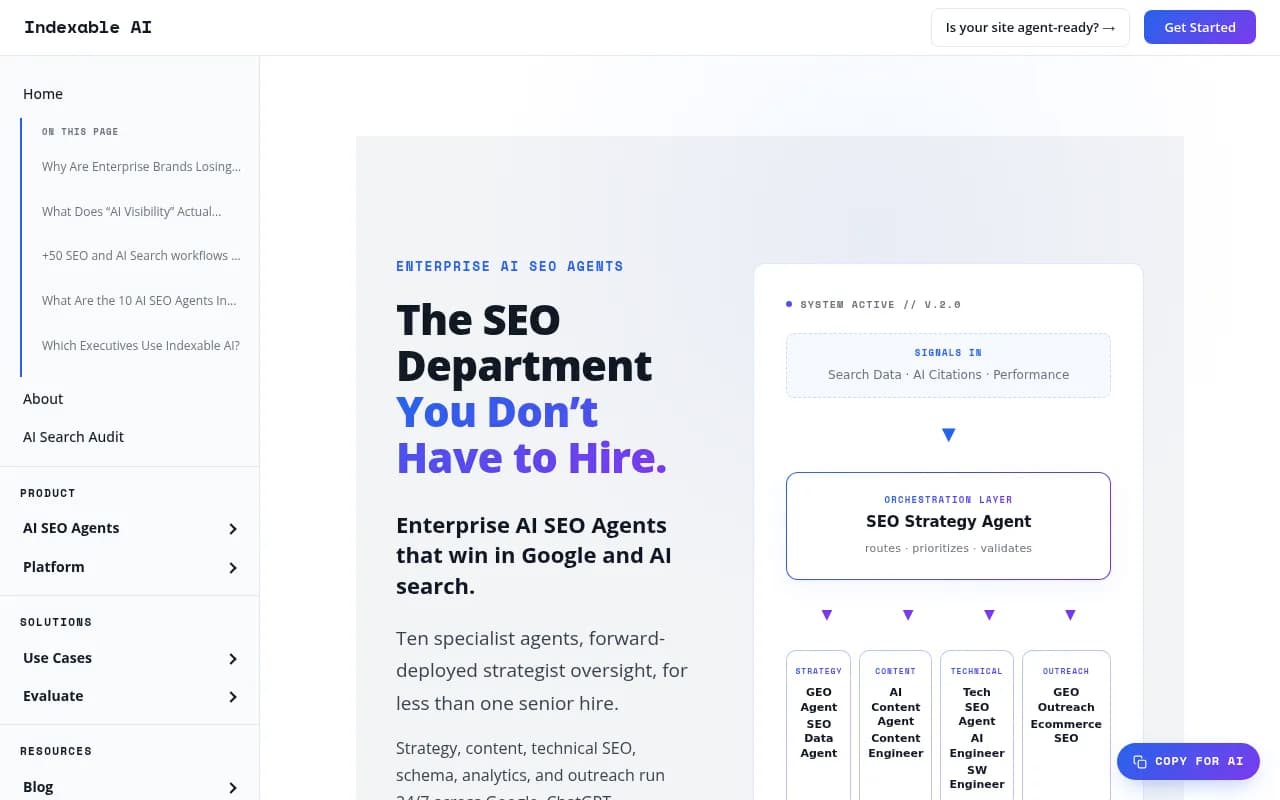
The pitch is blunt: "The SEO department you don't have to hire." Instead of giving you software to operate, Indexable gives you a fleet of ten agents and a principal strategist who steers them. That puts it somewhere between an agency and a platform. You pay a monthly fee, the agents do the production work, and a human signs off on anything significant.
The target buyer is a CMO, VP of Marketing, SEO director or CRO at a mid-market or enterprise brand who knows what needs doing but lacks the headcount. The company has dedicated use-case pages for each of those roles, which tells you how it sells: to budget holders, not practitioners.
Key features
Ten specialist agents. The roster is the product. A SEO Strategy Agent acts as the orchestrator, routing and prioritizing work. Around it sit a GEO Agent, SEO Data Agent, AI Content Agent, AI Content Engineer, AI Technical SEO Agent, SEO AI Engineer (schema), SEO Software Engineer, GEO Outreach Agent and an Ecommerce SEO Agent. The Growth and Scale tiers include nine of them; the Ecommerce agent arrives at Enterprise.
GEO Agent. This agent finds the specific prompts where AI engines name a competitor instead of you, then briefs the fix. That is the useful framing. Most monitoring tools stop at telling you your share of voice. Here the output is meant to be a work order that the content, schema and outreach agents pick up.
AI visibility tracking across 7 platforms. Every plan covers AI Overviews, AI Mode, ChatGPT, Perplexity, Claude, Gemini and Copilot. Competitor tracking scales with the tier: 3 on Growth, 5 on Scale, 10 on Enterprise and unlimited on Enterprise Plus. Indexable also publishes its own AI Visibility Index with category-level citation data, which is a decent proof of methodology even if it is marketing.
+50 workflows. The site lists them all on every tier with no feature gates. Examples include strike distance analysis, topic clustering, citation rate forecasting, citation drift tracking, hallucination rate audits, fan-out optimization, JS rendering audits, entity graph audits, content decay detection, JSON-LD generation, backlink gap analysis, broken link reclamation and engineering tickets. Some of the names ("CRAFT validation", "ASCOC pre-publish gate") are proprietary and not explained on the homepage, so ask what they actually check before you buy.
Technical and schema work. The Technical SEO Agent audits crawlability, Core Web Vitals and rendering gaps. The SEO AI Engineer generates and validates JSON-LD, and the Software Engineer opens tickets or deploys fixes. The company talks a lot about the "rendering gap", meaning AI crawlers that cannot read JavaScript-heavy pages, and claims server-side rendering and sub-100ms edge delivery on rebuilt sites.
Agentic site construction. At the top tier, Enterprise Plus includes an Agentic Website Builder that rebuilds your site in semantic HTML5 with JSON-LD woven through and a product catalog structured for UCP (Universal Commerce Protocol). It also lists MCP and A2A protocol support. This is the most ambitious and least verifiable part of the offering. A full rebuild is a major project, and the homepage gives no case studies.
Ecommerce SEO. For retailers, the Ecommerce agent audits product catalogs and faceted navigation indexability and optimizes for AI shopping surfaces including ChatGPT, Perplexity and Amazon Rufus. Given the founder's Williams-Sonoma background, I would expect this to be a genuine strength, but I could not confirm outcomes.
Human-in-the-loop governance. Every deployment gets a forward-deployed Principal SEO Strategist for oversight. On Enterprise, one is embedded with your team. The documented process has four phases: strategic ingestion, semantic construction, agent activation and ongoing governance, with weekly performance reviews, monthly strategy adjustments and quarterly roadmaps. Enterprise adds human approval gates on critical actions, and the stated approach is to start with low-risk, reversible changes.
Who is it for
The sweet spot is a mid-market SaaS company or ecommerce brand with a real organic channel, a marketing leader who is under pressure about AI search, and no appetite for hiring three more SEOs. Think a 200-person SaaS company whose single SEO manager is drowning in content briefs, schema fixes and engineering tickets. Indexable's own cost comparison puts a Director of SEO at about $20,900 a month fully loaded and a three-person team near $35,000, against $500 to $1,000 for its plans. Those are vendor-authored numbers, but the direction is fair: you are comparing against headcount or an agency retainer, not against another software subscription.
Large retailers and marketplaces are the other obvious fit, especially ones worried about agentic commerce and structured product data. The Enterprise tier's millions-of-pages crawling and Ecommerce agent point that way.
Who should skip it? Solo founders and small sites. Indexable's own listicle admits solo sites get more value from a point tool, and I agree. Also skip it if you want to log in, explore your own data and run your own experiments. There is no self-serve product, no free tier and no trial. Practitioners who like owning the workflow will find the "talk to an architect" model frustrating. And if your main need is measuring AI visibility rather than outsourcing the fixes, you are paying for a lot of execution you may not want.
Integrations and ecosystem
This is the thinnest part of the public information. The site does not publish a list of named integrations. I could not confirm connections to Google Search Console, GA4, specific CMSs or analytics tools, though agents that implement fixes and deploy schema obviously need some access to your site and data. The only named collaboration channel is a Slack or direct channel on the Scale tier and above. Phone support is listed on Growth.
There is no public API or developer documentation that I found, and no browser extension or mobile app. The protocol support (MCP, A2A, UCP) is about how your site talks to AI agents, not about plugging Indexable into your stack. Ask in the sales call exactly which systems the agents read from and write to, and what permissions they need. That question matters more here than for a typical SaaS tool, because these agents change things.
Pricing and value
Pricing is per domain and scope, and always "from":
- Growth, from $500/month: nine agents, AI visibility tracking across 7 platforms, weekly reporting, 3 competitors, quarterly site audits, priority phone support. Aimed at startups and mid-market.
- Scale, from $750/month (most popular): adds a dedicated account manager, on-site deep dives, executive-ready reports, sentiment monitoring, monthly audits, a Slack or direct channel and 5 competitors.
- Enterprise, from $1,000/month: adds the Ecommerce SEO agent (all 10), a forward-deployed SEO strategist, crawling at millions-of-pages scale, monthly strategy reviews, human approval gates and 10 competitors.
- Enterprise Plus, custom: adds the Agentic Website Builder, custom software and AI engineering, board-level QBR prep, a dedicated account team, unlimited competitors and custom SLAs.
There is a separate one-time AI Search Audit, and the site advertises a free 1:1 audit delivered within 24 hours with no call required. A search snippet also mentions a 6-month pilot, but I could not verify its terms.
Is it good value? Against an agency at $10,000 to $35,000 a month, the entry price looks remarkably low, which is exactly why I would ask what drives the final quote. The page does not say. Against pure monitoring tools, the comparison is awkward: Promptwatch's Essential plan is $95/month and Business is $579/month for a self-serve platform, while ZipTie starts at $69 and Peec AI around $89. Those tools sell software; Indexable sells outcomes. If you actually have nobody to do the work, paying $500 to $1,000 and up is cheap. If you do have people, you are paying for execution capacity you may duplicate.
Strengths and limitations
What it does well
- Execution focus. The GEO Agent finding losing prompts and handing them to content, schema and outreach agents is the right loop. Most competitors stop at the dashboard.
- Human accountability. A named principal strategist and approval gates reduce the risk of autonomous agents shipping something bad to your site.
- Breadth of scope. Strategy, content, technical, schema, outreach and ecommerce under one roof, with the same 50-plus workflows on every tier.
- Low entry price for a managed service. From $500 a month is far under a typical agency retainer.
- Honest framing on AI visibility. The homepage argues that Google rankings do not carry over to AI citations and that engines cite different sources. That matches what Promptwatch's own research shows, for example in its ChatGPT citation share by domain rank data, where mid-authority sites earned almost half of citations in August 2026.
Limitations
- Opaque and sales-led. No self-serve access, no free tier, no trial, and no explanation of what moves a quote from $500 to something higher.
- Little independent proof. I found no G2 or Capterra listings, third-party reviews or named case studies. The "best AI SEO agents" page ranks Indexable first and is self-published.
- Unclear integrations. No published list of connections or API.
What it lacks compared with Promptwatch
Indexable competes directly with Promptwatch, and the gaps are specific. Based on public information, Indexable does not show:
- IP-verified AI crawler logs and a crawl-to-citation path per page
- Visitor analytics attributing real traffic and conversions from AI platforms
- Google Search Console and Bing Webmaster data overlaid on AI citations
- Reddit, YouTube and LinkedIn citation reports
- Prompt volumes, difficulty scores and query fan-out data
- Page-level tracking and offsite mention discovery
- AI Shopping tracking in ChatGPT and Amazon Alexa, plus Ads Radar
- A self-serve Content Agent publishing to WordPress, Webflow or Framer, an Action Board and Agent Chat
- Real-UI tracking of 15+ engines, including coding agents like Codex and Claude Code
Promptwatch also has a free Explore tier and a 7-day trial on paid monthly plans, with a published price list. If you want to see your own data and control the optimization loop, that is a very different experience from booking a call.
Bottom line
Indexable makes sense if you are a marketing leader who wants SEO and GEO handled end to end and trusts a named strategist plus supervised agents to do it. The pricing is low for a managed service, the scope is broad, and the human approval model is sensible. The unknowns are real, though: scope-based quotes, unclear integrations and no outside validation. Run the free audit, ask for references, and push hard on what the agents can and cannot change on your site.
If you would rather own the data and the workflow, with crawler logs, AI traffic attribution, prompt intelligence and an agentic Content Agent you can operate yourself, Promptwatch is the stronger choice for optimization rather than hand-off. For more options, the GEO software directory at bestgeosoftware.com is a useful starting point.
Best use case in one sentence: a mid-market or enterprise brand with no SEO bench that wants a supervised agent team to execute SEO and GEO for less than one senior hire.
Tags:
Frequently asked questions
What is Indexable?
How much does Indexable cost?
Is there a free trial or free plan?
Which AI platforms does Indexable track?
How does Indexable compare to Promptwatch?
Who should not use Indexable?
Similar and alternative tools to Indexable