HighLevel Review 2026
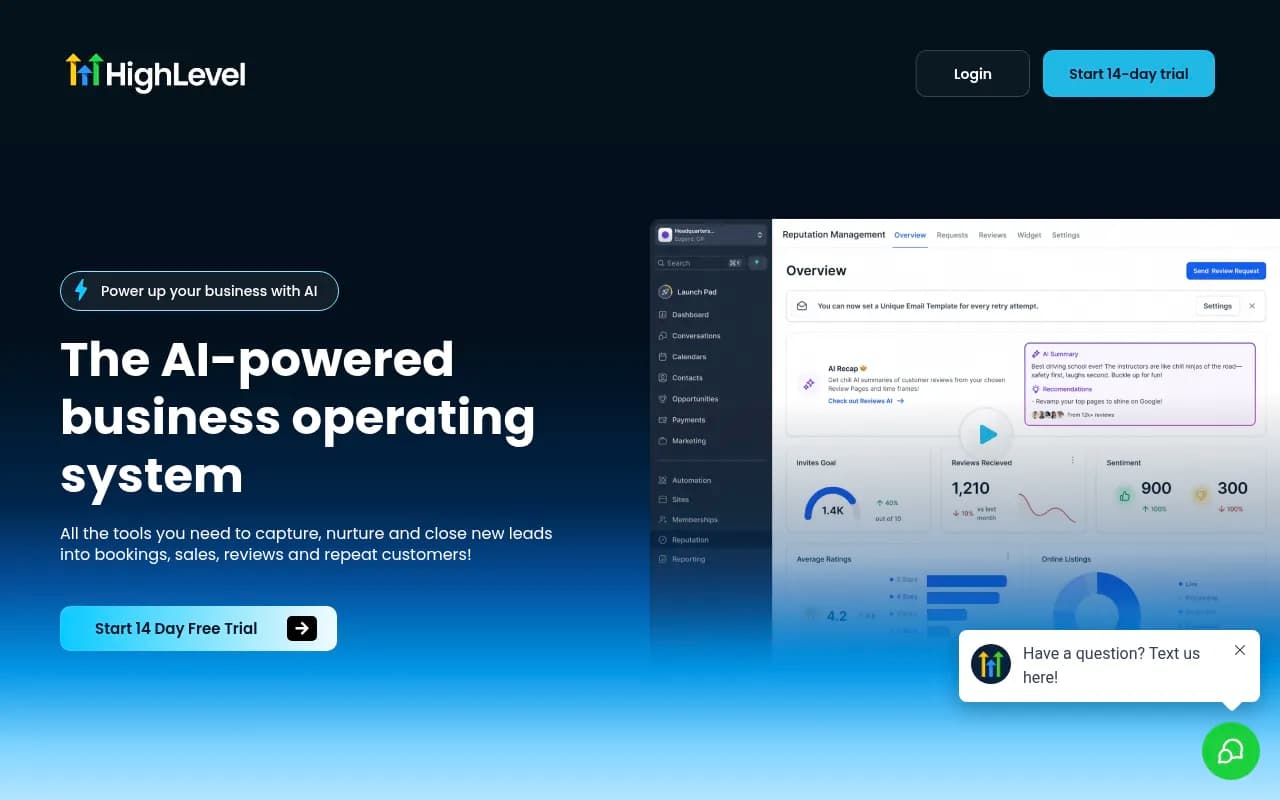
HighLevel is an all-in-one sales and marketing platform built for agencies and small businesses. White-label CRM, funnel builder, AI voice, SMS/email automation, reputation management, and course hosting — starting at $97/mo with a 14-day free trial.
Key takeaways
- HighLevel packs CRM, funnel builder, email/SMS marketing, reputation management, AI voice calling, and course hosting into a single platform starting at $97/month
- The white-label capability is the real draw for agencies: resell the entire platform under your own brand to clients
- The breadth of features is impressive but comes with a steep learning curve — solo operators without a systems mindset often feel overwhelmed
- At $297/month for unlimited sub-accounts, the math works out favorably for agencies managing 10+ clients compared to paying for separate tools
- The platform now powers 1M+ businesses and has processed over $5.2 billion in sales facilitated in 2025 alone
HighLevel (marketed as GoHighLevel) is an all-in-one sales and marketing platform built primarily for digital marketing agencies and the small-to-medium businesses they serve. Founded in 2018 by Shaun Clark and Varun Vairavan and headquartered in Dallas, Texas, the company has grown from a niche agency tool into a platform powering over one million businesses worldwide. The core pitch is simple: replace the stack of tools an agency typically juggles — HubSpot for CRM, ClickFunnels for funnels, Mailchimp for email, Birdeye for reviews, Calendly for scheduling — with a single platform that does all of it, and then white-label the whole thing to resell to clients.
The timing of HighLevel's rise makes sense. Agencies were drowning in SaaS subscriptions, and clients were frustrated by disconnected tools that didn't talk to each other. HighLevel's answer was to build everything under one roof and make the agency the hero by letting them brand it as their own software. That model resonated. The platform has grown aggressively, adding AI features across the board in 2024 and 2025, including Voice AI for inbound calls, Conversation AI for chat, Content AI for writing, and an AI-powered review reply system.
The target audience is specific: digital marketing agencies running client accounts, solo consultants who want to productize their services, and small business owners who want enterprise-grade automation without enterprise-grade complexity (or price). It's not really built for large enterprise sales teams or companies with complex B2B pipelines — those users will find the CRM side too lightweight compared to Salesforce or even HubSpot's upper tiers.
Key features
CRM and pipeline management
The CRM is the backbone of everything. Contacts can be tagged, segmented into Smart Lists, and moved through visual sales pipelines with drag-and-drop simplicity. Lead scoring is available to prioritize follow-up. The pipeline view is clean and functional — not as deep as Salesforce, but more than enough for service-based businesses tracking leads through a standard sales process. You can have multiple pipelines per sub-account, which is useful for agencies managing different service lines for a client.
Workflow automation engine
This is where HighLevel genuinely shines. The visual workflow builder lets you chain together triggers and actions across SMS, email, voicemail drops, phone calls, Facebook Messenger, Instagram DMs, WhatsApp, and more. A missed call can automatically trigger a text-back within seconds. A form submission can kick off a multi-week nurture sequence. Appointment no-shows can trigger a re-booking campaign. The logic is flexible enough to handle complex branching scenarios, and the pre-built templates (called "Snapshots") let agencies deploy proven workflows to new clients in minutes rather than days.
Funnel and website builder
HighLevel includes a drag-and-drop page builder for landing pages, full websites, and sales funnels. It's not as polished as Webflow or even Squarespace for design-heavy work, but it's functional and fast. Order forms with upsells and downsells are built in, which means you can run a complete e-commerce or course sales flow without touching a third-party tool. Webinar funnels are also supported natively.
AI features (Voice AI, Conversation AI, Content AI)
The AI layer has expanded significantly. Voice AI handles inbound calls with a conversational AI agent that can answer questions, qualify leads, and book appointments — useful for service businesses that miss calls after hours. Conversation AI manages live chat and social DMs, routing or responding based on rules you set. Content AI assists with writing emails, SMS messages, and social posts. AI Review Reply automatically generates responses to Google reviews. These aren't just checkbox features — the Voice AI in particular is genuinely useful for local service businesses like HVAC companies or dental practices that can't staff a phone 24/7.
Reputation management
Automated review request campaigns go out via SMS or email after a job is completed or an appointment is fulfilled. The platform aggregates reviews from Google and Facebook, lets you respond directly, and includes widgets to display reviews on your website. Video review capture is a newer addition — clients can record short testimonial videos that get embedded on your site. For local businesses where Google reviews drive a significant portion of new business, this module alone can justify the subscription cost.
White-label and SaaS reselling (Pro plan)
The $497/month Pro plan unlocks the ability to white-label the entire platform — custom domain, custom branding, your own app name — and resell it to clients as your own SaaS product. HighLevel provides a SaaS configurator that lets you set your own pricing tiers, define what features each tier includes, and bill clients directly through Stripe. Agencies running this model can generate recurring SaaS revenue on top of their service retainers. This is the feature that separates HighLevel from most competitors and is the reason the platform has such a devoted agency following.
Membership and course platform
Courses and membership sites are built in. You can create gated content, drip lessons, and sell access via the built-in checkout. It's not as feature-rich as Kajabi or Teachable for pure course creators, but for an agency that wants to add a course product for a client without spinning up a separate platform, it works well.
Calendars and appointment booking
The calendar system handles individual and team booking, round-robin assignment, and paid appointments. Appointment reminders go out automatically via SMS and email. It integrates with Google Calendar and Outlook. The booking experience is clean and comparable to Calendly, with the advantage that it's connected to the rest of the CRM rather than being a standalone tool.
Social planner and ad manager
A built-in social media scheduler handles posting to Facebook, Instagram, LinkedIn, Google Business Profile, and TikTok. The Ad Manager connects to Google and Facebook/Instagram ad accounts for basic campaign management. Neither of these is as deep as dedicated tools like Hootsuite or Google Ads directly, but having them in the same dashboard as your CRM and automations is genuinely convenient for agencies managing full-service accounts.
Who is it for
The clearest fit is a digital marketing agency managing 5 to 50 client accounts. At $297/month for unlimited sub-accounts, the economics are obvious — if you're paying $50-100/month per client for separate CRM, email, and scheduling tools, HighLevel pays for itself with just a handful of clients. Agencies in niches like home services (HVAC, plumbing, roofing), healthcare (dental, chiropractic, med spas), real estate, and fitness studios tend to get the most out of it because those businesses have predictable lead-to-appointment workflows that map cleanly onto HighLevel's automation engine.
Solo consultants and freelancers who want to productize their marketing services also do well here. The Starter plan at $97/month gives you 3 sub-accounts and all core features, which is enough to run a small client base or use the platform for your own business. The white-label SaaS model on the Pro plan is particularly appealing to consultants who want to transition from hourly work to recurring software revenue.
Small business owners who want to run their own marketing without hiring an agency are a growing segment. The platform is genuinely capable of replacing a $500-1000/month marketing stack, but only if the owner is willing to invest time in setup and learning. Someone who wants a simple email newsletter tool or a basic CRM will find HighLevel overkill.
Who should probably look elsewhere: enterprise B2B companies with complex multi-stage sales cycles and large sales teams (Salesforce or HubSpot Enterprise are better fits), e-commerce brands with large product catalogs (Klaviyo and Shopify handle that better), and anyone who needs deep analytics or attribution modeling beyond basic reporting.
Integrations and ecosystem
HighLevel connects to a solid range of third-party tools, though the integration depth varies. Native integrations include Stripe and PayPal for payments, Google Calendar and Outlook for scheduling, Facebook and Google for ads and lead forms, Twilio for SMS/voice (used under the hood), Mailgun and SendGrid for email delivery, and Zapier for connecting to virtually anything else.
The platform has a REST API with basic access on the Unlimited plan and more comprehensive access on the Pro plan. Developers can build custom integrations, and there's a growing marketplace of third-party apps and add-ons built on the HighLevel ecosystem. The GitHub presence (github.com/GoHighLevel) shows some developer tooling, and third-party builders like BuilderBot have created integrations for specific use cases.
The mobile app (iOS and Android) is a genuine strength — you can manage conversations, check pipelines, send messages, and even record video messages from your phone. For agency owners and solo operators who aren't always at a desk, this matters.
The Snapshots system deserves mention as part of the ecosystem: pre-built account configurations that include funnels, workflows, email sequences, and pipelines for specific industries. You can buy Snapshots from the HighLevel marketplace or from third-party creators, which dramatically reduces setup time for common use cases.
Pricing and value
HighLevel has three main tiers:
- Starter at $97/month (or $970/year): 3 sub-accounts, unlimited contacts, unlimited users, all core features, 24/7 support. Good for solo operators or very small agencies.
- Unlimited at $297/month (or $2,970/year): Unlimited sub-accounts, user/agent reporting, ability to rebill phone and email usage to clients without markup, basic API access. This is the most popular plan for growing agencies.
- Pro at $497/month: Everything in Unlimited plus white-label capabilities, SaaS mode for reselling, advanced API access, and additional AI features.
A 14-day free trial is available on all plans with no credit card required upfront. Annual billing saves roughly 17% compared to monthly.
Usage-based costs apply on top of the subscription: SMS, email, phone calls, and AI features are billed separately based on consumption (typically through Twilio and Mailgun rates). This can add up for high-volume users, though the Unlimited plan's rebilling feature lets agencies pass these costs directly to clients.
Compared to alternatives: HubSpot's Marketing Hub starts at $800/month for comparable features. ActiveCampaign's agency-tier pricing is similar to HighLevel's Unlimited plan but lacks the funnel builder and reputation management. ClickFunnels 2.0 at $297/month covers funnels and courses but not the full CRM and automation depth. For agencies, HighLevel's value proposition is strong — the consolidation savings alone typically justify the cost.
Strengths and limitations
What it does well:
- The white-label SaaS model is genuinely unique at this price point. No other platform lets you resell a full marketing suite under your own brand for $497/month.
- Workflow automation is deep and flexible. The ability to automate across SMS, email, voice, and social channels from a single builder is rare.
- The missed call text-back feature sounds simple but is one of the highest-ROI automations for local service businesses — it alone converts a meaningful percentage of missed calls into booked appointments.
- The community and ecosystem are real assets. The HighLevel Facebook group has hundreds of thousands of members, and the Ideas Board actually influences product development. Finding answers, templates, and Snapshots is easy.
- Pricing is genuinely competitive for agencies. The unlimited sub-accounts model means your cost doesn't scale with client count.
Honest limitations:
- The interface is dense. There's a lot here, and the UX doesn't always make it obvious where things live. New users regularly report spending weeks just getting oriented. The learning curve is steeper than tools like HubSpot or ActiveCampaign.
- The built-in tools are broad but not always deep. The website builder won't satisfy a designer. The course platform won't satisfy a serious course creator. The CRM won't satisfy a complex B2B sales team. HighLevel wins on breadth, not depth.
- Reporting and analytics are a weak point. Basic dashboards exist, but if you need sophisticated attribution, cohort analysis, or custom reporting, you'll be exporting data and building reports elsewhere. Competitors like HubSpot have a significant edge here.
- The AI features, while growing, are still catching up to dedicated AI tools. Voice AI is useful but not as sophisticated as purpose-built conversational AI platforms.
Bottom line
HighLevel is the right choice for digital marketing agencies that want to consolidate their client delivery stack, generate recurring SaaS revenue, and stop paying for five separate tools to do what one platform can handle. The $297/month Unlimited plan is where most agencies land, and for anyone managing more than 5-10 client accounts, the math is straightforward.
Best use case in one sentence: a 5-person digital marketing agency managing 20 local service business clients who wants to deliver CRM, automation, reputation management, and booking under their own branded platform without building anything from scratch.
Tags:
Frequently asked questions
What is HighLevel (GoHighLevel)?
How much does HighLevel cost?
Can I white-label HighLevel and resell it to clients?
Who is HighLevel best suited for?
Does HighLevel replace tools like HubSpot, ClickFunnels, and Mailchimp?
Is there a free trial for HighLevel?
Similar and alternative tools to HighLevel