Key takeaways
- Ranking and getting cited are separate outcomes. Ahrefs found only about 12% of URLs cited by ChatGPT, Gemini, and Copilot rank in Google's top 10 for the same prompt, while Google AI Overviews pulls roughly 38% of citations from the top 10.
- The useful list is pages with healthy impressions and clicks in Google Search Console or Bing Webmaster Tools, zero AI citations, and a record of whether AI crawlers even visited them.
- Bing matters more than most teams think: Microsoft Copilot draws on Microsoft's search stack, so Bing indexing and ranking feed Copilot citations.
- Most gaps trace back to three causes: crawler access, page type, and passage structure. Each one is checkable and fixable.
- Do the audit monthly, not once. Citations decay, and news content loses half its cited pages within about five weeks.
The question behind this walkthrough
You have pages that bring in organic clicks. Search Console says so. Bing Webmaster Tools says so. Then you ask ChatGPT, Perplexity, or Copilot the same question the page answers, and your competitor gets named instead.
That is the ranked-but-not-cited gap. It is common, and it is findable if you stop treating AI visibility as a separate universe from search data. The trick is to put the two datasets next to each other, page by page.
This guide walks through how to do that: what data to pull, how to join it, how to diagnose each page, and what to change. I'll cover the manual route first, since it works with free tools, then the point where a platform makes more sense.
Why a page can rank and still not get cited
Google ranks documents. AI engines retrieve passages, then decide which sources deserve a spot in the final answer. A page can clear the first stage and lose at the second.
The numbers vary by engine, which is the part people forget:
- Google AI Overviews still leans on classic organic results. Ahrefs puts the share of AI Overview citations from the top 10 at about 38%, though other analyses in early 2026 range lower.
- ChatGPT, Gemini, and Copilot are far looser. The same Ahrefs study of 15,000 prompts found only 12% of cited URLs ranked in Google's top 10.
- Copilot sits on Microsoft's search stack, so your Bing position is the better predictor there than your Google position.
On volume, Promptwatch's data on sources per response shows ChatGPT citing about 5 sources per web-search answer, Google AI Overviews about 10, and Perplexity almost exactly 10 every day. Copilot is erratic: its average swung from under 2 to nearly 17 within a few weeks before settling low. So the number of slots is small, and you are competing for them against pages that may have never ranked in the top 10.
One caveat. Some third-party write-ups claim that nearly 90% of AI searches split into sub-questions. Promptwatch's own measurements of ChatGPT query fanouts are much lower: about 2.15 distinct searches per response in early December 2025, about 1.84 by early March 2026, and 1.0 when data resumed in April 2026 (ChatGPT query fanouts). Treat fanout claims with some suspicion and test with your own prompts.
Step 1: Build the ranked list from Google and Bing
Start with what you can prove ranks. You want a table of URLs with clicks, impressions, and average position from both engines.
Google Search Console
In the Performance report, set the date range to the last 3 months, switch to the Pages tab, and export. Filter to pages with meaningful impressions, say 500 or more, so you are not chasing noise.
Google's own AI features documentation states that a page must be indexed and eligible for a snippet to be a supporting link in AI Overviews or AI Mode, with no special markup required. So the first filter is simple: if the page is indexed and snippet-eligible, it is at least in the game on Google's surfaces.
Bing Webmaster Tools
Export the same view from Bing Webmaster Tools: pages, clicks, impressions, position. Most SEO teams skip this step, and it is a mistake now. Because Copilot draws on Microsoft's search stack, a page that is invisible in Bing is probably invisible in Copilot, however well it does on Google.
A quick sanity check while you are in there: confirm the pages are indexed in Bing, and consider submitting changed URLs through IndexNow. Tools like IndexerNow or MonkeyIndexer exist to push URLs faster, but the free built-in submission covers most sites.
Merge the two exports
Put both exports in one spreadsheet keyed on URL. Columns: Google clicks, Google position, Bing clicks, Bing position. Sort by combined clicks. The top 50 to 100 pages are your candidate list.
Step 2: Find out which of them AI actually cites
Now the hard half. You need to know, for each candidate page, whether any AI engine cites it and for which prompts.
The manual method
Take the topic of each top page and write 10 to 20 prompts a buyer would ask. Run them across ChatGPT, Perplexity, Google AI Overviews, Gemini, and Copilot. Record every cited URL by engine. Then compare against your candidate list. The pages from Step 1 that never appear are your gap.
This works and costs nothing, but it has two real limits. Answers vary between runs, so one pass is a sample, not a measurement. And it does not scale past a few dozen prompts.
For a quick first look, you can paste a topic into [tool:chatgpt] and [tool:perplexity] directly. Perplexity is a good test bench since its citation count is stable at about 10 per answer. If a change you make shows up there, it is more likely your edit than engine noise.
The tool method
There is a long list of AI visibility trackers. The simple ones (Otterly.AI, Peec AI) answer "was my brand mentioned?" and stop. For this particular audit you want something that also shows page-level data and joins it with search data.
Promptwatch does this in its Search Insights view: Google Search Console and Bing Webmaster traffic per page, overlaid with AI crawls, citations, and clicks. That makes the question in this guide's title a single filter, "pages that rank in Google and Bing but never get cited by AI," rather than a weekend of spreadsheet work. Its 360 Insights ties crawls, citations, clicks, and search data together per page.

If you want to compare other options, the directories at bestgeosoftware.com and ai-rank-tools.com list the field. TrueRanker is also worth a look, since it markets a combined Google rank and AI citation tracker.
Step 3: Check whether AI crawlers can reach the page
Before you rewrite anything, rule out the boring cause. If an AI crawler never fetched the page, no amount of better writing will get it cited.
There are three places to look:
- robots.txt. OpenAI states that a site opted out of its search crawler is not shown in ChatGPT search answers. Check that OAI-SearchBot, PerplexityBot, and the Claude search crawlers are not blocked by accident.
- Server or CDN rules. Bot-protection settings on Cloudflare and similar services block AI user agents more often than people realise.
- Rendering. If the answer only appears after JavaScript runs, many crawlers will see an empty shell. Prerender.io exists for exactly this problem.
To see actual crawler behaviour, you need server logs or a tool that reads them. Screaming Frog's log analyser, Oncrawl, and Botify handle that on the traditional side. Promptwatch's Agent Analytics shows IP-verified hits from GPTBot, OAI-SearchBot, ChatchatGPT-User, ClaudeBot, PerplexityBot and others, which pages they read, what errors they hit, and a citation rate per page. Spoofed bots are filtered out, which matters because user-agent strings are trivially faked.
For a free first pass, Promptwatch's Agentic Readiness Check shows which AI crawlers can read your site. Market-wide crawler context lives in Promptwatch's AI crawler traffic report, which breaks down verified requests from OpenAI, Anthropic, Google, Perplexity, and Mistral from June to September 2026.
The diagnostic table you want looks like this:
| Crawled by AI? | Cited by AI? | What it usually means |
|---|---|---|
| No | No | Access problem: robots, CDN, rendering, or not in the sitemap |
| Yes | No | Content problem: wrong page type, buried answer, stale |
| Yes | Yes | Working. Protect it and refresh it |
| No | Yes | Cited from a cached or third-party source; check offsite mentions |
The second row is where most of your effort goes.
Step 4: Diagnose pages that are crawled but not cited
Here is where you read the page like an engine would. Three checks cover most cases.
Check the page type
ChatGPT does not cite all content types evenly. In Promptwatch's content type report for Sep 28 to Oct 4, 2026, the split was:
| Content type | Share of ChatGPT citations |
|---|---|
| Product pages | 22.4% |
| Landing pages | 16.8% |
| Listicles | 13.6% |
| How-to guides | 8.7% |
| Documentation | 7.5% |
| General articles | 6.1% |
| Comparisons | 5.9% |
| News | 5.7% |
| FAQ pages | 3.3% |
| Reviews | 1.7% |
If your best-ranking page is a general article and the prompt is commercial, you are fighting uphill. For commercial prompts, product pages took 26.0% and landing pages 20.6%, with listicles at 15.0%. For informational prompts, how-tos and docs do better. Match the page type to the intent of the prompts you want to win.
Also note that page types age differently. In Promptwatch's half-life report, landing pages and docs stayed cited longest from a July 6, 2026 snapshot, while news lost half its pages within 36 days. A ranking news post is the likeliest to fall out of citations first.
Check where the answer lives
AI engines pull passages. If the direct answer to the prompt sits halfway down, after three paragraphs of preamble, a competitor with the answer in the first sentence under a clear heading will get quoted instead.
Open the page and ask: could a stranger lift this one passage, with nothing around it, and have a complete, verifiable answer? Include the claim, the reason, and a number or source. If not, that is your edit.
Promptwatch's fanout data suggests writing headings that look like keyword searches rather than chatty questions. Its example is "Best CRM for small agencies 2026." Put the entity and category near the front of titles and H2s, and prefer a focused page per intent over one mega-page.
Check freshness
A study of 17 million AI citations found cited URLs are 25.7% fresher on average than Google's organic results for the same queries. A page can hold a Google ranking for years on authority alone while quietly dropping out of AI answers. Look at the last-modified date and whether the numbers on the page are still true.
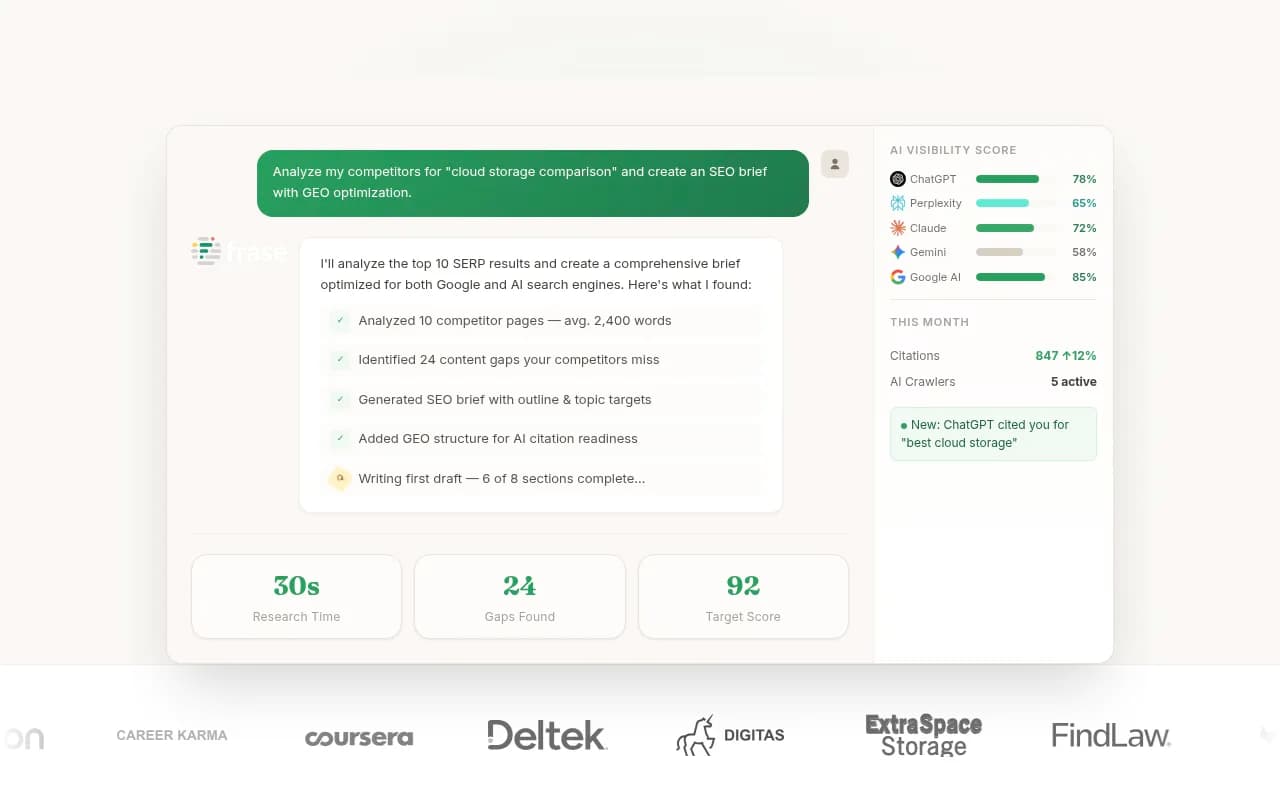
For refresh work, Frase, Clearscope, and Surfer SEO are the usual content-optimization picks. Promptwatch's Content Refresh gives git-diff-style updates tied to the prompts that currently cite competitors.

Step 5: Look for what the winners have
For each prompt where you are absent, list the pages that were cited. Then go through them with a short checklist.
- What type of page is it?
- Does it answer the question in the opening lines?
- When was it updated?
- Is the brand named across other sites, not just linked?
- Is the domain strong or mid-authority?
On the last point, there is some hope for smaller sites. Promptwatch's domain rank data shows sites with DR 46 to 75 earned almost half of ChatGPT citations in August 2026, while DR 91 to 100 fell to about 3%. Citation does not simply follow the biggest domain.
Also check which sources the engines trust in your industry. For software prompts, Promptwatch's October 2026 data shows GitHub, Microsoft's docs, and G2 leading, with documentation and help centers earning the largest share. In travel, booking and search sites earn more than half of citations. Sometimes the fix is not your page at all but a listing on the third-party site that does get cited.
A word on social sources: ChatGPT got only 0.46% of its citations from social platforms from Sep 28 to Oct 4, 2026, while Google AI Overviews got 12.2% (social media citations by AI model). And reddit.com's share of ChatGPT citations fell from about 4% to 0.5% on August 14, 2026 (Reddit citations are dropping in ChatGPT). If your strategy leaned on Reddit threads for ChatGPT visibility, check it again.
Step 6: Fix and prioritize
You will have dozens of gap pages. Do not fix them all. Rank by two things: how much traffic the page already has, and how commercially valuable the matching prompts are.
A workable order:
- Access fixes. Unblock crawlers, fix rendering, add missing pages to the sitemap. These are cheap and apply across many pages.
- Passage rewrites on high-traffic pages. Put the direct answer first, add a number or source, tighten the heading.
- Page-type changes. Where an article should really be a landing page or comparison, build the right asset.
- Freshness updates, starting with news and time-sensitive content.
- Offsite work. Get named on the listicles, reviews, and docs that engines already cite.
Promptwatch's Action Board generates this kind of prioritized list automatically, including content gaps and untapped pages, and its Content Agent can draft and publish to WordPress, Webflow, or Framer, then track whether the new page gets crawled, cited, and clicked. You can do the same loop by hand. The tooling mostly saves time.
For teams that want help running this work rather than buying software, 1001 SEO Media runs AI search and technical SEO engagements built around this kind of audit.
Step 7: Measure again
Re-run the same prompt set 2 to 4 weeks after changes. Compare:
- Cited or not, per engine
- Position in the source list
- Self-citation rate (how often your own pages are the ones cited when you are mentioned)
- AI-referred visits in your analytics
Judge engines by their own noise level. Perplexity is steady, so use it for quick feedback. Copilot swings wildly, so look at monthly trends. ChatGPT's per-response citation counts also shift with model updates; Promptwatch recorded a drop around the GPT-5.3 rollout on March 4, 2026, so a sudden fall in citations is not always your fault.
To see traffic, set up AI referral tracking in your analytics. One Search Engine Land analysis put AI referral traffic around 1.08% of total web traffic. That is small, but the conversion quality can be high: Crisp reported 2x higher conversion rates from AI traffic than from traditional channels.
Tools at a glance
| Job | Free option | Dedicated tools |
|---|---|---|
| Google ranking data | Google Search Console | Semrush, Ahrefs, Moz |
| Bing ranking data | Bing Webmaster Tools | Semrush, Sistrix |
| AI citation tracking | Manual prompt runs | Promptwatch, Profound, Otterly.AI, Peec AI |
| Crawler logs | Server logs | Botify, Oncrawl, Promptwatch Agent Analytics |
| Joined search + AI view | Spreadsheet | Promptwatch Search Insights |
| Content refresh | Manual edits | Frase, Clearscope, Surfer SEO |


To be fair, Semrush and Ahrefs Brand Radar have bolted AI tracking onto their suites, but fixed prompt sets and a lack of crawler data limit how far they go for this specific audit. Otterly.AI and Peec AI are cheaper but stop at monitoring. For deeper cuts of the market, the directory at aisearchtoolrank.com is a decent place to browse.
Common mistakes
- Treating one prompt run as a result. Answers vary. Run each prompt several times, or use a tracker that runs daily.
- Ignoring Bing. Copilot depends on it.
- Rewriting pages that were never crawled. Check access first.
- Chasing sub-question theories without evidence. Test against your own prompts.
- Fixing the page and forgetting offsite mentions. Engines often cite third-party roundups, so being named there counts.
What to do this week
Export your top 100 pages from Search Console and Bing Webmaster Tools. Write 20 buyer prompts. Run them in ChatGPT, Perplexity, and Copilot. Mark every top page that never shows up. Then check robots.txt and your CDN rules for those pages before you touch a single sentence. That one afternoon will tell you whether you have an access problem, a content problem, or both.