Key takeaways
- Reviews are a small slice of what ChatGPT cites. In Promptwatch Data for Sep 28 to Oct 4, 2026, review pages were 1.7% of classified citations, while product pages (22.4%) and landing pages (16.8%) dominated.
- Reviews matter more when a prompt names your brand. Their share rises to 5.6% for branded prompts, more than 3x the overall rate.
- Birdeye suits multi-location businesses, Podium suits teams that live in text messaging, and Reputation.com suits large enterprises. None of them is an AI visibility tool.
- Review software helps feed the sources AI reads. It won't tell you whether ChatGPT or Perplexity actually recommends you. You need a separate way to measure that.
The question nobody on these vendors' comparison pages answers
Search for a comparison of these three platforms and you'll find the same things: pricing styles, inbox features, location dashboards. What you won't find is an answer to the question a lot of owners are now asking. If I get 500 more Google reviews, will ChatGPT recommend me?
I'll be upfront about what I could and couldn't verify. I did not test vendor-specific AI features for these three platforms, and pricing for all of them is quote-based or changes often, so confirm it on their sites. What I can do is lay out how they differ, then use first-party citation data to say what reviews do and don't do for AI recommendations.
Reputation.com vs Podium vs Birdeye at a glance
| Platform | Core strength | Best for | Pricing style |
|---|---|---|---|
| Birdeye | Broad suite: reviews, listings, surveys, messaging, webchat | Mid-market and multi-location brands | Quote-based; third-party roundups cite roughly $299+/mo with annual terms |
| Podium | Messaging-first: SMS, webchat, payments, review requests | Local service businesses that run on texting | Quote-based; roundups cite roughly $399+/mo |
| Reputation.com | Enterprise reputation and listings management at scale | Large chains and enterprises with many locations | Custom enterprise quote |
Price figures come from third-party comparison pages, one of which sells a competing product. Treat them as ballpark and ask for a current quote.
On G2, the figures in our research were Birdeye at 4.7 (4,205+ reviews) and Reputation at 4.5 (2,465+ reviews). Those are buyer ratings of the software, not a signal about AI visibility.
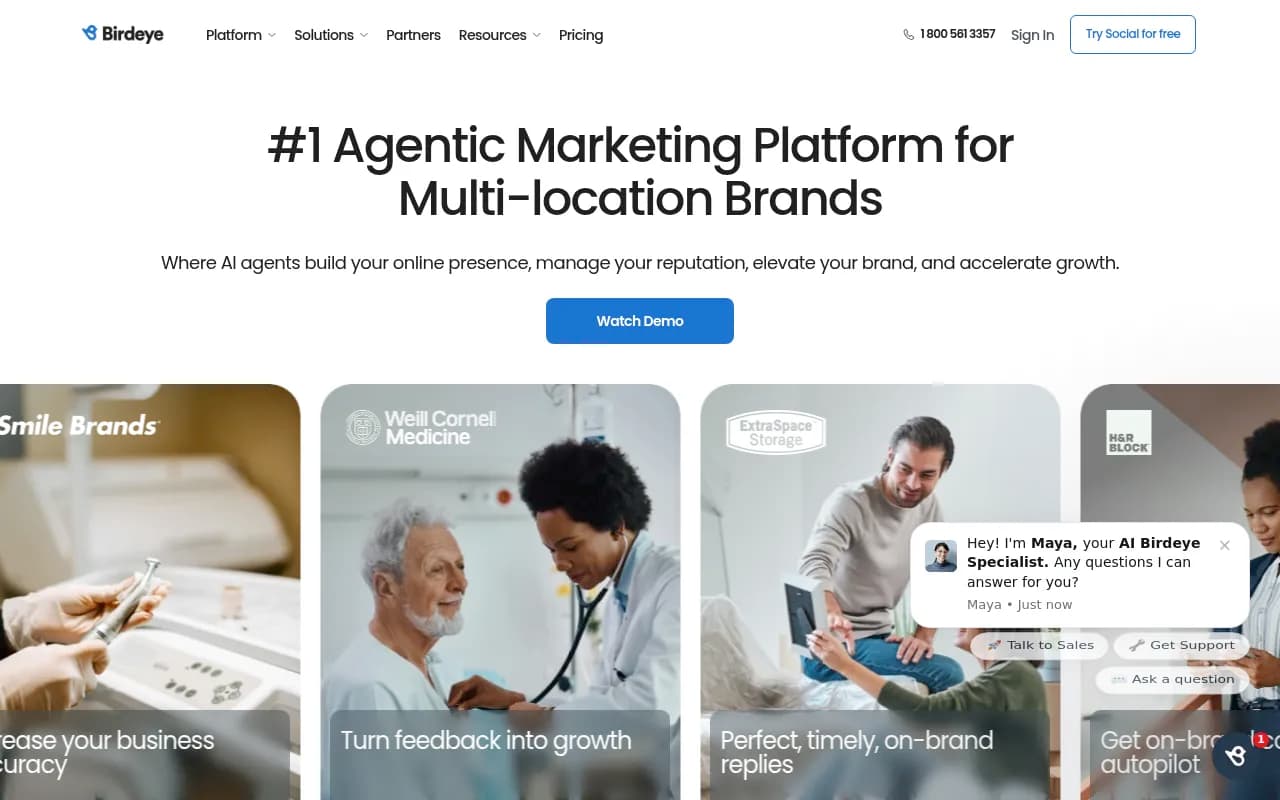
Birdeye: the all-in-one option
Birdeye is built for businesses managing reputation across many locations. Roundups describe automated review monitoring and AI-drafted replies, 200+ review site integrations, listings management, a unified inbox for SMS, webchat and social, and surveys. Its multi-location dashboard, which lets you compare branches and spot trends, gets repeated praise.
The tradeoff is breadth. It's a lot of platform, and a single-location shop may never touch most of it. One of the roundups we read says it expects annual contracts, which is worth checking during a demo.
Podium: messaging first, reviews second
Podium puts the customer conversation at the center. Reviews come out of text-message requests that ride on the same inbox you use for leads, webchat and payments. Reviewers consistently describe it as strong on messaging and lighter on review-specific tooling. One competitor-written comparison claims it lacks AI-written replies, but that source sells a rival product, so check this yourself.
If your team already answers customers by text all day, Podium's approach is natural. If you only want review management, you'll pay for things you don't use.
Reputation.com: enterprise scale
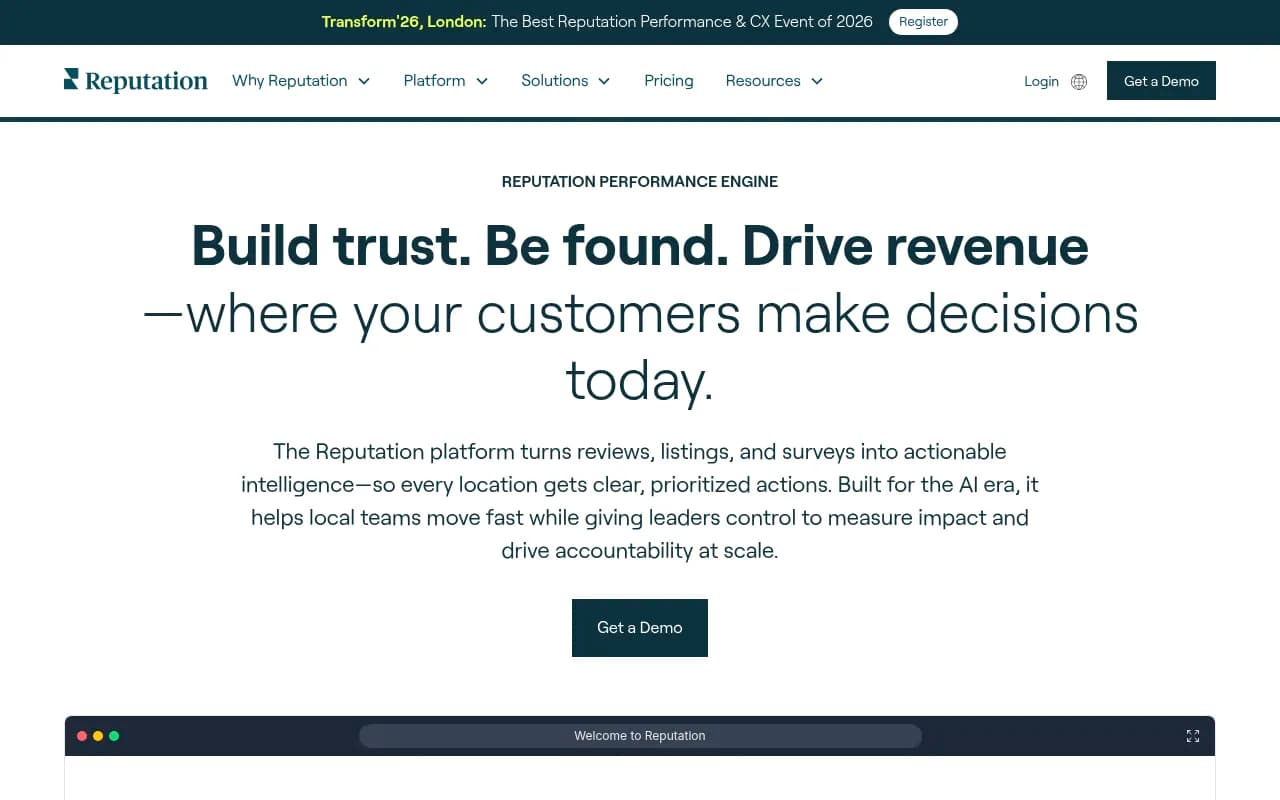
Reputation.com (now branded simply Reputation in places) is built around a composite reputation score, location-level monitoring, listings and response workflows. Buyer guides place it with large enterprises and 100+ location chains. Setup is typically sales-led, with no self-serve trial in the sources we read.
For a franchise system or healthcare network that needs governance, permissions and analytics in one console, it makes sense. For a five-location business it is probably too much.
What AI systems actually cite
Here's where the review-platform pitch meets reality. Promptwatch Data tracks what ChatGPT cites, and the picture is less review-centric than most vendors imply.
In Promptwatch's ChatGPT citation share by content type report (Sep 28 to Oct 4, 2026):
| Content type | Share of ChatGPT citations |
|---|---|
| Product pages | 22.4% |
| Landing pages | 16.8% |
| Listicles | 13.6% |
| How-tos | 8.7% |
| Documentation | 7.5% |
| General articles | 6.1% |
| Comparisons | 5.9% |
| News | 5.7% |
| FAQ pages | 3.3% |
| Reviews | 1.7% |
About 39% of citations go to pages describing what a company sells. Reviews are 1.7%. That is lower than most people expect.
When reviews do show up
The same report splits by prompt type. For branded prompts, meaning the question names your company, review pages rise to 5.6% of citations, more than 3x their overall share. Social posts rise to 3.0%. So reviews do matter when someone asks "is [your brand] any good?" They matter much less when someone asks "best plumber near me" or "best CRM for small businesses," where product pages, landing pages, listicles and comparisons make up almost 70% of commercial citations.
The practical read: reviews protect you at the moment a buyer is checking you out. They are a weak lever for being discovered in the first place.
Which review sites count
For software queries, Promptwatch's software citation report (Sep 28 to Oct 4, 2026) found review sites and analysts earn 1.57% of citations, with G2 the most cited at 0.73%, then Gartner (0.34%) and Capterra (0.32%). Vendor sites (2.01%) and docs and help centers (2.64%) together earn about 3x as much as review sites. If you sell software, your own docs and a complete G2 or Capterra profile probably do more than a generic review-request campaign.
That report doesn't name Birdeye, Podium or Reputation.com individually, so I can't tell you how often those vendors' own pages get cited.
Social and syndicated reviews
Review platforms often push content to social channels, so the social data is worth a look. Promptwatch's October 2026 social media citation data shows ChatGPT gets just 0.46% of its citations from social platforms, after Reddit's share collapsed in August. Google AI Overviews gets 12.2%, about 26x more, with YouTube at 4.28%, Facebook at 2.38% and Instagram at 1.61%. Perplexity sits at 2.7%.
So a public Facebook page or Instagram profile has a better chance of showing up in AI Overviews than in ChatGPT. Which engine your customers use should shape where you invest.
So do review platforms help you get recommended by AI?
Partly, and indirectly. My honest take:
- They help with branded checks. When someone asks an AI about you by name, reviews carry more weight than they do for generic queries.
- They help with the underlying signals. Fresh, plentiful Google reviews and consistent listings are good hygiene for local search, which AI tools often draw on. I did not find evidence in this research on exactly how Google reviews feed AI Overviews or AI Mode, so treat that link as plausible, not proven.
- They don't help with commercial discovery on their own. That's driven by product pages, landing pages, listicles and comparison content.
- They don't measure AI visibility. None of the three tells you whether ChatGPT, Perplexity or Gemini mention you, in what position, or with what sentiment.
One of the roundups we read argues the whole category works after the fact, managing perception once a review is live. That source sells a feedback product, so take the framing with salt, but the point about timing is fair. Review software is reactive by design.
What to pair them with
Measure whether AI recommends you
You can't improve what you can't see. AI visibility platforms run prompts across ChatGPT, Gemini, Perplexity and others and report whether your brand appears. Promptwatch does this against the real interfaces of those assistants and then goes further: it shows which pages get cited, which AI crawlers visit your site, and where content gaps are, with an agent that can write and publish the fixes. That is the layer these three review platforms don't cover.

If you want to compare options, the GEO software directory at bestgeosoftware.com lists others.
Fix the content AI actually cites
Promptwatch's own advice from the content-type data is to collect reviews on the sites people trust in your category, get into the best-of roundups ChatGPT cites, and publish your own comparison pages. Do all three, in that order of effort: roundup placements and comparison pages are where commercial citations come from.
Keep listings consistent
If you run many locations, listings tools like Yext, Synup or Uberall overlap with what Birdeye and Reputation.com do. Check whether you're paying twice.
Which one should you choose?
| If you are... | Look at first | Why |
|---|---|---|
| A multi-location brand wanting reviews, listings and surveys in one place | Birdeye | Widest suite, strong location comparison |
| A local service business that already texts customers | Podium | Reviews come out of your existing conversations |
| A large enterprise with hundreds of locations and compliance needs | Reputation.com | Built for governance and scale |
| A small shop wanting only review replies and requests | A lighter tool such as NiceJob or a budget option | Avoids paying for an enterprise suite |
Then add an AI visibility layer on top regardless of which you pick, because that is the only way to see whether the review work is changing what AI says about you.
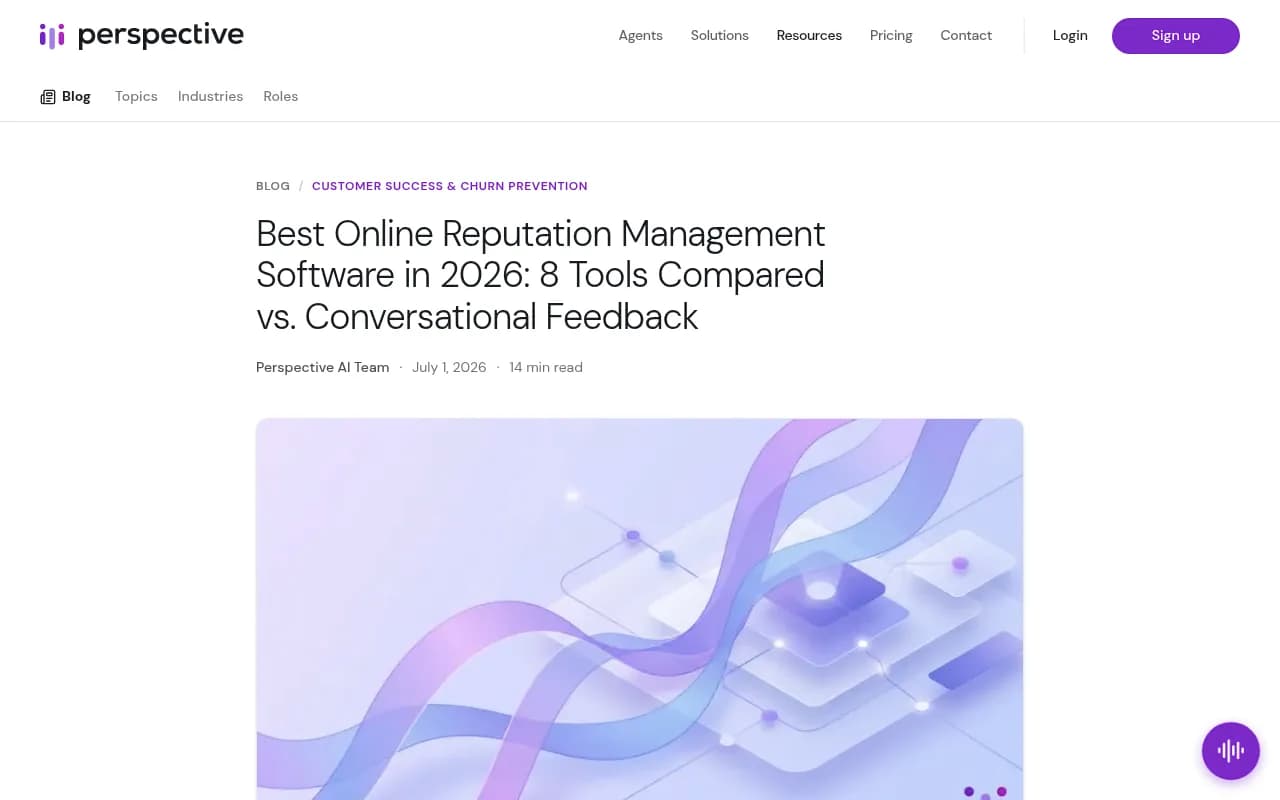
The roundup above is useful for seeing how competitors position these three, but remember it is written by a vendor with a rival product.
A simple 30-day plan
- Pick the review platform that fits your size and workflow. Don't buy for AI claims.
- Write down 20 prompts a buyer might ask an AI about your category and your brand name.
- Run them in ChatGPT, Gemini and Perplexity, or through a tracker, and record who gets named.
- Find which pages and sources are being cited for those prompts. Compare against your own pages.
- Publish or update product pages, landing pages and comparison content for the gaps.
- Keep review requests flowing on the sites that matter in your category, then re-run the prompts monthly.
Reviews are worth collecting. Just don't expect them to carry your AI visibility on their own, because the data says the pages AI cites most are the ones describing what you sell.