Reputation.com Review 2026
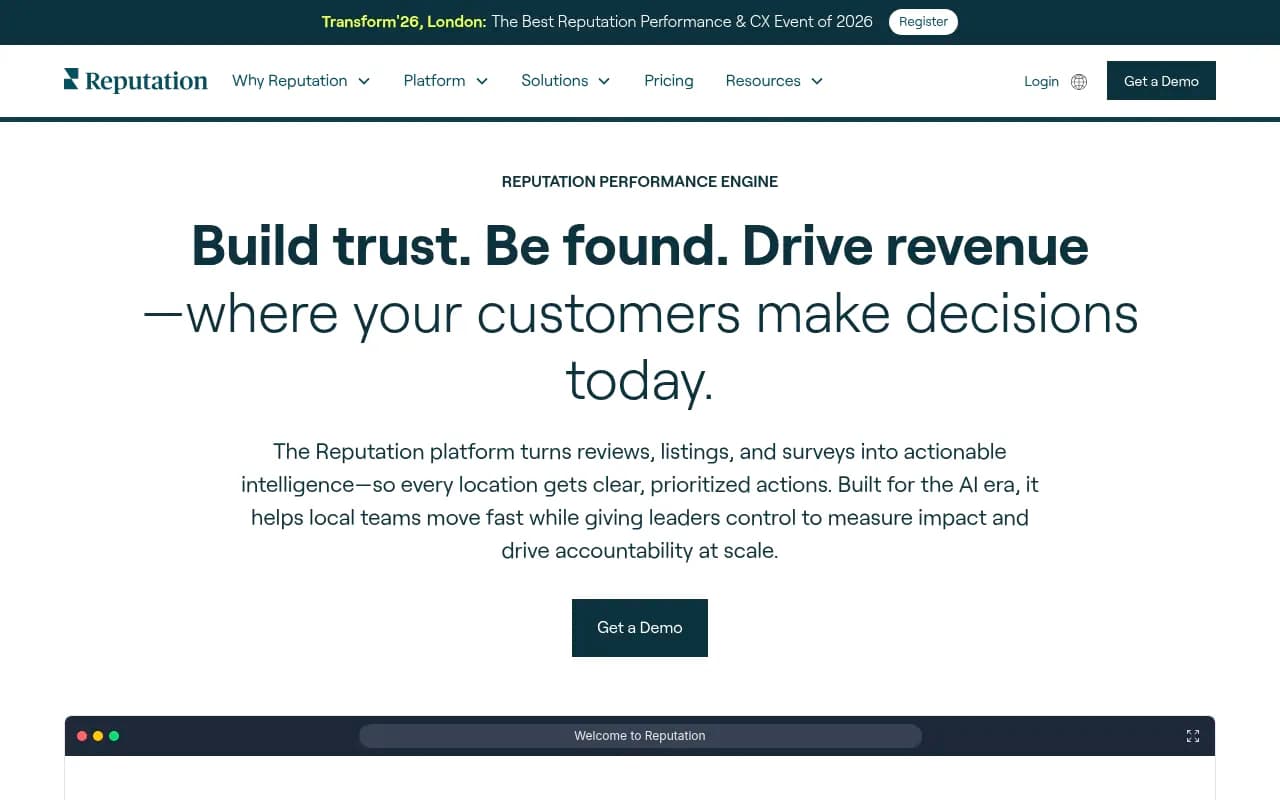
Reputation.com is an AI-powered reputation management platform for multi-location brands. It unifies reviews, listings, surveys, social, and competitive insights to help enterprise teams manage brand trust and local search visibility at scale.
Key takeaways
- Best for multi-location enterprise brands in automotive, healthcare, retail, and financial services that need to manage reviews, listings, and customer feedback across dozens or hundreds of locations from a single platform.
- Strong all-in-one suite covering reviews, local listings, surveys, social publishing, competitive benchmarking, and an AI query tool (Reputation IQ) -- more breadth than most point solutions.
- Rep Score is a genuinely useful proprietary metric that rolls nine customer experience signals into one number, making it easier to track performance across locations without drowning in raw data.
- Pricing is enterprise-oriented -- the website references a Core plan starting around $80/month, but meaningful multi-location deployments will cost significantly more, and transparent self-serve pricing is limited.
- Not a tool for AI search visibility or GEO -- Reputation.com focuses on traditional review platforms, local SEO, and customer feedback. It does not track how your brand appears in ChatGPT, Perplexity, Claude, or other AI models, and has no content gap analysis or AI citation tracking.
Reputation.com has been in the online reputation management space for roughly 15 years, which gives it something most newer competitors simply can't match: deep, industry-specific workflows built from real enterprise deployments. The company serves multi-location brands across automotive dealerships, hospital networks, restaurant chains, retail franchises, and senior care facilities. The pitch is consolidation -- instead of juggling separate tools for Google Business Profile management, review response, NPS surveys, and social publishing, Reputation.com tries to pull all of that into one platform with shared analytics and a single login.
The target audience is clearly enterprise. The demo-first sales model, the "Number of Locations" field on every contact form, and the industry-specific solution pages all point to customers managing 50 to 5,000+ locations. This is not a tool you'd buy for a single restaurant or a two-person agency. It's built for the VP of Marketing at a regional hospital network or the digital director at a national auto dealer group who needs accountability and consistency across a large footprint.
The company has gone through several rebrands and product expansions over the years, most recently leaning hard into AI positioning with the launch of Reputation IQ and a rebuilt platform they describe as "AI built-in, not bolt-on." They also run an annual awards program called the 800 & 900 Awards, recognizing businesses that hit high Rep Scores -- a clever way to drive platform adoption and create social proof among their customer base.
Key features
Rep Score is Reputation.com's signature metric. It aggregates nine factors -- including review volume, average rating, review recency, response rate, listing accuracy, and social engagement -- into a single 0-1000 score per location. The idea is that a single number is easier to communicate to executives and hold location managers accountable to than a dashboard full of individual metrics. In practice, it works well as a performance benchmark, especially when comparing locations against each other or tracking improvement over time. Competitors like Birdeye and Podium don't have an equivalent proprietary score, which gives Reputation.com a differentiation point in enterprise sales conversations.
Reviews & Review Booster handles the full review lifecycle: requesting reviews via email or SMS, monitoring incoming reviews across Google, Yelp, Facebook, and dozens of industry-specific platforms, and responding at scale with AI-assisted response drafts. Review Booster specifically focuses on increasing review volume through automated request campaigns triggered by customer interactions. The AI response feature generates contextually appropriate replies that can be reviewed and sent by location managers, which is genuinely useful when you're managing hundreds of locations and can't have a dedicated person writing every response.
Listings + Local SEO manages business listing data across Google Business Profile, Apple Maps, Bing, Yelp, and other directories. The platform pushes consistent NAP (name, address, phone) data and extended attributes to these sources, which matters for local search ranking. Reputation.com has recently added messaging around AI discovery -- the idea that accurate, structured listing data helps AI assistants surface your locations in response to local queries. This is a reasonable claim, though it's worth noting this is passive optimization through data accuracy, not active AI search visibility tracking.
Reputation IQ is the platform's AI query interface, launched as part of their recent AI rebuild. You can ask plain-English questions like "Which locations have the most negative reviews about wait times?" and get synthesized answers from your review data. It's positioned as a way for executives to get decision-ready insights without digging through dashboards. The quality of this kind of natural language interface depends heavily on the underlying data quality and the sophistication of the query engine -- it's a promising feature, though enterprise AI query tools vary widely in how well they actually handle nuanced operational questions.
Surveys captures structured customer feedback through post-visit or post-transaction surveys. The platform routes responses to the appropriate location managers and tracks resolution. This is particularly valuable in healthcare and automotive, where service recovery matters and you want negative feedback captured privately before it becomes a public review. The survey module integrates with the broader Rep Score calculation, so survey sentiment feeds into the overall location performance metric.
Insights & Competitive Insights provides analytics across your own locations and benchmarks you against competitors. The competitive module pulls public review data from competitors in your market and shows you where you're winning or losing on specific topics -- staff friendliness, wait times, cleanliness, etc. For a regional manager trying to understand why one location is underperforming relative to a competitor two miles away, this kind of granular competitive data is genuinely actionable.
Social Suite centralizes social media publishing and engagement across Facebook, Instagram, Google Posts, and other channels. For multi-location brands, the challenge is maintaining brand consistency while giving local teams enough flexibility to post relevant content. Reputation.com handles this with brand-level templates and approval workflows, so a corporate team can set guardrails while local managers still have some autonomy.
Actions turns feedback signals into routed tickets. When a survey response or review flags an operational issue, the platform can automatically create a task, assign it to the right person, and track resolution. This closes the loop between customer feedback and operational improvement -- which is the part most reputation tools skip entirely.
Who is it for
The clearest fit is a multi-location enterprise brand with 50+ locations that currently manages reviews manually or through a patchwork of tools. Think a regional healthcare system with 80 clinics, a national auto dealer group with 200 rooftop locations, or a franchise restaurant chain trying to maintain consistent ratings across markets. These organizations have the scale where manual review management breaks down and the budget to justify an enterprise platform.
Marketing and CX teams at these organizations are the primary users. The platform is designed so corporate teams can set strategy and monitor performance while local managers handle day-to-day response and feedback. The role-based access and location hierarchy features matter a lot here -- a district manager needs a different view than a store manager, and both need a different view than the CMO.
Industries where Reputation.com particularly shines: automotive (they have deep integrations with dealer management systems), healthcare (HIPAA-aware workflows for responding to patient reviews), and senior care/assisted living (where family trust and online reputation directly affect occupancy rates). The platform's 15 years of industry-specific development shows in these verticals.
Who should probably look elsewhere: small businesses with a single location, startups that need a lightweight review tool, and any brand whose primary concern is visibility in AI search engines like ChatGPT or Perplexity. Reputation.com is built around traditional review platforms and local search -- it doesn't track AI model citations, doesn't analyze how AI engines perceive your brand, and has no content optimization tools for AI search. For that use case, you'd need a dedicated AI visibility platform.
Integrations and ecosystem
Reputation.com connects to the major review platforms -- Google Business Profile, Yelp, Facebook, Tripadvisor, Healthgrades, DealerRater, and others. The breadth of review source integrations is one of the platform's strengths, particularly for industries like healthcare and automotive that have specialized review sites.
On the CRM and operations side, the platform integrates with Salesforce, various dealer management systems (CDK, Reynolds & Reynolds), and healthcare EMR systems for triggering survey requests based on patient visits. These industry-specific integrations are a meaningful differentiator for enterprise buyers.
The platform has an API for custom data workflows and supports Looker Studio for custom reporting. There's also a Zapier integration for lighter-weight automation needs.
No dedicated mobile app was prominently featured in the current product materials, though the platform is accessible via mobile browser. Browser extensions aren't a core part of the product.
Pricing and value
Reputation.com's pricing is not fully transparent on the website. The pricing page references a Core plan starting around $80/month, but this appears to be a baseline entry point. Multi-location enterprise deployments are custom-quoted based on number of locations, features needed, and contract length.
For context, third-party sources like SaaSworthy note that the average basic reputation management software plan runs around $29/month, but Reputation.com is positioned well above that market. Enterprise contracts for large multi-location deployments typically run into five or six figures annually.
There is no meaningful free tier. The demo-first sales process means you'll need to talk to a salesperson before getting real pricing. This is standard for enterprise software but worth knowing if you're hoping to self-serve.
Compared to alternatives: Birdeye and Podium are closer in price range and feature set for mid-market buyers. Yext focuses more narrowly on listings and is often cheaper for that specific use case. For pure review management at smaller scale, tools like Grade.us or ReviewTrackers are significantly cheaper. Reputation.com's pricing is justified primarily by the breadth of the platform and the depth of enterprise features -- if you're using most of the suite, the consolidation value is real.
Strengths and limitations
What it does well:
- Scale and breadth: The combination of reviews, listings, surveys, social, competitive insights, and actions in one platform is genuinely hard to match. For enterprise teams tired of stitching together five tools, this consolidation has real value.
- Industry depth: 15 years of vertical-specific development shows. The automotive and healthcare workflows, integrations, and benchmarks are more mature than most competitors.
- Rep Score: A single, defensible performance metric that executives can track and location managers can be held accountable to. Simple in concept, genuinely useful in practice.
- Actions module: Closing the loop from feedback to operational ticket is something most reputation tools don't do. It's what separates a monitoring tool from a management tool.
Honest limitations:
- No AI search visibility: Reputation.com has no capability to track how your brand appears in ChatGPT, Perplexity, Claude, Gemini, or other AI models. As AI search becomes a primary discovery channel, this is a real gap. The platform's "AI era" positioning is largely about AI-assisted review responses and AI query interfaces for your own data -- not about monitoring or optimizing your presence in AI search results.
- Pricing opacity and enterprise lock-in: The lack of transparent self-serve pricing and the demo-required sales process creates friction for smaller buyers and makes it hard to evaluate ROI before committing. Annual contracts are standard.
- UI complexity: A platform this broad inevitably has a learning curve. Some users report that navigating between modules and configuring location hierarchies takes meaningful onboarding time.
Bottom line
Reputation.com is a mature, feature-rich platform for enterprise brands managing customer trust across many physical locations. If you're a national retailer, healthcare network, or auto dealer group that needs to consolidate review management, listing accuracy, customer surveys, and competitive benchmarking into one system with real accountability features, it's one of the strongest options in 2026.
That said, if your primary concern is how your brand shows up when customers ask ChatGPT or Perplexity for recommendations -- which is increasingly where discovery happens -- Reputation.com won't help you there. That's a different problem requiring a different tool.
Best use case in one sentence: Multi-location enterprise brands in automotive, healthcare, or retail that need a single platform to manage reviews, listings, surveys, and local CX performance at scale.
Tags:
Frequently asked questions
What is Reputation.com?
Who is Reputation.com best suited for?
How much does Reputation.com cost?
Does Reputation.com track AI search visibility (ChatGPT, Perplexity, etc.)?
What is the Rep Score?
How does Reputation.com compare to Birdeye or Podium?
Similar and alternative tools to Reputation.com