Key takeaways
- Perplexity and ChatGPT retrieve and cite differently, so a brand can be cited in one and absent from the other. Treat them as two separate measurement problems.
- Perplexity cites almost exactly 10 sources per answer and is steady day to day, which makes it a good test bench. ChatGPT's source lists vary a lot by prompt type.
- Track more than mentions: position in the answer, citation, source quality, sentiment and accuracy.
- Visibility is a rate across a stable prompt set, not a fixed rank, because both engines are non-deterministic.
- Fixes differ. For Perplexity, work on fetchable, fresh, source-worthy pages. For ChatGPT, work on your own site, listicles, guides, comparisons and consistent third-party descriptions.
Why the same brand gets different results
A lot of teams find out about this by accident. Someone pastes a category question into ChatGPT, the brand shows up second. Someone else runs it in Perplexity and the brand is nowhere, with three competitors and two affiliate roundups cited instead. Then the argument starts about which one is "right".
Both are right. They are different systems pulling from different evidence. One third-party analysis from Unveil reported that the two engines overlap on only about 11% of cited domains. I could not verify that figure independently, so treat it as a rough signal, but it matches what most people see when they compare runs side by side.
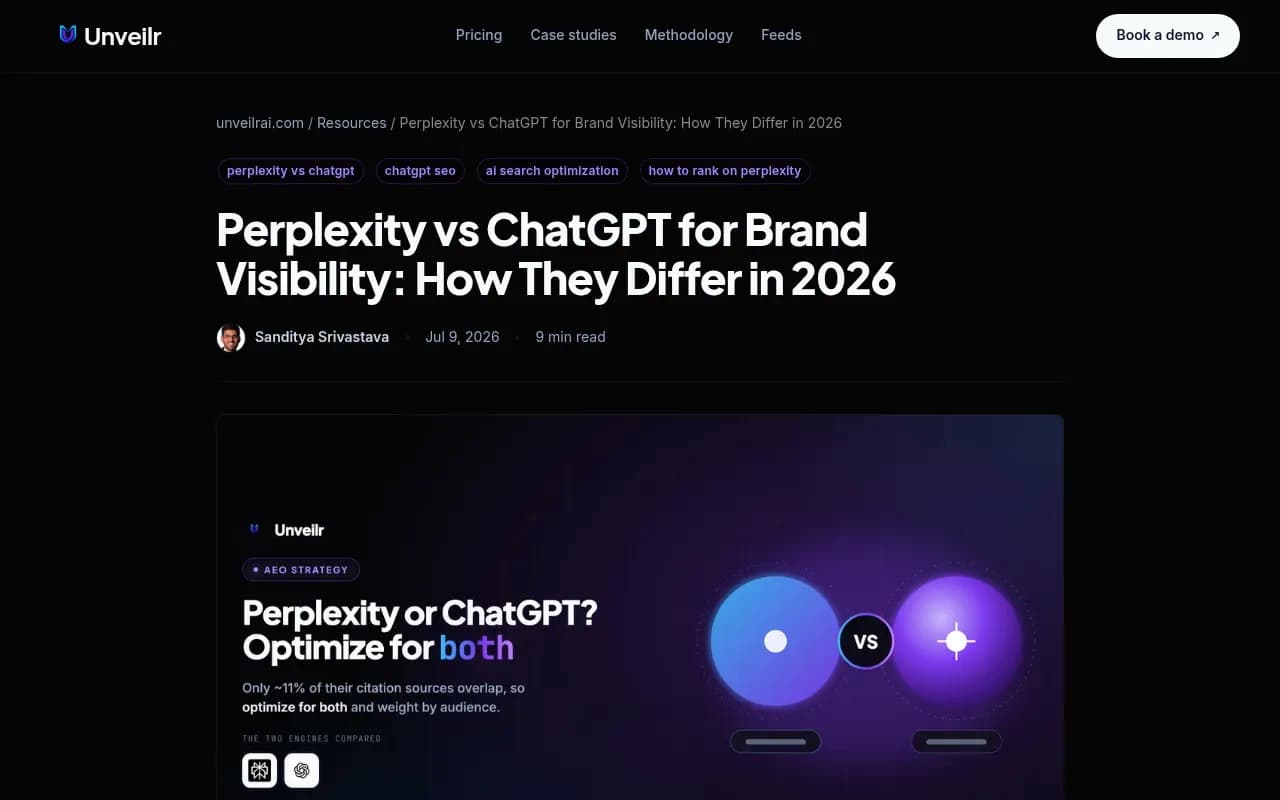
The short version of the mechanics:
- Perplexity is built around live retrieval. It searches the web per query and puts numbered sources next to claims. Your visibility there depends heavily on whether your pages can be fetched, parsed and judged relevant right now.
- ChatGPT mixes model knowledge with search that it triggers selectively. When it searches, it fans out into multiple web queries and cites a wider, more variable set of domains. When it does not search, you are measuring what the model remembers about you.
Perplexity
How the two engines cite, in numbers
Promptwatch Data has two reports that make the difference concrete.
First, sources per answer. According to Promptwatch's average sources per response report, Perplexity cites almost exactly 10 sources per answer, day after day. ChatGPT averaged about 5 sources on web-search answers in that dataset, though that figure drifts with model and retrieval updates and only counts messages where search was triggered.
That ChatGPT number looks low next to a newer report. In Promptwatch's unique domains per ChatGPT response data (Sep 28 to Oct 4, 2026, responses with at least one citation), 47.6% of responses cited 10 or more unique domains and 66.1% cited at least 8. The two reports measure different things and different periods, so do not mix them in one chart. The practical point holds either way: ChatGPT's source count moves with the model, the prompt type and the week, while Perplexity's barely moves.
The prompt type matters a lot for ChatGPT:
| Prompt type (ChatGPT, Sep 28 to Oct 4, 2026) | Responses citing 10+ domains | Notes |
|---|---|---|
| Organic (no brand named) | 52.5% | Wide source pool, 71.8% cite at least 8 |
| Competitor comparison | 49.1% | Only 0.35% cite a single domain |
| Brand-specific | 21.3% | Most common count is 5 domains (14.9%) |
For a branded prompt like "is Asana good for small teams", ChatGPT leans on a short list, and review sites and forums often sit on it. For a category prompt with no brand named, you are competing against a much larger pool.
Where the sources come from
Social platforms are a good example of how different the engines are. Promptwatch's social media citations by AI model report (Sep 28 to Oct 4, 2026) found:
| Engine | Share of citations from social platforms | Biggest social sources |
|---|---|---|
| ChatGPT | 0.46% | LinkedIn at 0.3%, Reddit at 0.09% |
| Perplexity | 2.7% | LinkedIn and Reddit tied at 0.86%, YouTube 0.79% |
| Google AI Overviews | 12.2% | YouTube 4.28%, Facebook 2.38%, Reddit 2.15% |
Reddit used to matter far more in ChatGPT. Promptwatch Data showed reddit.com's share of ChatGPT citations collapsing from about 4% to 0.5% on August 14, 2026. If your ChatGPT plan was "seed some Reddit threads", that plan is mostly dead. Reddit still shows up in Perplexity, so the same tactic can work in one engine and do nothing in the other.
Content types also shift. Product pages were the most cited type in ChatGPT in the same October window, at 22.4% of citations, according to Promptwatch's content type report. That is a good reason to check that your product and landing pages say clearly what you do and who they are for.
What to measure in each engine
Mentions alone mislead. A brand listed eighth in a long answer is not the same as a top recommendation, and a wrong description can hurt more than silence. The MaxAEO comparison suggests five metrics, and I think they hold up:
- Mention rate: how often the brand appears across your prompts.
- Recommendation rank: first, top three, buried, or absent.
- Citation rate: whether visible sources support the answer.
- Citation quality: whether those sources are current, independent and specific.
- Sentiment and accuracy: stale pricing, wrong features, old categories.
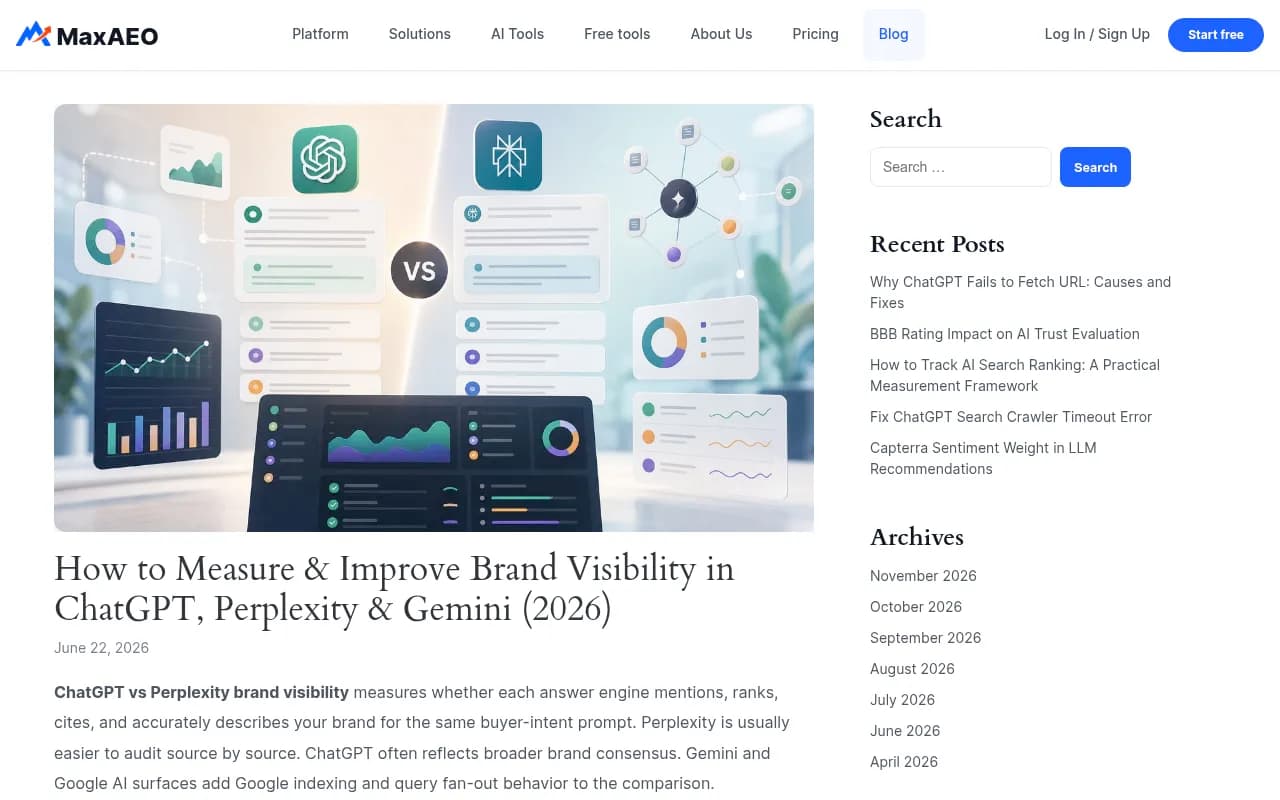
How I would weight them per engine:
| Metric | Perplexity | ChatGPT |
|---|---|---|
| Mention rate | Useful, but pair with citations | Core baseline for brand consensus |
| Position in answer | Useful | Core, since lists vary in length |
| Own-domain citation rate | Core, the most auditable signal | Important, but often indirect via third parties |
| Source share vs competitors | Core, stable denominator of about 10 | Noisy, track the trend not the day |
| Accuracy and sentiment | Check the cited page too | Core, memory can be stale |
Two more things to record that people skip. First, whether search was used at all in ChatGPT. A response without retrieval tells you about model memory, and mixing it with search-backed responses muddies everything. Second, which Perplexity mode you used. Search, Pro Search and Research are different experiences, and SeekLab's comparison rightly warns against pooling fast Search and deeper Research observations.
Build a tracking setup that does not lie to you
The approach below works regardless of which tool you use.
Step 1: build a stable prompt set
Start with 30 to 50 prompts buyers actually ask. Split them into three groups: organic category prompts ("best X for Y"), competitor comparisons ("A vs B"), and brand-specific prompts ("is [brand] good for Z"). Keep these groups separate in reporting, since the table above shows ChatGPT behaves very differently across them.
Step 2: sample repeatedly
Both engines are non-deterministic. The same question returns different sources and wording on repeat asks. Ask each prompt several times, over several days, and report a rate. A single screenshot is an anecdote.
Step 3: record the conditions
Log country, language, platform, mode, date, and whether you were logged in. Webalert also makes a point worth repeating: keep consumer app, Sonar or Agent API, and raw Search API results in separate cohorts, because they return different products and response shapes. A timeout is missing data, not brand absence.
Step 4: capture what the answer cited and why
For every run, note your position, whether your domain was cited, which competitors appeared, which third-party pages carried your name, and whether the description was accurate. Separate owned-domain citations from third-party corroboration. An industrial supplier can be recommended via a trade publication without its own site being linked, and that still counts for something.
Step 5: tie it to traffic
Mentions are not revenue. Check referral sessions from each engine in your analytics, and look at AI crawler activity on your server logs. If PerplexityBot or OAI-SearchBot gets blocked or hits errors, no amount of content work will help.
Tools for tracking both engines
You can do all of this by hand in a spreadsheet for a small prompt set. It stops being fun around prompt 50. Here is how the options split.
Promptwatch is the one I would put first if you want to go past monitoring. It tracks the real interfaces of ChatGPT and Perplexity (plus Google AI Overviews, Gemini, Copilot and others) by country and language, and gives visibility score, share of voice, position and sentiment per model. It also has IP-verified AI crawler logs, visitor analytics for AI-referred traffic, and a content gap workflow, so when Perplexity ignores you the next step is not a guess. Reddit, YouTube and LinkedIn citation reports are included, which matters given the social numbers above.

Other options in the catalog, with their general positioning:
| Tool | Positioning | Best for |
|---|---|---|
| Promptwatch | Tracking plus crawler logs, traffic attribution and content actions | Teams that want to fix gaps, not just see them |
| Profound | Enterprise AI visibility monitoring | Large brands with enterprise budgets |
| Otterly.AI | Affordable prompt tracking | Small teams starting out |
| Peec AI | Monitoring without optimization workflows | Simple reporting needs |
| LLM Pulse | Visibility across ChatGPT, Perplexity and more | Lightweight multi-engine tracking |
| PromptRush | Daily scans from $19 per month | Tight budgets |



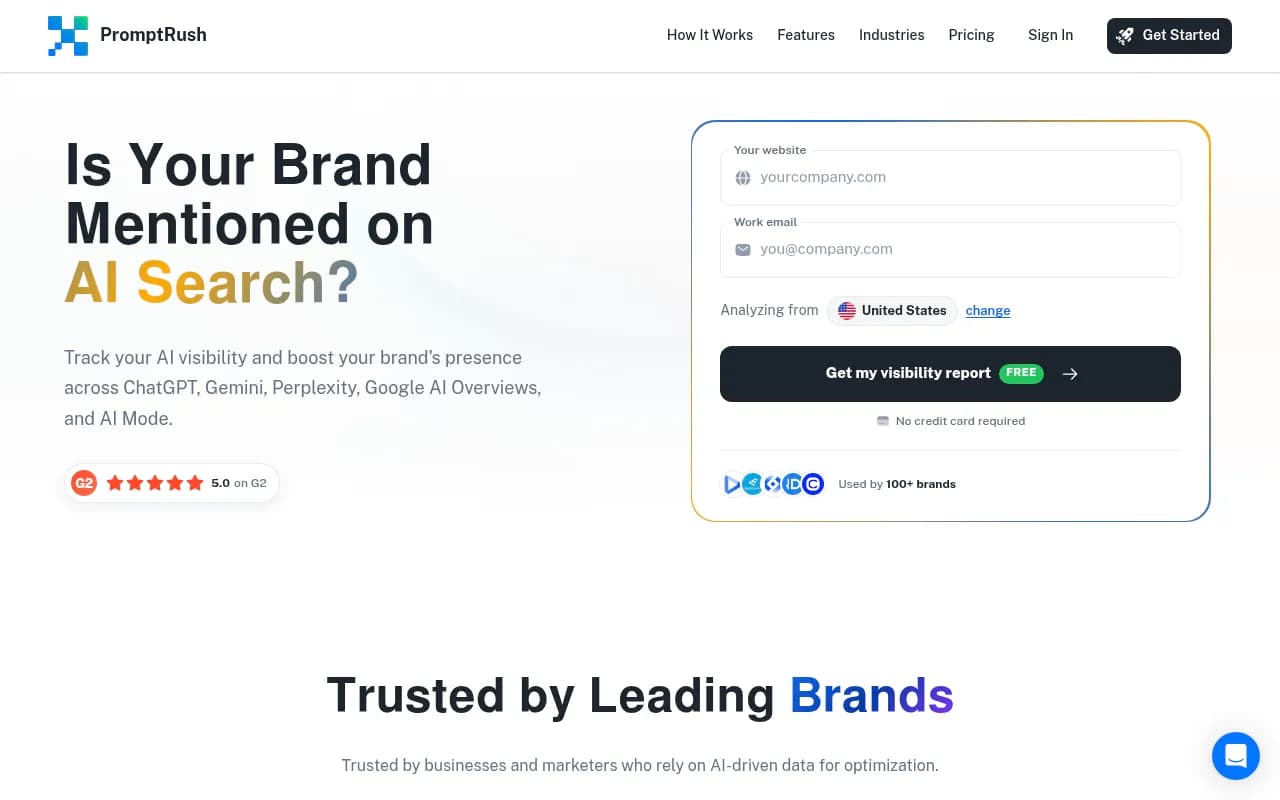
I have not verified pricing or feature depth for the tools other than Promptwatch, so check each vendor's site. If you want a wider survey, the GEO software directory at bestgeosoftware.com lists many more.
What to do when you win in one engine and lose in the other
Visible in ChatGPT, missing in Perplexity
This is usually a retrieval problem. Check these first:
- Is PerplexityBot allowed, and are key pages fast and readable as plain HTML?
- Are your pages thin or generic, so they never match specific buyer prompts?
- Do competitors have fresher comparison pages and independent coverage?
- Are the cited sources affiliate roundups you are not on?
Then build the assets Perplexity likes to cite: comparison pages that fairly name alternatives, product pages with concrete features and target users, original data and methodology posts, customer stories with measurable outcomes, and current review profiles. Because Perplexity's source count is so stable, you can watch whether a new page moves your citation share within days.
Visible in Perplexity, missing in ChatGPT
This is more often an entity and consensus problem. ChatGPT may not describe you clearly, or it may rely on third-party pages that do not mention you. Focus on your own site, listicles, guides and comparisons rather than forum seeding. Check which review sites sit on the short source list for brand prompts and make sure your profiles there are accurate and current. Content age matters too: Promptwatch's content half-life data found landing pages and docs stayed cited longest while news lost half its pages within 36 days, so evergreen pages are worth more than a news-style post.
Visible in neither
Start with access and clarity. Run an AI crawler check, confirm your pages state plainly who you serve and what you do, and then find the third-party pages that already rank for your category and get your brand onto them honestly.
Common mistakes
- Pooling modes and conditions. Search vs Research in Perplexity, search vs no search in ChatGPT.
- Reporting a single run. Report a rate over repeated samples.
- Counting mentions without rank or accuracy.
- Applying one tactic to both engines. Reddit seeding is a good example.
- Treating citation order as a click score. It is not documented as one.
- Quoting a ChatGPT sources-per-answer figure without saying which dataset and period it came from.
A simple reporting layout
If you need to show this to a boss, one page is enough. Put Perplexity and ChatGPT side by side for each prompt group, with mention rate, average position, own-domain citation rate, and accuracy flags. Add a line for AI-referred sessions. Then list the top three fixes per engine. Keep the prompt set frozen for at least a quarter so trends mean something, and add new prompts in a separate group.
People who want help building the program rather than the dashboard can look at an agency. 1001 SEO Media runs GEO work for clients and uses Promptwatch for the measurement side.
Bottom line
Perplexity is the easier engine to audit. Its sources are visible, its count is steady at about 10, and your content changes show up quickly. ChatGPT is the larger and noisier baseline, where prompt type, search triggering and model updates move the numbers. Track both, keep their data separate, and fix each one with the tactic that fits it. For more of the underlying numbers, the Promptwatch Data hub is updated regularly.