Key takeaways
- Peec AI does one thing well -- clean AI visibility monitoring -- but lacks white-label reporting, multi-client workspace architecture, and content optimization, which are table stakes for B2B agencies in 2026.
- The best alternatives depend on your agency's size: smaller shops need affordable multi-seat access and exportable reports; larger agencies need crawler logs, prompt intelligence, and content generation at scale.
- Promptwatch is the only platform in this comparison that closes the full loop: find visibility gaps, generate content to fix them, and track the results -- all in one place.
- Most tools on this list are monitoring dashboards. That's fine if you only need to report. It's not enough if clients expect you to actually move the needle.
- White-label PDF exports and client portals vary significantly across platforms -- check the specific plan tier before committing, since several tools gate these features behind higher tiers.
Peec AI has earned genuine respect in the AI visibility space. It's clean, fast, and doesn't require a PhD to interpret. If you're a solo brand manager who wants a simple dashboard showing how your company appears in ChatGPT and Perplexity, it does that job well.
But agencies have a different problem. You're managing 15, 30, maybe 60 client brands. You need workspaces that don't bleed into each other. You need reports that carry your logo, not the tool's. You need to show clients not just where they're invisible, but what you're doing about it. And you need all of this to scale without your team spending half their week on manual exports.
Peec AI wasn't built for that. It's a monitoring tool for individual brands, and that's fine -- it just means agencies need to look elsewhere.
Here's a practical comparison of six alternatives that actually address the agency workflow problem.
What agencies actually need (beyond basic monitoring)
Before getting into the tools, it's worth being specific about what "agency-ready" means in 2026. These are the criteria that separate a genuinely useful platform from a nice-looking dashboard:
- Multi-client workspace isolation: Each client's data stays separate, accessible from one login, without requiring separate accounts or manual switching.
- White-label reporting: Branded PDF exports or live dashboards you can share with clients under your agency's name.
- Competitive benchmarking: The ability to track how a client's competitors appear in AI responses alongside the client's own visibility.
- Content optimization or gap analysis: Showing clients where they're invisible is step one. Helping them fix it is what justifies your retainer.
- Prompt coverage and volume data: Not all prompts are equal. Knowing which queries drive the most AI traffic helps prioritize work.
- AI model breadth: ChatGPT and Perplexity are obvious. But Google AI Overviews, Claude, Gemini, Grok, and Copilot all matter depending on your client's audience.
With those criteria in mind, here's how the alternatives stack up.
The 6 best Peec AI alternatives for B2B agencies
1. Promptwatch
Promptwatch is the most complete option on this list for agencies that need to do more than report. The core difference from Peec AI -- and from most other tools -- is that it's built around an action loop rather than a monitoring dashboard.

The workflow goes like this: Answer Gap Analysis shows you exactly which prompts your client's competitors rank for in AI responses but your client doesn't. Content Agents then generate articles, comparisons, and briefs grounded in that real prompt data. Then you track whether the new content actually moves visibility scores. That cycle -- find gaps, create content, measure results -- is what makes it an optimization platform rather than a tracker.
For agency operations specifically, Promptwatch handles multi-client setups across its Professional and Business tiers, with page-level tracking that shows exactly which client pages are being cited by which AI models. The AI Crawler Logs feature is genuinely useful here: you can see when ChatGPT or Perplexity's crawlers hit a client's site, which pages they read, and whether those pages are moving from crawled to cited. Most competitors don't have this at all.
It monitors 10 AI models (ChatGPT, Perplexity, Google AI Overviews, Google AI Mode, Claude, Gemini, Meta/Llama, DeepSeek, Grok, Copilot), tracks Reddit and YouTube as citation sources, and includes ChatGPT Shopping tracking for e-commerce clients.
Pricing starts at $99/month for a single site, with the Professional plan at $249/month covering 2 sites and 150 prompts. Agency and enterprise pricing is available for larger portfolios.
The honest limitation: if you only want a simple monitoring dashboard and have no interest in content production, Promptwatch is more platform than you need. But for agencies that want to show clients measurable improvement rather than just charts, it's the strongest option available.
2. Slate
Slate is built specifically for marketing agencies managing multiple client brands, and it shows in the product design. The multi-client workspace architecture is clean -- each brand is isolated, you manage everything from one login, and the reporting layer is designed with agency deliverables in mind.
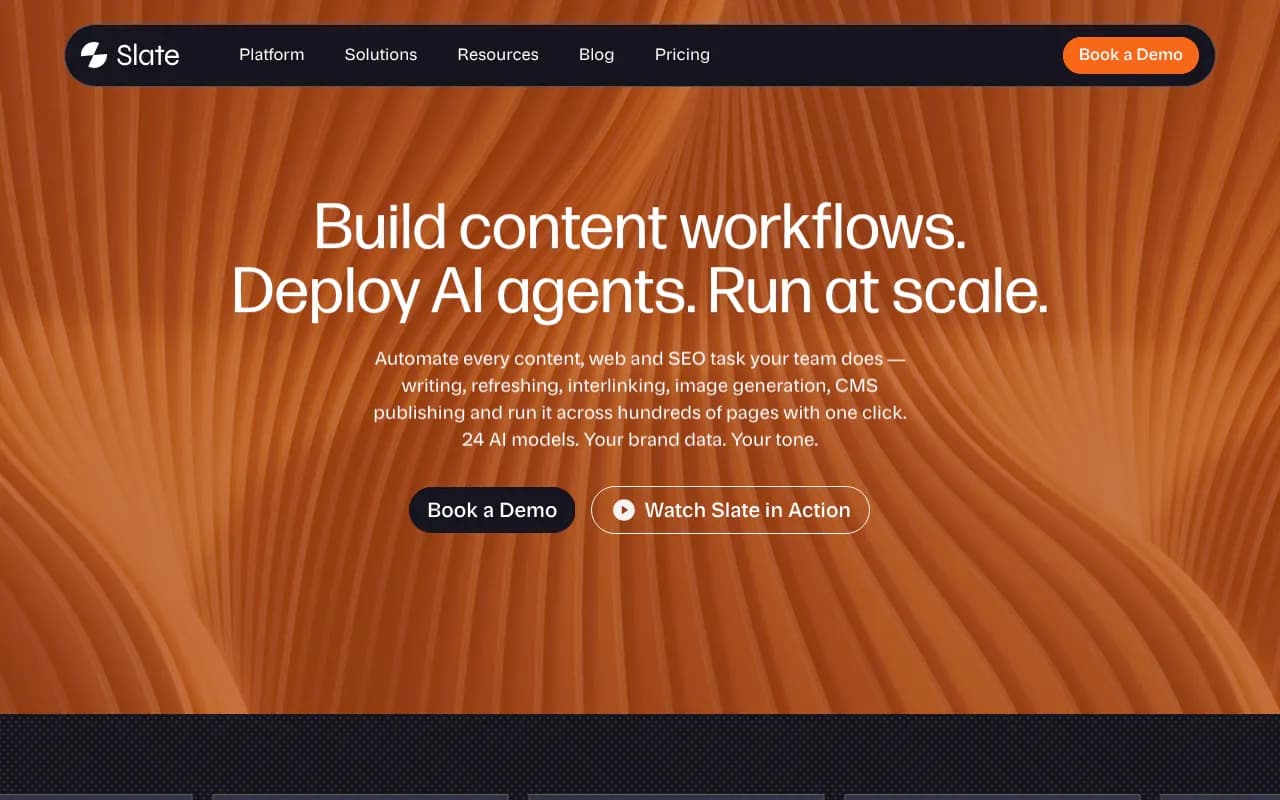
Where Slate stands out is in competitive intelligence depth. You can track how a client's top competitors appear in AI responses across the major LLMs, which makes it useful for both ongoing reporting and new business pitches. The interface is polished enough that you could walk a client through it without a lot of explanation.
The limitation is that Slate sits more on the monitoring side than the optimization side. It shows you the data clearly, but generating content to fix visibility gaps requires going elsewhere.
3. Otterly.AI
Otterly.AI is a solid entry point for smaller agencies or those just starting to add AI visibility to their service offering. It monitors six AI platforms, integrates with Looker Studio for white-label reporting, and has a Semrush integration that's useful if your team already lives in that ecosystem.

The Looker Studio white-label capability is genuinely practical -- you can build client-facing dashboards that look like your agency's own product. That's a meaningful advantage for agencies that care about presentation.
The trade-off is depth. Otterly.AI is monitoring-first, and it doesn't have crawler logs, content generation, or prompt volume data. For agencies managing a handful of clients who want clean monthly reports, it works well. For agencies running 20+ clients who need to show optimization progress, it starts to feel thin.
Pricing is competitive, which makes it worth considering for agencies that are still building out their AI visibility practice and don't want to over-invest before they've sold the service to clients.
4. Profound
Profound covers more AI platforms than almost any other tool on this list, which matters if your clients operate in markets where Gemini, Copilot, or regional AI search engines have significant share.
The enterprise positioning is real -- Profound is built for larger organizations with complex reporting needs, and the feature set reflects that. Competitive benchmarking is strong, and the data quality is generally regarded as reliable.
The practical issue for many B2B agencies is pricing. Profound uses custom enterprise pricing, which means you're not going to get a quick answer about whether it fits your budget. For agencies managing a large portfolio of enterprise clients, that conversation is worth having. For mid-market agencies, the price point may be hard to justify against alternatives that cover most of the same ground at a fraction of the cost.
Also worth noting: Profound doesn't have Reddit or YouTube tracking, and there's no ChatGPT Shopping monitoring. If those channels matter for your clients, that's a gap.
5. Scrunch AI
Scrunch AI takes a slightly different angle on the agency problem. It's focused on helping teams understand not just where a brand appears in AI responses, but the quality and sentiment of those mentions -- whether the AI is recommending the brand positively, neutrally, or not at all.
For B2B agencies working with clients in competitive categories where AI models have strong opinions (think software, financial services, healthcare), that sentiment layer adds real value to client conversations. It's easier to explain why a client needs to act when you can show that ChatGPT is actively recommending a competitor over them.
Multi-client management is supported, and the reporting exports are clean. The platform is less focused on content optimization than Promptwatch, but it's more analytically rich than basic monitoring tools.
6. Cairrot
Cairrot is worth mentioning specifically for smaller B2B agencies that need multi-client AI visibility tracking without a large budget commitment. It tracks five or more LLMs, supports multiple client accounts, and is priced accessibly enough that agencies can include it in a service offering without significant margin pressure.
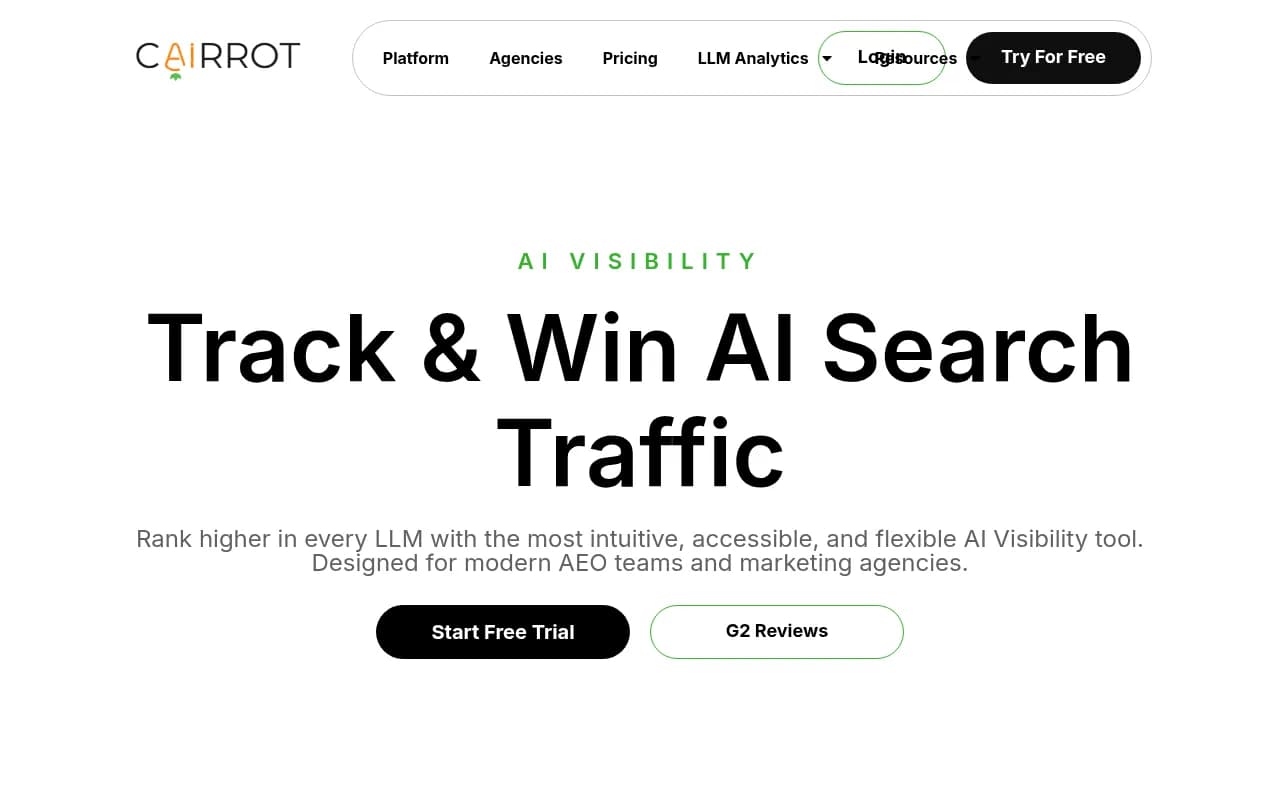
It's not the most feature-rich option on this list -- there's no content generation, no crawler logs, and prompt volume data is limited. But for agencies that are adding AI visibility as a reporting line item rather than a core service, Cairrot gives you the data you need to produce credible monthly reports without overcomplicating the workflow.
Side-by-side comparison
| Platform | Multi-client workspaces | White-label reporting | Content generation | Crawler logs | AI models covered | Best for |
|---|---|---|---|---|---|---|
| Promptwatch | Yes | Yes | Yes (Content Agents) | Yes | 10 | Agencies that need to show optimization results, not just data |
| Slate | Yes | Yes | No | No | 6+ | Agencies focused on competitive intelligence and clean reporting |
| Otterly.AI | Yes | Via Looker Studio | No | No | 6 | Small agencies starting their AI visibility practice |
| Profound | Yes | Yes | No | No | 10+ | Enterprise agencies with large client portfolios |
| Scrunch AI | Yes | Yes | No | No | 6+ | Agencies where brand sentiment in AI responses matters |
| Cairrot | Yes | Limited | No | No | 5+ | Budget-conscious agencies adding AI visibility as a line item |
| Peec AI | Limited | No | No | No | 5+ | Individual brands, not agency workflows |
What Peec AI is actually missing
It's worth being specific rather than vague about why Peec AI doesn't work well for agency use cases.
The interface is genuinely good. Community feedback consistently praises how clean and intuitive the data presentation is. If you're evaluating tools for a single brand, Peec AI is worth a look.
But the agency-specific gaps are real:
There's no white-label reporting. You can't export a branded PDF or share a client-facing dashboard under your agency's name. That's a fundamental problem when your deliverable is a monthly report.
Multi-client workspace architecture is limited. Managing multiple brands means managing multiple accounts, which creates operational friction at scale.
There's no content optimization layer. Peec AI shows you where a brand is invisible in AI responses. It doesn't help you fix it. For agencies that want to justify a retainer with measurable improvement, that's a significant gap.
Prompt volume data is thin. Knowing that a client isn't appearing for a particular query is useful. Knowing whether that query drives meaningful AI traffic -- and how hard it would be to win -- is what lets you prioritize work intelligently.
None of this makes Peec AI a bad product. It makes it the wrong product for agency workflows.
How to choose
The right platform depends on what you're actually selling to clients.
If you're selling AI visibility reporting as a deliverable -- monthly PDFs showing where clients appear in ChatGPT and Perplexity -- Otterly.AI or Cairrot will cover you at a reasonable price point. Slate is worth considering if you want stronger competitive intelligence in those reports.
If you're selling AI visibility optimization -- meaning clients pay you to actually improve their AI search presence, not just measure it -- you need a platform with content gap analysis and generation capabilities. Promptwatch is the only tool on this list that closes that loop end-to-end.
If you're working with enterprise clients who have complex multi-market needs and budget to match, Profound is worth the conversation despite the custom pricing.
The honest version of this advice: most agencies in 2026 are still figuring out how to package AI visibility as a service. If you're early in that process, start with something affordable and monitoring-focused. As you build the practice and clients start asking "okay, so what do we do about it?" -- that's when you need a platform that can answer that question.
A note on methodology
The tools in this guide were evaluated against real agency use cases: managing 15+ client brands, producing white-label monthly reports, running pre-pitch audits for prospects, and demonstrating optimization progress over time. Feature claims were cross-referenced against community discussions on r/SEO, r/b2bmarketing, and r/GrowthHacking, as well as public pricing pages and third-party review sites.
Pricing and features in this space change frequently. Always verify current plan details directly with each vendor before making a decision.