Key takeaways
- BrightEdge has the deepest traditional SEO data (10B+ keywords) but its AI search features are layered on top of a legacy architecture, not built for it.
- Conductor is easier to deploy and better for content teams, but its AEO capabilities are still maturing compared to purpose-built platforms.
- Omnia is purpose-built for AI visibility tracking and fills the gap both legacy platforms leave open, though it doesn't replace your SEO suite.
- None of the three fully closes the optimization loop on their own. For teams that need to go from gap analysis to content creation to traffic attribution, purpose-built GEO platforms like Promptwatch cover more ground.
- The right choice depends heavily on your team structure: data-heavy SEO operations, content-forward editorial teams, and AI-first visibility programs have different needs.
There's a specific kind of frustration that comes from spending $30,000 a year on an enterprise SEO platform and then watching a competitor get cited in ChatGPT while your brand doesn't appear at all.
BrightEdge and Conductor have been competing for that $25,000 to $50,000 annual contract since roughly 2010. They're both credible, well-supported platforms with serious enterprise pedigrees. But they were designed for a world where Google's ten blue links were the only game in town. That world is changing faster than either platform has adapted.
Omnia entered the picture as a purpose-built AI visibility tool, explicitly targeting the gap that legacy SEO suites leave open. It's a different kind of product solving a different kind of problem.
This guide ranks all three by optimization depth specifically for AEO (Answer Engine Optimization) in 2026. Not by feature count. Not by brand recognition. By how far each platform actually takes you toward getting cited in AI-generated responses.
What "optimization depth" actually means for AEO
Before ranking anything, it's worth being clear about what we're measuring. Optimization depth in an AEO context means more than tracking whether your brand appears in ChatGPT or Perplexity. It means:
- Can the platform tell you why competitors are getting cited and you're not?
- Can it identify the specific content gaps driving that difference?
- Does it help you create or fix content to close those gaps?
- Can you measure whether the changes you made actually improved visibility?
A platform that only answers the first question is a monitoring tool. A platform that answers all four is an optimization platform. That distinction matters a lot when you're trying to justify the budget to a CMO.
BrightEdge: analytical depth, legacy architecture
BrightEdge is the largest pure-play enterprise SEO platform in the market. Its Data Cube covers over 10 billion keywords with real-time tracking across geographies and SERP features. For traditional search, that breadth is genuinely hard to match.
Where BrightEdge is strong
The platform's competitive intelligence is its best feature. You can see keyword-level share of voice against specific competitors, track SERP feature ownership (featured snippets, PAAs, image carousels), and get page-level performance data at a scale that smaller platforms can't match. For a 500-page enterprise site with complex technical SEO needs, BrightEdge's site audit and crawl capabilities are solid.
Its reporting is also built for executive stakeholders. The dashboards are credible in quarterly reviews, which matters when you're defending a six-figure SEO budget.
Where BrightEdge falls short for AEO
BrightEdge has added AI Overviews tracking and some LLM citation monitoring, but these feel like additions to a platform that wasn't designed with them in mind. The core architecture is built around keyword rankings in traditional search. AI citation data is surfaced, but the workflow for acting on it is thin.
Specifically: BrightEdge can show you that you're not appearing in AI Overviews for a set of queries. It's much harder to use the platform to understand why, identify the content that would fix it, and then track whether that content actually improved your AI visibility over time.
The adoption curve is also real. Most enterprise teams report 2 to 3 months before BrightEdge is fully deployed and producing useful data. That's not a dealbreaker, but it's a cost.
AEO optimization depth score: 2/5
Strong monitoring layer for traditional search, weak execution layer for AI citation optimization.
Conductor: content-forward, faster to deploy
Conductor has always positioned itself as the more content-team-friendly alternative to BrightEdge. Its AI-assisted content recommendations and shorter adoption curve (2 to 3 weeks versus months) make it genuinely easier to get editorial teams using it consistently.
Where Conductor is strong
The content workflow is Conductor's real differentiator. Where BrightEdge is built for SEO analysts who live in data, Conductor is built for the content strategist who needs to brief a writer. Its AI-assisted recommendations surface optimization opportunities in a format that non-technical users can act on.
For teams where the SEO function sits inside a broader content or marketing organization, Conductor's usability advantage is significant. You don't need a dedicated SEO analyst to extract value from it.
Conductor has also been faster to add AI search tracking features in 2025 and 2026 than BrightEdge, which reflects its more agile product culture.
Where Conductor falls short for AEO
The AEO features are improving, but they're still primarily monitoring. Conductor can show you where you appear (or don't) in AI-generated responses. The gap analysis capabilities are less developed than purpose-built AI visibility platforms, and the content generation features aren't specifically designed around what gets cited by LLMs.
There's also a ceiling on the data depth. Conductor's keyword database and competitive intelligence aren't as comprehensive as BrightEdge's, which matters for large enterprise sites with complex competitive landscapes.
AEO optimization depth score: 2.5/5
Better usability and faster iteration than BrightEdge, but still primarily a monitoring and traditional-SEO-optimization platform.
Omnia: purpose-built for AI visibility
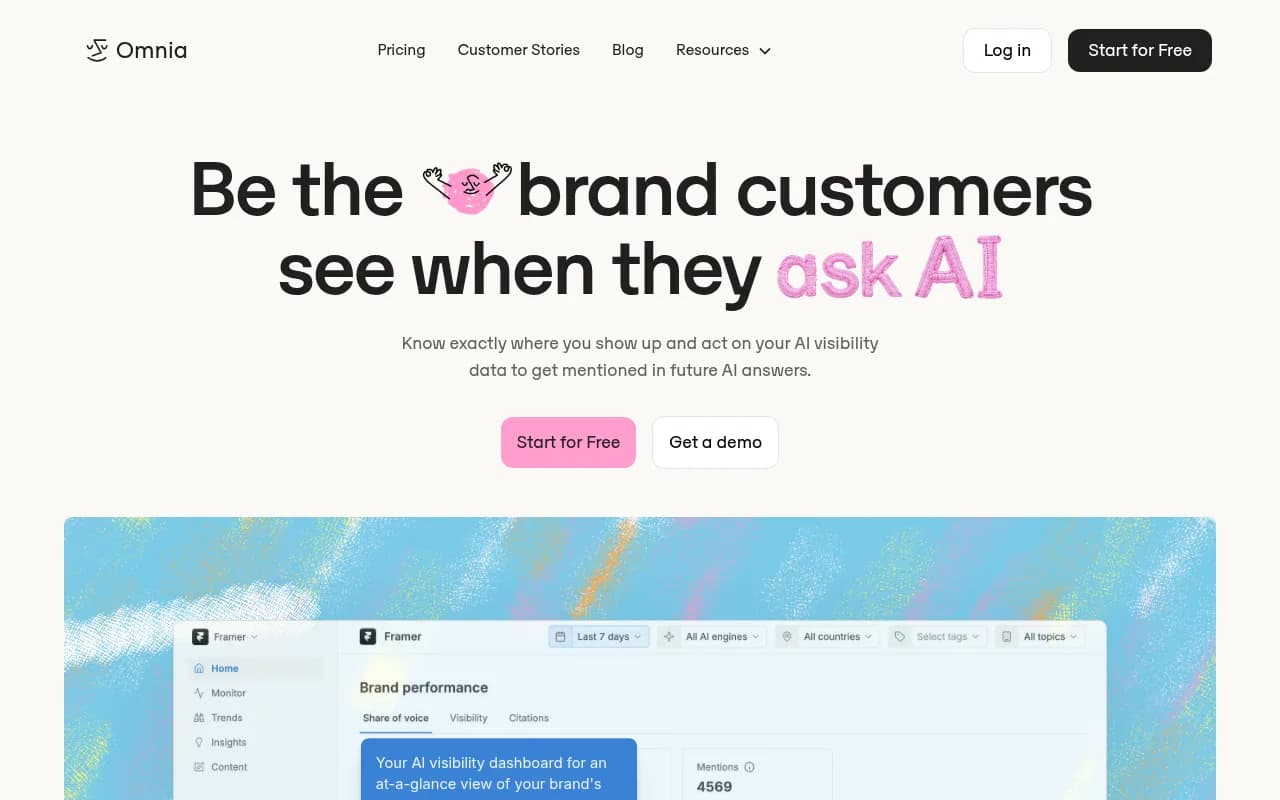
Omnia is a different kind of product. It wasn't built to replace BrightEdge or Conductor. It was built to do what they can't: track and optimize specifically for AI search citations.

Where Omnia is strong
Omnia's core value is citation intelligence. It tracks which sources AI models are citing in response to specific prompts, which lets you understand not just whether you're visible but why competitors are visible and you're not. That's a meaningfully different question than "what's my keyword ranking."
The platform also handles localized tracking by country, which matters for enterprise teams with international presence. US-only AI visibility data can be actively misleading if your buyers are in Germany or Australia.
Prompt coverage is another area where Omnia outperforms legacy platforms. Rather than tracking a fixed set of branded queries, it maps the actual prompts buyers use during research and discovery, which gives you a more accurate picture of where you're winning and losing in AI-generated responses.
Where Omnia falls short
Omnia doesn't have the traditional SEO depth of BrightEdge or Conductor. If you need keyword ranking data, technical site audits, or backlink analysis, you still need a separate platform. Omnia is explicitly positioned as a complement to your existing SEO stack, not a replacement.
The content generation capabilities are also more limited than some newer GEO platforms. Omnia identifies gaps well; the execution layer for closing those gaps is less developed.
AEO optimization depth score: 3.5/5
The strongest of the three for AI-specific visibility tracking, but still primarily a monitoring and analysis tool rather than a full optimization platform.
Head-to-head comparison
| Capability | BrightEdge | Conductor | Omnia |
|---|---|---|---|
| Traditional keyword tracking | Excellent (10B+ keywords) | Good | Minimal |
| Technical SEO auditing | Excellent | Good | Not available |
| AI citation monitoring | Basic | Basic-to-moderate | Strong |
| Prompt gap analysis | Weak | Weak | Strong |
| Content generation for AEO | None | Basic AI assist | Limited |
| Localized AI tracking | Limited | Limited | Yes |
| Adoption curve | 2-3 months | 2-3 weeks | Weeks |
| Best for | Data-heavy SEO teams | Content-forward teams | AI-first visibility programs |
| Pricing (approx.) | $25K-$50K/yr | $25K-$50K/yr | Lower entry point |
| AEO optimization depth | 2/5 | 2.5/5 | 3.5/5 |
The pattern is clear. BrightEdge wins on data breadth for traditional search. Conductor wins on usability. Omnia wins on AI-specific visibility intelligence. None of them fully closes the optimization loop.
The gap all three leave open
Here's the honest assessment: even Omnia, the strongest of the three for AEO purposes, is primarily a monitoring and analysis tool. It tells you where you're invisible and why. It doesn't generate the content that would fix it, and it doesn't directly connect improved AI visibility to traffic and revenue.
That gap matters. The full AEO optimization loop looks like this:
- Find the specific prompts where competitors are cited and you're not
- Understand what content is driving those citations
- Create content engineered to get cited by LLMs
- Track whether that content actually improved your visibility
- Connect visibility improvements to traffic and pipeline
BrightEdge and Conductor cover step 4 reasonably well for traditional search, but steps 1-3 and 5 for AI search are weak across all three platforms. Omnia covers steps 1-2 well but is thinner on 3-5.
Platforms built specifically around this full loop, like Promptwatch, are worth evaluating if your team needs to go beyond monitoring into actual optimization. Promptwatch's Answer Gap Analysis identifies the specific prompts where competitors are visible and you're not, its AI writing agent generates content grounded in citation data, and its traffic attribution connects AI visibility to actual revenue.

That's not a knock on Omnia, BrightEdge, or Conductor. They're solving real problems. But if your brief is "improve our AI search visibility and show the business impact," you need to be honest about what each platform actually delivers.
Which platform should you choose?
The answer depends on your team's actual situation, not on which platform has the most impressive demo.
Choose BrightEdge if your SEO team is data-science-heavy, you have a large site with complex technical SEO needs, and AI search visibility is a secondary priority behind traditional search performance. The platform's depth is real, even if its AEO capabilities are still catching up.
Choose Conductor if your SEO function sits inside a content or marketing team, you need faster time-to-value, and you want AI-assisted content recommendations that non-technical users can act on. The usability advantage is genuine.
Choose Omnia if AI search visibility is your primary concern and you already have a traditional SEO platform handling keyword rankings and technical audits. Omnia works best as a complement to an existing stack, not as a standalone solution.
Consider purpose-built GEO platforms if you need the full optimization loop: gap analysis, content creation, visibility tracking, and traffic attribution all in one place. Tools like Promptwatch, Profound, or Evertune are built specifically for this workflow.
A note on the broader market
The enterprise AEO market is moving fast. According to Adobe Analytics data, AI-sourced traffic to U.S. retail sites grew 3,500% between July 2024 and May 2025. Gartner projected a 25% drop in traditional search volume by 2026. Those numbers explain why every legacy SEO platform is scrambling to add AI visibility features.
The risk for enterprise buyers is paying for a platform that's adding AI features as an afterthought while the core product remains optimized for a search environment that's shrinking. BrightEdge and Conductor are both in this position to some degree.
That doesn't mean they're bad platforms. For teams where traditional search still drives the majority of organic traffic, they remain defensible choices. But the evaluation criteria for "best enterprise SEO platform" in 2026 are genuinely different from what they were in 2022, and the platforms that were built for the new environment have a structural advantage in AEO depth.
The honest answer is that most enterprise teams will end up running two platforms: one legacy SEO suite for traditional search, and one purpose-built AI visibility tool for the citation layer. The question is which combination makes sense for your team size, budget, and strategic priorities.