Key takeaways
- Perplexity, Claude, and Gemini each have distinct citation behaviors — a one-size-fits-all AEO strategy won't cut it across all three.
- Most AEO tools track AI visibility but stop there. The ones worth using in 2026 also help you identify gaps and create content that fills them.
- Structured, authoritative, direct-answer content is the common thread across all AI models — but the signals each model weights differ.
- Tracking your AI visibility without acting on it is a waste of time. The loop is: find gaps, create content, measure results.
- Tools like Promptwatch can show you which prompts you're missing across specific models, not just ChatGPT.
Why "just optimize for ChatGPT" is already a losing strategy
For the past two years, most AEO conversations have been ChatGPT-centric. That made sense when ChatGPT had an overwhelming share of AI search traffic. But 2026 looks different.
Perplexity has become the go-to tool for research-heavy queries. Claude is increasingly used for professional and technical questions. Gemini is embedded in Google's ecosystem and handles a huge volume of everyday searches through AI Overviews and AI Mode. These aren't niche platforms anymore.
The problem is that each model cites sources differently. Perplexity is aggressive about pulling citations and showing them inline. Claude tends to synthesize without linking unless it's in a search-enabled context. Gemini's AI Overviews favor content that already ranks well in traditional Google search. If your AEO strategy only optimizes for one of them, you're invisible to the others.
This guide walks through how each platform works, what signals they respond to, and how to use AEO tools to actually win featured positions across all of them.
How Perplexity, Claude, and Gemini actually cite content
Before you can optimize for these platforms, you need to understand how they behave.
Perplexity
Perplexity is the most citation-transparent of the three. It actively shows numbered sources for almost every response, and users can click through to verify. This means getting cited by Perplexity is visible and measurable.
Perplexity tends to favor:
- Pages that directly answer a specific question in the first paragraph
- Content with clear structure (headers, lists, numbered steps)
- Sources with strong domain authority and recent publication dates
- Reddit threads, YouTube videos, and forum discussions for opinion-based queries
One thing worth knowing: Perplexity's crawler (PerplexityBot) is active and frequent. If your site has crawl errors or blocks bots in your robots.txt, you're effectively invisible to it.
Claude
Claude's citation behavior depends heavily on context. In its default conversational mode, it synthesizes information without citing sources. But when users enable web search (available in Claude's paid tiers), it pulls live sources and shows them.
Claude tends to favor:
- Long-form, well-reasoned content that demonstrates expertise
- Pages that cover a topic comprehensively rather than just answering one question
- Content that reads naturally and authoritatively, not keyword-stuffed
- Established domains with a track record of accurate information
Claude is harder to track because its citation behavior isn't always visible to the end user. This is where having crawler log data becomes genuinely useful — you can see when Anthropic's crawler is hitting your pages even when you can't see the output.
Gemini and Google AI Overviews
Gemini's AI Overviews are deeply tied to traditional Google ranking signals. If you're not ranking in the top 10 for a query, your chances of appearing in an AI Overview for that query drop significantly. But it's not purely a function of rank — content structure matters too.
Gemini tends to favor:
- Content that directly answers the query in a concise, structured format
- Pages with strong E-E-A-T signals (experience, expertise, authoritativeness, trustworthiness)
- Schema markup and structured data
- Content that Google's crawlers have indexed recently
Google AI Mode (the more conversational version of Gemini search) pulls from a wider range of sources and behaves more like Perplexity in terms of citation transparency.
The AEO content framework that works across all three
Despite their differences, Perplexity, Claude, and Gemini share some common preferences. Content that performs well across all three tends to have these characteristics:
Direct answers up front. Don't bury the answer in paragraph four. State it clearly in the first 100 words, then expand. AI models are looking for the answer, not the preamble.
Clear heading structure. Use H2 and H3 headers that mirror the questions your audience is actually asking. "How does X work?" and "What is the difference between X and Y?" are the kinds of headers that get pulled into AI responses.
Factual specificity. Vague claims get ignored. Specific data points, named examples, and concrete numbers get cited. "Studies show that..." is useless. "According to Gartner's 2025 AI adoption report, 67% of enterprises..." is citable.
Topical depth over breadth. A page that thoroughly covers one topic beats a page that superficially covers ten. AI models are increasingly good at detecting thin content.
Author and entity signals. Pages with clear author attribution, organization schema, and consistent brand mentions across the web perform better. This is especially true for Claude and Gemini.
How to use AEO tools to find your gaps
Knowing the framework is one thing. Knowing which specific gaps to fill on your site is another. This is where AEO tools earn their keep.
The most useful AEO tools in 2026 do more than show you a visibility score. They show you the specific prompts where competitors are being cited and you're not. That's the actionable data.
Here's what to look for in an AEO tool:
- Prompt-level tracking across multiple models (not just ChatGPT)
- Competitor citation analysis (who's getting cited for the prompts you care about)
- Source detection (which of your pages are being cited, and by which models)
- Content gap identification (prompts where you have no relevant content)
- Crawler log data (which AI bots are hitting your site and when)
Promptwatch covers all of these. Its Answer Gap Analysis shows you the exact prompts where competitors are visible but you're not, across Perplexity, Claude, Gemini, ChatGPT, and several other models. The crawler log feature is particularly useful for understanding whether AI bots are actually reading your new content after you publish it.

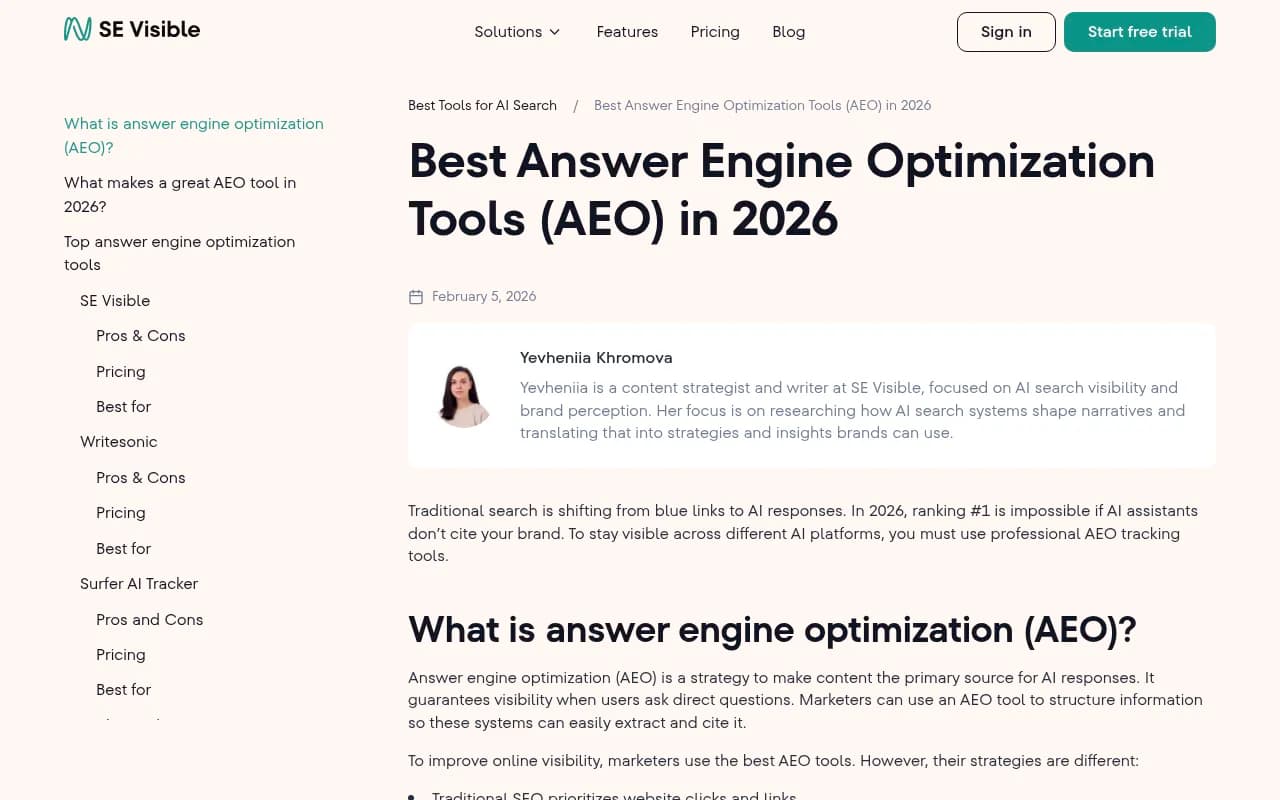
For teams that want a more traditional SEO-adjacent approach, SE Visible from SE Ranking tracks brand visibility and sentiment across AI search engines with a clean interface.
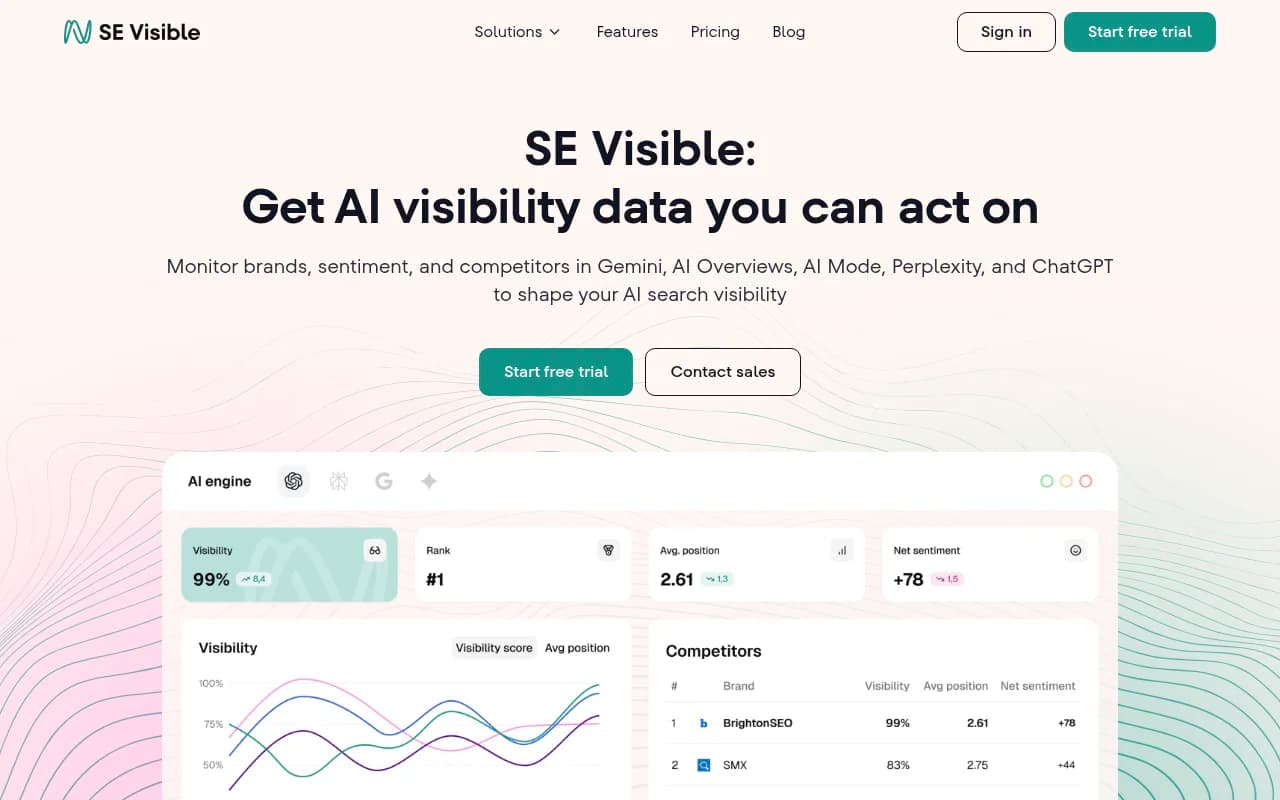
Nightwatch combines classic rank tracking with AI visibility monitoring, which is useful if you're managing both traditional SEO and AEO in the same workflow.
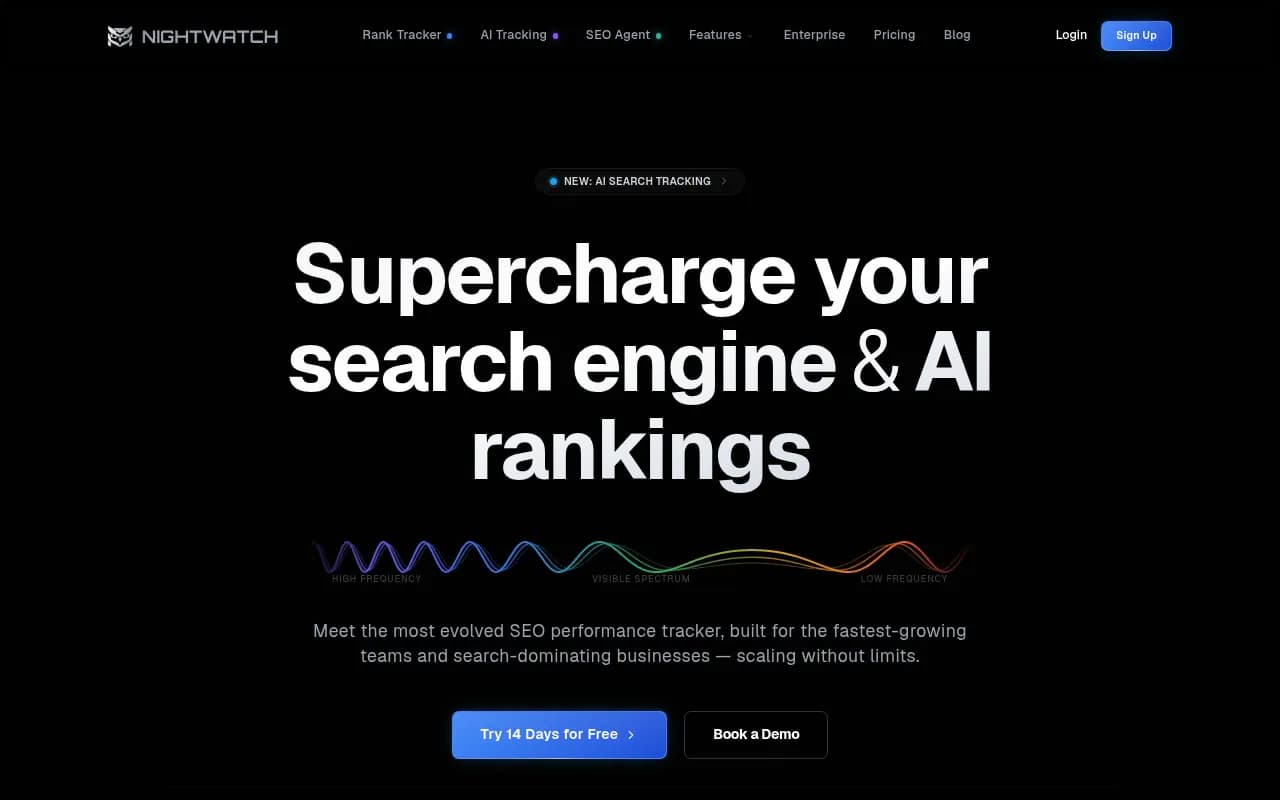
Writesonic has built out a GEO workflow that combines visibility tracking with in-platform content optimization — worth looking at if you want tracking and content creation in one tool.
Platform-specific tactics
Winning in Perplexity
Perplexity's citation system is your friend here because it's transparent. You can actually see what it's citing for any query by searching yourself.
Start by identifying 20-30 queries in your space and running them in Perplexity. Note which sources appear. If competitors are showing up and you're not, look at what their cited pages have that yours don't. Usually it comes down to: more direct answers, better structure, or more specific data.
Perplexity also pulls heavily from Reddit and YouTube for certain query types. If your brand isn't mentioned in relevant Reddit discussions, that's a gap worth addressing — not by spamming threads, but by genuinely participating in communities where your expertise is relevant.
One technical note: make sure PerplexityBot isn't blocked in your robots.txt. It sounds obvious, but a surprising number of sites accidentally block it.
Winning in Claude
Claude is harder to optimize for directly because its citation behavior is less predictable. The best approach is to focus on becoming a genuinely authoritative source in your space — the kind of content that a well-read expert would cite.
This means:
- Publishing comprehensive guides that cover topics end-to-end
- Building a consistent publishing cadence so Claude's training data (and search-enabled responses) see you as an active, reliable source
- Getting cited by other authoritative sites, since Claude's synthesis tends to favor sources that are widely referenced
For tracking Claude specifically, you need a tool that monitors Anthropic's crawler activity. Most basic AEO tools don't do this. Promptwatch's crawler logs show when ClaudeBot hits your pages, which gives you a feedback loop even when you can't see the output directly.
Winning in Gemini and Google AI Overviews
For Gemini, traditional SEO fundamentals still matter more than for the other two. If you're not ranking on page one for a query, your AI Overview chances are slim.
But beyond rankings, structure is critical. Google's AI Overviews tend to pull from pages that have:
- Clear question-and-answer formatting
- FAQ schema markup
- Concise, direct answers (usually 40-60 words) followed by supporting detail
- Strong internal linking to related content
Google AI Mode is more experimental and pulls from a broader range of sources. It's worth monitoring separately from AI Overviews because the citation patterns differ.
Building a repeatable AEO workflow
One-off optimizations don't compound. What works is a repeatable process. Here's a simple workflow that applies across all three platforms:
Step 1: Identify high-value prompts. Use an AEO tool to find prompts in your space with meaningful volume where you're currently not being cited. Prioritize by volume and competitive difficulty.
Step 2: Audit what's currently being cited. For each priority prompt, look at what content is winning citations. Identify the structural and content patterns that appear across the top sources.
Step 3: Create or update content. Either create new pages targeting the gap or update existing pages to better match the patterns you identified. Focus on direct answers, clear structure, and factual specificity.
Step 4: Monitor crawler activity. After publishing, watch your crawler logs to see when AI bots index the new content. This tells you how quickly each model is picking up your changes.
Step 5: Track citation changes. Give it 2-4 weeks, then check whether your citation rate for those prompts has improved. Adjust based on what you see.
This loop — find gaps, create content, track results — is what separates teams that grow their AI visibility from teams that just watch their dashboards.
AEO tool comparison: what to use for what
| Tool | Models tracked | Content generation | Crawler logs | Best for |
|---|---|---|---|---|
| Promptwatch | 10+ (ChatGPT, Perplexity, Claude, Gemini, Grok, DeepSeek, Copilot, more) | Yes (Content Agents) | Yes | Full AEO workflow: gaps, content, tracking |
| SE Visible | AI Overviews, AI Mode, Gemini, ChatGPT, Perplexity | No | No | Strategic brand visibility monitoring |
| Writesonic | ChatGPT, AI Overviews, Gemini, Perplexity, Claude | Yes | No | Tracking + content optimization in one |
| Nightwatch | ChatGPT, AI Overviews, Copilot, Perplexity, Claude | No | No | SEO + AI visibility combined |
| Otterly.AI | ChatGPT, Perplexity, Gemini, Claude | No | No | Budget-friendly basic monitoring |
| Profound | Multiple enterprise models | No | No | Enterprise brand monitoring |
| Athena HQ | 8+ AI search engines | No | No | Monitoring-focused teams |

The technical side people ignore
Most AEO content focuses on content strategy. The technical side gets less attention, but it matters.
Robots.txt and crawler access. Each AI platform has its own crawler. PerplexityBot, ClaudeBot, GPTBot, Google-Extended — check that none of these are blocked on your site unless you have a specific reason to block them.
Page speed and crawlability. AI crawlers behave differently from Googlebot, but slow pages and crawl errors still hurt you. A page that times out during a crawl doesn't get indexed.
Schema markup. FAQ schema, HowTo schema, and Article schema all help AI models understand your content structure. They're not magic, but they're low-effort signals worth adding.
Canonical tags and duplicate content. AI models can get confused by duplicate content just like Google can. Make sure your canonical setup is clean.
Tools like Prerender.io handle some of the technical rendering issues that can affect AI crawler access, particularly for JavaScript-heavy sites.
What good looks like in 2026
The brands winning AI visibility across Perplexity, Claude, and Gemini in 2026 aren't doing anything exotic. They're publishing specific, well-structured content that directly answers questions their audience is asking. They're monitoring which prompts they're winning and losing. And they're iterating based on real data rather than guessing.
The main mistake is treating AEO as a one-time project. AI models update constantly, new competitors enter the citation landscape, and user query patterns shift. The teams that maintain visibility are the ones running a continuous optimization process, not the ones who published a few FAQ pages in Q1 and moved on.
Pick the right tools for your workflow, build the habit of checking your citation data regularly, and focus your content efforts on the specific gaps your data shows — not on what feels intuitively important.