Key takeaways
- "Slop" was Merriam-Webster's 2025 Word of the Year, defined as low-quality digital content produced in bulk by AI. That's not a meme anymore, it's a dictionary entry.
- Roughly 17% of the top 20 Google results were AI-generated as of late 2025 (Originality.ai), so your content isn't competing against obviously human writing anymore, it's competing against a sea of mediocre AI output. Sounding different is now an advantage.
- Internally, "workslop" costs a mid-size company real money: BetterUp and Stanford found 40% of desk workers received AI workslop in the past month, costing roughly $186 per employee per month in cleanup time.
- AI search engines are already filtering out low-signal content on their own. Reddit's citation share in ChatGPT dropped from about 3.8% to under 1% in a matter of days in August 2026, a sign that even AI platforms are getting pickier about what counts as trustworthy.
- A short, repeatable checklist (banned phrases, structural tells, and a human read-through) catches most slop before it ships. You don't need a PhD in linguistics, you need a five-minute habit.
Why this is suddenly everyone's problem
If you run a content team, you've probably had this conversation already: someone ships a draft, it's technically correct, it's on-brief, the headline works. And it still feels like nothing. No error to point to, just a vague sense that nobody actually wrote it, a machine assembled it.
That feeling has a name now. Merriam-Webster picked "slop" as its 2025 Word of the Year, defining it as "digital content of low quality that is produced usually in quantity by means of artificial intelligence." Dictionary people don't usually validate internet slang unless it's describing something real. This is describing something real.
Here's the part that should worry a content lead specifically: this isn't confined to spam blogs nobody reads. Originality.ai's ongoing tracking found that about 17% of the top 20 Google search results were AI-generated as of last fall. That means AI content, including the sloppy kind, is already sitting in results next to yours. If your team's output reads like everyone else's AI output, you don't stand out by using AI. You stand out by not sounding like it.

What AI slop actually is (and isn't)
Slop isn't "content made with AI." That distinction matters, because a lot of content leads panic and ban AI outright, which mostly just slows down a team that was already going to use AI anyway, just less carefully.
Slop is content that's generic, repetitive, or hollow, regardless of who or what produced it. Google's own spam policy actually backs this up: the "scaled content abuse" rule targets pages made primarily to manipulate rankings "whether automation, humans, or a combination are involved." A content mill of underpaid freelancers churning out templated garbage is just as much a target as an unedited ChatGPT dump. The method isn't the violation. The lack of value is.
So the real question for a content lead isn't "did AI touch this?" It's "does this sound like someone who has actually done the thing they're writing about, or does it sound like the average of everything ever written about the topic?" Slop is the average. Good content, AI-assisted or not, has a point of view.
The tells: what to actually look for
A researcher named Sam Paech and colleagues published a paper at ICLR 2026 (arXiv:2510.15061) that measured this rigorously. They found certain phrasing patterns show up over 1,000 times more often in LLM output than in human writing. That's not a stylistic quirk, it's a fingerprint. Here's what to scan for in a review pass.
Banned phrases
If you see these in a draft, don't edit around them, ask why they're there at all:
- "Not only X, but also Y" and its cousin "It's not just X, it's Y"
- "In today's fast-paced world/digital landscape"
- Participle-phrase padding: sentences that end in "...highlighting," "...underscoring," "...fostering," "...ensuring" tacked on for fake depth
- "Crucial," "pivotal," "testament to," "stands as," "in the heart of" -- all inflate the importance of something that doesn't need it
Structural tells
- Rule-of-three lists everywhere, even when the idea only has two parts or four
- Every paragraph the exact same length, every list item starting with a bolded label followed by a colon
- A "conclusion" section that restates the intro almost word for word and ends with something like "the future looks bright"
- Headings in title case that read like a listicle from 2019
The trust gap
- No specific numbers, names, dates, or sources anywhere in the piece, just "many experts believe" or "studies show"
- No opinion. If you removed the byline, could this have been written by literally anyone on the internet? If yes, that's the problem.
- Zero friction. Real writing about real work includes mistakes, dead ends, and "this didn't work at first." Slop is suspiciously tidy.
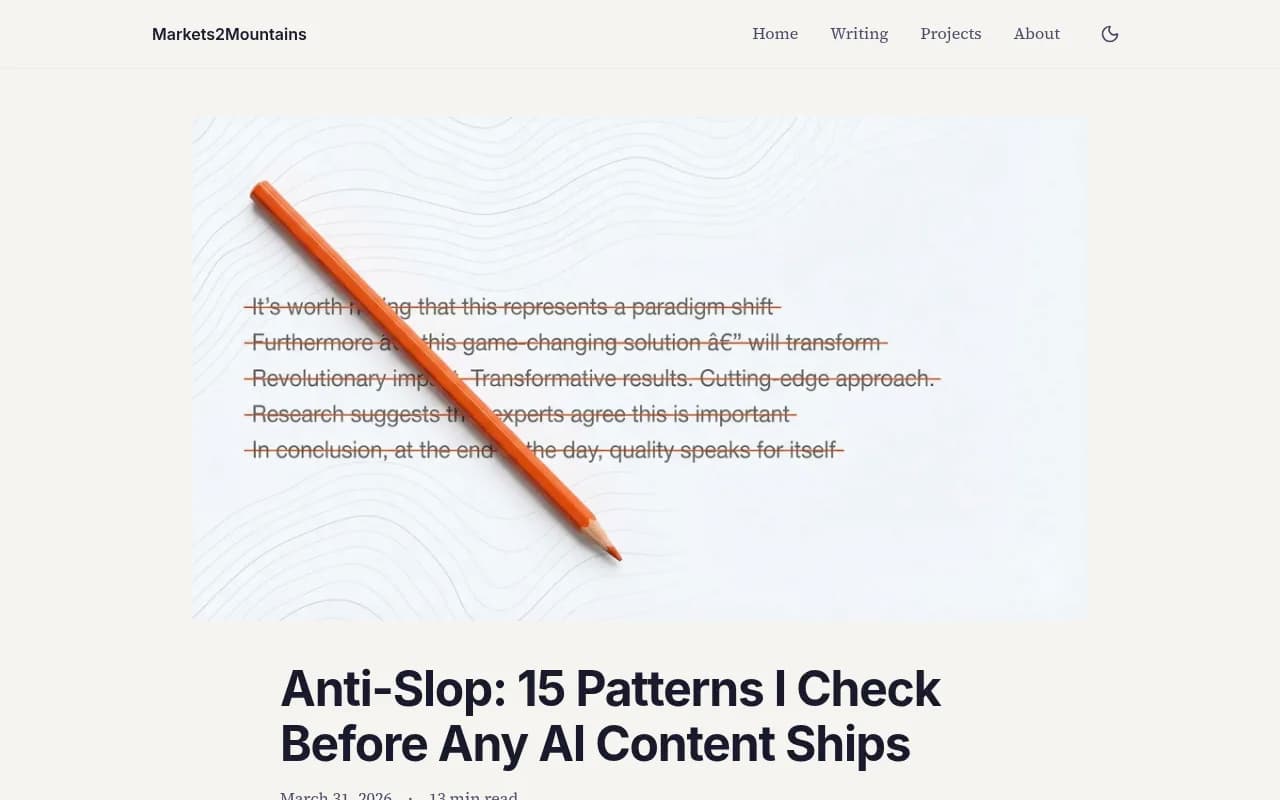
One practitioner who ships AI-assisted content daily built a 15-point pre-publish checklist around exactly this, organized into banned phrases, structural patterns, and trust signals. It's worth reading in full if you want a working template rather than a theory.
The internal cost you're probably not measuring
Most slop conversations focus on readers and Google. There's a quieter cost inside the building. BetterUp Labs and Stanford's Social Media Lab coined the term "workslop" for AI output that looks finished but isn't, and found 40% of U.S. desk workers had received some in the past month. The average incident takes about two hours to clean up, and across a 10,000-person company that works out to roughly $9 million a year in lost productivity.
If your content team is generating drafts faster with AI but your editors are spending more time fixing them, you haven't gained anything. You've just moved the labor downstream and made it less visible on a timesheet. If editing time per piece is going up while your team calls itself "faster," that's the tell. Track it.
AI search engines are already filtering out the low-effort stuff
Here's something most content teams miss: you're not the only one deciding what counts as slop. The AI platforms your content shows up in are making that call too, and the data shows they're getting stricter.
Promptwatch's tracking of ChatGPT Search citations found Reddit held a steady 3.8% citation share through late July and early August 2026, then collapsed to under 1% within days in mid-August. That's an 86% relative drop in about a week. Google's AI Overviews and AI Mode pulled back from Reddit too, just more gradually. Whatever changed, it looks like a deliberate re-weighting away from lower-signal, UGC-heavy sources.
Meanwhile, Promptwatch's data on ChatGPT citation types shows product pages and how-to content leading the month, while generic listicle-style content that says nothing specific keeps losing ground. And a separate report on average sources per response found ChatGPT typically cites only around five sources per answer, roughly half of a classic ten-link Google results page. With half the slots, there's no room for the merely adequate. Content has to be the single best answer to a specific question, which is the exact opposite of scaled, generic slop.
One more myth worth killing here: publishing markdown mirrors of your blog "for the AI" doesn't help your AI search visibility. Promptwatch's research found markdown files account for just 0.05% of citations across ChatGPT, Claude, Perplexity, and AI Overviews, essentially a rounding error. That tactic is for coding agents like Claude Code, not consumer AI search.
If you care about your content showing up in AI answers, tools like Promptwatch can show you which of your pages are actually getting cited and why, rather than guessing.

A practical audit checklist for content leads
Here's a version you can actually run on a Friday afternoon without hiring a linguist.
- Pick five recent pieces at random, not your best ones
- Search each for the banned-phrase list above. More than two hits, send it back
- Read the conclusion out loud. If it sounds like a corporate mission statement, rewrite it
- Ask: does this piece contain one fact, number, or detail that could only come from someone who actually did the thing? If not, that's the gap to fill, not a styling problem
- Check editing time per piece over the last quarter. Rising editing time with "faster" drafting is a workslop signal, not a productivity win
- Spot-check one piece with an AI detector, understanding that these tools are vendor-tested and imperfect, so treat a single score as a flag to investigate, not a verdict
Tools that help you catch it before it ships
None of these replace a human editor with a trained eye, but they cut down how much slop reaches that editor in the first place.
| Tool | What it actually checks | Best for |
|---|---|---|
| Grammarly | Grammar, tone, clarity, some AI-tell flagging | General polish pass |
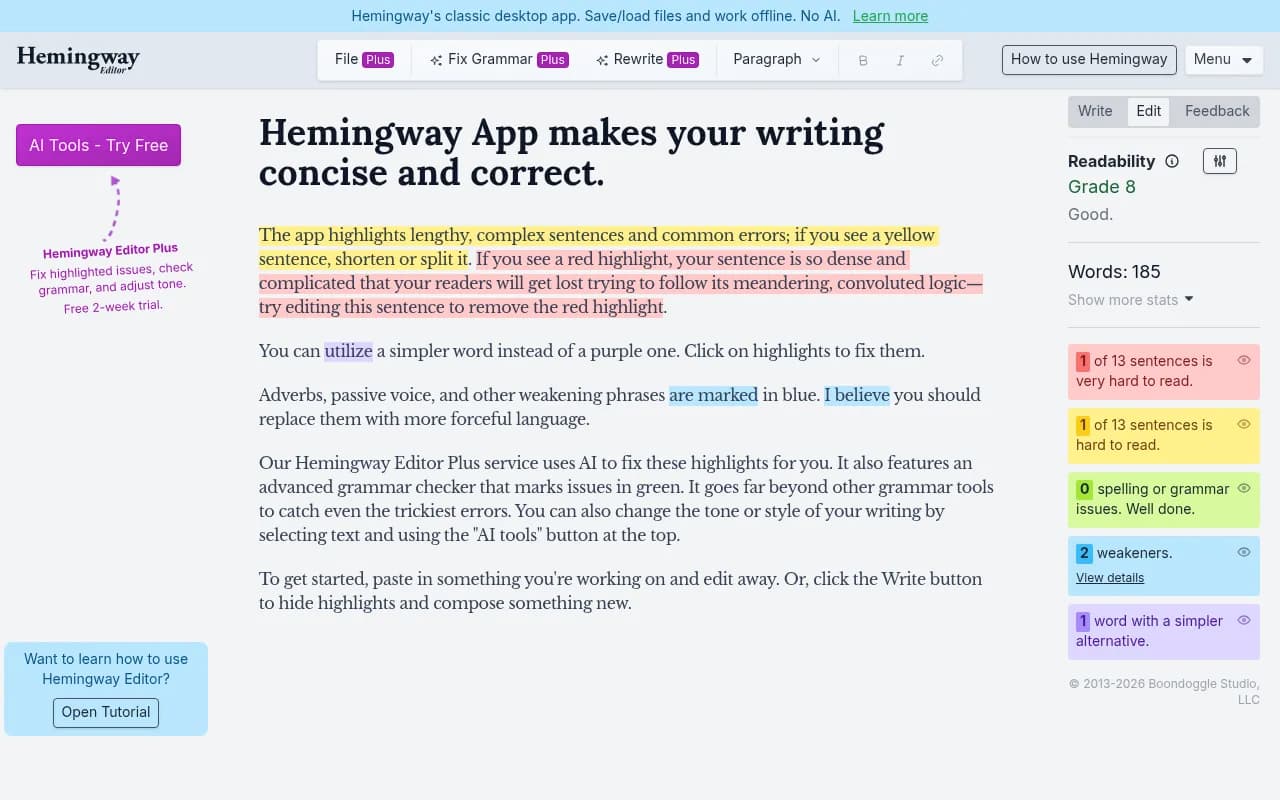
| Hemingway App | Readability, sentence length, passive voice | Catching bloated, over-hedged sentences |
| LanguageTool | Grammar and style across multiple languages | Multilingual content teams |
| Surfer SEO | Content structure and on-page optimization | Making sure edited content still targets the right terms |
| Clearscope | Semantic relevance and content depth scoring | Long-form pieces that need real topical coverage |
| Promptwatch | AI citation tracking, content gap analysis, crawler logs | Knowing whether your published content is actually getting cited in AI answers, not just ranking in Google |
A quick note on AI detectors specifically: accuracy claims from vendors like Originality.ai and Pangram range widely depending on the study, and false positive rates climb in non-English text. Use a detector score as one data point in a review, not as the final word on whether something ships.
Building a review process that actually scales
The teams that avoid slop long-term don't rely on one editor catching everything at the end. They build the check earlier:
- Require every brief to include one fact, source, or example only someone close to the subject would know, before drafting even starts
- Run the banned-phrase scan as a saved search or a simple script, not a mental checklist someone forgets under deadline
- Track editing time per piece as a real metric, the same way you'd track word count or turnaround time
- Rotate who does the final human read. Fresh eyes catch tells that a tired editor on their fourth pass will skim right past
If you're also tracking how your content performs in AI search specifically, rather than just Google rankings, it's worth pairing this editorial process with a visibility tool that shows which pages AI platforms actually cite and which ones they ignore. That data tends to be a more honest signal of quality than any internal review, because AI systems are already voting with their citations on what counts as trustworthy. If you want to go deeper on GEO-specific tooling beyond Promptwatch, the directory at bestgeosoftware.com has a broader rundown of options.
The bar isn't "did a human write every word." It's "does this sound like it came from someone who has actually lived the problem." AI can help you hit that bar faster. It can also help you miss it at scale, which is worse than missing it slowly. The checklist above won't catch everything, but it will catch the obvious stuff, and the obvious stuff is what's currently costing you trust.