Key takeaways
- AthenaHQ has a free Essential plan (300 credits, 5 engines) and a Starter plan at $295/month, with nothing published in between. Annual billing takes 17% off.
- One credit is one AI response. Starter's 3,600 credits work out to roughly $0.082 per response (my own math, not a vendor claim), and real spend depends on prompts x engines x refresh frequency.
- API access and extra credits are paid add-ons with no published price, so an integration-heavy setup costs more than $295.
- Cheaper alternatives exist ($29 to $95 entry points), but most are monitoring-only. The real switching cost is losing history, rebuilding prompts, and giving up (or gaining) the content workflow.
- If you want the tool to fix visibility gaps, not only report them, compare cost per outcome, not cost per month.
What AthenaHQ actually costs in 2026
Start with the official AthenaHQ pricing page, because third-party reviews disagree with each other on the details.

| Plan | Price | What is included |
|---|---|---|
| Essential | Free | $25 one-time credit, 300 credits, 5 engines (ChatGPT, Perplexity, AI Overviews, Gemini, Copilot), unlimited members, prompt and response analysis, content recommendations, Athena AI agent |
| Starter | $295/month (17% off annually) | 3,600 credits, 11 models, unlimited topics, prompts and competitors, integrations, CSV export, content optimization agent, one-month credit rollover |
| Enterprise | Custom | Custom credits, multi-region and multi-language, SSO, audit log, Knowledge Base and claim review, BI dashboards, white-glove setup |
| API access | Paid add-on | Price not published |
| Extra credits | Paid add-on | Price not published |
A few things in that table deserve a closer look.
The credit model is the real price
AthenaHQ defines one credit as one AI response. That sounds simple until you multiply it out. Ten prompts tracked across eleven models, refreshed daily, burn 110 credits a day. That is 3,300 a month, which nearly empties a Starter allowance with only ten prompts. Several independent reviews also say that monitoring cadence and the AI chat feature draw from the same credit pool, which makes the monthly bill harder to forecast than the sticker price suggests.
Promptwatch Data is a useful reality check on why per-response billing matters. In Promptwatch's ChatGPT query fanout report (early December 2025 to April 2026), average fanouts per ChatGPT response fell from 2.15 to about 1.84 by early March, then came back at 1.0 in April. Under a per-response credit model, fanout depth does not change your credit count. That is my inference, not an AthenaHQ statement, but it means your cost is driven by prompts, engines and refresh rate, nothing else.
Discrepancies to watch
Some facts conflict across sources, so verify before you budget:
- Starter model coverage is listed as 11 on the official page, while some reviews say 9 or 10. Use the official figure and confirm at purchase.
- Capterra lists a $95 first-month promotion (67% off $295). The official page does not show it, so treat it as unconfirmed.
- The official comparison table marks the advanced content optimization agent and multiple countries as Enterprise-only, while the Starter bullets list a content agent and country-level support. Ask sales which is true for your use case.
- The page lists a "$300/month free credit" on Starter. I could not verify the terms.
Why the $0 to $295 jump hurts
The free tier is genuinely free: no card, unlimited seats. But 300 credits is about one afternoon of serious tracking. Ten prompts across five engines is 50 responses per run, so six runs and you are done. As a trial it works. As a monitoring setup it does not.
And the next step is $295 with no $99 or $149 middle rung. A solo consultant, a small agency, or a single-brand startup either overpays or goes elsewhere. That gap is why most people searching this topic are shopping.
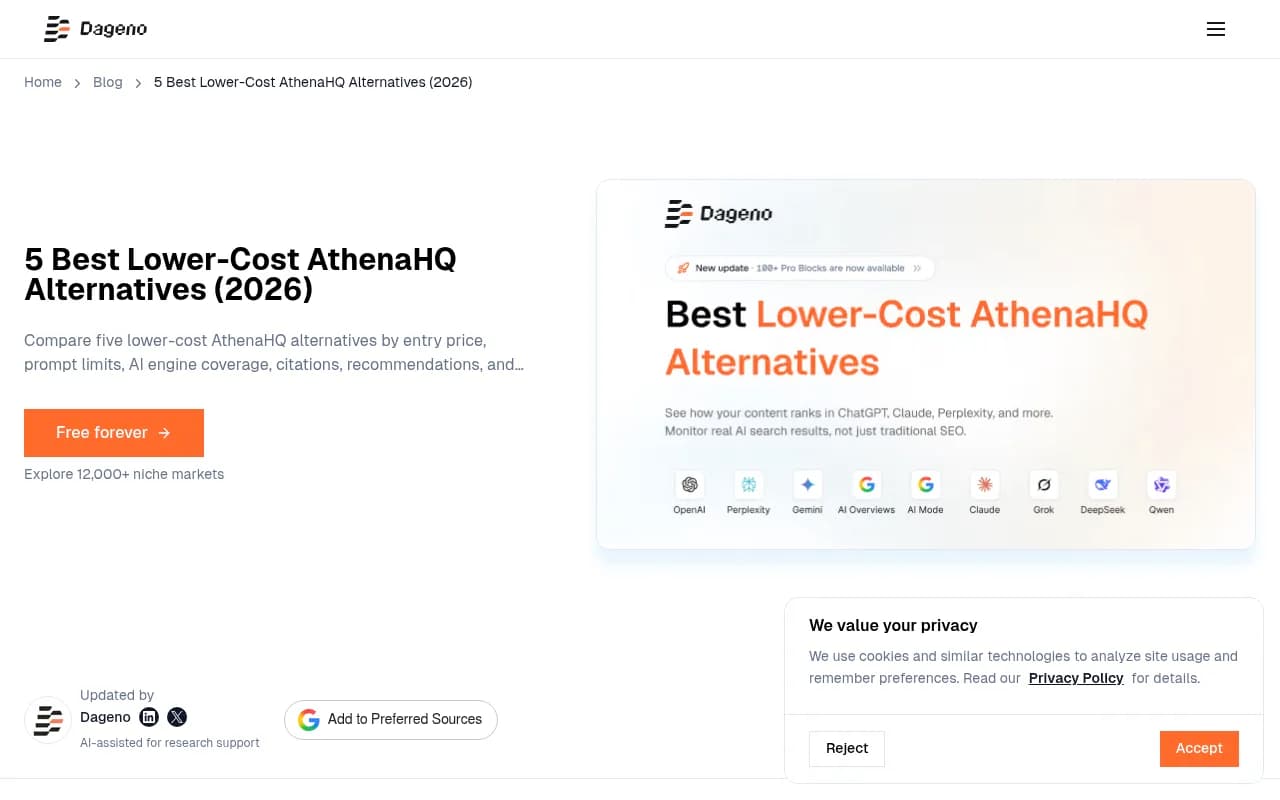
Treat vendor-authored comparison posts like this one with some salt. Dageno wrote that list and puts itself first. The numbers are still useful as a starting point, as long as you confirm each price on the vendor's own page.
AthenaHQ vs alternatives: entry prices side by side
These figures come from vendor-authored comparison articles and the vendors' own pages as of autumn 2026. I did not re-verify every competitor price independently, so check the live pricing pages.
| Tool | Entry price | Pricing model | Main tradeoff |
|---|---|---|---|
| AthenaHQ | Free, then $295/month | Credits (1 = 1 response) | Add-ons unpriced, big jump after free |
| Otterly.AI | $29 Lite, $189 Standard, $489 Premium | Prompt allowance | Claude, Gemini and AI Mode not included by default |
| Peec AI | $95 Starter | Usage-based, 3 models of your choice | Monitoring focus, extra models cost more |
| Rankscale | Lowest floor, credit ladder to $780 | Credits | Tracks 17+ engines, fewer enterprise features |
| Dageno | $79 Starter | Tiered | Three selected platforms on Starter |
| Profound | Free 7-day trial, custom paid pricing | Quote only | No self-serve price |
| Chosenly | $200 to $400 flat | Flat monthly | Smaller ecosystem |
| Promptwatch | $95 Essential, $245 Professional, $579 Business | Prompts and responses per plan | Content Agent starts at Business |
Otterly.AI
Otterly.AI has the cheapest real self-serve plan with published prices on every tier and no credit system. The catch is engine coverage. If you care about Claude, Gemini or Google AI Mode, read the add-on list carefully.

Peec AI
Peec AI starts at $95 with three models of your choice. It is a clean monitoring product. You get visibility numbers, not a content engine.

Rankscale
Rankscale has the lowest floor price and tracks 17+ engines, with a credit ladder that tops out around $780 on Enterprise. It is credit-based like AthenaHQ, so the same forecasting problem applies.
Dageno
Dageno's $79 Starter pairs tracking with content action, but limits you to three AI platforms at that tier.
Profound
Profound dropped self-serve pricing. You get a 7-day trial on three engines and then a quote. Agency views have been reported with client workspace add-ons around $399/month each, though I have not confirmed that on Profound's own page.

Where Promptwatch fits
Promptwatch sits in a different category from most of the cheap options above. Instead of stopping at a dashboard, it runs a loop: monitor what AI says about you, trace which pages and third-party sources get cited, act on gaps with the Action Board and Content Agent, then measure with IP-verified AI crawler logs and visitor analytics.

The pricing is also friendlier to the gap AthenaHQ leaves. Essential is $95/month (50 prompts, 6,000 responses, daily tracking, 500 Agent Credits), Professional is $245/month (150 prompts, 18,000 responses, crawler logs, 5 AEO articles) and Business is $579/month (350 prompts, 42,000 responses, the automated Content Agent, faster-than-daily tracking, local targeting, Fact Check, ChatGPT Shopping insights and Ads Radar). Annual billing is 12 months for the price of 10. Always confirm on promptwatch.com/pricing.
Two honest caveats. First, the Content Agent is a Business-plan feature, so at $95 you are buying monitoring plus Agent Chat, Brand Narrative and site audits, not automated publishing. Second, at $579 Business costs more than AthenaHQ Starter. The comparison only makes sense if you would actually use the content, crawler and local features. Promptwatch also publishes a side-by-side GEO platform comparison, and there is a direct Promptwatch vs AthenaHQ page.
A free starting point is the AI visibility report, and monthly plans come with a 7-day trial at app.promptwatch.com.
What switching actually costs
The monthly fee is the smallest line item once you account for moving. Here is what I would budget for.
Prompt set rebuild
Most tools let you paste prompts in, but not all keep your topics, tags and personas. Expect a few hours to rebuild monitors, and a day if you track several countries or languages. Some platforms fix language and location when a monitor is created, so you may need separate monitors per market.
Lost history
This is the one that stings. Your visibility trend lines stay with AthenaHQ. Export CSVs (Starter includes CSV export) before you cancel, and keep a baseline snapshot. If you do not, you will not be able to say whether the new tool shows an improvement or just a different measurement method.
Measurement differences
Tools collect answers differently. Some scrape real interfaces, others use APIs, and the numbers differ. Run both tools in parallel for two to four weeks before you trust any before-and-after comparison. A month of overlap on a $95 plan is cheap insurance.
Integrations and workflow
AthenaHQ Starter includes integrations and a content optimization agent. If your team actually uses those, switching to a monitoring-only tool means rebuilding that workflow elsewhere, and that cost is mostly staff time. If you only ever looked at the dashboard, a cheaper tracker costs you nothing in capability.
Add-on exposure
Because AthenaHQ's extra credits and API access have no published price, ask for quotes before you compare. A $295 plan with API and overage might land well above what the sticker implies, and that changes the math for every alternative.
How to choose
A rough decision path:
- You mostly want to know whether you show up in ChatGPT and Perplexity, on a tight budget: Otterly.AI or Peec AI.
- You need broad engine coverage at a low floor and are comfortable with credits: Rankscale.
- You want tracking plus content in one cheap tool and can live with three platforms: Dageno.
- You want the tool to fix gaps, publish content, read crawler logs and attribute AI traffic: Promptwatch, and budget for Professional or Business rather than Essential.
- You are an enterprise buyer who will negotiate anyway: AthenaHQ Enterprise or Profound, with a demo and a written quote.
If you are exploring more options, the GEO software directory and the AI rank tracking tools directory list many more.
A quick cost-per-outcome check
Before deciding, write down three numbers:
- How many prompts you need tracked, in how many engines, at what refresh rate. Multiply them for monthly responses.
- How many pieces of content you want published against gaps each month, and who writes them today.
- Whether you need AI traffic and crawler data, or only mentions.
If number two is zero and number three is no, a $29 to $95 tracker is probably enough. If you are paying a writer or agency to close citation gaps, a platform that does the work may be cheaper than a cheaper dashboard. If you would rather hand the whole thing to specialists, 1001 SEO Media runs GEO programs for brands, and it uses Promptwatch for the tracking side.
Bottom line
AthenaHQ is a capable product with an awkward price ladder: free, then $295, with unpublished add-ons on top. Cheaper trackers cover the monitoring job for a fraction of the cost. Switching is worth it if you only monitor. If you rely on its content agent and integrations, price the whole workflow, run both tools in parallel for a month, export your history first, and confirm every number on the vendor's live pricing page.