Key takeaways
- Landing pages and docs hold citations longest. After 30 days ChatGPT still cited 78% of landing pages and 76% of docs from day 0; after 60 days, 69% and 67%.
- News decays fastest. Half of news pages are gone after 36 days, and about a quarter are never cited again after day 0.
- Product pages, reviews and how-to guides are the middle group: 55% still cited after 60 days, half-life around 74 to 77 days.
- Comparisons (63% at day 60) and listicles (60%) keep more than people expect, so they are worth sustained effort.
- Other studies report much shorter half-lives (11 days, about 3.4 weeks), but they measure something different. Don't compare the numbers directly.
What the question really is
Once ChatGPT cites a page, how long does it keep doing so? Most teams treat AI citations like rankings: win one and you hold it. Others assume they vanish in days. The honest answer depends on the content type, and on how you measure "stays cited".
The cleanest dataset I found for ChatGPT specifically is from Promptwatch, published as What Is the Half-Life of Content in ChatGPT? on October 5, 2026. It is worth walking through in detail, then putting next to the third-party studies that seem to disagree with it.

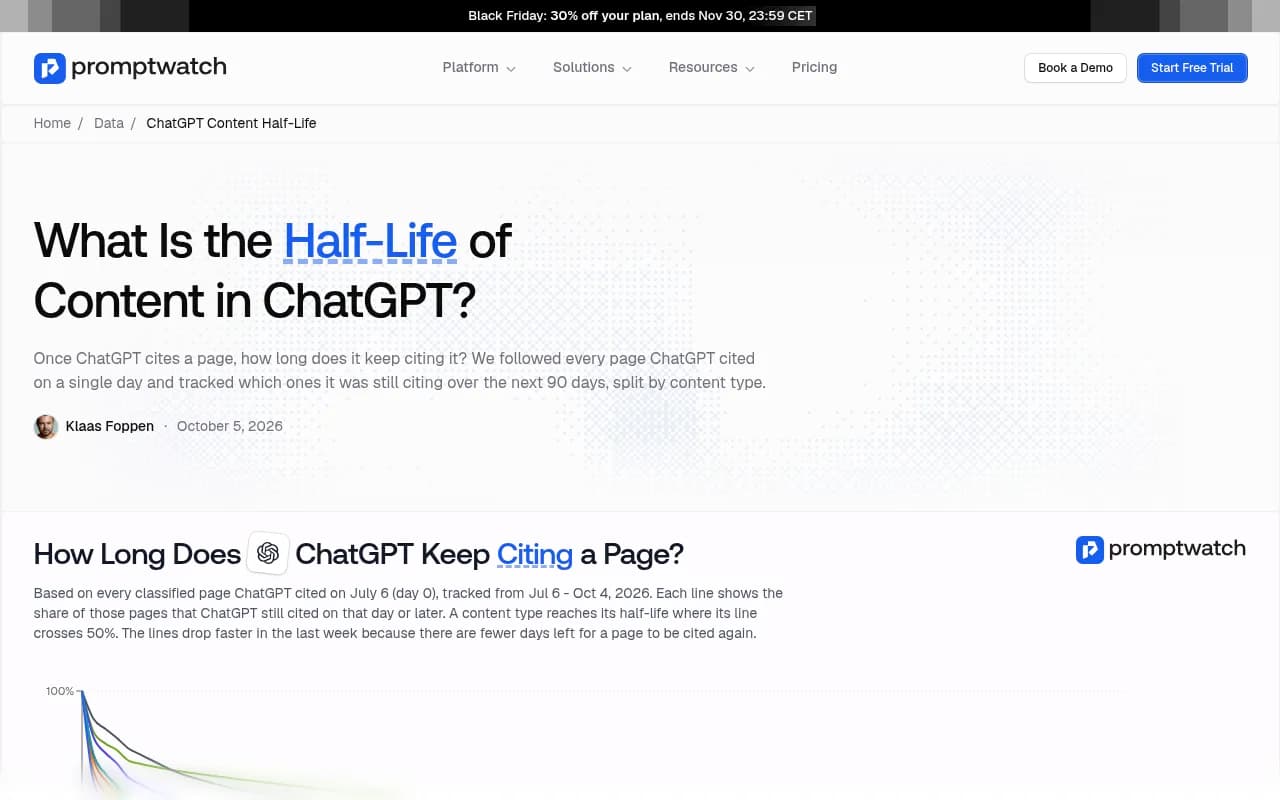
How the Promptwatch half-life study works
The method is simple, which is part of why it is useful.
- Promptwatch took every classified page ChatGPT cited on July 6, 2026. Call that day 0.
- It tracked those pages through October 4, 2026, a 90-day window.
- Each line on the chart shows the share of day-0 pages that ChatGPT still cited on that day or later.
- A content type reaches its half-life where its line crosses 50%.
- Eight types are tracked: landing, product, docs, comparison, review, how-to, listicle and news. Pricing pages are classified as landing or product pages.
One caveat from the report itself: the lines drop faster in the final week because fewer days remain for a page to be cited again. That is an artifact of the window ending, not real decay. Keep it in mind when you read the 90-day numbers.
The results by content type
| Content type | Still cited after 30 days | Still cited after 60 days | Half-life |
|---|---|---|---|
| Landing pages | 78% | 69% | Likely close to or beyond 90 days |
| Docs | 76% | 67% | Likely close to or beyond 90 days |
| Comparisons | 72% | 63% | Likely close to or beyond 90 days |
| Listicles | n/a | 60% | Likely close to or beyond 90 days |
| Product pages | n/a | 55% | About 74 to 77 days |
| Reviews | n/a | 55% | About 74 to 77 days |
| How-to guides | n/a | 55% | About 74 to 77 days |
| News | n/a | 41% | 36 days |
The report did not publish 30-day figures for every type, so I left those cells empty instead of guessing.
Landing pages and docs
These are the stickiest. ChatGPT still cited 78% of day-0 landing pages and 76% of docs a month later. Docs also show the smallest drop right after day 0: 93% of them were cited again later, against 77% of news pages.
That fits what you would expect. Docs and landing pages are the canonical source for what a product does and what it costs. A model answering a question has little reason to swap them for something newer, as long as they are still accurate.
This lines up with Promptwatch's software citation data, where documentation and help centers earn the largest share of ChatGPT citations for software prompts (Sep 28 to Oct 4, 2026). Docs are cited a lot, and they stay cited.
Comparisons and listicles
Comparisons keep 72% after 30 days and 63% after 60. Listicles keep 60% after 60 days, which is better than product pages. Promptwatch's recommendation is to put lasting effort here, since both keep more than 60% of their citations after two months.
The reason to care: listicles and comparisons are the formats AI engines lean on for "best X" and "X vs Y" prompts. They are also the formats you can most easily publish yourself.
Product pages, reviews and how-to guides
Product pages decay faster than you might expect. After 60 days, 55% are still cited, level with reviews and how-to guides, and all three reach half-life after 74 to 77 days.
This matters because product pages are the most cited content type in ChatGPT at 22.4% of citations (Sep 28 to Oct 4, 2026). They get cited a lot, but they do not hold on by themselves. Specs, availability and prices need to stay current or the page loses ground to a fresher source.
News
News is the outlier. Almost a quarter of news pages are never cited again after day 0. Half are gone after 36 days. By day 60 ChatGPT still cites 41% of them.
If your plan is to earn citations through press coverage or announcement posts, treat it as a burst. It works, then it fades in about five weeks.
A second opinion: Preston B.'s version of the same test
Preston B. (Searchable, ex-Scrunch) ran a similar exercise on the same July 6 start date and posted the results on LinkedIn. His read differs on one point: how-to guides fell off fastest, with fewer than half still cited by day 37, while comparison pages lasted until about day 63.
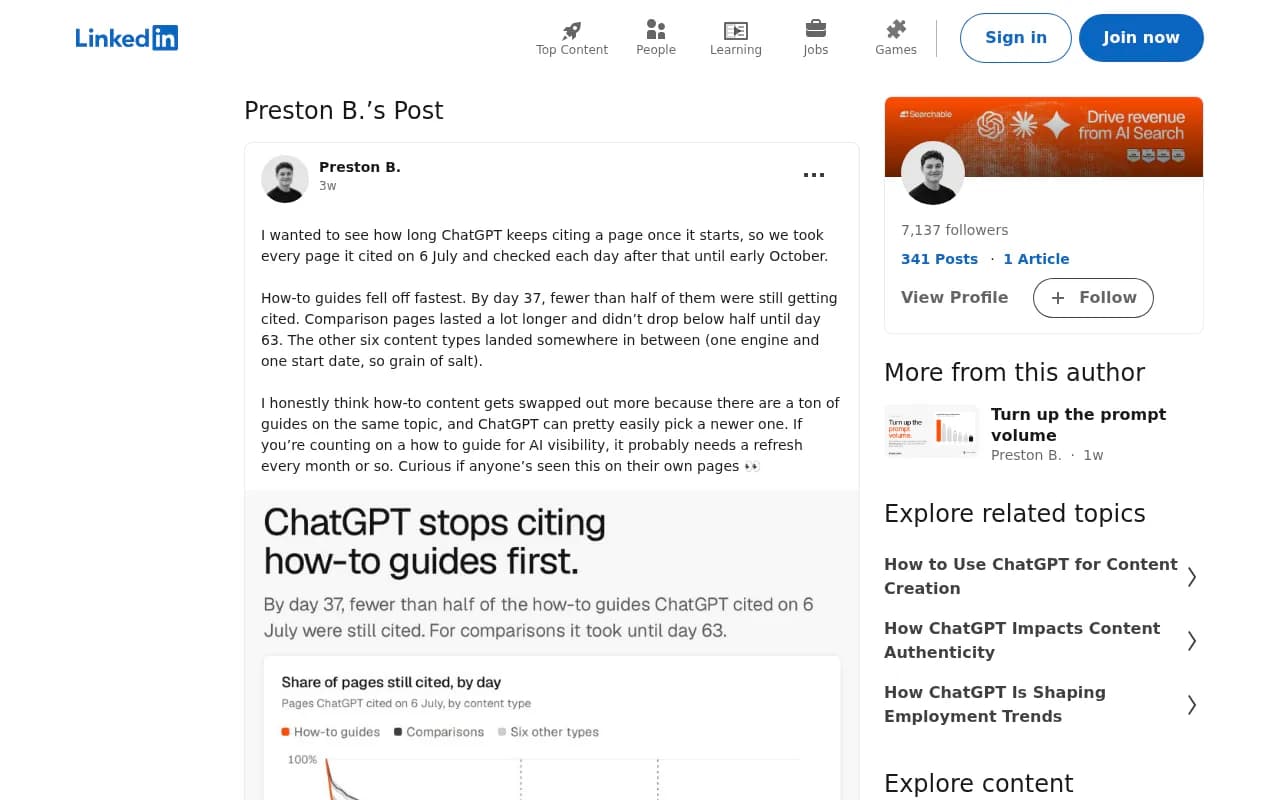
He flags it himself as one engine and one start date. His theory is that how-to topics have a lot of near-duplicate guides, so ChatGPT can swap in a newer one easily. That is plausible, and his practical advice (refresh how-to content roughly monthly) is a reasonable hedge. But I would treat it as a hypothesis. The Promptwatch figures put how-tos at about the same decay as product pages and reviews, and the two analyses use different classification and cut-offs.
The pattern both agree on: comparison pages last, and how-to and news content turn over.
Why other studies say 11 days or 3.4 weeks
You will see much shorter numbers elsewhere. They are not wrong, but they measure something else.
| Study | Headline figure | What it measures |
|---|---|---|
| Promptwatch Data | Landing pages and docs still ~67 to 69% cited at day 60 | Share of day-0 cited pages that ChatGPT cites again on or after each day |
| Profound | Half-life of an AI citation is 11 days | Days after a page's peak citation share until it falls to half that share and stays there |
| Scrunch | ChatGPT around 5.8 weeks for Perplexity, "nearly 70% longer" than ChatGPT | Citation events over time by platform |
| Rankinllm.ai | ChatGPT about 3.4 weeks | Platform-level citation decay |
The Profound study looked at 883,000 pages across seven engines over twelve months. Its half-life is based on citation share relative to other pages in the category, measured from the peak. A page can still be cited at a lower rate and count as having "decayed". Promptwatch's measure only asks whether the page is cited again at all on or after a given day. Share of attention falls faster than presence in the list of sources.
The Profound study also has a useful finding on content families. Reporting content (news, announcements, research) fades first on every engine: median half-life of 27 days with 7.0% still above half-peak at day 56, against 29 days and 11.2% for comparisons, listicles and reviews. Different method, same direction: news is the shortest-lived, and "choose" content holds best.
Two more points from Profound worth knowing:
- Engines do not move together. Cross-engine correlations of decay run between 0.03 and 0.09, so a page fading on ChatGPT tells you almost nothing about Claude or Perplexity.
- Pages cited by five or more engines are 5.5 times as likely as single-engine pages to still sit above half their peak share after eight weeks.
The takeaway is not to pick one number and quote it. Pick the metric that matches your question. If you ask "will ChatGPT keep citing this page at all?", the Promptwatch measure is the closer match. If you ask "will this page keep its share of attention?", the 11-day style number is closer.
What to change in your content plan
- Treat landing pages, docs and pricing pages as long-term citation assets. They hold most of their citations for months, so the main job is accuracy. Stale prices or features on a page that keeps getting cited is a real risk.
- Do not assume product pages coast. They lose citations about as fast as how-to guides. Keep specs, availability and prices current.
- Invest in comparison pages and listicles. Both keep more than 60% of citations after two months, and they match the prompts buyers actually use.
- Use news for short bursts. Plan on roughly five weeks of visibility for half the pages, then publish the next one.
- Refresh on a schedule that matches the type. Docs and landing pages when facts change; how-tos and product pages every month or two; news is disposable.
- Aim for breadth. Being cited across several engines correlates with lasting longer, so do not tune everything for ChatGPT alone.
How to measure this on your own site
Aggregate numbers are a starting point. Your own pages may behave differently, so run the same test yourself:
- Pick a start date and log every page that is cited that day for your tracked prompts.
- Check each day or week afterwards whether the page is still cited. Segment by content type.
- Watch the last week of your window with suspicion, since the window-end effect inflates apparent decay.
- Note when you refreshed a page and whether its citation rate recovered.
A tool that tracks citations at the page level makes this far less painful. Promptwatch's Page Tracker shows the prompts and responses that cite any URL you watch, and its AI crawler logs show whether AI bots are actually reading the page you refreshed, which separates an access problem from a content problem. If you want to compare options, the GEO software directory lists other trackers, and Profound and Scrunch both publish their own decay research.

For free spot checks, Google Search Console shows which pages earn impressions, which helps you decide what to refresh first.
Limits of the data
- It is one engine (ChatGPT), one start date (July 6, 2026) and one 90-day window.
- Landing pages, docs, comparisons and listicles never crossed 50% inside the window, so their true half-life is unknown. It is likely close to or beyond 90 days.
- Classification of pages into types is automated. A pricing page can land in landing or product.
- ChatGPT's behavior changes. Promptwatch's data recorded a drop in average citations per response around the GPT-5.3 rollout on March 4, 2026, and site: queries jumped at scale on August 8, 2026, so stability can shift with a model or search update.
Bottom line
If you only remember one thing: documentation, landing pages and pricing pages are the durable citation assets in ChatGPT, comparisons and listicles are the best formats to keep building, and news is a five-week burst. For the broader picture of what gets cited, see the rest of Promptwatch Data.