Key takeaways
- seoClarity is a quote-only enterprise SEO platform with AI tracking (Clarity ArcAI) layered onto deep technical SEO. Semrush bundles AI search into its SEO tiers. Promptwatch is a dedicated GEO platform that also pulls in Search Console and Bing data.
- The real question is where your team's pain sits: ranking and technical SEO at scale, or being named and cited inside ChatGPT, Gemini, Perplexity and Google AI Overviews.
- Semrush pricing has changed. Its current page shows bundled SEO plus AI Search tiers from $139/mo (SEO) and $199/mo (Starter), instead of the older base-plan-plus-$99 add-on model quoted in many 2026 reviews.
- Most teams at enterprise scale end up running a suite and a GEO platform side by side. They are not exclusive.
- Whatever you shortlist, test it on your own prompts. seoClarity's own comparison article reaches the same conclusion.
The actual decision
Search split in two a while ago. People still type into Google, and they also ask ChatGPT or Perplexity a question and get an answer that already names the brands worth considering. Enterprise SEO suites were built for the first behavior. GEO (generative engine optimization) platforms were built for the second.
So the choice in the title is a bit of a false binary, but it is a useful one. Do you extend the platform your SEO team already lives in, or do you add a tool built for AI answers? I will compare seoClarity, Semrush and Promptwatch on the dimensions that tend to decide this, and then say who should pick what.
A disclosure first: this site is published by 1001 SEO Media, an agency that uses Promptwatch as its GEO platform. I have tried to stick to what the vendors publish and to flag what I could not verify.
Why AI visibility is not a keyword-rank problem
The reason suites struggle here is structural. A rank tracker checks a fixed list of keywords against a results page with ten positions. An AI answer has no stable positions. Each engine also cites a different number of sources.
According to Promptwatch Data on average sources per response, ChatGPT cites about 5 sources per web-search answer, while Google AI Overviews and Perplexity cite about 10. Microsoft Copilot swung from under 2 to nearly 17 sources within a few weeks. Different engines have different numbers of citation slots, so you need per-engine measurement, not one blended score.
Citation behavior also moves fast. Promptwatch's data on Reddit citations shows reddit.com falling from roughly 4% to 0.5% of ChatGPT citations on August 14, 2026. A tool that only reports once a week against a static prompt list will miss shifts like that.
And the crawlers matter. In Promptwatch's AI crawler traffic data, OpenAI made up 79.8% of verified AI crawler requests in the week of Aug 31 to Sept 6, 2026, down from 94.8% in early June. The mix is changing, which is why knowing which bots actually read your pages is a real input to decisions.
The three platforms at a glance
| seoClarity | Semrush (SEO + AI Search) | Promptwatch | |
|---|---|---|---|
| Category | Enterprise SEO platform with AI tracking | SEO suite with AI search bundled in | Dedicated AI visibility and GEO platform |
| Pricing | Custom quote, no self-serve tier | SEO $139/mo, Starter $199/mo, Pro+ $299/mo; Enterprise by demo | Essential $95/mo, Professional $245/mo, Business $579/mo, agency plans from $199/mo, Enterprise custom |
| AI engines | AI Search Visibility Tracking, AI Overviews Tracking; full engine list not published in what I found | Google, ChatGPT, Perplexity, Gemini "and more" | ChatGPT, Gemini, Perplexity, Google AI Overviews, AI Mode, Copilot, Meta AI, Alexa, Claude and more, via real interfaces |
| AI crawler data | AI Bot Activity plus Log File Analysis | Not a headline feature | IP-verified crawler logs joined to citations |
| Content execution | Page Optimizer, Schema Optimizer, ClarityAutomate, AI Content Writer | Prompt research, AI-ready Site Audit | Content Agent that writes and publishes to WordPress, Webflow or Framer |
| Traditional SEO depth | Very deep | Very deep | Brings in Search Console and Bing data, not a SERP rank tracker |
Pricing is as published at the time of writing. Confirm Semrush at semrush.com/pricing/seo-ai-search and Promptwatch at promptwatch.com/pricing.
seoClarity: automation and technical depth
seoClarity is built for large sites with big keyword sets and complicated templates. Reviewers describe it as a favorite among technically focused enterprise teams, and the feature list backs that up: unlimited keyword rank tracking, the Research Grid keyword database, the Clarity Grid visualization engine, the Sia automation engine that prioritizes actions by projected traffic impact, log file analysis, an SEO split tester and a flexible API.
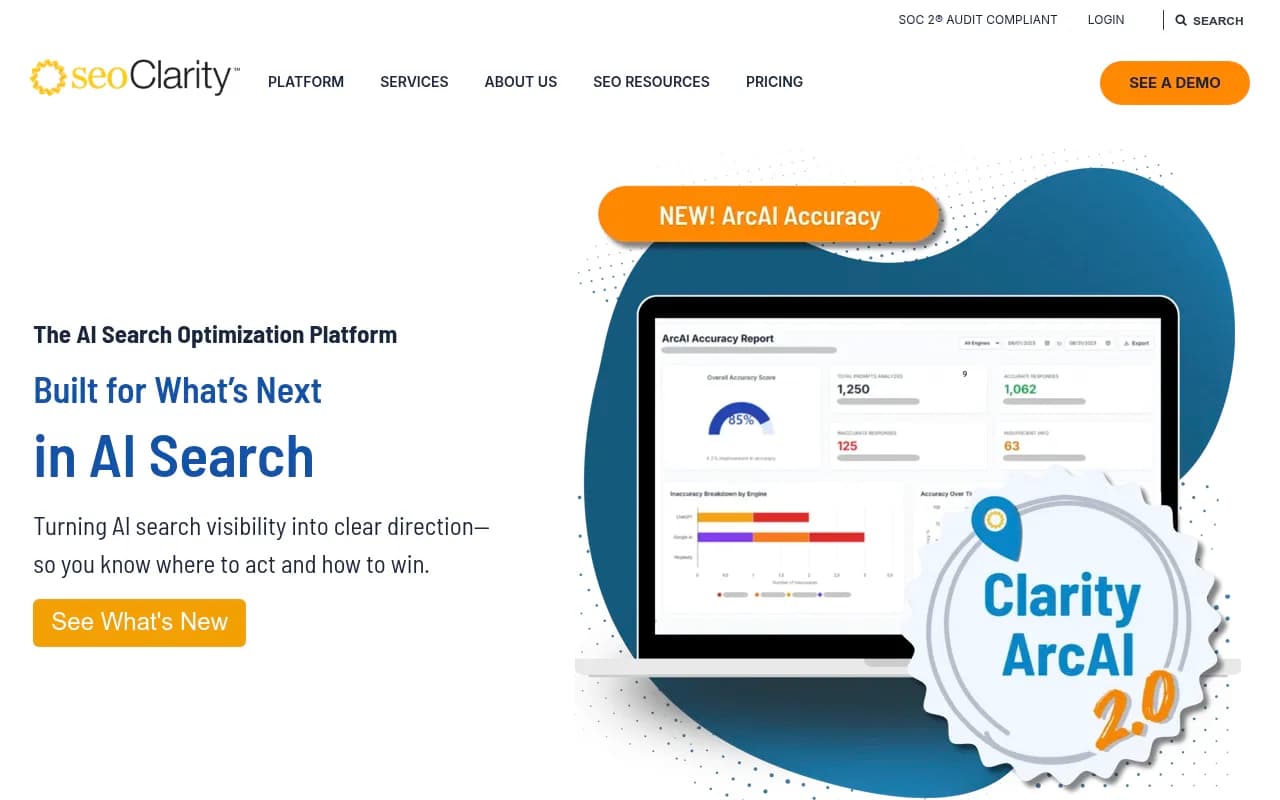
The AI side is branded Clarity ArcAI and includes AI Search Visibility Tracking, AI Overviews Tracking and AI Bot Activity. That is a real answer to the question, and the bot activity piece overlaps with what dedicated GEO tools do with crawler logs. Stackmatix, in its enterprise roundup, still calls AI visibility tracking an "evolving capability" here, which is fair to keep in mind.
Pricing is custom. There is no self-serve tier, so a small team cannot just try it. SOC 2 audit compliance is listed, which procurement teams like to see.
Best fit: a technical SEO organization that already runs on seoClarity and wants AI tracking in the same login, with the budget and patience of an enterprise contract.
Its own comparison article, "8 Enterprise AI Visibility Platforms Compared", ends with the advice to build a shortlist and test on your own prompts. I could not retrieve the body of that article, so I am only quoting the conclusion.
Semrush: breadth, now with AI search bundled
Semrush is the tool most marketers already have open. Its strength is data breadth across keywords, backlinks and SERP features, plus paid media and social research. The Conductor ranking notes it leans toward data access rather than execution, so teams are often left to interpret and prioritize on their own.
Pricing needs a correction to what you may have read. Several 2026 reviews describe a base plan plus a $99/mo AI Toolkit add-on. The current official pricing page instead shows bundled tiers:
- SEO at $139/mo ($117.33/mo billed annually): 5 websites, 500 keywords tracked daily, plus basic AI search performance, sentiment and custom prompt monitoring.
- Starter (SEO + AI Search) at $199/mo ($165.17/mo annually): 50 prompts tracked daily, 1 domain for AI brand performance, 300 AI visibility reports per day, MCP access, and coverage of Google Search, ChatGPT, Perplexity and Gemini "and more".
- Pro+ at $299/mo ($248.17/mo annually): 15 websites and 1,500 keywords. The details beyond that were cut off in what I could retrieve.
Enterprise is a separate, demo-only offering for multiple brands, regions and teams.
The tradeoff is clear. Fifty tracked prompts on Starter is a small panel for a brand with several product lines and markets. And the same reviewers who like the convenience say specialized tools go deeper on prompt-level insight, engine coverage, crawler logs and content creation. Semrush also connects to Salesforce and HubSpot through Zapier, according to EWR Digital, while seoClarity names no CRM connector. If CRM handoff matters, that is a point for Semrush.
Best fit: teams already invested in Semrush who want AI visibility next to their rankings without a new vendor.
Promptwatch: a GEO platform that acts, not only reports
Promptwatch starts from the other end. It tracks how ChatGPT, Gemini, Perplexity, Google AI Overviews, AI Mode, Copilot, Meta AI, Claude and other engines mention and cite you, using the real interfaces rather than only APIs, in each country and language you pick. Then it traces where answers come from, and helps you fix gaps.

The loop is the point. Monitoring is the first step. The Action Board prioritizes what to do, content gap analysis maps your pages against the prompts AI answers, and the Content Agent writes and publishes pages to WordPress, Webflow or Framer, with a review inbox if you want humans in the loop. After publishing, IP-verified AI crawler logs show whether bots read the page, Page Tracker shows whether AI cites it, and visitor analytics show whether it sends traffic.
A few capabilities that suites tend not to match:
- Query fan-outs, prompt volumes and difficulty scores, so you pick prompts that matter
- Brand Narrative, which pulls the individual claims AI makes about you and your competitors
- Reddit, YouTube, LinkedIn and Instagram citation reports
- Local targeting at exact coordinates, and up to hourly tracking on Business
- ChatGPT Shopping and Ads Radar on the Business plan
- A hosted MCP server and REST API
Pricing is public: Essential $95/mo (50 prompts, no crawler logs), Professional $245/mo (150 prompts, crawler logs, 5 AEO articles), and Business $579/mo (350 prompts, Content Agent, local targeting, Fact Check, Shopping and Ads Radar). Agencies pay $199, $399 or $799 per month for unlimited projects. Every plan includes unlimited team seats. Enterprise adds SSO, audit logs and a white-label portal, and Promptwatch is ISO/IEC 27001 certified and GDPR compliant.
It is not a classic SERP rank tracker, and I would not pretend otherwise. It brings in Search Console and Bing data, but a team that needs unlimited daily keyword tracking across a million URLs still needs a suite.
See the Promptwatch vs Semrush comparison for the vendor's own side-by-side.
Where they actually differ
Measurement
Suites report AI visibility as another column next to rankings. That is genuinely useful for stakeholder reporting, since one login shows both. Dedicated platforms go deeper per prompt: persona-based prompting, sentiment per claim, citation rank and per-engine behavior. If your executive question is "are we in the ChatGPT answer for our top 100 buying prompts, and what does it say about us", depth wins. If the question is "is AI visibility trending up alongside organic", a bundled view is enough.
Diagnosis
Most reviewers agree on one gap: bolt-on AI modules rarely tell you why a page is skipped. Crawler logs are the cleanest diagnostic, because they separate an access problem (bots cannot read the page) from a content problem (they read it and still do not cite it). seoClarity covers bot activity and log files, which is a strength. Promptwatch joins logs to citations at the page level. Semrush's AI tier does not lead with this.
Execution
seoClarity's execution tools are strongest on classic technical SEO: schema, page optimization, split tests. Promptwatch's are aimed at AI citations: content that fills prompt gaps, published and then re-measured. Semrush leaves most of the execution to you.
Cost
Semrush is the cheapest way to dip in, at $199/mo for 50 prompts and one AI-tracked domain. Promptwatch's Essential at $95/mo gives 50 prompts too, but without bundled SEO tooling. seoClarity cannot be compared on price because it is quote-only, and that opacity is a real cost in itself when you are building a shortlist.
Which should you pick?
| Situation | Likely choice |
|---|---|
| Large site, heavy technical SEO, already on seoClarity | Stay on seoClarity, evaluate ArcAI, add a GEO tool if gaps appear |
| Team lives in Semrush, wants a first look at AI visibility | Semrush Starter or Pro+, upgrade to a dedicated tool when 50 prompts feels tight |
| AI search is a revenue channel and you need to fix citations, not only count them | Promptwatch |
| Agency managing many clients | Promptwatch agency plans, alongside whatever suite you use for rankings |
| Strict enterprise procurement and need one vendor | Shortlist seoClarity or Semrush Enterprise, then run a head-to-head on your own prompts |
My honest read: for most enterprise teams the answer is both. Keep the suite for rankings, audits and reporting, and add a GEO platform where AI visibility needs depth and action. Stackmatix's roundup frames it the same way, as a hybrid approach.
How to run a fair test
- Pick 30 to 50 real buyer prompts across two or three topics, and include branded, competitor and comparison prompts.
- Run the same set in each tool for two weeks.
- Check whether each tool shows the actual cited URLs, not just a mention count.
- Ask what each tool tells you to do next, and whether it can do part of it.
- Confirm crawler visibility. Can you see which AI bots hit which pages?
- Get a written price for your prompt, domain and market counts. For seoClarity and Semrush Enterprise that means a quote.
A quick free starting point is Promptwatch's free AI visibility report, or the 7-day free trial on monthly plans, which lets you run your own prompts before committing.
Other options in the category
If neither extreme fits, other enterprise-leaning names in this space include [tool:brightedge], [tool:conductor] and [tool:botify] on the suite side, and [tool:profound] and [tool:scrunch] among dedicated platforms. For a wider scan of dedicated tools, browse the GEO software directory at bestgeosoftware.com.
Bottom line
seoClarity is the pick for technical SEO muscle at scale, Semrush is the low-friction pick if you already pay for it, and Promptwatch is the pick when AI answers are the thing you need to change. Verify pricing on each vendor's page, since Semrush's has already shifted this year, and decide on results from your own prompts, not a feature grid.