Key takeaways
- On August 8, 2026, the share of ChatGPT fan-out queries using the site: operator jumped from 0.37% to 16.8% in one day, according to Promptwatch Data.
- Searches per response rose from about 1.08 to about 1.83 on the same day. The site: searches look like they were added on top of generic searches, not swapped in for them.
- A site:-scoped query can only return what Google or Bing has indexed from your domain, so crawlability, indexing and clear page-level topics matter more than before.
- Write one page per intent, use headings that read like searches, and cover comparison, pricing and alternatives angles separately.
- Third-party studies report different site: shares (6.8% to 23%). The gap is mostly about how fan-outs were collected, so don't mix datasets.
What actually changed on August 8
ChatGPT changed how it searches overnight. For weeks, site: operators appeared in roughly 0.3 to 0.5% of fan-out queries, about 1 in 280. Then, per Promptwatch's data covering the days around August 8, 2026, that share went to 16.8%. About 1 in 6 fan-outs now targets a specific domain.
A fan-out, if you haven't met the term, is one of the background web searches ChatGPT runs to build an answer. You ask something like "best project management tool for agencies", and the model quietly runs several narrower searches. Some are now things like site:asana.com pricing agencies or site:g2.com project management agencies.
Two details from the data matter most:
- The average number of fan-outs per response went from about 1.08 to about 1.83 and stayed there. If site: queries had replaced generic ones, the average would have stayed flat. It didn't, so they are an extra retrieval path.
- The change happened in a single day. That points to a model or system-prompt rollout on OpenAI's side, not a gradual drift in user behavior. There was also a dip to 0.15% on August 3 to 5, which Promptwatch reads as a staged rollout or pre-launch experiment.
The good news is that your existing visibility through generic searches isn't gone. The new part is that ChatGPT now goes wider and deeper at the same time.
Why would ChatGPT do this?
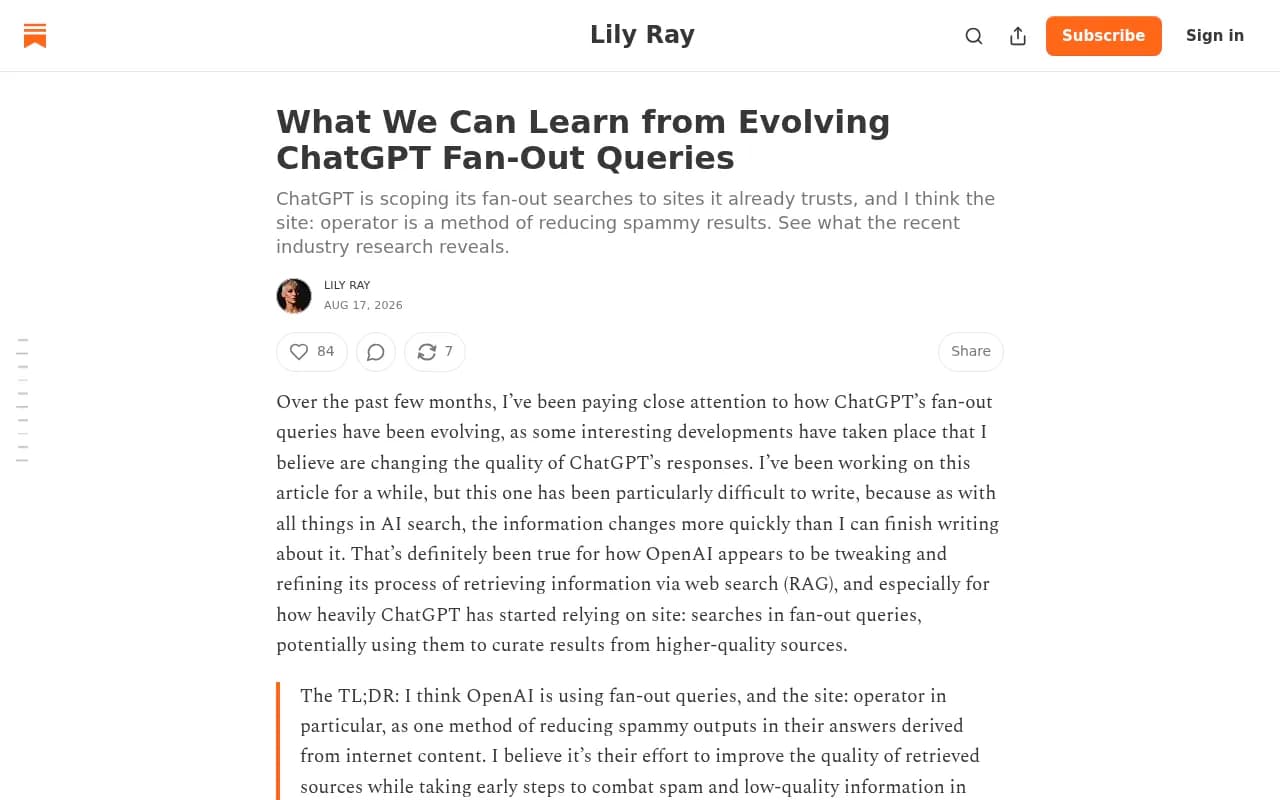
Nobody outside OpenAI knows for sure. Lily Ray's read, published August 17, 2026, is that OpenAI is using fan-outs, and site: in particular, as one way to cut spam from retrieved sources. Scoping a search to a domain the model already trusts is a cheap quality filter. She compares it to what Google has tested with E-E-A-T, "but ChatGPT style".
I find that theory plausible, and it fits the other numbers floating around. Ahrefs analyzed 15 million fan-outs and found 6.8% used site:, spread across roughly 116K domains, with 76% of those aimed at brand sites. If the model is mostly asking "what does the brand itself say about this?", then your own domain is now a retrieval surface in a way it wasn't a year ago.
It's still a theory. Treat it as a useful mental model, not a rule.
Why the numbers disagree across studies
If you've read three articles on this, you've seen three different site: percentages. Here is the spread:
| Source | Reported site: share | Notes |
|---|---|---|
| Promptwatch Data (Aug 2026) | 0.37% to 16.8% on Aug 8 | Daily share of all fan-outs |
| Peec AI (David Konitzny) | ~0.3% to ~23% | Measured the day GPT-5.6 became default |
| Ahrefs (15M fan-outs) | 6.8% | 76% of those targeted brand sites |
Lily Ray attributes much of the gap to collection method. Some tools pull fan-outs through OpenAI's API, others extract them from the consumer ChatGPT interface. Those can behave differently. Peec's data also showed prompts with a single fan-out dropping from 94.0% to 43.5% and average retrieved sources roughly doubling from about 12 to 24.
The takeaway: the direction is consistent everywhere, the exact percentage isn't. Pick one source, track it over time, and don't compare absolute numbers across tools.
One more caution. Promptwatch's earlier fan-out page described 3 to 8+ queries per prompt in its intro, which is far above the 1.08 to 1.83 averages from the August report. Different collection methods and model mixes. Don't blend them.
What a site: query can and can't find
This is the part people skip. A query like site:yourdomain.com pricing goes to a search engine. It can only return pages that engine has indexed from your domain. So:
- If a page isn't indexed, it can't be surfaced by a scoped search.
- If your page title and headings don't match the words in the query, a competitor's third-party review of you may outrank your own page inside your own domain's results. (Within a site: search it's just your pages ranking against each other.)
- Thin category pages, broken internal search and orphaned content all cost you chances.
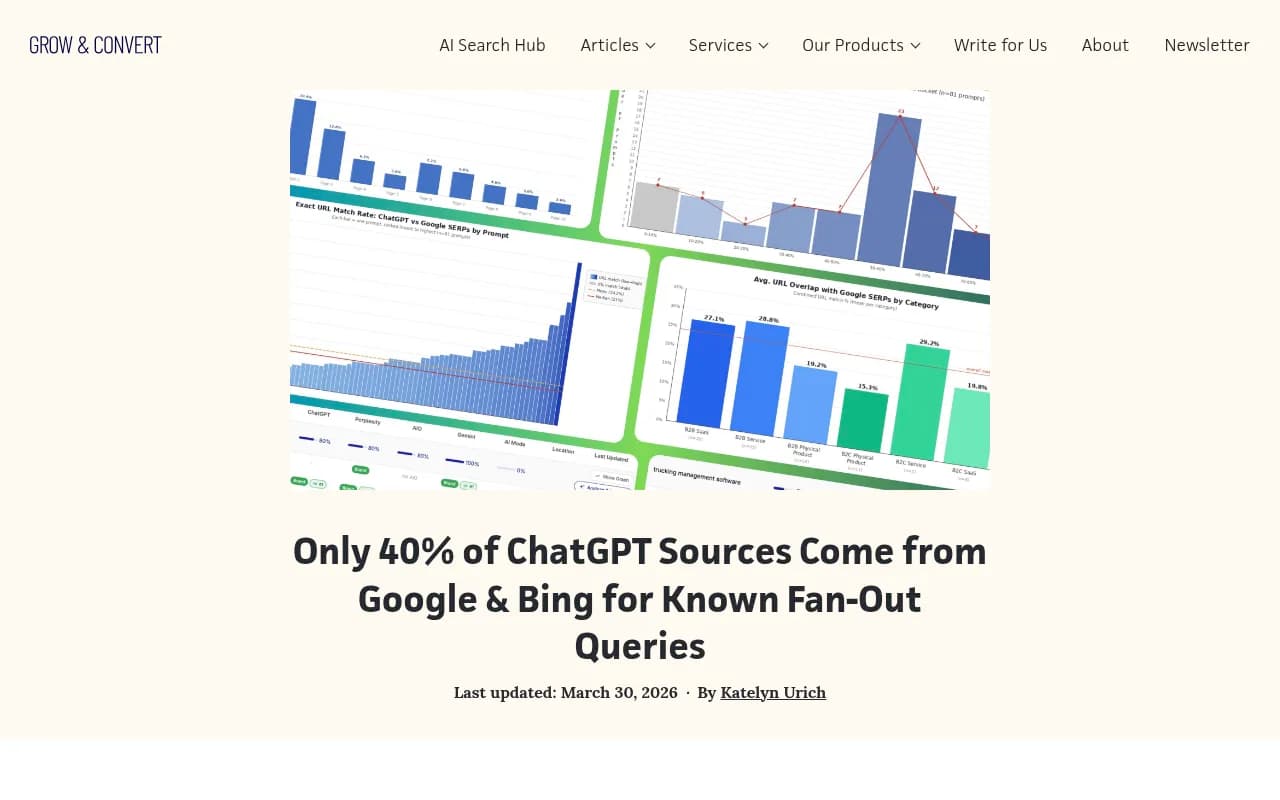
Also keep in mind the Grow and Convert study from March 2026: across 100 buying-intent prompts, only about 40% of cited sources ranked in the first 10 pages of Google or Bing for the fan-out queries. ChatGPT's retrieval isn't a pure mirror of search rankings. That study found trying to produce single pages to rank for specific fan-outs doesn't reliably work, which is a good reason to focus on coverage and clarity rather than chasing individual queries.
How to write pages that win targeted fan-outs
1. Give every intent its own page
Each fan-out is a separate retrieval. A page that tries to answer pricing, comparison and setup in one scroll will half-answer all three. Promptwatch's recommendation from its fan-out data is to favor a cluster of focused pages over one mega-page. I agree, with one caveat: don't spin up 40 near-duplicates either. One clear page per real question.
A practical cluster for a product might be:
- A pricing page that states actual numbers and plan limits
- An "X vs Y" page for each real competitor
- An alternatives page
- A how-to or setup guide
- An integrations or use-case page per major segment
2. Write headings that read like searches
Models write short queries. Promptwatch's data shows average fan-out length fell from about 117 characters in December 2025 to the high 80s in early 2026 and about 53 characters in April. Your headings should sound like that, not like conversation.
Compare:
- Weak: "So, what will this actually cost you?"
- Better: "Acme CRM pricing for small agencies 2026"
Front-load the entity and the category in titles and H2s. For a site:acme.com query, the brand part is already satisfied by the operator, so the topic words in your title and headings carry the match.
3. Make the answer extractable
Put the plain answer near the top of the page, then the detail. Use tables for plan comparisons, specs and limits. A model scoping a search to your domain wants to land on a page and lift a clean fact. Product pages are the most cited content type in ChatGPT, at 22.4% of citations from Sep 28 to Oct 4, 2026, per Promptwatch's content-type report. Landing pages and docs also stay cited longest, per the content half-life report, while news loses half its pages within 36 days. Durable, factual pages beat timely commentary here.
4. Cover the angles around a topic
Comparisons, pricing, alternatives, integrations and "for [audience]" lookups are separate chances to be found. If you only have a feature page, then site:yourdomain.com alternatives returns nothing useful and ChatGPT moves on to someone else's page about you.
5. Fix the indexing basics
Before touching copy, check:
- Key pages return 200 and are in your XML sitemap.
- Nothing important is blocked in robots.txt or noindexed by accident.
- Every page you want cited is reachable by internal links (no orphans).
- Titles and meta descriptions are unique and descriptive.
- You aren't blocking AI crawlers you actually want, such as OAI-SearchBot.
Google Search Console is the free way to confirm what's indexed.
For a crawl of your own site, Screaming Frog will surface orphaned pages, duplicate titles and broken internal links.
Re-run your fan-out analysis
Promptwatch's blunt advice here is right: keyword mappings built before August 8 are stale. The queries ChatGPT generates from a given prompt changed materially that day. If you built a content map from fan-out data in July, redo it.
A simple routine:
- Pick 20 to 50 prompts that matter to revenue (buying intent, comparisons, "best X for Y").
- Capture the fan-outs ChatGPT generates for each.
- Note which ones are site:-scoped and to which domains. Are those yours, a competitor's, or a review site's?
- Map each fan-out to an existing page on your site. Where there's no match, that's a content gap.
- Check whether the matching page is indexed and whether its title and H2s use the same words as the fan-out.
Promptwatch's free GEO Inspector Chrome extension shows fan-outs and fetched versus cited sources for a ChatGPT conversation, and it runs locally. Its ChatGPT query fanout data and how-to guide on using fan-outs are worth reading alongside.
Tools that help
You can do a lot by hand, but tracking this over time needs tooling. A rough guide:
| Job | Tool type | Examples |
|---|---|---|
| Track prompts, fan-outs and citations in the real ChatGPT UI | AI visibility platform | Promptwatch, Profound |
| Basic mention monitoring | Prompt tracker | Peec AI, Otterly.AI |
| Check what's indexed and ranking | Search data | Google Search Console |
| Find orphaned and thin pages | Crawler | Screaming Frog |
| Optimize page copy against SERP | Content optimization | Surfer SEO, Clearscope |
Promptwatch is the one I'd point to for this specific problem, because it tracks the real ChatGPT interface, shows query fan-outs per prompt, and has IP-verified AI crawler logs so you can see whether OpenAI's bots reach the pages your site: queries depend on. It also has a content gap analysis and an agent that drafts pages against the gaps, which is the part that saves time once you know what's missing.

Monitoring-only trackers can tell you whether you were mentioned. They generally won't tell you why a scoped search skipped your page.


For on-page optimization once you know the target topic:

If you want to compare more options, the GEO software directory at bestgeosoftware.com lists many of them.
What I'd do this week
Honestly, none of this is exotic. It's mostly hygiene that people skipped because generic ranking was good enough.
- Audit indexing for your top 50 commercial pages.
- Add the missing comparison, pricing and alternatives pages for your top three products or services.
- Rewrite titles and H2s on those pages to read like a short search query.
- Put a plain-language answer and a table near the top of each.
- Re-pull fan-outs for your priority prompts and remap.
- Check again in a month, because platform-controlled search behavior can change overnight, and August 8 showed it does.
One thing worth remembering: site: scoping could reverse as quickly as it arrived. Pages that are well organized, indexed and clearly about one thing will do fine under either behavior. That's the bet I'd make.
Common questions
Does the site: surge mean ChatGPT only cites brand sites now?
No. Generic searches still run, and the average number of fan-outs rose rather than fell. Ahrefs found 76% of site: queries target brand sites, but that's a share of a minority of fan-outs.
Should I stop optimizing for generic queries?
No. Promptwatch's data indicates site: is an additional path, not a replacement. Keep both.
Can I block site: queries to my domain?
They run against search engines, not your server. The lever you control is what's indexed and how it reads.
How do I know which of my pages get hit?
Crawler logs and citation tracking show which pages AI systems fetch and cite. Search Console shows what's indexed and ranking. Together they identify pages that are crawled but never cited, or indexed but never fetched.