Key takeaways
- Botify and Lumar are crawler-led. They win on crawl budget, rendering, log analysis and site health for very large sites. Their GEO story builds on that foundation.
- BrightEdge and seoClarity are suite-led. They win on reporting, content workflow and keyword data across many teams. Their AI search tracking sits next to a classic SEO feature set.
- Pricing is mostly opaque. seoClarity publishes tiers ($2,500, $3,200 and $4,500 a month, per a competitor's blog, so confirm with the vendor). Botify, Lumar and BrightEdge sell by demo.
- None of the four is an execution engine for AI answers by default. If your question is "why does ChatGPT name my competitor and not me, and what do I publish about it," you will likely pair one of these with a dedicated GEO platform.
- A caveat on sources: most public comparisons of these vendors are written by competitors. I have treated their vendor claims with suspicion and flagged where I could not verify something.
What "GEO depth" should mean when you buy an enterprise suite
Every vendor on this list now says "AI search" somewhere on the homepage. That tells you almost nothing. Before comparing, it helps to define what depth looks like, because a dashboard showing one extra column of AI Overview presence is not the same thing as a system for improving how AI engines describe you.
I would score each platform on five questions:
- Does it track AI answers (ChatGPT, Gemini, Perplexity, AI Overviews, AI Mode) using a prompt set you control, or only Google rankings?
- Does it show which of your pages get cited, and where?
- Does it verify AI crawler activity in your server logs, and separate training bots from answer-time fetchers?
- Does it tell you what to change, and does it help ship the change?
- Does it measure whether the change worked, including traffic from AI engines?
The crawler-led vendors are strongest on question 3. The suites are strongest on questions 1 and 4 in the context of existing SEO workflows. Almost nobody in this category is strong on question 5 inside a classic suite.
The content mix AI engines favor also matters when you judge a suite's recommendations. In Promptwatch Data's ChatGPT content type report (Sep 28 to Oct 4, 2026), product pages were the most cited type at 22.4% of classified citations, landing pages followed at 16.8%, and listicles at 13.6%. If a platform's AI recommendations are mostly "write more blog posts," that is a yellow flag.
The two camps at a glance
The market sorts into two groups. Botify and Lumar are technical platforms built on a crawler. BrightEdge and seoClarity are broader suites covering content, rankings, reporting and technical SEO. Third-party roundups agree on this split, so it is a safe starting frame.
| Platform | Core strength | AI search angle | Published pricing |
|---|---|---|---|
| Botify | Crawl, logs, rendering, indexation at millions of URLs | Positions itself as an AI search optimization platform built on crawling; AI bot analytics | Not published |
| Lumar (formerly Deepcrawl) | Crawling plus site health, accessibility and QA | Pairs crawling with GEO, speed and accessibility metrics | Not published, request form |
| seoClarity | Data scale, keyword and rank data, content tools, automation | AI search visibility tracking inside a full suite | Tiers reported at $2,500, $3,200 and $4,500 a month |
| BrightEdge | Reporting, content recommendations, on-site automation | AI Overview tracking, executive reporting | Not published |
One more detail: BrightEdge owns Oncrawl, another technical crawler and log analyzer, which tells you BrightEdge is investing in the technical side as well.
Botify: the crawl infrastructure pick
Botify is the reference product when crawl budget actually binds, meaning sites with millions of URLs, heavy JavaScript rendering and constant indexation questions. Reviews consistently describe it as the strongest of the four on crawling, rendering and log analysis, and weaker on keyword research and content workflow.
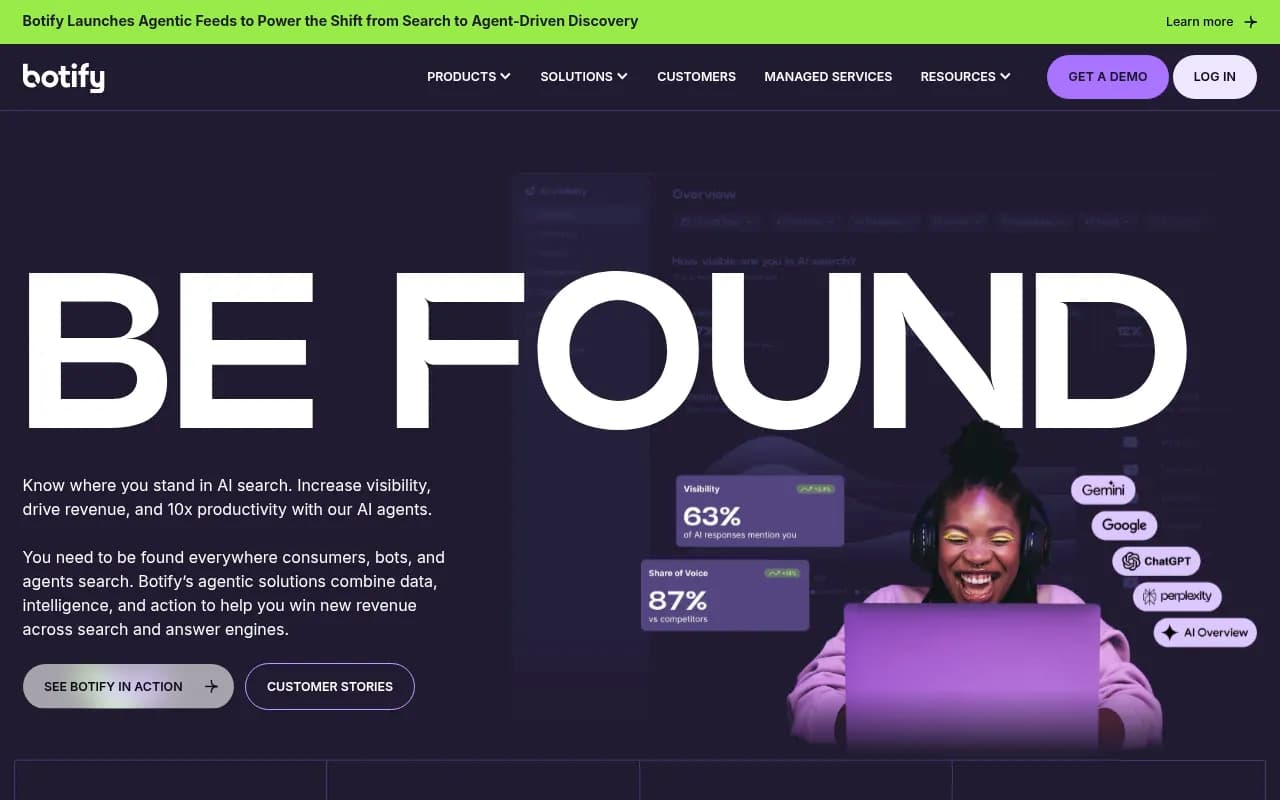
Its GEO pitch is a logical extension. If AI engines cannot reach or render your pages, nothing else you do matters, so a crawler-led vendor claims the "AI readiness" layer. That is a fair argument. It is also only half of GEO. Knowing that GPTBot hit a page tells you about access, not about whether the page gets cited or what the engine says about your brand.
Where Botify fits best: large e-commerce, marketplaces, publishers and classifieds where technical debt is the main drag on organic revenue. Where it fits less well: teams that need prompt-level AI answer tracking and content generation as the main deliverable.
A note on pricing lore. An old Reddit thread claims Botify costs about half of BrightEdge. It dates from 2019, so I would ignore it. Get a current quote.
Lumar: crawling plus site health and accessibility
Lumar, formerly Deepcrawl, joins technical SEO, accessibility and GEO in one crawler-led platform. It is the pick when QA, accessibility and release monitoring sit in the same remit as SEO, which is common in large organizations where SEO sits close to engineering.
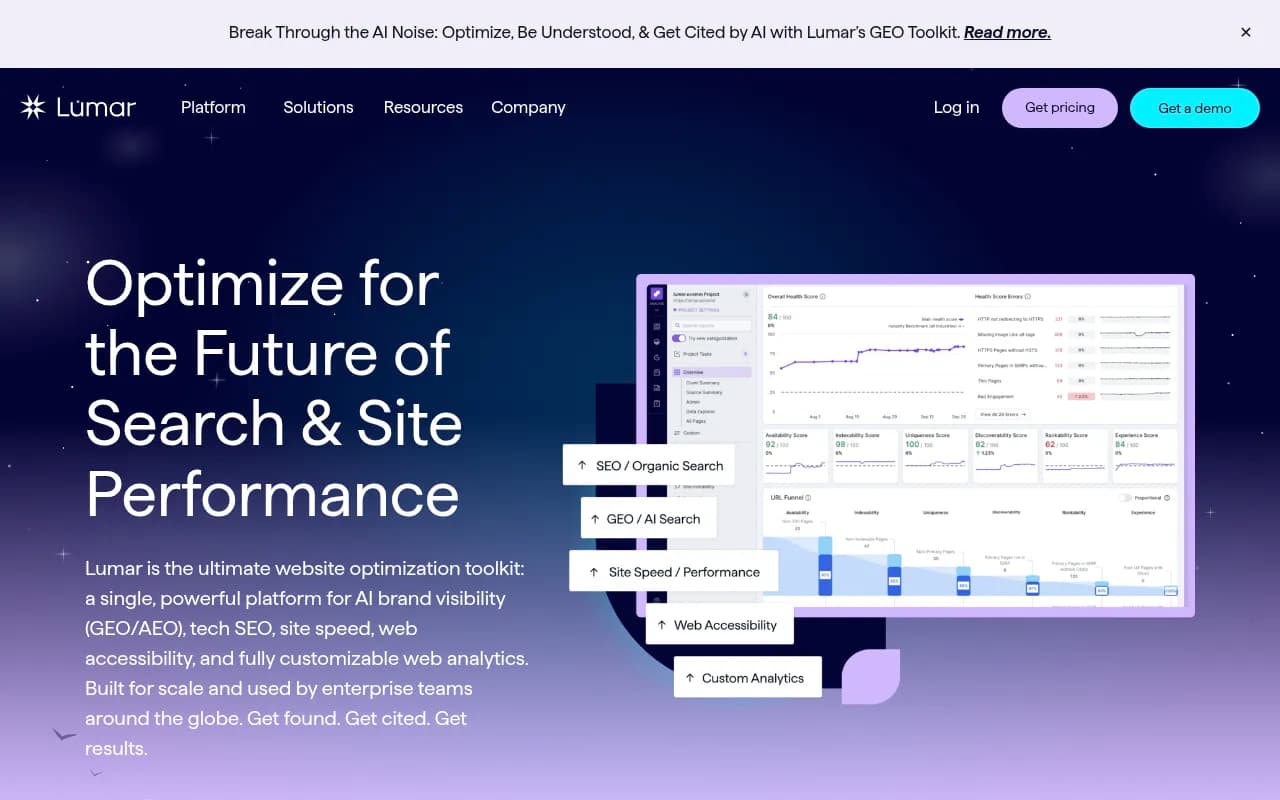
One comparison matrix I found rates Lumar as limited on AI search tracking and absent on keyword research. That matrix is a competitor-authored table, so treat it as directional. The takeaway holds up though: Lumar is for people who want to catch what breaks before it ships, and the GEO angle is an added metric layer rather than the center of gravity.
Practical use: wire Lumar into your deployment pipeline so a robots.txt change or a template regression that blocks AI crawlers gets flagged before it reaches production.
seoClarity: scale per dollar and a research data set
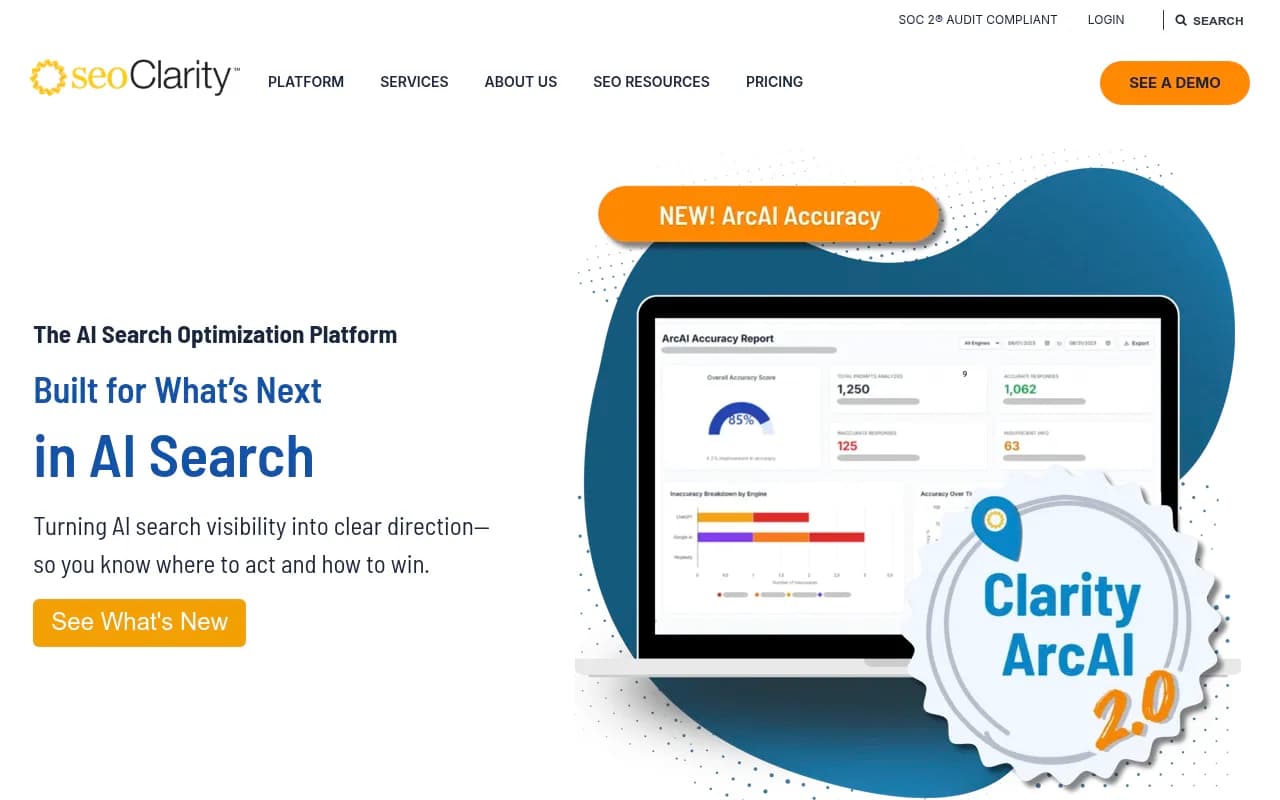
seoClarity is the suite that competes on data volume. It covers keyword research, rank tracking, content tools (topic research, briefs, an AI content writer), technical auditing, a crawler, log file analysis and reporting. It also lists answer box opportunity tooling, which is the nearest thing in its navigation to AI-answer thinking.
Two things stand out:
- It is the only one of the four with a price on the page. A competitor's roundup lists $2,500, $3,200 and $4,500 a month tiers and notes SOC 2 audit compliance and an automation product (ClarityAutomate) for deploying changes. Confirm all of it before budgeting.
- Its integrations lean toward data infrastructure: Okta, Ping Identity and Microsoft SSO, a GraphQL API, and Jira and Asana for work management, according to one integration table.
Its weakness for this article's question is depth, not breadth. One 2026 review says flatly that BrightEdge and seoClarity have custom pricing and no native AEO tracking, while another lists AI tracking as present. Those two claims conflict, which is itself a signal: ask each vendor for a live demo of AI answer tracking on your own prompts, not a slide.
BrightEdge: reporting and on-site automation
BrightEdge is the incumbent most associated with executive-ready reporting, market share analysis and content recommendations. Roundups describe it as best for automated on-site optimization and C-suite dashboards. One enterprise-platform roundup calls it the strongest suite choice if you need an incumbent's keyword history alongside AI data.
It publishes no pricing (its pricing URL 404s per one source) and sells by demo. Comparisons note AI Overview tracking is covered. Its integration reputation is as a marketing-stack connector, with a Connect API.
The case for it: you have many stakeholders, a long keyword history, and need to translate SEO into board-level language. The case against: if your actual problem is understanding and changing how ChatGPT or Perplexity describe you, a suite's reporting layer is not the same as an AI visibility workflow.
Side-by-side: who wins on what
| Capability | Botify | Lumar | seoClarity | BrightEdge |
|---|---|---|---|---|
| Crawl and rendering at millions of URLs | Strongest | Strong | Good | Good (plus Oncrawl) |
| Log file analysis | Core feature | Via integrations | Yes | Via Oncrawl |
| Keyword and rank data at scale | Basic | No | Very strong | Strong |
| Content workflow and briefs | Limited | No | Yes | Yes |
| Accessibility and QA | Limited | Strong | Limited | Limited |
| Executive reporting | Moderate | Moderate | Strong | Strongest |
| AI answer tracking | Positioned as AI search platform | GEO metrics | Included, verify depth | AI Overview tracking, verify depth |
| Published price | No | No | Yes (reported) | No |
Treat this as a starting grid built from vendor sites and competitor roundups, not a lab test. The "verify depth" cells are where your demo time should go.
The AI crawler question you should ask all four
This is the one area where the crawler-led vendors have a real structural advantage, so it deserves its own section.
In Promptwatch Data's AI crawler traffic report (verified requests, June 8 to Sep 6, 2026), OpenAI made up 79.8% of verified AI crawler requests in the week of Aug 31 to Sep 6, down from 94.8% in the week of June 8 to 14. Only requests whose source IP matches the operator's published ranges were counted, so spoofed user agents were excluded. Elsewhere, Promptwatch Data found Meta-WebIndexer grew from about 2% to nearly 38% of tracked AI crawler requests between mid-July and August 9, 2026. The mix moves fast.
So ask every vendor:
- Do you verify crawler IPs against operator-published ranges, or trust user agent strings?
- Do you separate training crawlers from answer-time fetchers?
- Does the log view connect to citations, so I can tell an access problem from a content problem?
- Which crawlers do you recognize today (GPTBot, OAI-SearchBot, ChatGPT-User, ClaudeBot, PerplexityBot, Meta-WebIndexer, Google's agents)?
If a vendor cannot answer in the demo, the GEO claim is marketing.
Where a dedicated GEO platform fits next to these suites
The honest read is that none of these four was built first for AI answers. Botify and Lumar are crawlers that added GEO. BrightEdge and seoClarity are SEO suites that added AI tracking. That is not an insult; it is a product history, and it shows in what is strong and what is bolted on.
Many enterprise teams end up running one of these for technical and ranking work and a purpose-built AI visibility platform alongside it. Promptwatch is built for that role: it tracks how ChatGPT, Gemini, Perplexity, Claude, Google AI Overviews and AI Mode mention and cite a brand, shows IP-verified AI crawler logs and AI-referred traffic, and then closes the loop with a prioritized action list and a Content Agent that writes and publishes pages to WordPress, Webflow or Framer. Pricing runs from $95 a month on Essential up to $579 on Business, which is where the Content Agent and faster tracking begin; confirm on promptwatch.com/pricing.

If you want to see where the gap is before committing to anything, the free AI visibility report scans how ChatGPT, Gemini and Perplexity talk about your brand. For a broader look at the category, the GEO software directory at bestgeosoftware.com lists alternatives, and Promptwatch has a head-to-head comparison hub.
Which one should you pick?
Pick by the bottleneck, not by the logo.
Your site has millions of URLs and indexation is the pain
Botify first. Add Lumar to the shortlist only if accessibility and release QA belong to the same team. Plan to add a dedicated AI visibility tool for prompt-level tracking.
Many stakeholders need shared reporting and content workflow
BrightEdge if executive dashboards and on-site automation matter most. seoClarity if data volume and a published price matter more. Run the same keyword set and the same reporting questions through both during a trial.
You want a single contract and fewer vendors
A suite (seoClarity or BrightEdge) gets you closest, but accept that AI answer depth will probably be thinner than a specialist's. Make the vendor demo AI tracking on your real prompts.
Your main job is changing how AI engines describe you
None of the four is the obvious first purchase. Start with a GEO platform, and keep your crawler or suite for the technical and ranking layer.
Demo checklist for all four
- Show AI answer tracking for 20 of my real prompts across ChatGPT, Gemini, Perplexity and AI Overviews, collected from the user-facing interface, not only an API.
- Show which of my pages were cited, and where in the source list.
- Show IP-verified crawler logs, and how you split training from answer-time bots.
- Show a recommended change, who ships it, and how you measure the result.
- Show AI-referred traffic and conversions in the same view.
- Give me the price in writing, including prompt, seat and URL limits.
The contract point matters too. These tools are typically sold on annual terms, so a structured trial on your own site is worth the effort.
What I could not verify
Some honesty about this comparison. The vendor-specific GEO details here come from vendor pages and competitor-written roundups (Indexable AI and Honeyb publish several of them, and both sell competing products). I did not find first-party documentation on exact AI module names, prompt limits or current pricing for Botify, Lumar or BrightEdge, and seoClarity's pricing comes from a third party. Check everything above against a fresh demo.
The bottom line: Botify and Lumar have the most credible GEO foundation because AI visibility starts with crawlability. BrightEdge and seoClarity have the broadest context for organizations that live in reports and workflows. For real GEO depth, meaning tracking, tracing, acting and measuring, expect to run a specialist next to whichever of these four you pick.