Key takeaways
- News is only 5.7% of ChatGPT citations, and half of cited news pages stop being cited within 36 days. Publishers need a different playbook from SaaS brands.
- The most useful GEO tools for publishers do three things: show which of your pages AI cites, show which AI crawlers actually reach your site, and tie that to traffic.
- Prompt trackers that only answer "was I mentioned?" are not enough for a newsroom. You need page-level and topic-level data.
- Evergreen assets (explainers, guides, data pages, comparisons) hold citations far longer than breaking news, so your tooling should help you refresh them.
- Pricing and feature details change often. Confirm everything on each vendor's own site before you buy.
Why publishers need a different GEO approach
Most GEO advice is written for software companies that want to be recommended in a "best CRM" answer. Newsrooms have a different problem. You are not asking an AI to recommend you. You want to be the source it cites when it answers a question about an event, a policy, a person, or a how-to.
The numbers from Promptwatch Data (Sep 28 to Oct 4, 2026) make the point. Product pages account for 22.4% of ChatGPT citations and landing pages for 16.8%. News is 5.7%. Listicles are 13.6%, how-tos 8.7%, documentation 7.5%. Editorial formats combined make up about 43% of citations, so there is plenty of room for publishers, but not mostly through breaking news.
The decay data is harsher. In Promptwatch's content half-life report, which tracked pages ChatGPT cited on July 6, 2026 through Oct 4, 2026, almost a quarter of news pages were never cited again after day 0, and half were gone after 36 days. Landing pages and docs were still cited at 78% and 76% after 30 days. Product pages, reviews and how-tos reached their half-life after 74 to 77 days.
So the tool question is not just "where do I show up?" It is "which of my pages earn citations, how long do they last, and what do I do about it?"
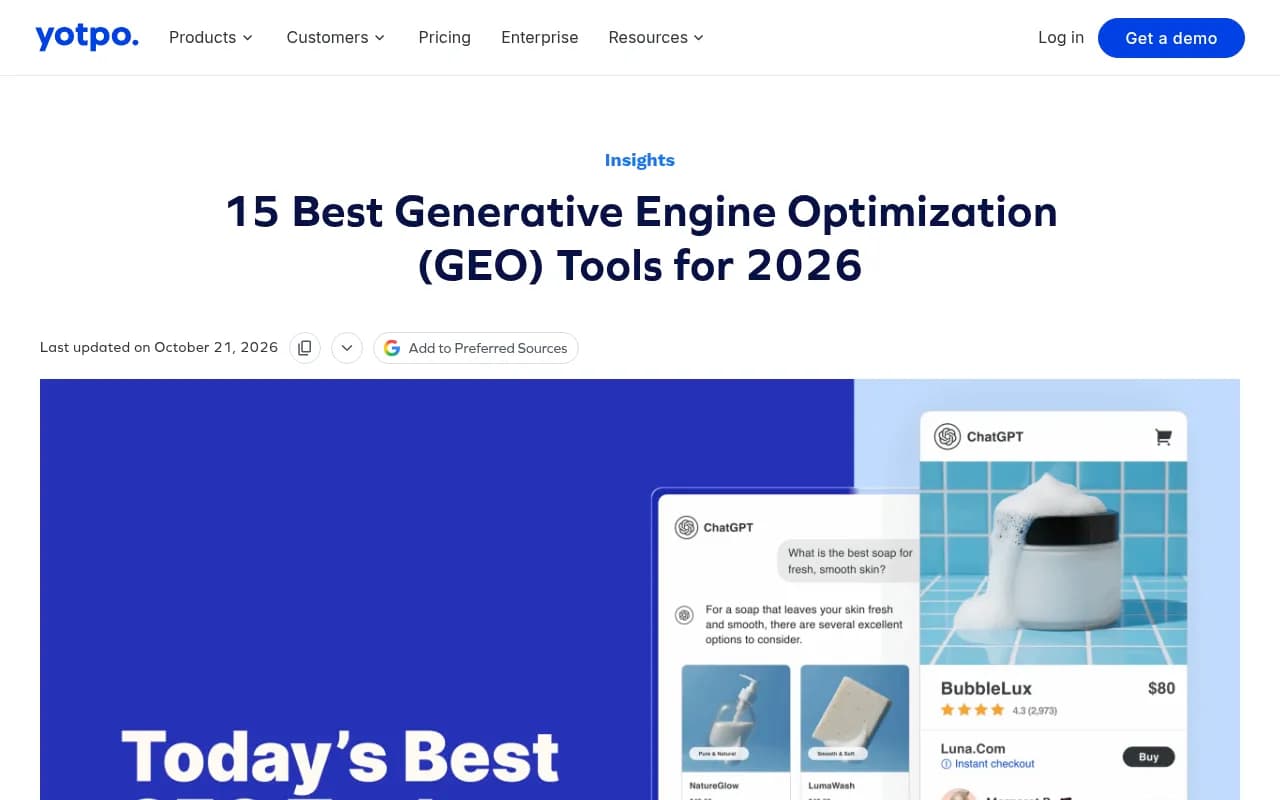
A note on the generic roundups. Most of the "best GEO tools" lists you will find, including the Yotpo one pictured above, are written by vendors for brand and ecommerce teams. They are useful for orientation, but none of them focus on publishers. Treat their rankings with some skepticism.
What a publisher should look for in a GEO tool
Before the tool list, here is the checklist I would use if I were buying for a news site.
Page-level citation data
Brand-level mention counts tell a publisher almost nothing. You need to know which URLs get cited, for which prompts, and where they sit in the source list. A newsroom with 50,000 URLs needs to find the 200 that matter.
AI crawler logs
Publishers are in an unusual position: many have deliberately blocked some AI bots, licensed content to others, and run CDN or paywall rules that block more by accident. Guessing is risky. The Promptwatch AI crawler traffic report shows OpenAI at 79.8% of verified AI crawler requests in Aug 31 to Sep 6, 2026, down from 94.8% in early June, with the rest split among Anthropic, Google, Perplexity and Mistral. Its advice is simple: if a provider is a large share overall but near zero in your logs, you are probably blocked from it. Also note that crawler volume can be training traffic, answer-time fetches, or both, so you need a view that splits bots.
Real UI tracking across multiple engines
Answers and citations in the consumer ChatGPT, AI Overviews and Perplexity interfaces can differ from what the API returns. Social sources also vary a lot by engine. In the week of Sep 28 to Oct 4, 2026, ChatGPT drew 0.46% of citations from social platforms while Google AI Overviews drew 12.2% (Promptwatch Data). If your audience finds you through different engines, you want to see each one separately.
Topic and freshness reporting
News publishers own topics, not products. A good tool lets you group prompts by beat (politics, health, local government) and see where you are cited versus competitors and aggregators.
A path from insight to action
Seeing a gap is the easy part. The tools worth paying for help you refresh a stale explainer, spot a page that ranks in Google but is never cited, or publish a new piece against a prompt you are losing.
Traffic attribution
Citations without clicks are vanity. Check whether the tool connects AI referrals to your analytics, ideally alongside Search Console data.
Comparison table: GEO tools for publishers
| Tool | Best for | Crawler logs | Page-level citations | Content workflow |
|---|---|---|---|---|
| Promptwatch | End-to-end tracking and fixing | Yes | Yes | Yes |
| Profound | Enterprise monitoring | Verify with vendor | Yes | Limited |
| Botify | Large-site technical SEO plus AI visibility | Log analysis (verify AI coverage) | Verify with vendor | Technical focus |
| Conductor | Enterprise content teams | Verify with vendor | Verify with vendor | Content workflow |
| Semrush / Ahrefs Brand Radar | Existing SEO suite users | No | Limited | No |
| Otterly.AI / Peec AI | Cheap prompt monitoring | No | Limited | No |
| Schema App | Structured data at scale | No | No | Markup |
| Meltwater | Media monitoring and PR | No | Limited | No |
This table reflects general positioning. Where it says "verify with vendor," I could not confirm the capability from public information, so ask for a demo.
The tools, by job
Tracking AI citations and fixing gaps: Promptwatch
Promptwatch is the one I would put on a publisher's shortlist first, mainly because it goes beyond "you were mentioned." It tracks the real interfaces of ChatGPT, Google AI Overviews, AI Mode, Gemini, Perplexity, Copilot and others, and it shows citation data per page, including a content-type classification and how long a cited page keeps getting cited. That second part matters for news: you can see which of your pages are decaying and which are holding.

For a newsroom, the features that carry the most weight are:
- IP-verified AI crawler logs, so you can see whether GPTBot, ClaudeBot, PerplexityBot and others are reaching your articles, and what errors they hit. Spoofed bots are filtered out. It works with Cloudflare, Vercel, Fastly and raw server logs, which covers most publisher stacks.
- Prompt volumes, difficulty and query fan-outs, which show the actual web searches an AI runs for a question. That helps you shape explainers around what the model looks for.
- Search Console and Bing data next to AI data, which answers "which pages rank in Google but never get cited?"
- Reddit, YouTube and LinkedIn citation reports, useful if you distribute video or social explainers.
- The Action Board and Content Agent, which turn gaps into prioritized tasks and drafts. Newsrooms will want the review inbox on, not the hands-off mode. I would not let anything publish to a news site without an editor.
Pricing starts with a free Explore tier (10 prompts, ChatGPT only), then Essential at $95/month and Professional at $245/month. Business at $579/month adds the automated Content Agent and state or city tracking, which is handy for local news. Confirm current prices at promptwatch.com/pricing.
It is a GEO platform, not a classic SERP rank tracker, so if your editors live in rank-tracking dashboards you will still want one alongside it.
Enterprise monitoring: Profound
Profound is a well-known enterprise option for tracking brand visibility in AI answers, and it shows up in nearly every GEO roundup.
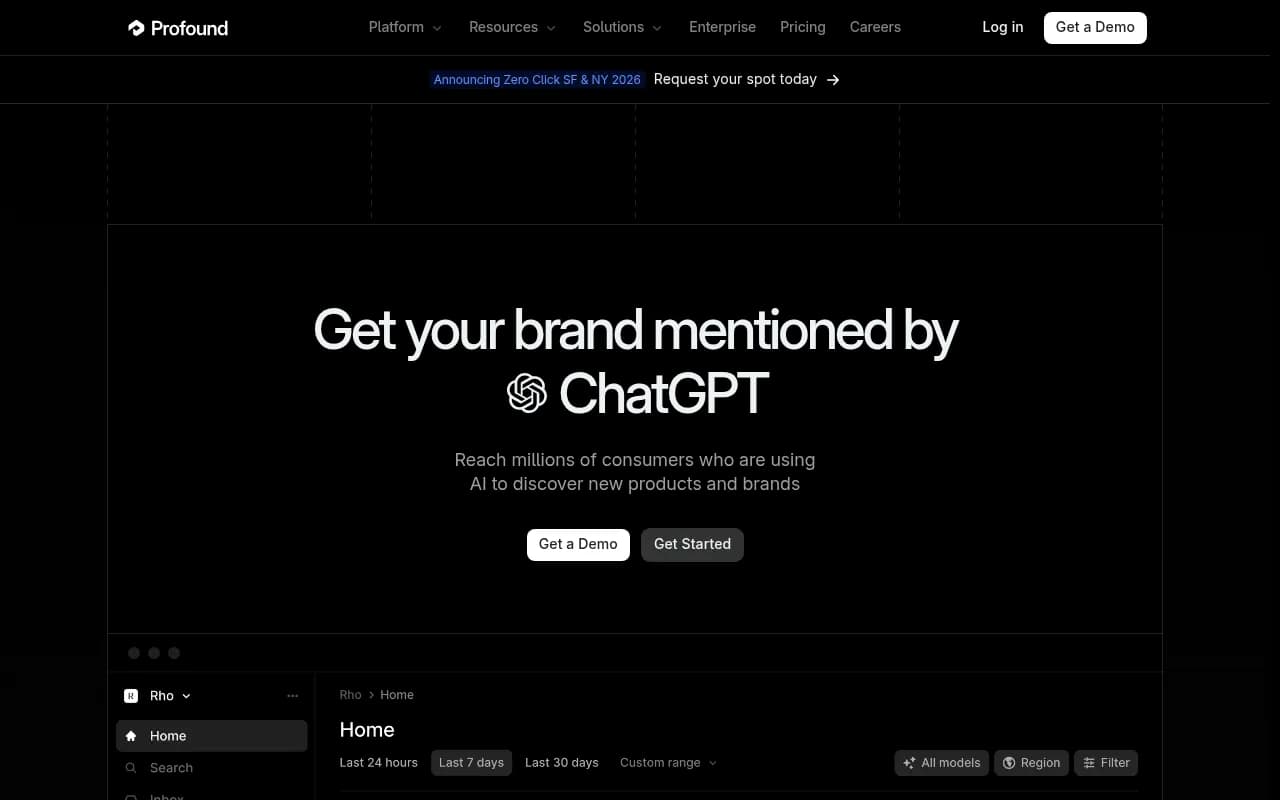
It suits large organizations that mainly want monitoring and reporting. The tradeoffs I would probe in a demo: price, whether it includes crawler logs, and how much of it is execution as opposed to measurement. Several publishers I have seen evaluate it end up asking for page-level reporting more than brand-level scores.
Technical foundations for big sites: Botify and seoClarity
If your site has millions of URLs, the problem is often not content but access, rendering and crawl budget. Botify and seoClarity both sell enterprise SEO with AI search visibility layered on top.
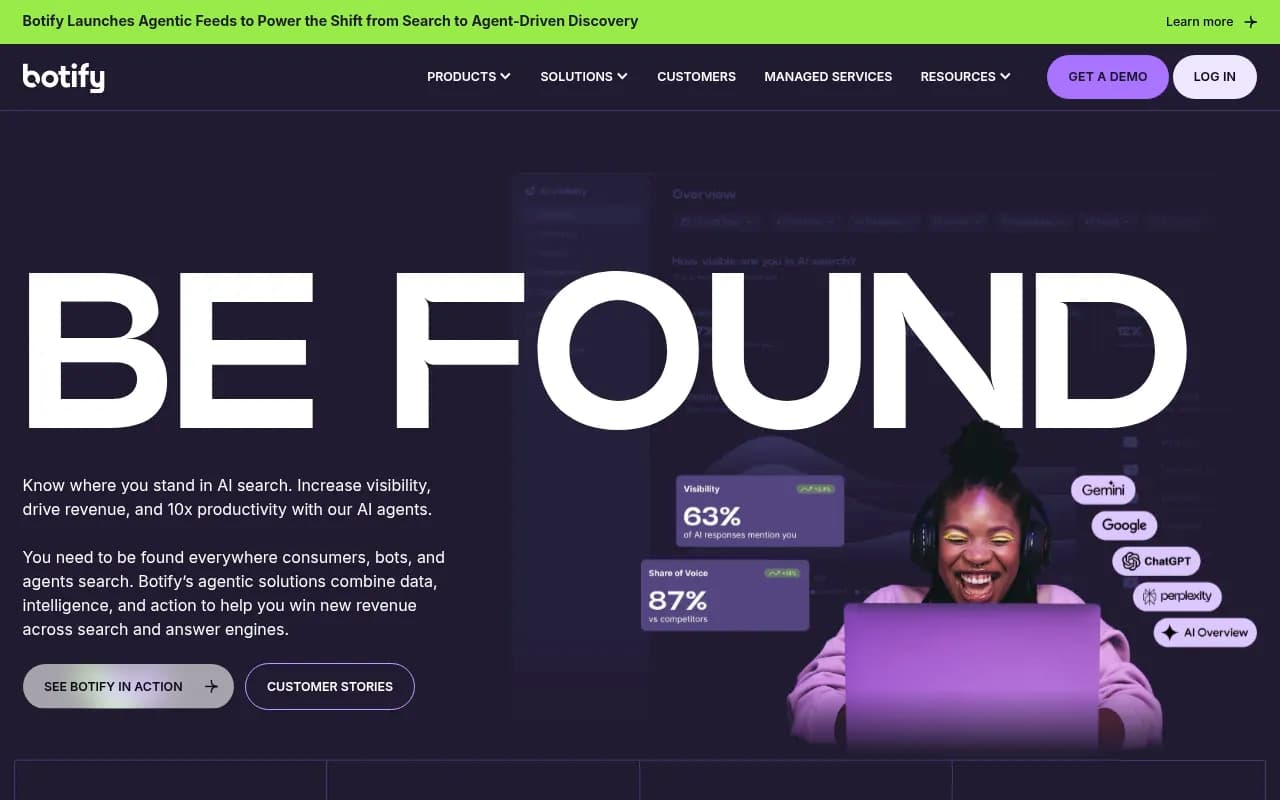
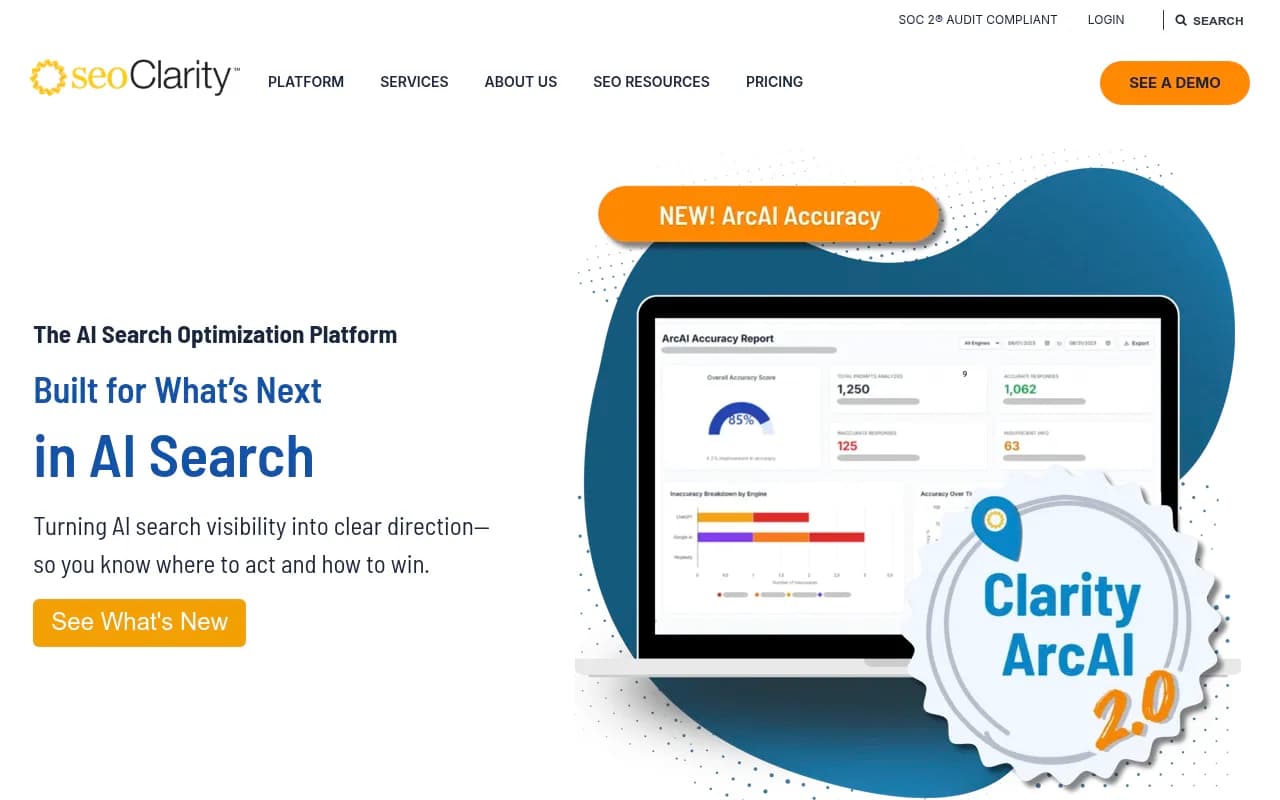
These are the tools to look at when your engineering team needs to answer questions like "are our article templates actually readable without JavaScript?" The crawling and log analysis side is the strong suit. The AI-specific depth varies, so ask what they measure at the citation level.
Enterprise content and SEO suites: Conductor and BrightEdge
Conductor and BrightEdge are established enterprise platforms that now sell AI search visibility modules. They fit publishers with large central SEO teams who already work inside those systems and want one reporting layer.
If you are already a customer, the AI add-ons are worth a look before buying a separate tool. If you are not, I would compare them against a purpose-built GEO platform first.
Cheap prompt monitoring: Otterly.AI and Peec AI
Small publishers and niche blogs sometimes just want to watch a set of prompts. Otterly.AI and Peec AI are basic monitors in that role.


They are fine for answering "did we appear?" They do not give you crawler logs, visitor attribution or content generation, so you will hit their limits as soon as you want to know why a page is not being cited.
SEO suite add-ons: Semrush and Ahrefs Brand Radar
If your team already pays for Semrush or Ahrefs, their AI tracking features are the lowest-friction way to get started.

The limit is depth. Fixed prompt sets and no crawler logs mean you see a surface view of visibility, not the mechanics behind it. Good for a first look, thin for a newsroom that wants to diagnose.
Structured data: Schema App
Publishers have an edge here: Article, NewsArticle, Person (author) and Organization markup are standard practice, and consistent markup helps machines understand who wrote what and when. Schema App handles structured data at scale.
I would not claim schema directly makes AI cite you, since nobody outside the labs can prove that. But clean entity data is cheap insurance and helps traditional search too.
Media monitoring: Meltwater
Press coverage and syndication still matter, because AI engines pull from third-party pages. Meltwater is a media intelligence tool that can help you see who is quoting and republishing your reporting.
It is not a GEO tool by itself. Think of it as the input side: where your reporting travels, which can then be matched against what AI cites.
Free options to start with
If you are not ready to pay, try Google Search Console for baseline search data and a free scan like AEO.express or Amplitude AI Visibility for a quick snapshot.

Free scans are one-time snapshots. They will not tell you about citation decay or crawler access.
A practical GEO stack for a newsroom
Here is how I would assemble this depending on size.
| Publisher type | Suggested stack |
|---|---|
| Local or niche publisher | Promptwatch Essential or Professional, Search Console, Yoast SEO or equivalent for markup |
| Mid-size regional group | Promptwatch Business (state and city tracking), Schema App, a crawler like Screaming Frog |
| National or global publisher | A GEO platform with crawler logs, Botify or seoClarity for technical work, Meltwater for media tracking |
| Agency serving publishers | Agency plans with white-label reporting and unlimited projects |
Publishers running a lot of properties should also browse the GEO software directory at bestgeosoftware.com and the AI rank tracking directory for more options.
How to use the data once you have it
Tools are useless without a routine. Here is a workflow that fits a newsroom.
- Check crawler access first. Open your robots.txt, CDN and WAF rules and compare them to your crawler logs. Decide, deliberately, which bots you want to allow. Do not let an old firewall rule make that decision for you.
- Split your content into two buckets: time-sensitive news and evergreen assets. Expect news to spike and fade. The half-life data says to treat press coverage as a short burst of visibility.
- Build evergreen assets around your beats. Explainers, glossaries, data pages, how-tos and comparisons keep their citations longer. Promptwatch's half-life report found how-tos and reviews lasting 74 to 77 days to half-life, and landing pages and docs holding 76 to 78% at 30 days.
- Refresh instead of republishing. An updated explainer with a clear date and corrections beats a new near-duplicate. Look for pages that rank in Google but never get cited, and fix those first.
- Watch query fan-outs. ChatGPT started using the site: operator at scale on August 8, 2026, going from roughly 0.4% to about 17% of fan-out queries, according to Promptwatch Data. That means models are increasingly searching inside specific domains. A well-organized site with clear section pages is easier to retrieve from.
- Expect volatility. Yotpo's guide suggests 40 to 60% monthly variance in AI citations. That figure comes from a vendor, so treat it as a rough warning rather than a benchmark. Track trends over weeks, not single days.
- Do not chase domain authority. In August 2026, sites with domain rank 46 to 75 earned almost half of ChatGPT citations, while DR 91 to 100 fell to about 3% (Promptwatch Data). Smaller and mid-size publishers have a real shot.
- Do not lean on Reddit or social as a distribution plan for ChatGPT. Reddit's share of ChatGPT citations fell from about 4% to 0.5% on August 14, 2026 (Promptwatch Data). AI Overviews is a different story, which is why per-engine tracking matters.
Questions publishers should ask vendors
- Do you track the actual consumer interface or only the API?
- Can I see citations at the URL level and filter by section or author?
- Do you provide IP-verified AI crawler logs, and which CDNs do you support?
- How do you separate training crawls from answer-time fetches?
- Can I export data to Looker Studio, my warehouse or my BI tool?
- What controls exist before AI-generated content gets published? On a news site the answer should involve a human editor.
- How do prices scale with prompts and responses? Prompt tracking costs can climb fast with a large beat structure.
What about agencies?
Some publishers prefer to outsource strategy. Agencies like LSEO position themselves in this space, and the LSEO guide is one of the top results for "best GEO agencies 2026."

As with the tool roundups, an agency ranking written by an agency is marketing first. If you do go that route, look for senior specialists, transparent reporting and no long lock-in contracts. 1001 SEO Media, which publishes this site, offers GEO and technical SEO services on that basis, and works with Promptwatch for AI visibility measurement.
Final recommendations
If you only remember three things: check that AI crawlers can actually reach your articles, invest in evergreen pages because news citations fade in about five weeks, and pick a tool that shows page-level data instead of a single visibility score. For most newsrooms, that points toward a platform with crawler logs and citation analytics. Promptwatch fits that brief for small to mid-size teams, while very large publishers will want to pair a GEO platform with an enterprise technical tool like Botify. Start with a free scan or a trial, then confirm pricing and features on each vendor's page before you commit.