Key takeaways
- Peec.ai is a solid AI visibility monitoring tool, but it has no content creation, content gap analysis, or optimization capabilities built in.
- Knowing you're invisible in AI search is only useful if you can do something about it. Most GEO platforms stop at the data.
- Real GEO content generation in 2026 is grounded in actual prompt data, citation analysis, and competitor gaps -- not generic AI writing.
- Raw AI-generated content published at scale can hurt your Google rankings, which in turn hurts your LLM visibility. The quality bar matters.
- Platforms that close the loop between monitoring and content creation are what separates teams that improve their AI visibility from teams that just watch it.
Peec.ai raised $21M in Series A funding. It has a clean interface, covers ChatGPT, Perplexity, Google AI Overviews, and DeepSeek, and it does what it promises: it shows you where your brand appears (or doesn't appear) in AI-generated answers.
That's genuinely useful. But there's a ceiling.
Once you know you're invisible for a set of prompts, the platform doesn't tell you what to do about it. There's no content gap analysis, no brief generation, no optimization tooling. You get the data, then you're on your own.
In 2025, that was probably fine. In 2026, with AI search eating a meaningful share of discovery traffic, "on your own" is a real problem.
This guide is about what comes after the monitoring. What does it actually take to generate content that gets cited by AI models? And what should you look for in a platform that claims to help you do it?
What Peec.ai does well (and where it stops)
To be fair to Peec.ai: the monitoring itself is competent. It tracks brand mentions across AI engines, shows you which prompts surface competitors instead of you, and gives you a visibility score over time.
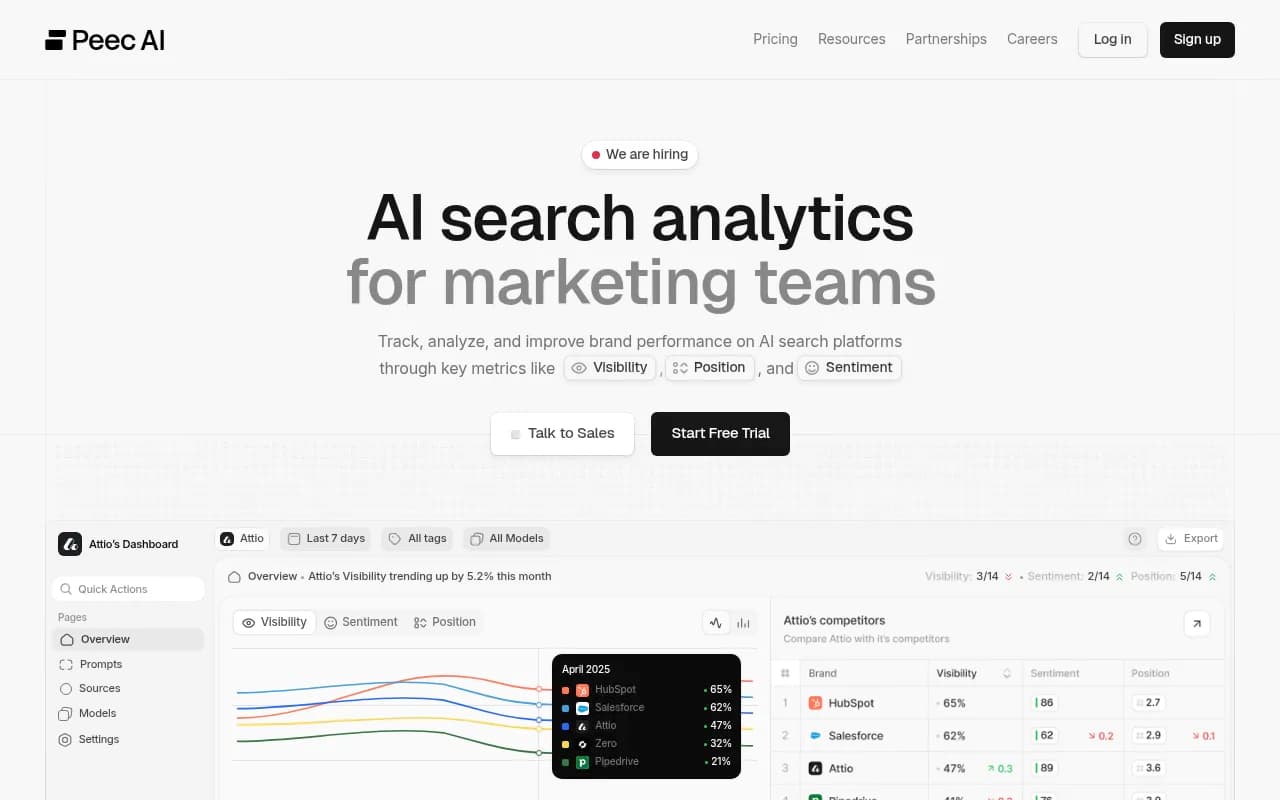
The Pro plan runs €199/month and covers four base AI engines. Claude, Gemini, and Google AI Mode are enterprise add-ons with custom pricing. You're capped at 100 prompts and 9,000 AI answers per month.
What's missing is everything that happens after you identify a gap:
- No content generation or brief creation
- No site audits or technical GEO analysis
- No traffic attribution from AI referrals
- No crawler log analysis to see how AI bots interact with your pages
- No Reddit or YouTube tracking (both of which directly influence LLM recommendations)
- No ChatGPT Shopping visibility
That's not a knock on Peec.ai specifically -- it's a monitoring tool, and it's honest about that. The problem is that many teams buy a monitoring tool and assume they've addressed their GEO problem. They haven't. They've just made the problem visible.
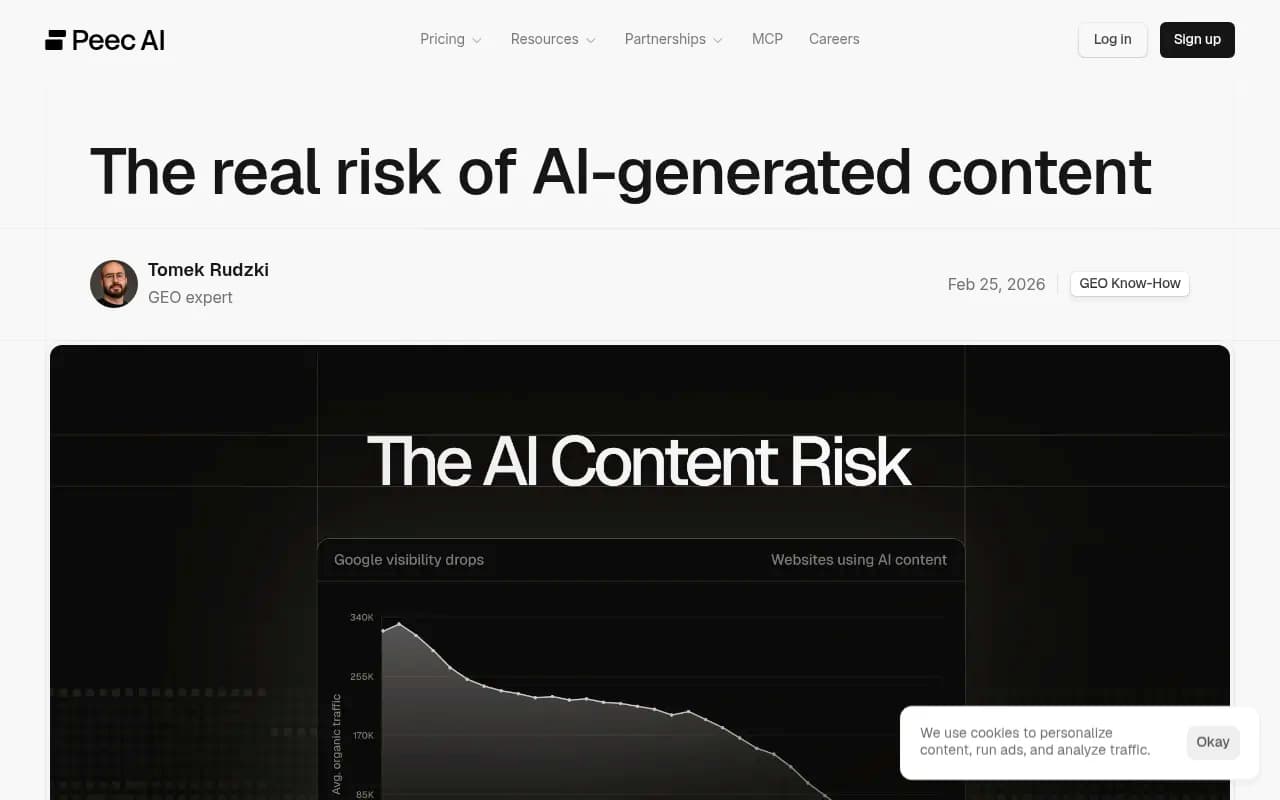
Interestingly, Peec.ai's own blog warns against the exact kind of low-quality AI content that some competing platforms push. Their GEO expert Tomek Rudzki wrote in February 2026 that companies are "negatively affecting their business by rushing to publish AI-generated content" -- and that sites with poor-quality AI content follow a predictable path: they rank for a while, then they drop, sometimes dramatically.
That's a fair warning. But it also creates a gap: if Peec.ai tells you not to publish raw AI output, and also doesn't give you tools to create anything better, what exactly are you supposed to do?
Why monitoring alone doesn't move the needle
Here's the core issue with monitoring-only GEO tools. Visibility data tells you the outcome. It doesn't tell you the cause, and it doesn't give you the fix.
Say Peec.ai shows you that a competitor is getting cited for the prompt "best enterprise data backup solutions" and you're not. What do you do with that?
You could:
- Guess what content you're missing
- Write something generic and hope it works
- Hire a consultant to figure out what the AI models actually want to see
None of those are efficient. And none of them are grounded in the actual data that would tell you what to write.
Real GEO content generation starts with understanding why AI models cite certain sources and not others. That means looking at:
- Which specific pages are being cited, and what they cover
- What prompt volumes look like (are people actually asking this?)
- What topics and angles competitors are covering that you're not
- How AI crawlers are interacting with your existing pages
- Whether your content is even being discovered and indexed by AI agents
Without that foundation, you're writing into a void.
What real GEO content generation actually looks like in 2026
The best GEO content workflows in 2026 follow a loop: find the gaps, create content to fill them, track whether it works. That sounds simple, but the execution is specific.
Step 1: Identify the right prompts to target
Not all prompts are equal. Some are asked by thousands of people every day. Others are niche edge cases. Some are genuinely winnable -- your competitors are weak there, or the AI models are citing low-quality sources you could easily displace. Others are dominated by authoritative sources you can't realistically compete with.
Good GEO content generation starts with prompt intelligence: volume estimates, difficulty scores, and an understanding of how one prompt fans out into related sub-queries. If you're targeting "best CRM for small business," you also need to think about "best CRM for freelancers," "CRM with free tier," "CRM that integrates with Gmail," and so on.
Guessing at this is slow and wasteful. You need data.
Step 2: Understand what's missing from your content
Answer gap analysis is the core of this step. You run your target prompts through AI models and map the responses against your existing content. Where are competitors being cited and you're not? What topics are AI models drawing on that you haven't covered?
This isn't about keyword density or traditional SEO signals. AI models synthesize information from multiple sources. They're looking for content that directly answers specific questions, with enough depth and authority to be worth citing. If your content doesn't address the angle the AI is looking for, it won't get cited -- even if you rank well on Google for related terms.
Step 3: Generate content that's actually engineered for AI citation
This is where the quality bar matters enormously.
Peec.ai's own blog is right that raw AI output published at scale is a bad idea. Google has gotten good at detecting it, and a Google ranking drop has a downstream effect on LLM visibility -- because many AI models use Google rankings as a signal during their grounding process.
But "don't publish raw AI output" doesn't mean "don't use AI to help create content." The difference is in how the content is generated and what it's grounded in.
Good GEO content generation uses:
- Real prompt data and citation data as the brief foundation
- Competitor analysis to identify angles and depth requirements
- Brand guidelines and existing knowledge base to maintain voice and accuracy
- Search results and news context to ensure freshness
- Human review to add genuine expertise and perspective
The output isn't a generic 1,500-word article stuffed with keywords. It's a piece specifically engineered to answer the questions AI models are already exposing as gaps.
Step 4: Track what happens after you publish
Publishing is not the end of the process. You need to know:
- When AI crawlers discover your new content
- When they start citing it
- Which models are citing it and for which prompts
- Whether your visibility scores are improving
- Whether that visibility is translating into actual traffic and revenue
Most monitoring tools can show you visibility scores over time. Fewer can show you the full timeline from publish to crawl to citation, or connect AI visibility to revenue attribution.
The tools that close the loop
The GEO market has split into two categories: monitoring tools and optimization platforms. The distinction matters.
| Tool | Monitoring | Content generation | Crawler logs | Traffic attribution | Prompt intelligence |
|---|---|---|---|---|---|
| Peec.ai | Yes | No | No | No | Limited |
| Otterly.AI | Yes | No | No | No | No |
| AthenaHQ | Yes | No | No | No | Limited |
| Profound | Yes | Limited | No | No | Yes |
| Scrunch AI | Yes | Yes | No | No | Limited |
| Promptwatch | Yes | Yes | Yes | Yes | Yes |
Promptwatch is the platform that most directly addresses the full loop described above. It combines answer gap analysis, AI content generation grounded in real prompt and citation data, crawler log monitoring, and traffic attribution in one place.

The content agents don't just generate articles -- they generate briefs and content grounded in which prompts have volume, which competitors are being cited, what angles are missing from your site, and what your brand guidelines require. That's a different product category from a monitoring dashboard with a "generate content" button bolted on.
Scrunch AI is worth mentioning as another option that includes some content tooling alongside monitoring.
For teams that want to separate the monitoring and content creation functions, Surfer SEO handles content optimization well, though it's not specifically built for GEO.
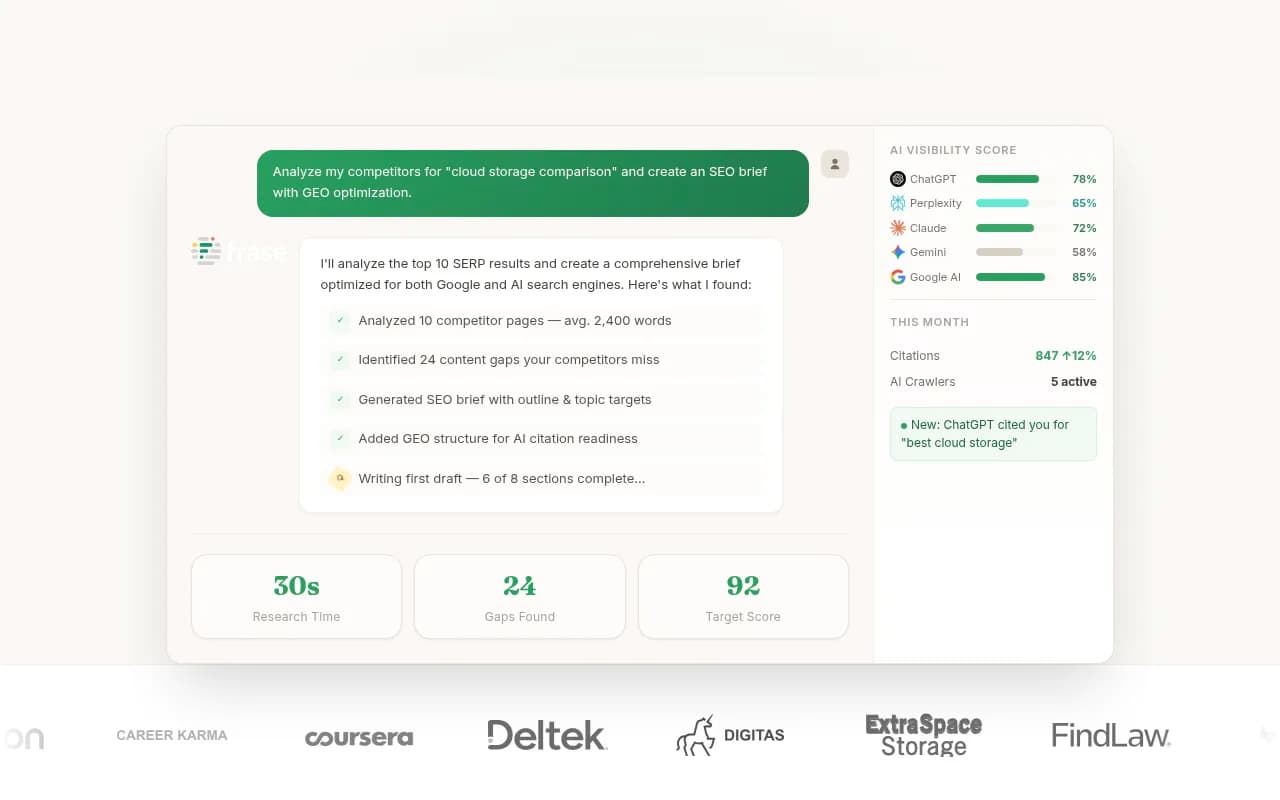
Frase is another option for content brief generation, though again, it's not GEO-native.
The quality problem with AI content generation for GEO
There's a real tension here worth addressing directly.
GEO requires publishing more content -- more prompts covered, more angles addressed, more questions answered. That's a lot of writing. AI generation is the obvious solution.
But as Peec.ai's own research shows, low-quality AI content can tank your Google visibility. And since LLMs use Google rankings as a grounding signal, that creates a negative feedback loop: you publish AI content to improve LLM visibility, it hurts your Google rankings, which hurts your LLM visibility.
The way out of this is not to avoid AI generation entirely. It's to raise the quality bar on what gets generated.
That means:
- Starting from real data (prompt volumes, citation analysis, competitor gaps) rather than generic topic ideas
- Generating content that addresses specific questions with genuine depth, not surface-level summaries
- Adding human expertise, proprietary data, or original perspective that raw AI output can't produce
- Monitoring what actually gets cited versus what doesn't, and iterating
The teams winning at GEO in 2026 aren't the ones publishing the most AI content. They're the ones publishing the most useful content for the specific questions AI models are trying to answer.
What to look for when evaluating GEO platforms
If you're evaluating whether to stick with Peec.ai or move to a platform with content generation capabilities, here are the questions worth asking:
Does it show you what to write, not just where you're missing? Visibility scores are table stakes. The useful question is: what specific content would close this gap?
Is the content generation grounded in real data? Generic AI writing tools can produce GEO content, but without prompt volume data, citation analysis, and competitor gap mapping, you're guessing at what to write. The grounding matters.
Can you track from publish to citation? If you can't see when AI crawlers discover your new content and when they start citing it, you can't learn what's working. Crawler logs and citation tracking are essential for iteration.
Does it connect visibility to revenue? AI visibility that doesn't translate to traffic and conversions is interesting but not actionable. Traffic attribution closes the loop between GEO effort and business outcome.
Does it cover the models that matter for your audience? Peec.ai's base plan covers four engines. If your audience is heavy Claude or Gemini users, you're paying extra or flying blind.
The bottom line
Peec.ai is a legitimate monitoring tool. If you need to understand where your brand appears in AI search and you're not ready to invest in a full optimization workflow, it does that job reasonably well.
But monitoring is not optimization. Knowing you're invisible for 40 prompts doesn't make you visible for those prompts. And in 2026, with AI search driving a growing share of discovery traffic, the gap between knowing and doing is where brands are losing ground.
The platforms worth investing in are the ones that take you from gap identification through content creation to citation tracking -- in a single workflow, grounded in real data. That's what separates a GEO tool from a GEO dashboard.