Key takeaways
- Reputation in AI answers is not the same job as SEO. You need to know what the models say about you, which sources they pull from, and whether the description is accurate, not only whether you appear.
- Sources shift fast. In Promptwatch's data, reddit.com fell from roughly 3.8% to about 0.5% of ChatGPT citations in a few days in August 2026, so one-off audits go stale quickly.
- Pick a tool that covers the engines your buyers use, tracks sentiment and citations (not just mentions), and helps you fix problems instead of only reporting them.
- Branded prompts lean on your own product and landing pages plus reviews. Cleaning up those pages and your review profiles is usually the fastest reputation fix.
- Most tools in this category are vendor-reviewed by the vendors themselves. Run a trial with your own brand prompts before you commit.
Why reputation in AI answers needs its own tooling
When someone asks ChatGPT "is [your brand] any good for startups?", they get one synthesized answer. No ten blue links, no chance to scroll past a bad review. The model decides what to say about you, and it builds that answer from pages it fetched and from what it learned in training.
That creates problems brand teams did not have with classic search. An outdated pricing claim can be repeated to thousands of people. A competitor's comparison page can frame your product. A single hostile forum thread can become the "summary" of your reputation. And you cannot see any of it unless you ask the models the same questions your buyers ask, over and over, in each country and language.
This is what AI visibility tools do. They run a set of prompts across engines on a schedule, then report whether you are mentioned, how you are described, which competitors appear beside you, and which sources the engine cited. The better ones go a step further and help you change the outcome.
This guide is aimed at brand, communications and marketing teams, not only SEOs. So the evaluation leans toward sentiment, accuracy, source attribution and workflow, rather than pure rank-style metrics.
What the data says about where AI answers come from
Before picking a tool, it helps to know what you are trying to influence. A few findings from Promptwatch Data matter for reputation work.
Branded prompts lean on your own pages
In Promptwatch's analysis of ChatGPT citation share by content type (Sep 28 to Oct 4, 2026), product pages made up 22.4% of all citations and landing pages 16.8%. For branded prompts, such as "is HubSpot good for startups", product pages were 23.3% and landing pages 22.8%. Reviews rose to 5.6%, more than three times their overall share, and FAQ pages hit 4.8%.
So for reputation, two things are in your control: your own pages answering pricing, features and audience questions clearly, and the review sites that carry your name. A brand FAQ page is cheap and it shows up in the data.
The source mix moves without warning
Promptwatch's report on Reddit citations dropping in ChatGPT shows Reddit holding about 3.83% of ChatGPT citations from Jul 18 to Aug 7, 2026, then falling below 1% on Aug 14. The Aug 14-17 average was 0.52%. Promptwatch flags the exact size as provisional, since a data-collection issue can't be ruled out, but the direction was clear and it began the same day ChatGPT changed its query fan-out behavior (see the site: operator report).
If your reputation strategy was "seed positive Reddit threads", that plan just got weaker for ChatGPT. Google's surfaces declined more gradually, with AI Overviews down about 11% and AI Mode about 30% over the same stretch.
Each engine trusts different places
Promptwatch's social media citations by AI model report (Sep 28 to Oct 4, 2026) found that social platforms made up only 0.46% of ChatGPT citations, versus 12.2% for Google AI Overviews and 2.7% for Perplexity. In AI Overviews, YouTube was 4.28%, Facebook 2.38% and Reddit 2.15%. LinkedIn was ChatGPT's top social source at 0.3%.
The practical read: a reputation problem that lives on social platforms may be loud in Google AI Overviews and nearly invisible in ChatGPT. You need per-engine reporting, not a blended score.
News fades, owned pages stay
According to Promptwatch's content half-life data, news pages cited by ChatGPT on July 6, 2026 lost half their citations within 36 days, while landing pages and docs held on far longer. A crisis story ages out of ChatGPT relatively fast. A wrong claim sitting on a landing page does not.
What to look for in an AI visibility tool for reputation
A checklist beats a feature tour. These are the things that matter when the goal is protecting how you are described.
- Real interface data. Answers from the actual ChatGPT or AI Overviews interface can differ from API output. If the tool only calls APIs, it may be showing you something your buyers never see.
- Sentiment and accuracy, not only mention counts. Being mentioned in a negative or wrong way is worse than not being mentioned.
- Citation sources. You need to know which URLs the engine used, so you can fix the source rather than argue with the model.
- Prompt control. Brand-specific, competitor-comparison and "is X legit" prompts matter more for reputation than generic category prompts.
- Multi-country and multi-language coverage if you operate internationally. Answers vary a lot.
- Alerts and reporting your comms team will actually read: scheduled PDFs, Slack digests, white-label exports.
- A path from finding to fixing: content briefs, page updates, or agents that do the work.
- Security basics for procurement: ISO 27001, GDPR, SSO, audit logs.
The best AI visibility tools for brand reputation in 2026
Promptwatch
Promptwatch is the one I would start with for teams that want to fix problems rather than just document them. It monitors the real interfaces of ChatGPT, Google AI Overviews, AI Mode, Gemini, Perplexity, Copilot, Meta AI and Alexa, plus API models like Claude, DeepSeek, Mistral and Grok, by country and language.
For reputation specifically, it scores per-response sentiment with trends and a weekly AI summary, and it shows heatmaps that compare brands, models, topics or countries on sentiment. Citation analytics show which of your pages and which third-party pages (including Reddit, YouTube and LinkedIn posts) feed the answers. Offsite Mentions catch third-party pages that name you without linking. IP-verified crawler logs show whether AI bots can even read the pages you want them to quote.
The action side is what separates it from trackers. The Action Board lists prioritized fixes, content gap analysis maps your pages against the prompts AI answers, and the Content Agent can draft and publish corrections to WordPress, Webflow or Framer, then track whether the new page gets crawled and cited. It is ISO/IEC 27001 certified and GDPR compliant, which helps with security reviews.
Pricing starts with a free Explore plan (ChatGPT only, 10 prompts). Paid plans run from $95/month (Essential) to $579/month (Business), with agency plans from $199/month. Confirm current numbers at promptwatch.com/pricing. The free AI Visibility Report is a quick way to see how ChatGPT, Gemini and Perplexity currently describe you.

Honest caveat: the full content automation sits on Business and Enterprise plans, so a team that only wants a monitoring dashboard may not use half of what it pays for.
Profound
Profound is the enterprise name most often mentioned in this category. Its own agency roundup claims daily tracking across main engines on 1.9+ billion real user prompts, with content creation and crawler-to-conversion attribution in one platform. Pricing is higher than most and the vendor's own list admits it is overkill for teams who only want a lightweight score. Note that these claims come from Profound's own blog.

Evertune
Evertune positions itself around how AI describes a brand rather than raw output counts, which is why it comes up in reputation conversations. It markets to large brands. I could not verify pricing or feature depth independently, so ask for a pilot on your own prompts.
BrandRank.AI
BrandRank.AI is built around reputation and sentiment, with a "Recommendation Share" metric. It is custom-priced and aimed at PR, brand and corporate communications teams, according to a vendor-authored list. Worth a look if comms owns this budget rather than SEO.

Bluefish AI
Bluefish is described in agency roundups as a fit for teams watching how AI represents sensitive brands. Enterprise-oriented and sales-led.
Scrunch AI
Scrunch is another enterprise option. Its distinctive idea is an AI-optimized page layer served to crawlers. Profound's roundup notes it does not generate content yet and that prompts are configured rather than pulled from real conversations.
Peec AI
Peec AI is a Berlin-based monitoring tool popular with agencies. It is a clean tracker without much of an optimization layer, so you will need another way to act on what it finds.

Otterly.AI
Otterly.AI is the budget pick, starting at $29/month per its own materials. Good for small teams that need to see where they stand. It lacks real prompt-volume data and in-platform content generation.

KIME
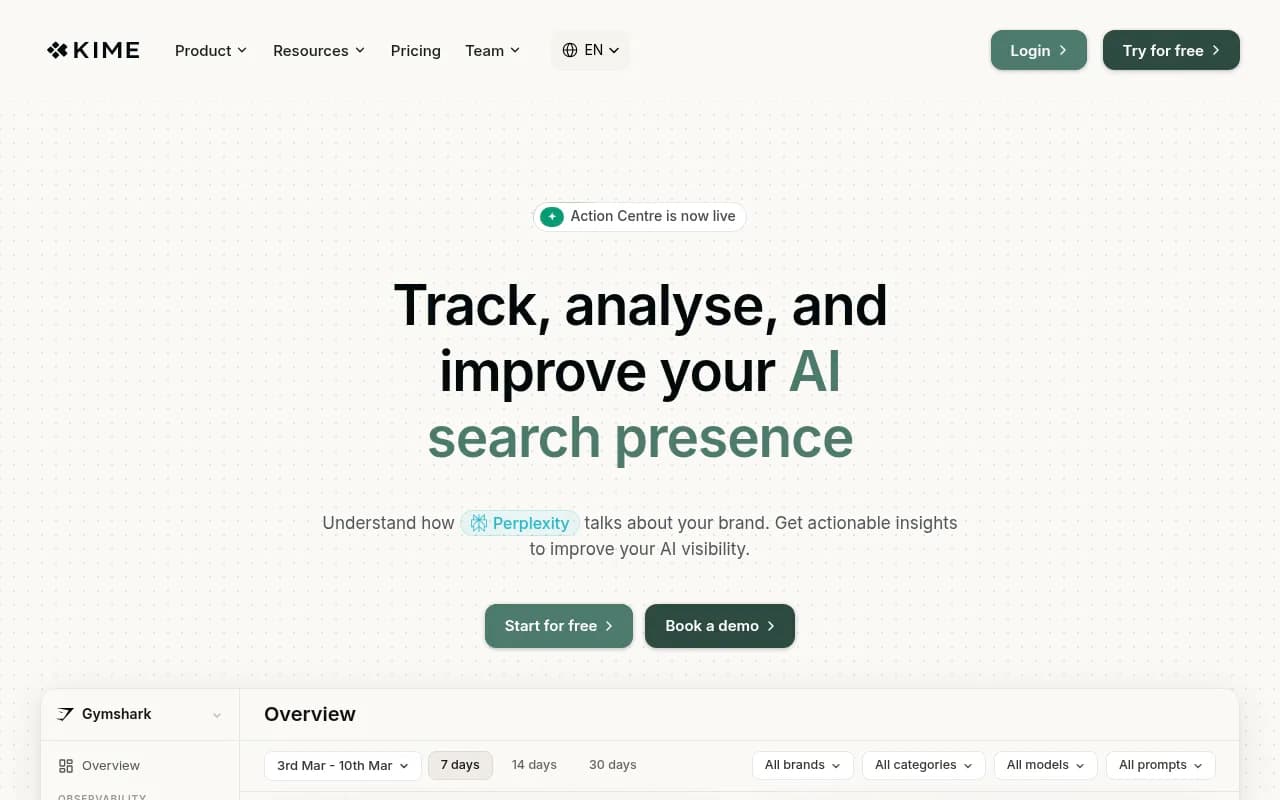
KIME ranks itself first in its own listicle, so treat that with salt. What stands out for reputation work is its sentiment split (positive, neutral, negative) and its tracking of paid placements inside AI answers. Pricing starts at \u20ac99/month by its own claim.
Semrush and Ahrefs Brand Radar
If your team already lives in Semrush or Ahrefs, their AI add-ons reduce tool sprawl. Ahrefs Brand Radar lets you correlate AI citations with backlink data you already own. The tradeoff is shallower AI-specific data and fixed prompt sets compared with dedicated platforms.
Adjacent tools: listening and reviews
AI visibility tools do not replace classic monitoring. Social listening tools like Brand24 and Meltwater catch the press, forum and social chatter that eventually feeds AI answers, and review platforms such as Trustpilot and Birdeye manage the review profiles that branded prompts quote.
Comparison table
Pricing and feature notes for non-Promptwatch tools come from vendor-authored sources and were not independently verified. Confirm before buying.
| Tool | Strength for reputation | Acts on findings | Starting price (as reported) | Best for |
|---|---|---|---|---|
| Promptwatch | Real-UI tracking, sentiment heatmaps, citation and crawler data | Yes: Action Board, Content Agent, CMS publishing | Free tier; $95/mo | Teams that want to fix, not just watch |
| Profound | Broad engine coverage, enterprise reporting | Content creation included | Higher, sales-led | Large brands and agencies |
| Evertune | Focus on how AI describes a brand | Limited info | Custom | Enterprise brand teams |
| BrandRank.AI | Reputation and sentiment scoring | Limited info | Custom | PR and comms |
| Bluefish AI | Sensitive-brand representation | Limited info | Custom | Regulated or high-stakes brands |
| Scrunch AI | AI-optimized page layer | Partly | Custom | Enterprise |
| Peec AI | Clean monitoring | No | Mid-range | Agencies |
| Otterly.AI | Cheap monitoring | Briefs only | $29/mo | Small teams |
| KIME | Sentiment split, paid-placement tracking | Agentic executions | \u20ac99/mo | Marketing teams |
| Semrush / Ahrefs | Fits existing suite | Minimal | Add-on pricing | Existing customers |
For wider lists, the GEO software directory at bestgeosoftware.com and the AI rank tracker directory at ai-rank-tools.com cover many more options.
A reputation workflow that actually works
Buying software is the easy part. Here is a routine that gets value out of it.
1. Build a reputation prompt set
Skip generic category prompts at first. Write 30 to 50 prompts that mirror what a skeptical buyer asks:
- "Is [brand] legit?" and "[brand] reviews"
- "[brand] vs [competitor]" for your top three rivals
- "[brand] pricing" and "[brand] cancellation policy"
- "Problems with [brand]" and "[brand] alternatives"
- Founder, executive and leadership queries if relevant
Run them in each country you sell in. Promptwatch's prompt types (brand-specific, competitor comparison, organic) map neatly onto this split.
2. Establish a baseline
Record sentiment, position in the answer and which sources get cited. Read the metrics together. Low share of voice is a coverage problem. Mentions without citations to your own domain suggest a content or crawlability problem. Weak sentiment points to reputation, and the cited sources tell you where.
3. Trace every bad answer to a source
A wrong claim almost always comes from a specific page: an old pricing article, a competitor comparison, a review thread, a stale press release. Find that URL in the citation list. Then pick the lever:
- Your own page: fix it, or publish a clearer one.
- A review site: respond, update your profile, collect fresh reviews.
- Third-party article: outreach for a correction, or publish a stronger source.
- Nothing citable: the model is working from training data, so you need more authoritative content out there over time.
4. Check that AI can read your corrections
A fix is worthless if crawlers cannot fetch it. Check robots.txt rules, error responses and rendering. Crawler logs, where your tool provides them, show whether the bots visited and whether they hit errors.
5. Monitor continuously
Given how quickly source preferences moved in August 2026, quarterly audits are too slow. Set up daily monitors, a weekly digest, and an alert path to whoever owns comms. Re-test after any model release, since citation behavior changed noticeably around the GPT-5.3 rollout in March 2026 (Promptwatch's citation drop data).
Choosing by team type
- Comms and PR led: BrandRank.AI, Evertune or Bluefish for the sentiment framing, paired with a listening tool.
- Marketing team that wants results: Promptwatch, because the fix workflow is built in.
- Agency managing many brands: Promptwatch agency plans, Profound or Peec AI. Look for client workspaces, white-label exports and pitch environments.
- Tight budget: Otterly.AI or Promptwatch's free tier to start.
- Already in an SEO suite: try the Semrush or Ahrefs add-on first, then see where it runs out.
Questions to ask in a vendor demo
- Does the data come from the real interface or an API?
- How is sentiment calculated and can I see the underlying responses?
- Can you show the exact cited URLs per answer?
- How many prompts, countries and responses are included at my price?
- What happens after you find a problem? Show me the workflow.
- Which engines are tracked daily versus weekly?
- Can I export everything if I leave?
Bottom line
AI answers are now a first impression for a lot of buyers, and the sources behind them move without notice. Get a baseline this week with your own brand prompts. If you want to start free, run Promptwatch's AI Visibility Report, then trial two or three tools against the same prompt set and keep the one that tells you why an answer is wrong and helps you change it. If you would rather have specialists run the program, 1001 SEO Media works on AI search visibility for brands and uses Promptwatch for its own client work.