Key takeaways
- AI visibility for restaurants is two jobs: local listing and review accuracy (what AI says about each location) and brand-level citation share (whether AI names you for "best X" questions). Few tools do both.
- Uberall's 2026 QSR benchmark reports that 83% of restaurants are invisible in AI search, so the baseline for most brands is low.
- Promptwatch's data shows ChatGPT leans on product pages, landing pages and listicles, not social posts, so your own menu pages and "best of" roundups matter more than viral content.
- Multi-location groups should pair a local listings tool (Uberall, Yext, Birdeye) with a dedicated AI visibility platform. Single-location owners can start with a free audit.
- Food and beverage brands selling products (CPG, packaged food) behave more like ecommerce brands and need citation, crawler and shopping tracking.
Why restaurants need a different approach to AI visibility
Most AI visibility tools were built for SaaS companies. They track prompts like "best CRM for startups" and report whether your brand showed up. Restaurants don't work like that. A diner asks "best tacos near me open late" or "where should I take eight people for a birthday in Austin." The answer depends on location data, reviews, menus, hours and a handful of listicles.
That splits the market into three kinds of tools:
- Local presence and reputation platforms that keep listings and reviews accurate, and are now adding AI search features.
- AI visibility and GEO platforms that track brand mentions and citations across ChatGPT, Gemini, Perplexity and Google AI Overviews, and in the best cases help you fix gaps.
- Operations AI (voice ordering, scheduling, inventory) that has nothing to do with being found. Momos's roundup of 16 restaurant workflow tools is mostly this category, which is useful, but it won't change what ChatGPT says about you.
Keep those separate in your head and the buying decision gets a lot simpler.
What the data says about restaurant visibility
Two pieces of research frame the problem.
Uberall's report, Fast Food, Faster Discovery: The 2026 GEO Playbook for Multi-Location QSRs, concluded that 83% of restaurants are invisible in AI search. Birdeye's State of AI Search 2026 adds that about 80% of brands get cited at least once, but only about 15% win the primary recommendation. Being mentioned is easy. Being the first answer is the hard part.
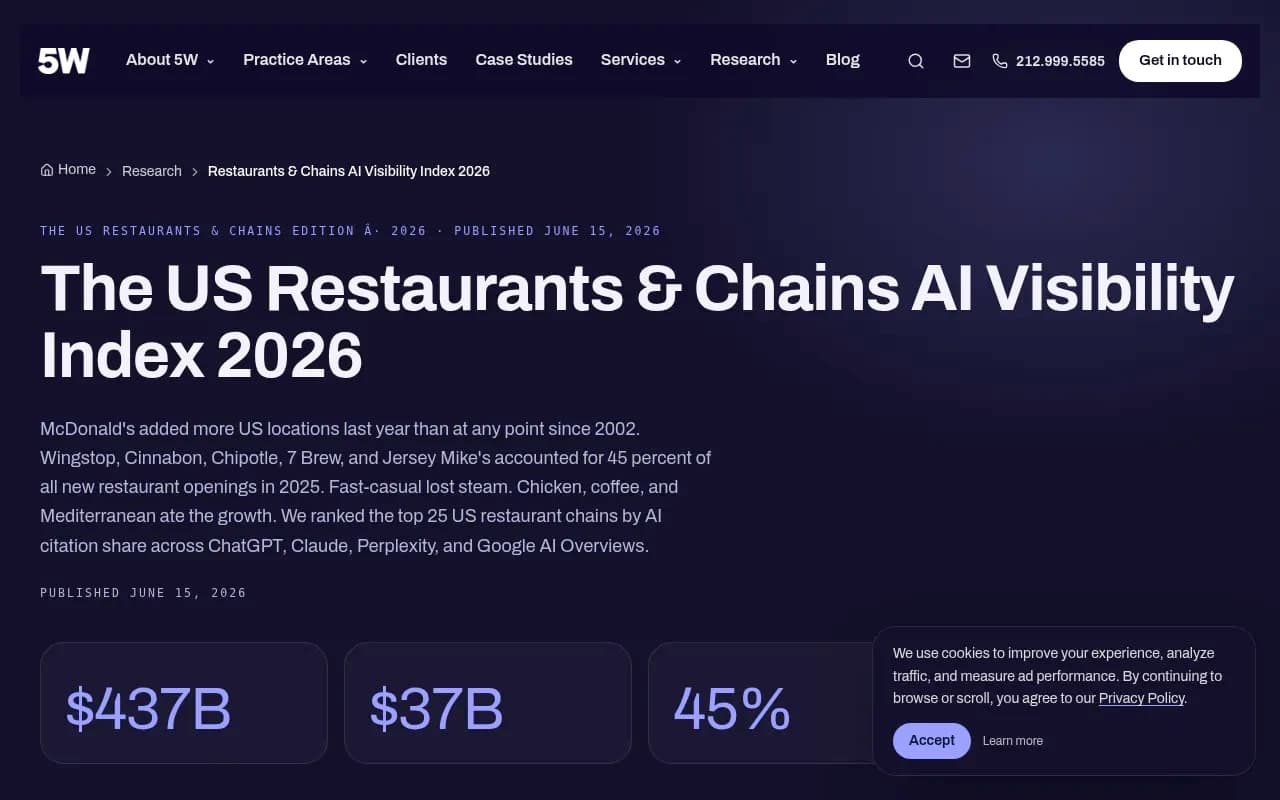
The 5W Public Relations US Restaurants & Chains AI Visibility Index 2026 looked at how four major AI platforms cite the top 25 US chains across 90+ consumer-intent queries. Two findings stand out. First, brand citation authority often outlasts business performance: Chipotle remains the default for "best fast-casual" despite negative same-store sales in late 2025, and Sweetgreen keeps its "best salad chain" slot after an 11.5% Q4 same-store sales decline. Second, challengers can take share quickly. Jersey Mike's is increasingly the answer for "best sub shop" as Subway's citation compresses, and Cava defines Mediterranean fast-casual well beyond its unit count.
The lesson for smaller brands: AI answers have strong defaults, but those defaults can shift when a competitor owns a specific sub-category ("best chicken finger chain," "best Cajun chicken sandwich"). Narrow categories are where you can win.
What ChatGPT actually cites
Promptwatch has no restaurant-specific report yet, but its content type data for Sep 28 to Oct 4, 2026 is useful. Product pages were 22.4% of classified ChatGPT citations and landing pages 16.8%. For commercial "best X" prompts, product pages hit 26.0%, landing pages 20.6% and listicles 15.0%. For branded prompts like "is [restaurant] good," reviews rise to 5.6%, more than three times their share across all prompts.
For a restaurant, "product page" translates to a complete, crawlable menu and location page with prices, dietary info, hours and an FAQ. Not a PDF menu. Not a menu image.
On social, the picture is different by engine. In Promptwatch's October 2026 social citation data, ChatGPT drew only 0.46% of citations from social platforms, while Google AI Overviews drew 12.2% (YouTube 4.28%, Facebook 2.38%, Reddit 2.15%, Instagram 1.61%). Reddit's collapse in ChatGPT is documented in Promptwatch's Reddit citation report: from roughly 4% to 0.5% on August 14, 2026. So an Instagram-first strategy helps you on Google surfaces but barely registers in ChatGPT.
Best AI visibility platforms for restaurants and food brands
Here is how the options group, with an honest view of who each one suits.
| Platform | Type | Best for | Main limitation |
|---|---|---|---|
| Promptwatch | AI visibility and GEO, with optimization | Chains, food brands, agencies needing tracking plus action | Not a listings or review-response tool |
| Uberall | Location marketing with AI search benchmarking | Multi-location QSRs | Focused on local listings, not content strategy |
| Birdeye | Reputation, reviews and Search AI | Multi-location restaurant groups | Review-centric; less depth on citations and crawlers |
| Yext | Listings and knowledge graph | Brands needing structured location data everywhere | Enterprise-oriented |
| Profound | Enterprise AI visibility | Large brands with budget | Monitoring-heavy, higher price |
| Otterly.AI | Basic prompt tracking | Budget-minded single brands | No crawler logs or content help |
| Peec AI | Prompt monitoring | Teams wanting simple tracking | Monitoring only |
| Tibly | AI visibility for local businesses | Small local operators | Narrower feature set |
Promptwatch for tracking and fixing
Promptwatch is the one I'd shortlist first for food brands and restaurant groups that want to act on the data, not just watch it. It tracks the real interfaces of ChatGPT, Google AI Overviews, AI Mode, Gemini, Perplexity and Copilot, by country (and by state or city from the Business plan), which matters when "best pizza near me" answers differ by market.

For restaurants the useful parts are:
- Prompt tracking with volumes and query fan-outs, so you see the actual searches AI runs behind "best brunch in Denver."
- AI crawler logs that show whether GPTBot, OAI-SearchBot or PerplexityBot can read your menu pages at all. Plenty of restaurant sites hide menus in images, PDFs or JavaScript widgets.
- Citation tracking that shows which listicles, review sites and YouTube channels AI pulls from, so you know where to pitch.
- A content gap analysis and Content Agent that can draft and publish pages to WordPress, Webflow or Framer, then track whether those pages get crawled and cited.
- AI Shopping tracking in ChatGPT and Alexa, relevant if you sell packaged food or meal kits.
Pricing starts with a free Explore tier (10 prompts, ChatGPT only), then Essential at $95/mo and Professional at $245/mo. Agencies managing multiple restaurant clients can look at the Kick-off ($199/mo) to Scale ($799/mo) agency plans. Confirm current numbers at promptwatch.com/pricing.
Uberall
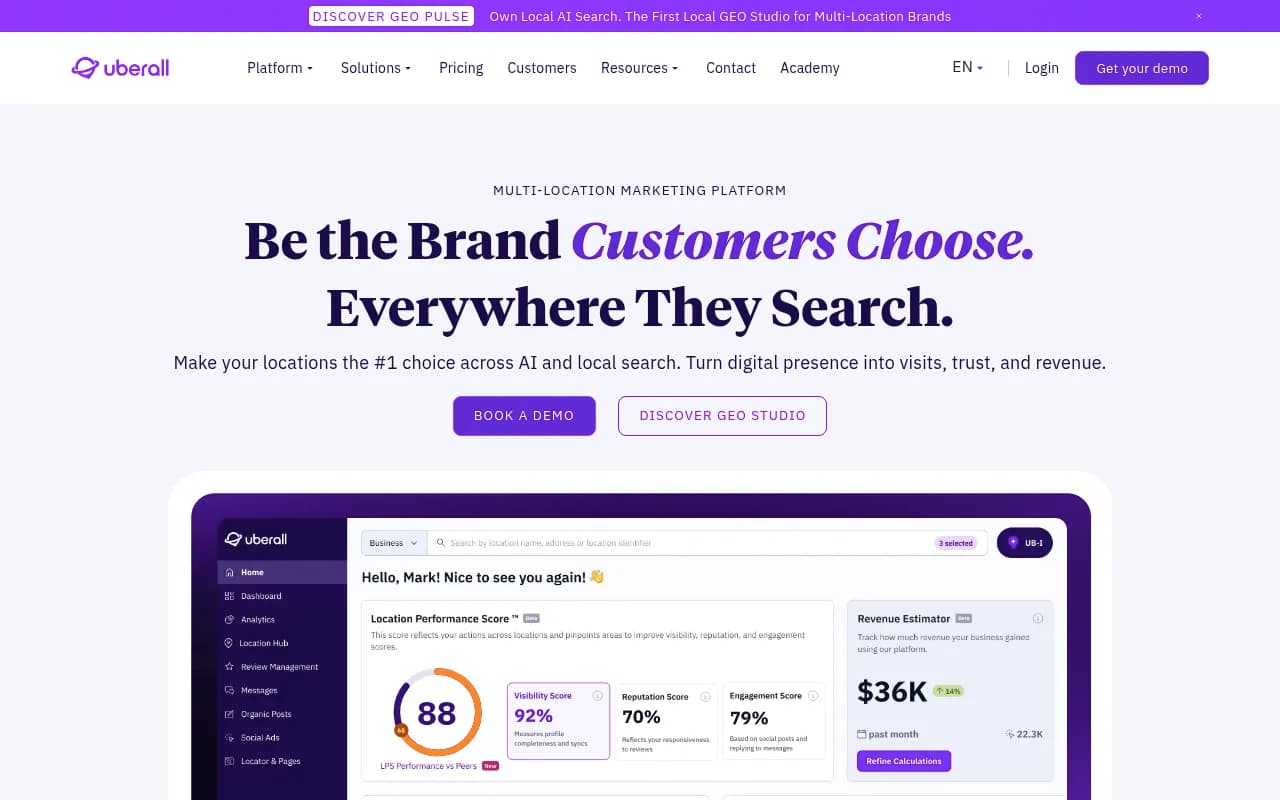
Uberall published the 83% benchmark and is built around the multi-location problem: thousands of storefronts, each needing accurate hours, menus and attributes across directories that AI systems read. If you run 50+ locations, this layer is non-negotiable.
Birdeye
Birdeye's pitch is that reviews now shape AI recommendations. Its Search AI lets multi-location brands check how each location appears in ChatGPT, Gemini and Perplexity, and its Insights AI combines review sentiment and listing health into scores per location. Given that reviews jump in weight on branded prompts, that is a sensible bet for groups with review-management pain.
Yext, Chatmeter and Synup
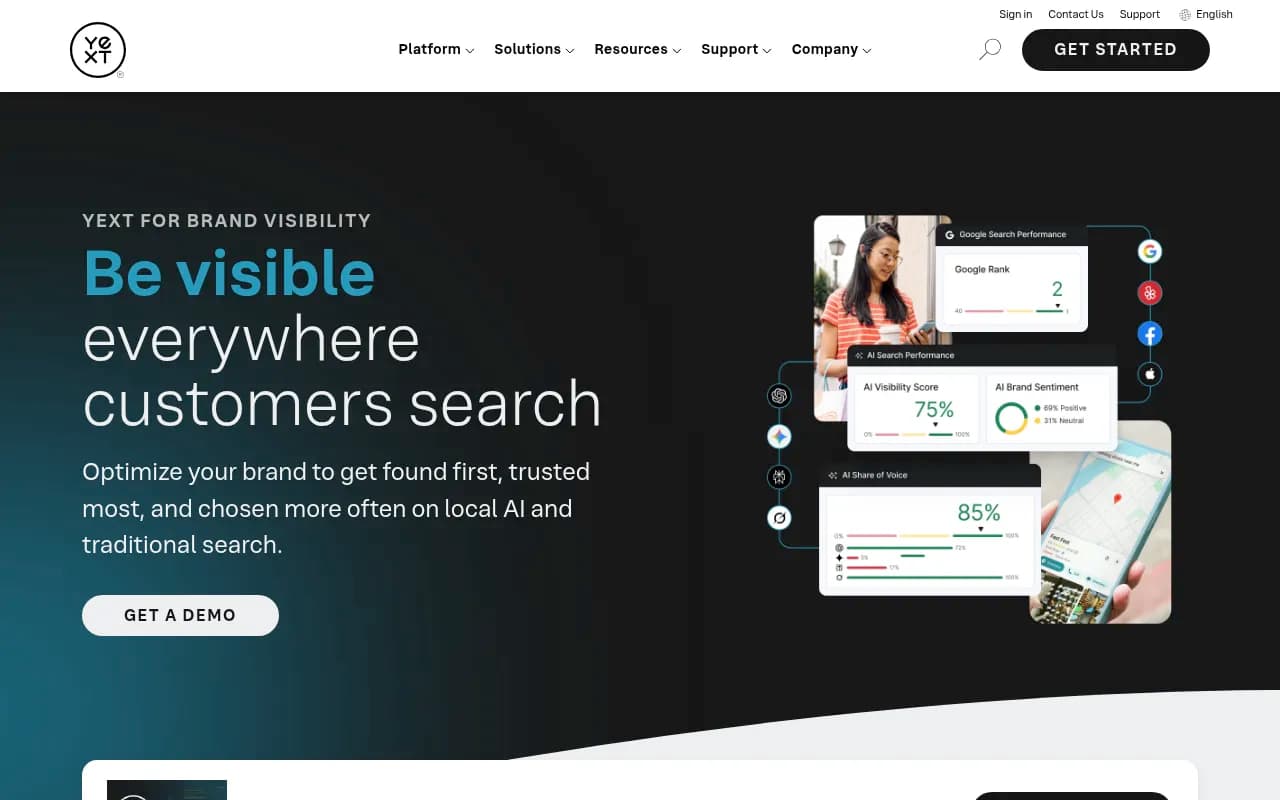
These are the listings-and-reputation incumbents. Yext suits brands that want one structured source of truth pushed to every endpoint. Synup positions itself as an AI agent running listings, reviews and local visibility. Chatmeter covers multi-location reputation and listings. None are AI visibility platforms in the Promptwatch sense, but they feed the data AI reads.
Profound, Otterly.AI and Peec AI
Profound is a strong enterprise monitoring option, though pricier. Otterly.AI and Peec AI are cheaper prompt trackers that answer "did we get mentioned?" fine. They stop there: no crawler logs, no AI traffic attribution, no content creation.



Tibly and AEO Vision
Tibly targets local businesses, which fits an independent owner. AEO Vision has a food and beverage industry page and Reddit/TikTok insight, which is handy if social discovery is your angle.

If you want to browse more options, the GEO software directory at bestgeosoftware.com lists dozens of trackers beyond what I cover here.
Which setup fits which restaurant business
| Business type | Recommended stack | Why |
|---|---|---|
| Single independent restaurant | Free audit tools, Google Business Profile, Tibly or Promptwatch free tier | Listings and reviews matter most; keep spend low |
| 5 to 30 location group | Birdeye or Synup plus Promptwatch Essential or Professional | Reviews and listings per location, plus brand-level citation tracking |
| 50+ location QSR or franchise | Uberall or Yext plus Promptwatch Business | Structured data at scale plus state/city tracking and content automation |
| Packaged food or CPG brand | Promptwatch plus Search Console | Shopping visibility, citations on recipe and review sites |
| Agency serving restaurants | Promptwatch agency plans | Multi-client workspaces and white-label reporting |
How to run a quick restaurant AI visibility audit
Before paying for anything, spend an hour on this.
1. Ask the questions your diners ask
Open ChatGPT, Gemini and Perplexity and run 15 to 20 prompts: "best [cuisine] in [neighborhood]," "best restaurant for [occasion]," "is [your restaurant] good," "[your restaurant] vs [competitor]." Note whether you appear, in what position, and which sources get cited. ChatGPT and Perplexity both show sources, which tells you where to focus.
Perplexity
2. Check what AI crawlers can read
If your menu is an image or an embedded third-party widget, AI systems can't parse it. Convert it to HTML text with prices, allergens and dietary tags. Check robots.txt isn't blocking AI bots. Crawler logs in a tool like Promptwatch show exactly which bots hit which pages and where they hit errors.
3. Audit listings and reviews
Name, address, phone, hours and categories must match everywhere. Reviews on Google, Yelp and Tripadvisor feed branded answers. Respond to reviews and keep recency up. Tools like BrightLocal and Moz Local help with listing consistency.
4. Find the roundups
ChatGPT cites listicles at 15% of commercial citations. Search for the "best [cuisine] in [city]" articles that get cited and work out how to be included: send samples, invite local writers, update your press kit. News coverage fades fast (Promptwatch's half-life data shows news pages losing half their citations in about five weeks), while landing pages keep citations for months, so evergreen pages beat one-off press hits.
5. Build an FAQ and a dedicated page per location
Parking, reservations, kids' menu, gluten-free options, private dining. These are the follow-up questions AI answers, and FAQ pages are a content type ChatGPT cites. A single "Locations" page with 40 addresses won't do it; each location needs its own page.
Platform-specific advice for restaurants
The engines behave differently, so don't treat "AI" as one thing.
- ChatGPT: Weighted to product and landing pages, listicles and reviews. Social barely counts. Prioritize your site, review platforms and "best of" lists.
- Google AI Overviews and AI Mode: More social-friendly. Per Promptwatch's data, YouTube is the biggest social source at 4.28%, then Facebook and Instagram. Keep Facebook and Instagram profiles complete and post short videos on YouTube.
- Perplexity: Smaller social share (2.7%) and heavy on web sources. Clean, factual pages win.
Don't invest in Reddit as a ChatGPT play right now. It may still matter for human diners and for Google surfaces, but ChatGPT citation share collapsed.
What I'd skip
Three common mistakes show up in restaurant marketing right now.
First, buying an operations AI tool and calling it an AI visibility strategy. Voice ordering and scheduling are good investments, but they don't change what ChatGPT recommends.
Second, chasing virality. The Staff Canteen post making the rounds argues visibility beats going viral, and the citation data backs that up: AI answers cite structured, factual pages far more than trending posts.
Third, measuring only mentions. Being named is cheap, and Birdeye's roughly 15% primary-recommendation figure shows how few brands get the top slot. Track position, share of voice and, where you can, actual traffic from AI platforms to your site and reservation links.
Costs and how to start
A reasonable first quarter for a mid-size group looks like this:
- Month one: run the manual audit, fix menu pages and listings, and start a free tracker to set a baseline.
- Month two: add a paid platform with prompt tracking across your top markets, set up crawler logging, and identify the five roundup articles you need to appear in.
- Month three: publish location pages and FAQ content, request reviews systematically, and measure change in visibility score and AI-referred traffic.
If you'd rather hand the whole thing to specialists, an agency like 1001 SEO Media handles technical SEO, local SEO and generative engine optimization together, and uses Promptwatch for the AI visibility measurement side. That is the same company that publishes this site, so weigh that accordingly.
The short version
For most restaurant groups the answer is a pair: a local listings and reputation layer (Uberall, Birdeye or Yext) and an AI visibility platform that tells you why you're missing and helps you fix it. Promptwatch fills the second slot best if you want crawler logs, citation analysis and content help in one place. Independents can begin with a free tier and a manual audit, then spend where the gaps show up. The brands that win "best chicken finger chain" style queries did it by owning a narrow category with clean, citable pages, and that is still open to you.