Key takeaways
- Fintech buyers ask AI assistants "best payment processor for SaaS" style questions, and ChatGPT cites many domains per answer: 47.6% of responses cite 10 or more (Promptwatch Data, Sep 28 to Oct 4, 2026).
- Most vendor "best for fintech" lists are self-promotional. Nearly every tool in them is marked as not fintech-specific, so judge tools on tracking depth and action, not a vertical label.
- Early-stage teams can start with a cheap tracker like Otterly. Once you need to know why you're missing and fix it, you need crawler data, citation analysis, and content tooling.
- Product pages, landing pages, and listicles earn almost 70% of ChatGPT citations on commercial prompts, which is the exact prompt style fintech buyers use.
Why fintech needs its own approach to AI visibility
Fintech is a strange category for AI search. Buyers are cautious, the stakes are regulated, and the research journey is long. A CFO asking ChatGPT for the best treasury management software is not going to click the first link and buy. She is going to build a shortlist, and the AI answer is increasingly where that shortlist starts.
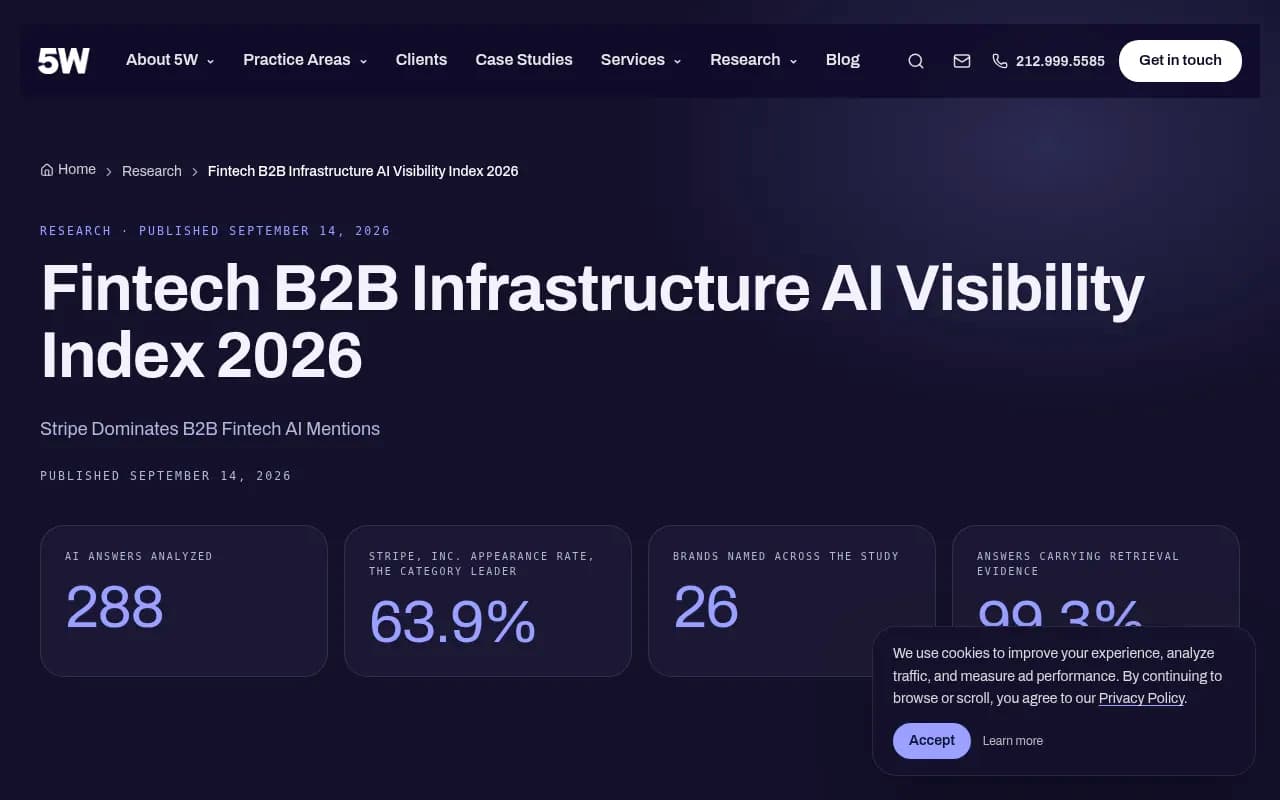
The research gives a sense of how lopsided this gets. A 5W Research index of B2B fintech infrastructure brands found Stripe appearing in 63.9% of tested answers, Plaid at 42.7%, Adyen at 41.0%, and Marqeta at 37.2%. If you are a Series A payments startup, you are not in that table, and your goal is to get into the answers for narrower prompts where the giants are less dominant.
Typical prompts you should be tracking:
- best payment processor for SaaS
- best treasury management software
- best AML compliance platform
- best banking CRM
- best loan origination software
- embedded finance platform comparison
Notice these are all commercial, comparison-style queries. That matters for what kind of content wins.
What AI actually cites for fintech-style prompts
Before picking a tool, it helps to know what you are trying to move. Promptwatch Data's ChatGPT citation content type report (Sep 28 to Oct 4, 2026) breaks citations down by page type:
| Content type | Share of all ChatGPT citations | Share on commercial prompts |
|---|---|---|
| Product pages | 22.4% | 26.0% |
| Landing pages | 16.8% | 20.6% |
| Listicles | 13.6% | 15.0% |
| Comparisons | 5.9% | 7.9% |
| Documentation | 7.5% | n/a |
| Reviews | 1.7% | 5.6% on branded prompts |
Two takeaways for a payments startup. First, your own product and landing pages do a lot of the work, so incomplete pricing, vague positioning, or JavaScript-heavy pages hurt you directly. Second, third-party listicles and review sites still shape the answer, particularly when someone asks about you by name. Reviews are over three times more common in branded prompts than in general ones.
The unique domains report adds a useful warning: about half of ChatGPT responses cite 10 or more domains, and organic prompts with no brand named hit 52.5%. You will almost always share an answer with a crowd. So the question is rarely "am I cited?" It is "where am I in the answer, how am I described, and which sources put me there?" Any tool that only gives you a yes/no mention rate is answering the wrong question.
If your content team is also worried about content freshness, the half-life data shows landing pages and docs staying cited longest, while news loses half its pages within 36 days. For a fintech startup, that argues for investing in durable product, docs, and comparison pages over reactive news posts.
What to look for in a platform
Here is the checklist I would use, in rough priority order for a regulated-industry startup.
- Real answers, not just API output. What a customer sees in the ChatGPT or AI Overviews interface can differ from what the API returns. Check how the tool collects responses.
- Citation and source analysis. You want to see which review sites, comparison pages, and forums feed answers about you. For fintech, that often means NerdWallet-style comparison sites, Investopedia, Trustpilot, and category review platforms.
- Crawler visibility. Payments sites are often heavy on JavaScript, gated docs, and login walls. If AI crawlers hit errors, no amount of content fixes it.
- Prompt volume and difficulty. Otherwise you are guessing which of your 50 prompts matter.
- Content action. A dashboard that tells you that you are invisible is half a product.
- Reporting and access controls. Compliance-minded teams often need exports, audit logs, and sometimes SOC 2 from the vendor.
- Price per tracked response, not headline price. Cheap plans with tiny prompt limits get expensive fast.
One caveat on the vendor lists floating around. A widely shared April 2026 ranking puts its own publisher first and labels nearly every competitor "Fintech: No." Its pricing snapshot, including a $99/month figure for Profound, should be checked against each vendor's pricing page before you trust it. Treat all of these roundups, including this one, as starting points.
The platforms worth shortlisting
Promptwatch
Promptwatch is the one I would put first for a startup that wants to improve visibility rather than just watch it. It tracks the real interfaces of ChatGPT, Google AI Overviews, AI Mode, Gemini, Perplexity, and Copilot, then goes further than most trackers: IP-verified AI crawler logs show whether bots can actually read your payments docs and product pages, citation analytics show which third-party pages feed answers, and the Content Agent plans, writes, and publishes to Webflow, Framer, or WordPress. The Action Board turns all of it into a prioritized to-do list, which suits small teams with no dedicated GEO person.
Pricing starts with a free Explore tier, then Essential at $95/month (50 prompts, all models, site audit, 360 Insights), Professional at $245/month, and Business at $579/month with the automated Content Agent. Confirm current numbers at promptwatch.com/pricing.

The honest downside: it is a broader platform than a pure tracker, so if you only want a weekly mention count, you will be paying for depth you will not use at first.
Otterly.AI
Otterly is the budget entry point, with plans commonly cited from around $29/month. It does prompt monitoring and URL audits, and has a Looker Studio connector. For a pre-product-market-fit fintech that just wants to see whether ChatGPT mentions it at all, this is a sensible low-risk start. It does not generate content or show crawler logs, so expect to outgrow it.

Peec AI
Peec is a clean, analytics-focused tracker with a short trial. Good if your marketing lead likes dashboards and your content is handled elsewhere. Like Otterly, it monitors without much help on what to do next.

Profound
Profound targets enterprise teams and leans on prompt volume data and compliance credentials, which matters when your legal team asks about vendor security. It is usually priced above what an early-stage startup wants to spend, so it fits better after a Series B than at seed.

AthenaHQ
AthenaHQ pitches itself on tying AI visibility to revenue and has an action layer. The reported entry price sits near $295/month with no trial, so it suits teams already sure they want this category.
Semrush and Ahrefs Brand Radar
If you already pay for Semrush or Ahrefs, their AI modules are the lowest-friction way to get a first look. Expect fixed prompt sets and shallower AI-specific data than a dedicated platform.
Others worth a look
Wellows is oriented toward agencies with per-client projects. Gauge is known for tracking ChatGPT ads. Scrunch and Writesonic both offer tracking with some content generation.
For a broader view of the market, the GEO software directory at bestgeosoftware.com lists far more options than fit here.
Side-by-side comparison
| Platform | Entry price (verify) | Real-UI tracking | Crawler logs | Content creation | Best for |
|---|---|---|---|---|---|
| Promptwatch | Free tier, then $95/mo | Yes | Yes, IP-verified | Yes, with CMS publishing | Startups that want to fix gaps |
| Otterly.AI | About $29/mo | Monitoring focus | No | No | Tight budgets, first look |
| Peec AI | About $95/mo | Monitoring focus | No | No | Analytics-led teams |
| Profound | Varies by tier | Yes | Limited | Agent-based | Enterprise, compliance-heavy |
| AthenaHQ | About $295/mo | Yes | Limited | Action center | Revenue attribution |
| Semrush AI toolkit | About $199/mo | Partial | No | No | Existing Semrush users |
Prices come from vendor-authored roundups and marketing pages, so check each pricing page before buying.
Picking by stage
Pre-seed to seed
You have a handful of prompts that matter and no spare headcount. Start with a free scan or a cheap tracker, find the ten prompts where a buyer would plausibly choose you, and fix your product and pricing pages first. Promptwatch's free Explore tier or Otterly both work for this. Do not buy an enterprise contract here.
Series A to B
Now the problem is competitive. You are fighting Stripe, Adyen, and a dozen well-funded rivals for shortlist slots. You need prompt difficulty, citation source analysis, and a repeatable content engine. This is where a platform with crawler logs and content tooling earns its price, and where an agency partnership can fill capacity gaps. If you want outside help with strategy, technical SEO and GEO, agencies like 1001 SEO Media work across both and use Promptwatch for the measurement side.
Growth stage and enterprise
You will want SSO, audit logs, multiple regions, and vendor security reviews. Profound, Promptwatch Business or Enterprise, and Conductor-type enterprise suites are the realistic shortlist.
A fintech-specific playbook once you have a tool
Tools only matter if you act on what they show. A sequence that works for payments and lending startups:
- Baseline. Track 30 to 50 commercial prompts across ChatGPT, AI Overviews, and Perplexity, in each market you sell in. Measure visibility, position, and sentiment, not only mentions.
- Check crawl access. Look at whether GPTBot, OAI-SearchBot, and PerplexityBot reach your pricing, docs, and product pages without errors.
- Fix the product pages. Complete pricing, supported countries, compliance certifications, integrations, and settlement times. These are the facts AI repeats.
- Build comparison pages. Publish honest "us vs. competitor" and "best X for Y" pages. Comparisons and listicles are a large share of commercial citations.
- Work the third-party layer. Find which review and comparison sites the AI cites for your category and get accurate, current listings there. Trustpilot-style review platforms matter most for branded prompts.
- Keep docs public. Documentation earns 7.5% of ChatGPT citations overall, and gated docs earn none.
- Recheck monthly. Answer sets move. Reddit's share of ChatGPT citations, for example, fell from about 4% to 0.5% on August 14, 2026, per Promptwatch Data. A tactic that worked in July can quietly stop working.
A note on compliance: when generating content with any AI tool, a human with regulatory knowledge needs to review claims about rates, licensing, or coverage. An AI-cited page that misstates your APR is worse than no citation.
Common mistakes
- Buying on the "fintech" label. Most tools are horizontal. The vertical expertise lives in your prompt list and your content, not the software.
- Tracking too few prompts. One prompt tells you very little given how many domains share each answer.
- Ignoring branded prompts. What ChatGPT says when someone asks about you directly often relies on only five or so sources, which makes it the easiest narrative to fix.
- Measuring mentions without traffic. Connect AI visits and conversions to your analytics so you can show the CFO a number.
Final recommendation
If you are early and cost-sensitive, start with Otterly or Promptwatch's free tier and fix your product pages. If you want one platform that finds the gaps, explains them with crawler and citation data, and helps you publish the fixes, Promptwatch is the strongest fit for a startup without a large SEO team. If a security questionnaire is your biggest hurdle, put Profound on the shortlist next to it. Whichever you choose, run a 30-day trial against a fixed prompt list so you can compare tools on your own data rather than someone's marketing table.