Key takeaways
- Banks and fintechs should judge AI visibility platforms on evidence capture, exports, access controls, and what the tool helps you fix, not on engine count alone.
- Citation share in finance is concentrated. In 5W Public Relations' 2026 banking index, JPMorgan Chase holds 28.4% and most regional banks barely register.
- Third-party sources such as Wikipedia, Bankrate, Investopedia and NerdWallet feed a big share of finance answers, so your own site is only part of the work.
- Promptwatch is the strongest pick when you want to find gaps and fix them. Profound and Scrunch suit large enterprises with heavy governance needs. Lower-cost trackers fit single-firm advisers.
- Always confirm pricing on the vendor's own page. Several published prices in this category have changed more than once.
Why financial services needs its own approach
Most AI visibility advice is written for SaaS companies. Finance is different in three ways.
First, the stakes are higher. If ChatGPT states the wrong savings rate or an outdated fee for your bank, that is a compliance and reputation problem, not just a missed mention. Second, the category is dominated by a few giants and by aggregators. Third, many teams work under legal review, so a tool that cannot export evidence or restrict who sees what will stall in procurement.
The demand side is real. Wellows cites a Gregory FCA 2025 study saying 60% of U.S. adults now use AI-powered search to find financial information. I would treat that figure as directional, since it comes via a vendor blog, but it matches what we see in practice: people ask assistants which bank, card or broker to choose.
What AI answers look like for banks today
The numbers differ by study, so use them as a sense of scale rather than gospel.
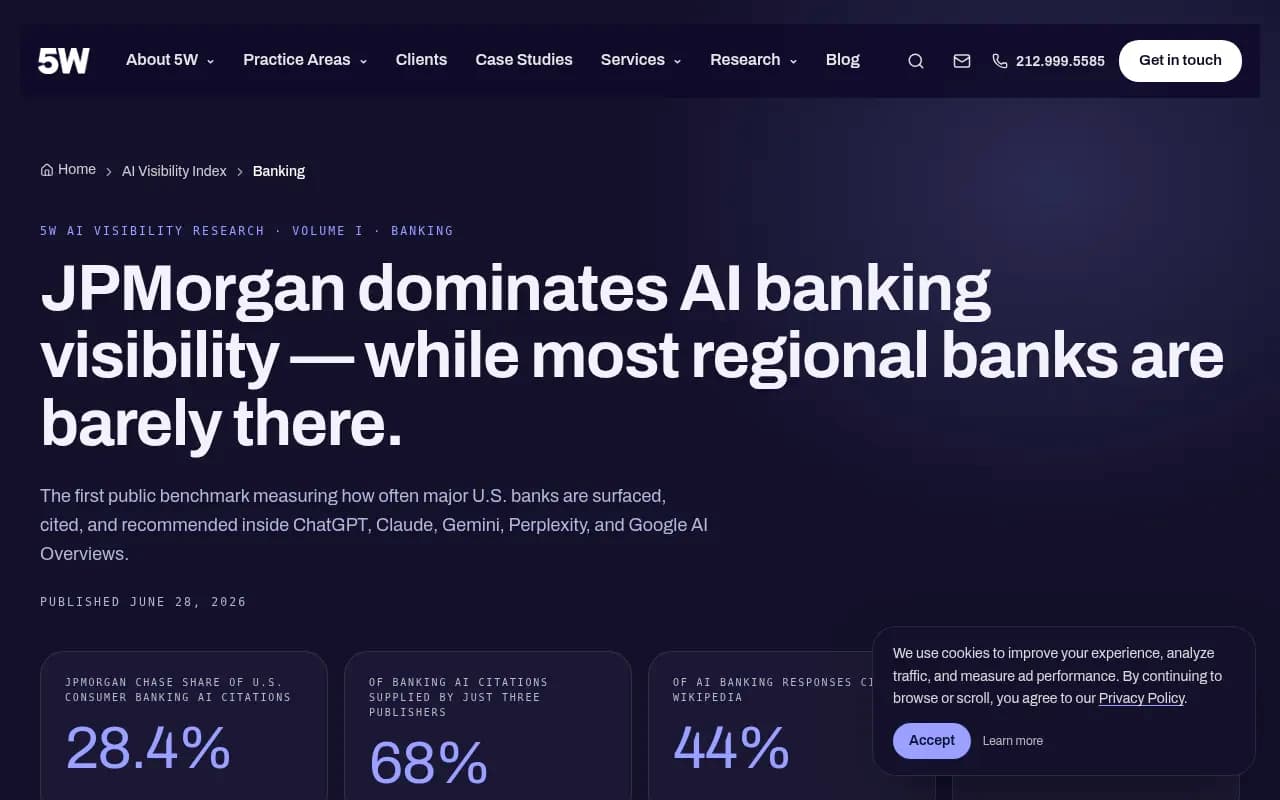
The 5W Public Relations Banking AI Visibility Index 2026 ranks banks by citation share:
| Rank | Bank | Citation share |
|---|---|---|
| 1 | JPMorgan Chase | 28.4% |
| 2 | Bank of America | 7.1% |
| 3 | Wells Fargo | 5.9% |
| 4 | Citi | 4.8% |
| 5 | Capital One | 4.2% |
The same index shows where answers get their material. Wikipedia (19.3%), Bankrate (17.8%), Investopedia (14.2%) and NerdWallet (9.6%) lead the source list, while bank-owned domains combined hold 6.8%. Read that again if you run a bank's marketing team: the sites describing you matter more than the site you own.
Other studies measure differently. eMarketer's Q1 2026 financial services leaderboard puts Capital One first on overall mention rate at 21%, ahead of JPMorgan Chase at 17% and PayPal at 16%. Knownful, quoted by Wellows, gives JPMorgan a 67.14% visibility score. Those are different metrics (mention rate, visibility score, citation share), which is why you should pick one metric inside your own tool and track it consistently rather than compare across reports.
What the citation data says about content types
Because there is no finance-specific Promptwatch report yet, I will stick to the general patterns and flag that they are not finance-only. In Promptwatch Data's content-type report (Sep 28 to Oct 4, 2026), product pages made up 22.4% of ChatGPT citations and landing pages 16.8%. For commercial prompts like "best X for...", product pages hit 26.0%, landing pages 20.6% and listicles 15.0%.
For a bank, that means your product pages (accounts, cards, mortgages) need complete rates, fees, eligibility and positioning in plain text. It also means getting listed in the roundups AI cites, which in finance usually means the aggregators above.
Social sources are uneven by engine. Promptwatch's social citation data for the same week shows ChatGPT drawing just 0.46% of citations from social platforms, while Google AI Overviews drew 12.2%, led by YouTube at 4.28%. Reddit's share in ChatGPT collapsed in August 2026. So a Reddit-heavy strategy for ChatGPT is a poor bet right now, while YouTube explainers are worth a look for AI Overviews.
For regulated sectors, authority sources dominate. In Promptwatch's healthcare report, government and public health sites earn almost half of ChatGPT citations. I would expect a similar pull toward regulators and established institutions in finance, but that is an inference, not a measured result.
How to evaluate a platform as a bank or wealth manager
Here is the checklist I would run through before a demo.
- Real-interface data. Does the tool capture what users actually see in ChatGPT, AI Overviews and Perplexity, or only API responses? The two can differ.
- Evidence capture. Can you save the exact answer and the cited sources for a compliance file?
- Citation-level reporting. You need to know which pages and third-party sites are cited, not just whether you were mentioned.
- Segmentation. Mortgages, cards, savings and wealth are different competitive sets. Can you separate them by project, topic or persona?
- Geography. Rates and regulation vary by country and sometimes state, so location tracking matters.
- Access and exports. Role-based access, audit logs, PDF and CSV exports, and API access.
- Crawler visibility. Can you see whether AI bots reach your rate pages, or get blocked by a WAF or login wall?
- Execution. When a competitor is cited and you are not, what does the tool help you do about it?
That last point separates platforms. Most tools stop at a dashboard.
The platforms worth shortlisting
Promptwatch
Promptwatch is the one I would put first for teams that want to act on the data. It tracks real interfaces of ChatGPT, Google AI Overviews, AI Mode, Gemini, Perplexity and Copilot by country and language, then connects that to IP-verified AI crawler logs, visitor analytics, and Google and Bing search data. That combination answers finance-specific questions such as whether AI bots are reaching your rate pages and which cited pages actually send visitors.
On the fix side, the Action Board prioritizes content gaps, offsite mentions and site health, and the Content Agent can draft and publish to WordPress, Webflow or Framer with a review inbox, which suits teams where every page goes through legal. Offsite Mentions helps with the aggregator problem, because it finds third-party pages that name your brand even without a link. Pricing starts with a free Explore tier, then Essential at $95/month, Professional at $245/month and Business at $579/month. Check promptwatch.com/pricing for current numbers.

Profound
Profound is the usual enterprise pick for analytics depth, with broad prompt and answer intelligence and enterprise controls. It suits large banks running multi-market programs with dedicated analysts. The trade-off is cost, and packaging has shifted over time, so get a written quote.

Scrunch
Scrunch leans toward governance and site-level control, including crawler observability and a machine-readable version of your site for AI agents. Published pricing starts around $250/month on annual billing. It fits large financial sites that want formal controls, though the learning curve is real.

AthenaHQ
AthenaHQ offers brand-claim and discrepancy monitoring, useful when you worry about AI stating wrong rates or terms. It has a free entry tier, while the Starter plan is reported at $295/month and advanced governance sits in Enterprise. Independent review coverage is thin.
Peec AI
Peec AI is a clean source-analysis and monitoring tool with multi-country support. It is a monitor rather than an optimizer, so pair it with your own content process.

Semrush
If your team already lives in Semrush, its AI Visibility Toolkit keeps AI tracking next to your SEO data. It is priced per domain, which gets expensive for a multi-brand bank.
SE Visible
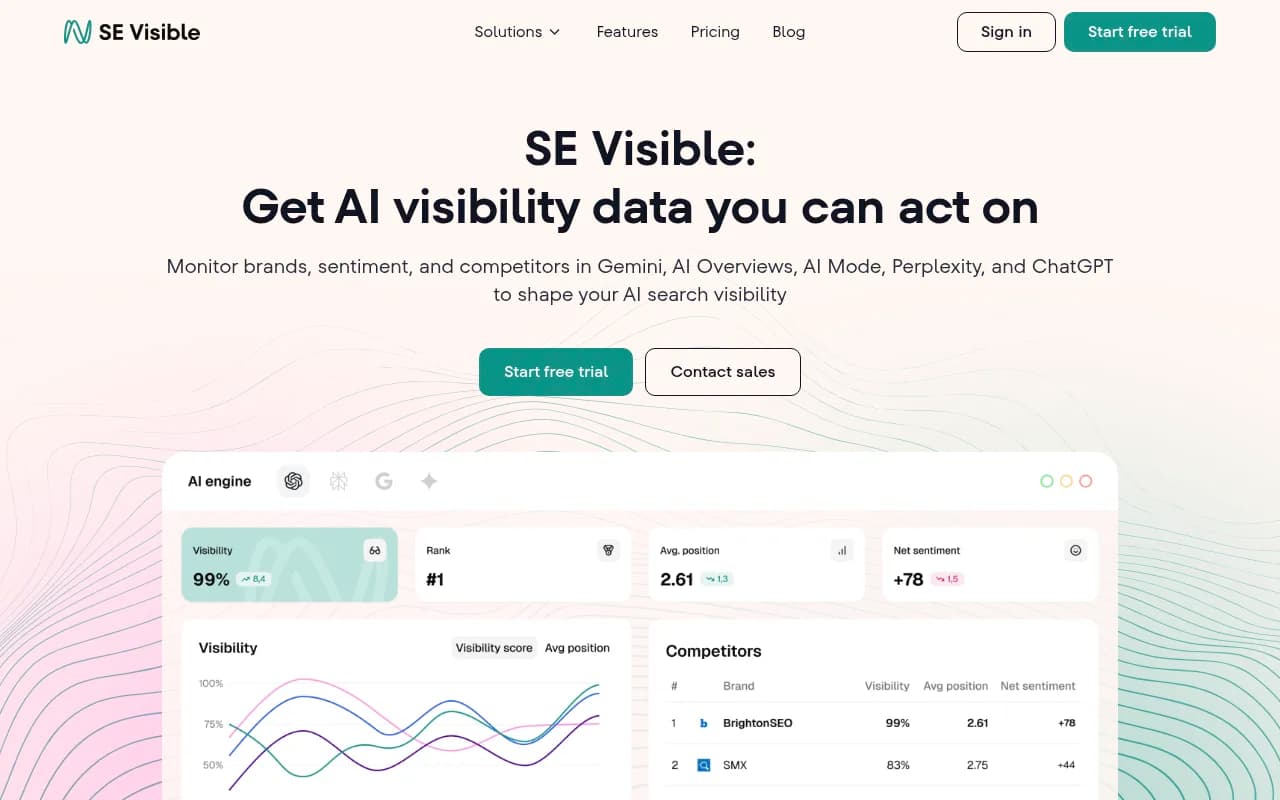
SE Visible from SE Ranking captures real-browser answers and is a value pick for smaller teams.
Writesonic
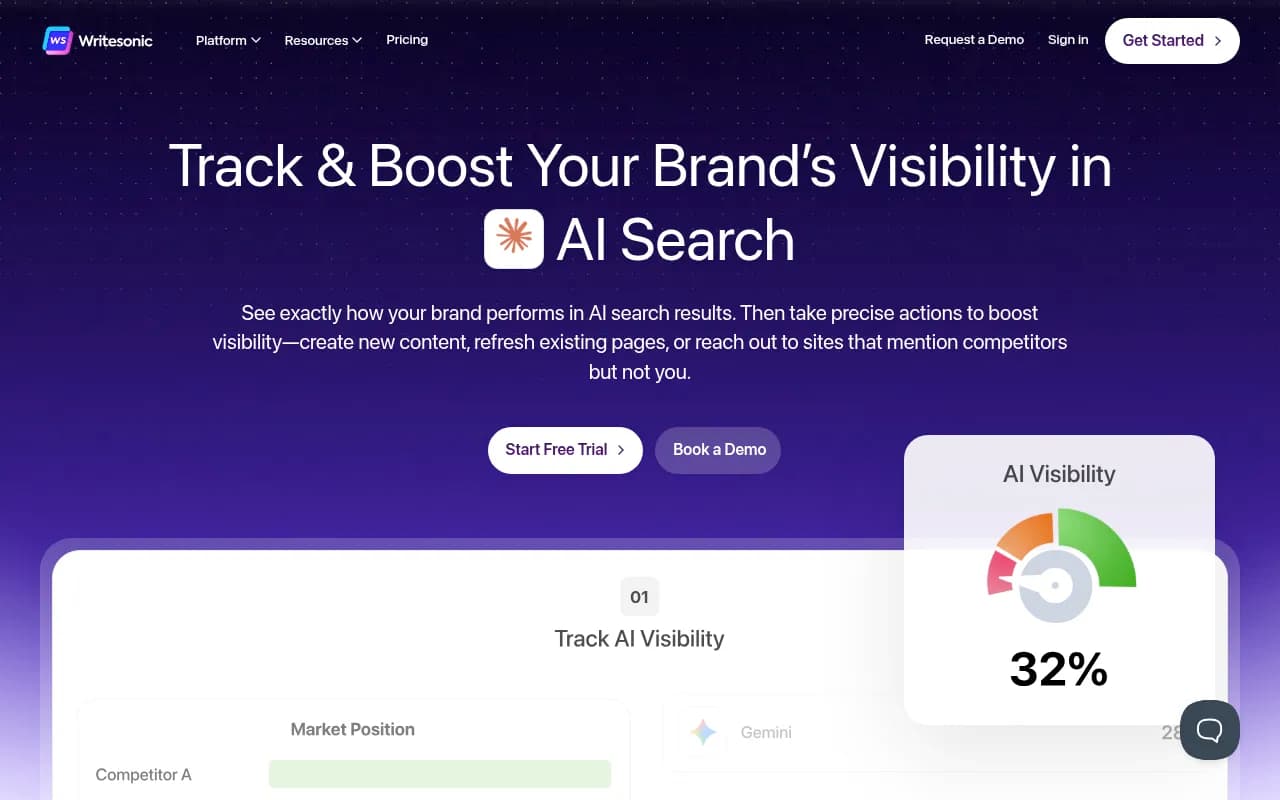
Wriesonic combines AI visibility tracking with content workflows at a low entry price. Expect to edit its drafts heavily before they pass compliance.
Enterprise SEO suites
Conductor, BrightEdge and seoClarity have added AI visibility to broad enterprise SEO platforms. If procurement already approved one of them, check its AI module before adding another vendor.
Comparison table
| Platform | Best for | Strength | Watch out for |
|---|---|---|---|
| Promptwatch | Banks and fintechs that want to fix gaps | Crawler logs, citation data, Content Agent, Action Board | Check plan limits for prompts and responses |
| Profound | Large multi-market banks | Analytics depth, enterprise controls | Cost and changing packages |
| Scrunch | Governance-heavy sites | Crawler observability, agent-ready site layer | Higher entry price, learning curve |
| AthenaHQ | Brand-claim monitoring | Discrepancy controls, free tier | Advanced controls need Enterprise |
| Peec AI | Source analysis | Transparent response data | Monitoring only |
| Semrush | Existing Semrush teams | SEO and AI data together | Per-domain pricing |
| SE Visible | Budget-conscious teams | Real-browser capture | Manual execution |
| Writesonic | Lean content teams | Tracking plus content | Drafts need compliance editing |
A note on vendor rankings
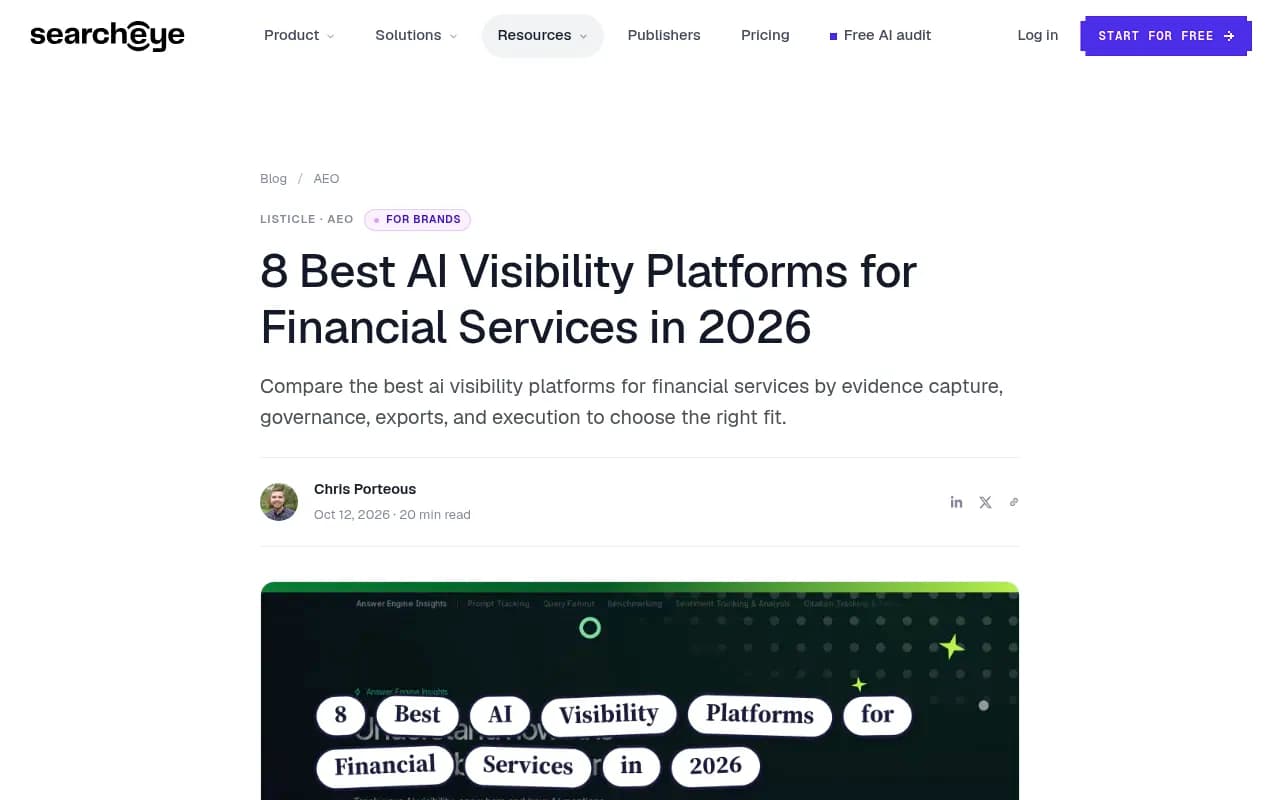
Some of the best-of lists in this space are written by the vendors they rank. SearchEye's October 2026 listicle puts itself first and says so plainly, and several "best for fintech" lists make similar self-placements. Use those lists for feature ideas, but run your own trial with your own prompts.
How to run a 30-day pilot
- Build a prompt set of 40 to 60 questions across your product lines: "best high-yield savings account", "is [your bank] safe", "[your bank] vs [competitor]", and branded fee questions.
- Split them by intent. Commercial, informational and branded prompts cite different content types.
- Track the same set in at least two tools if you can, and compare the raw answers.
- Pull citations. List the top ten domains cited for your category and check how many describe you accurately.
- Check crawler access. Make sure GPTBot, OAI-SearchBot, PerplexityBot and ClaudeBot can reach product and rate pages. Finance sites often block bots by accident.
- Fix three things only: one product page, one aggregator listing, one FAQ. Then measure change.
If you are mapping the wider market, the GEO software directory lists more tools than this guide covers.
Which one should you choose?
- A national bank or large insurer with a global team and analysts: shortlist Profound and Promptwatch, and add Scrunch if site-level controls are a priority.
- A regional bank or credit union: Promptwatch Essential or Professional, since the gap between you and the top 15 is a content and citation problem, not a data problem.
- A fintech: Promptwatch or Peec AI for monitoring, plus work on comparison pages and review sites.
- A solo adviser or small wealth firm: a low-cost tracker such as SE Visible or Peec AI, and a simple routine of fixing the pages that AI cites.
Whatever you pick, start with accuracy. Check what AI says about your rates, fees and eligibility first, then worry about share of voice.