Key takeaways
- AirOps is a workflow automation platform built for scaling AI content operations -- it connects data sources, runs bulk publishing pipelines, and handles programmatic SEO at volume
- Surfer SEO is an on-page optimization tool focused on scoring individual pages against top-ranking competitors using keyword density and NLP analysis
- Neither tool was built primarily for AI search visibility (ChatGPT, Perplexity, Google AI Overviews) -- they serve traditional SEO workflows
- For teams that need to track and improve how their brand appears in AI-generated answers, dedicated GEO platforms fill the gap these tools leave
- The right choice depends on your bottleneck: if you're stuck on content production volume, AirOps; if you're stuck on individual page quality, Surfer SEO; if you're invisible in AI search, neither alone will fix it
What these tools actually do
Before comparing them, it's worth being clear about what each tool was designed for -- because they're solving genuinely different problems.
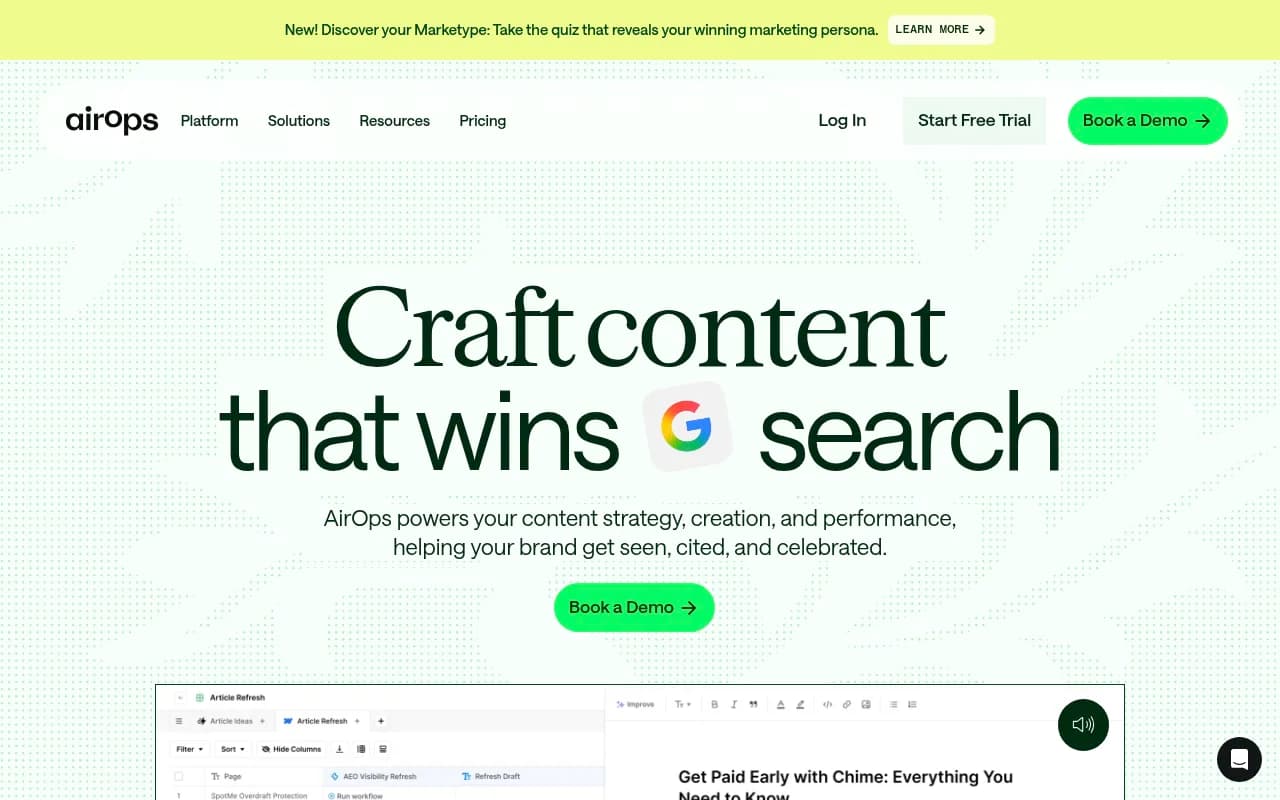
AirOps is a workflow automation platform for content teams. It lets you build AI-powered pipelines that pull from data sources, run content generation at scale, and push outputs to your CMS or publishing system. Think of it as a factory floor for content: you define the process once, then run it across hundreds or thousands of URLs. It's particularly useful for programmatic SEO -- location pages, product descriptions, data-driven articles -- where the structure is repeatable and the volume is high.
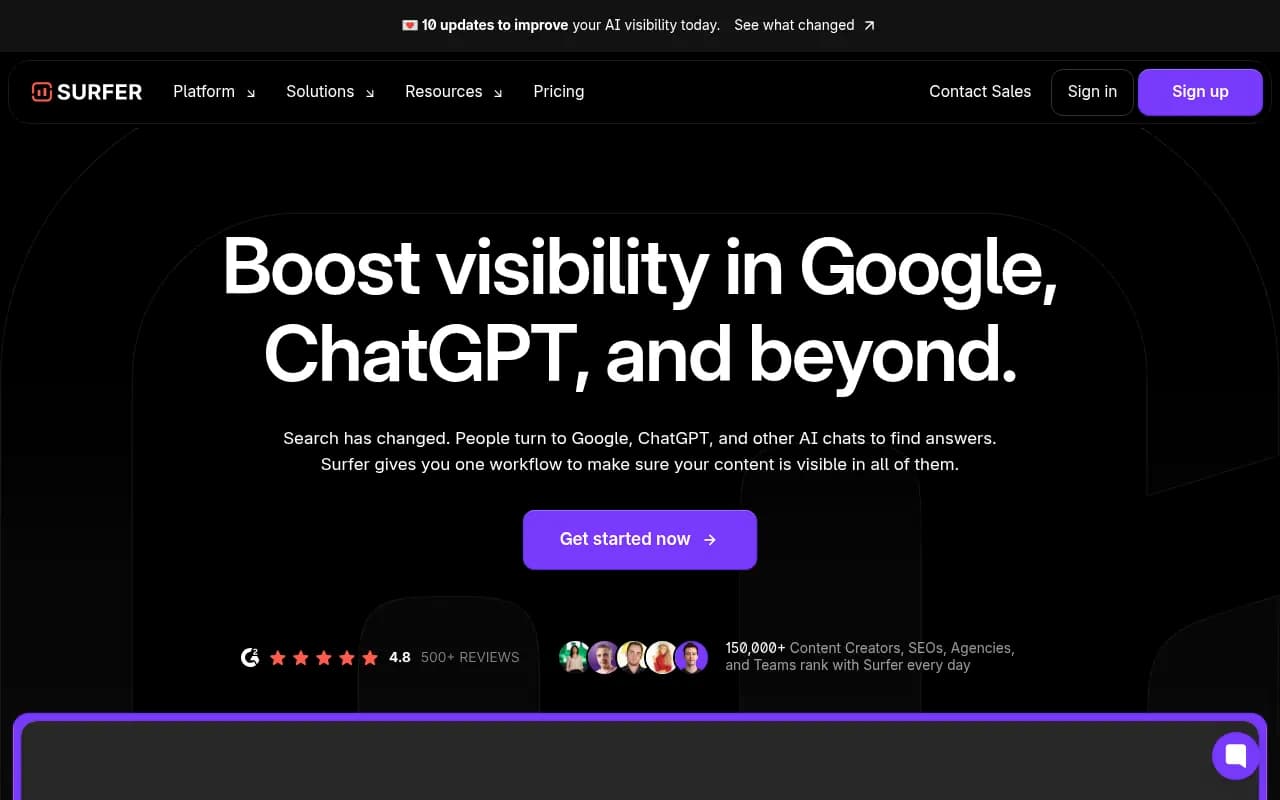
Surfer SEO is an on-page optimization tool. Its core feature is the Content Score, which analyzes the top-ranking pages for a given keyword and tells you how well your content matches the patterns those pages share -- keyword frequency, headings, word count, NLP terms. You write or paste content into the editor, and Surfer tells you what to adjust.
These tools aren't really competing with each other. One is about production throughput; the other is about page-level quality signals. A content team could reasonably use both. The question is which problem you're actually trying to solve.
Where AirOps wins
AirOps shines when your bottleneck is scale. If you have a large content library that needs refreshing, a programmatic SEO strategy that requires generating hundreds of similar pages, or a workflow that currently involves too many manual handoffs between tools, AirOps is genuinely useful.
Its template-based approach means you can define a content structure once -- say, a comparison page format or a product category article -- and run it across an entire dataset. That's a real time saver for teams managing e-commerce catalogs, SaaS feature pages, or local SEO at scale.
The platform also connects to external data sources, which means content can be dynamically populated with real information rather than generic AI filler. That's a meaningful difference from just prompting ChatGPT in a spreadsheet.
Where AirOps struggles is flexibility. The template model works well when your content is standardized. When you need custom editorial workflows, nuanced brand voice, or multi-stage review processes, the rigidity starts to show. Teams doing long-form editorial content or thought leadership often find it fights them more than it helps.
There's also a brand governance question. AirOps generates content, but controlling whether that content consistently sounds like your brand -- and meets compliance requirements -- requires additional tooling or careful prompt engineering on your end.
Where Surfer SEO wins
Surfer SEO's strength is clarity. It takes a fuzzy question ("is this content good enough to rank?") and turns it into a number. That's useful for writers who want concrete feedback and for managers who want a consistent quality bar across their team.
The real-time editor is genuinely helpful during the writing process. As you add or remove content, the score updates, and you can see which NLP terms you're missing. For writers who are newer to SEO, it provides guardrails without requiring them to understand the underlying logic.
Surfer also integrates with Google Docs and WordPress, which reduces friction for teams that don't want to change their existing writing environment.
The limitations are real, though. Surfer's Content Score is a proxy for ranking signals, not a guarantee. Hitting a green score doesn't mean you'll rank -- it means your content structurally resembles what's currently ranking. That's a useful signal, but it can create a false sense of security. Teams sometimes optimize for the score rather than for the reader, which produces content that's technically compliant but not particularly good.
More importantly for 2026: Surfer's model is built around traditional SERP rankings. It doesn't tell you whether your content is being cited in ChatGPT responses, whether it appears in Google AI Overviews, or whether Perplexity is pulling from your site. That's a significant blind spot as AI search becomes a primary discovery channel.
Head-to-head comparison
| Dimension | AirOps | Surfer SEO |
|---|---|---|
| Primary use case | Bulk content workflows and programmatic SEO | On-page optimization for individual pages |
| Best for | Teams producing content at scale | Writers optimizing specific pages |
| AI content generation | Yes, template-based | Yes, built-in AI writer |
| Keyword/NLP optimization | No | Yes, core feature |
| Content scoring | No | Yes (Content Score) |
| Workflow automation | Yes, core feature | Limited |
| Programmatic SEO | Yes | No |
| AI search visibility tracking | No | No |
| Google Docs integration | No | Yes |
| Pricing model | Subscription (workflow-based) | Subscription (credit-based) |
| Learning curve | Moderate to high | Low to moderate |
| Best team size | Mid-size to enterprise | Solo to mid-size |
The gap neither tool fills: AI search visibility
Here's the honest problem with both tools in 2026: they were designed for a world where Google's blue links were the primary discovery mechanism. That world still exists, but it's no longer the whole picture.
When someone asks ChatGPT "what's the best project management tool for remote teams?" or "which accounting software is easiest for freelancers?", the answer they get is shaped by what AI models have learned to cite -- not by who has the best Content Score or the most efficient content pipeline. AirOps can help you produce more content faster. Surfer can help you make individual pages better. Neither tells you whether those pages are actually being cited in AI-generated answers.
This is a real gap, and it's one that's becoming harder to ignore. Brands that are invisible in AI search are losing discovery opportunities that don't show up in their Google Analytics at all.
For teams that need to close this gap, dedicated GEO (Generative Engine Optimization) platforms are worth looking at. Promptwatch is one example -- it tracks how your brand appears across ChatGPT, Perplexity, Google AI Overviews, Claude, Gemini, and other AI engines, and it includes content gap analysis and AI-native content generation to help you actually fix visibility problems, not just measure them.

Other tools worth knowing about in this space:
Surfer SEO handles the on-page side but stops at traditional SERP signals. For AI-specific visibility, you need something purpose-built.
Clearscope is another strong on-page optimization option, with a cleaner interface than Surfer and better NLP analysis for some content types.

MarketMuse goes deeper on content strategy and topical authority, which matters for AI search because models tend to cite authoritative sources on a topic rather than individual optimized pages.
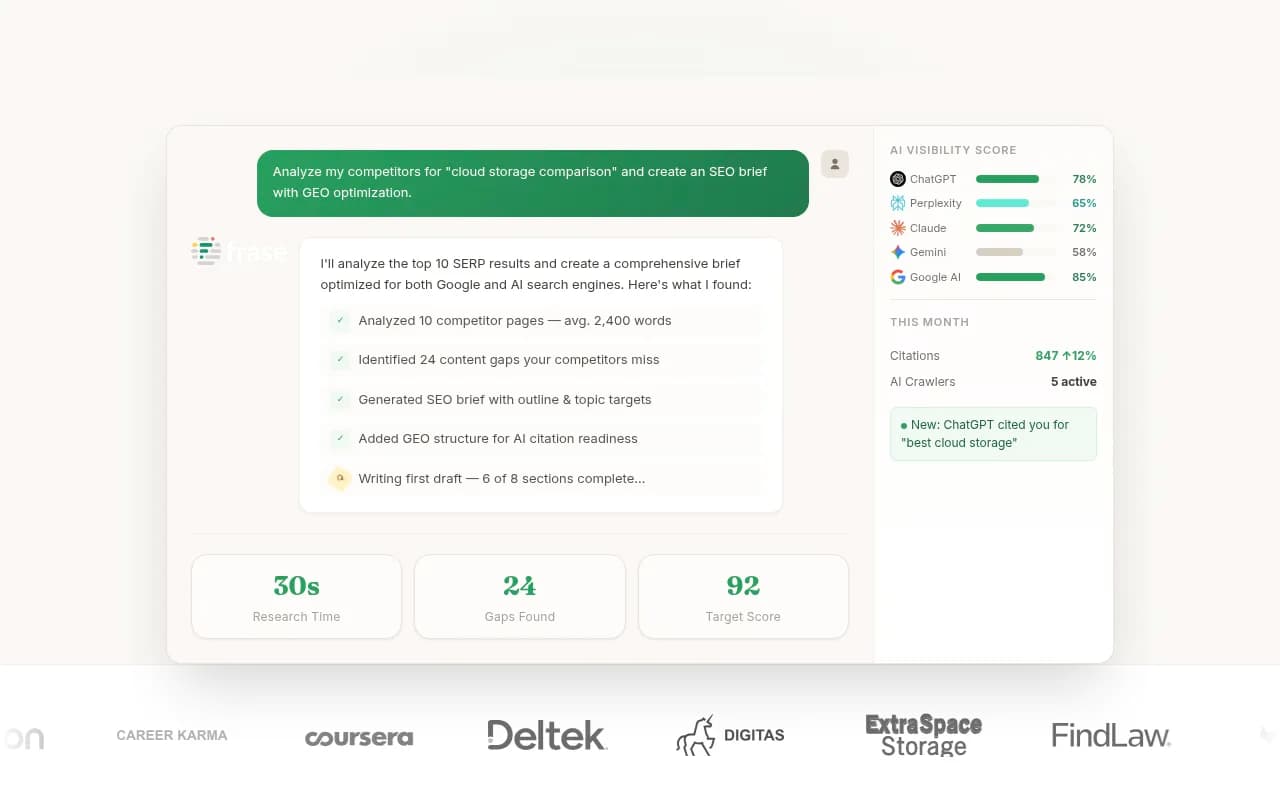
Frase sits between Surfer and AirOps -- it handles research, briefing, and optimization in one workflow, which reduces tool-switching for smaller teams.
Which type of team should use which tool
The decision really comes down to where your current bottleneck is.
Use AirOps if:
- You're running programmatic SEO at scale (hundreds or thousands of pages)
- Your team spends too much time on repetitive content tasks that follow a predictable structure
- You need to connect content generation to external data sources (product feeds, location data, etc.)
- You're comfortable with some technical setup and workflow configuration
Use Surfer SEO if:
- You're optimizing individual pages and want real-time feedback during writing
- Your team includes writers who aren't deeply familiar with SEO and need guardrails
- You want a consistent quality bar across a team of writers
- You're focused on traditional Google rankings and want to improve page-level signals
Use both if:
- You're producing content at scale (AirOps) and then optimizing key pages before publishing (Surfer)
- You have the budget and team capacity to manage two separate tools
Use neither alone if:
- Your primary concern is AI search visibility -- you'll need a GEO platform alongside or instead of these tools
A note on AI search and content strategy in 2026
The SEO software market has grown substantially, and there's no shortage of tools claiming to solve every problem. But the honest reality is that most content optimization tools -- including both AirOps and Surfer SEO -- were built for a pre-AI-search world and are adapting to the new reality at different speeds.
Surfer has added some AI writing features, but its core value proposition (the Content Score) is still anchored in traditional SERP analysis. AirOps has leaned into AI-powered workflows, but it's fundamentally a production tool, not a visibility tool.
The teams doing well in AI search right now are the ones who've separated these concerns clearly: they have a system for producing content at scale, a system for optimizing individual pages, and a system for tracking and improving AI search visibility. Those are three different jobs, and no single tool does all three well yet.
If you're evaluating your stack, the most useful question isn't "AirOps or Surfer?" -- it's "what's my actual bottleneck right now?" If you can't produce enough content, fix that first. If your content isn't ranking, fix that second. If your brand is invisible in AI-generated answers, that's the third problem, and it needs its own solution.
Bottom line
AirOps and Surfer SEO are both legitimate tools for specific jobs. AirOps is the better choice for teams that need to operate content at scale with repeatable workflows. Surfer SEO is the better choice for teams focused on individual page quality and traditional ranking signals.
What they share is a limitation: neither was built to address AI search visibility, which is increasingly where brand discovery happens. For teams that need to understand and improve how they appear in ChatGPT, Perplexity, Google AI Overviews, and other AI engines, the tooling needs to go beyond what either of these platforms currently offers.
The good news is that the GEO tooling space has matured significantly in 2026. There are now platforms that track AI citations, identify content gaps, and help you create content specifically engineered to appear in AI-generated answers -- which is a different problem from scoring a page against SERP competitors.
Pick the tool that matches your actual problem. And if your problem is AI search visibility, make sure you're looking at tools built for that job.