Key takeaways
- All four platforms track AI brand visibility, but they differ dramatically in what they do after showing you the data.
- AirOps is built around content workflow automation; Evertune leans heavily into Fortune 500 brand monitoring and sentiment; Relixir combines monitoring with AI content generation; Promptwatch is the only platform with the full loop -- monitoring, crawler logs, content generation, and revenue attribution -- in one place.
- For enterprise teams that need to move from "we're invisible in AI search" to "we're being cited and we can prove it drove revenue," Promptwatch is the most complete option in 2026.
- Budget matters: AirOps and Evertune are priced for large enterprise contracts; Promptwatch and Relixir have more accessible entry points without gutting features.
Why this comparison matters right now
AI search isn't a trend you can afford to monitor passively anymore. ChatGPT, Perplexity, Claude, and Google's AI Mode are now answering questions that used to send users to your website. If your brand isn't in those answers, you're losing pipeline to competitors who are.
The GEO platform market has exploded in response. There are now 20+ tools claiming to solve this problem, and most enterprise marketing teams are trying to evaluate them with limited time and a healthy skepticism about vendor claims. This guide focuses specifically on four platforms that come up repeatedly in enterprise shortlists: AirOps, Relixir, Evertune, and Promptwatch.
The honest version of this comparison isn't "which one has the most features." It's "which one actually closes the loop from visibility gap to measurable business outcome." That's the question we're answering here.
What "enterprise GEO" actually requires
Before comparing platforms, it's worth being specific about what enterprise teams actually need -- because the requirements are different from a solo founder tracking a few prompts.
Enterprise GEO typically involves:
- Monitoring dozens or hundreds of prompts across multiple AI models simultaneously
- Tracking multiple domains, brands, or product lines
- Connecting AI visibility data to actual revenue or pipeline
- Generating content at scale that's designed to be cited, not just read
- Understanding why AI models are or aren't citing you (crawler behavior, content gaps, source authority)
- Multi-region and multi-language tracking for global brands
- Agency or team collaboration features, SSO, and API access
With that baseline in mind, here's how each platform stacks up.
AirOps
AirOps started as an AI workflow automation tool and has evolved into a platform that connects AI search insight to content execution. Their Quill agent, launched in May 2026, is the most visible example of this: it's designed to automate the process of identifying content gaps and generating content to fill them.
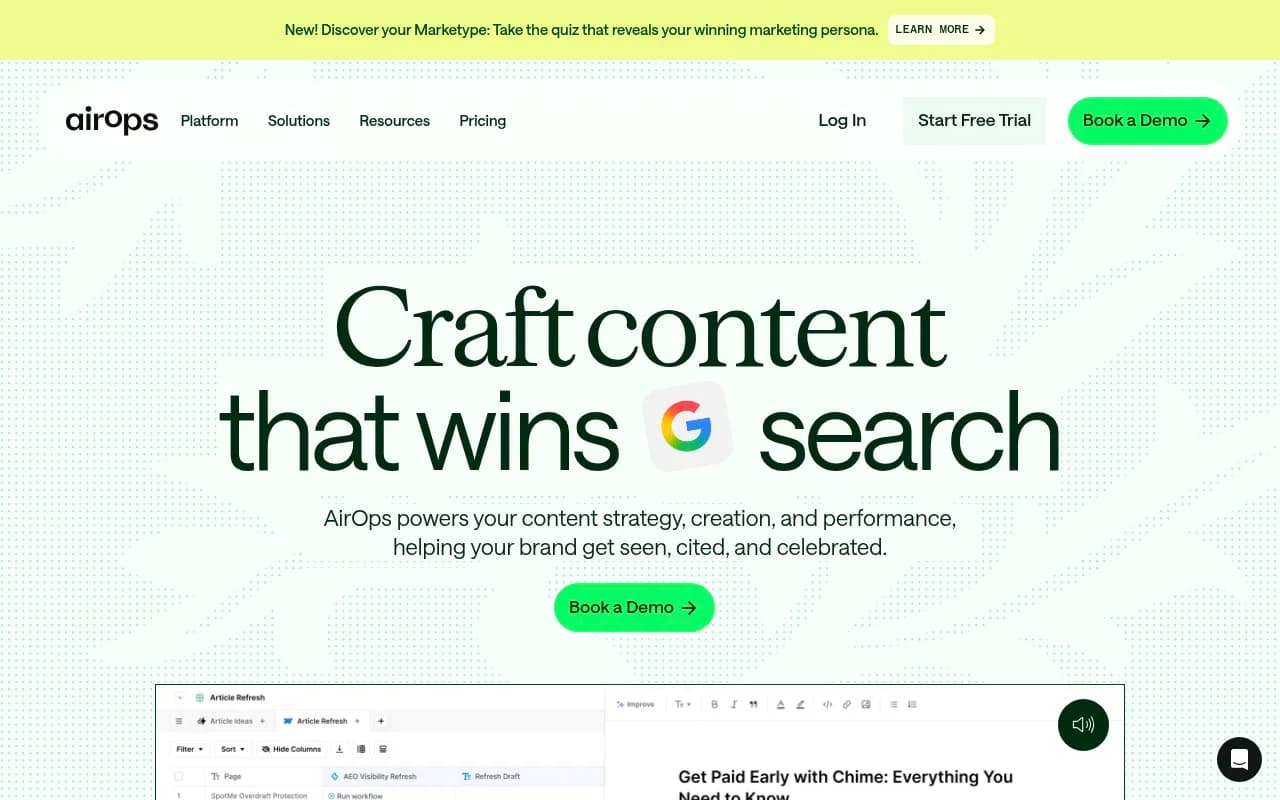
Where AirOps genuinely shines is in workflow orchestration. If your enterprise already has a content team and you need a system to scale their output in response to AI search data, AirOps is built for that use case. It integrates with existing CMS and content pipelines, which matters for large organizations that can't just rip and replace their tech stack.
The gaps are real, though. AirOps doesn't have native AI crawler logs, so you can't see how AI models are discovering (or failing to discover) your content. Its prompt monitoring depth is narrower than dedicated GEO platforms, and there's no ChatGPT Shopping tracking or Reddit/YouTube insight layer. For teams that need to understand the full picture of where AI citations come from, that's a meaningful limitation.
Pricing isn't publicly listed -- AirOps operates on a demo-first, custom contract model, which typically signals enterprise-tier pricing. That's fine if you have the budget, but it makes it harder to evaluate ROI before committing.
Best for: Enterprise content teams that want to automate content production workflows in response to AI search data, and already have separate monitoring infrastructure in place.
Relixir
Relixir positions itself as an all-in-one GEO platform with both monitoring and AI content generation built in. It's one of the newer entrants in this space, and it's moving fast.
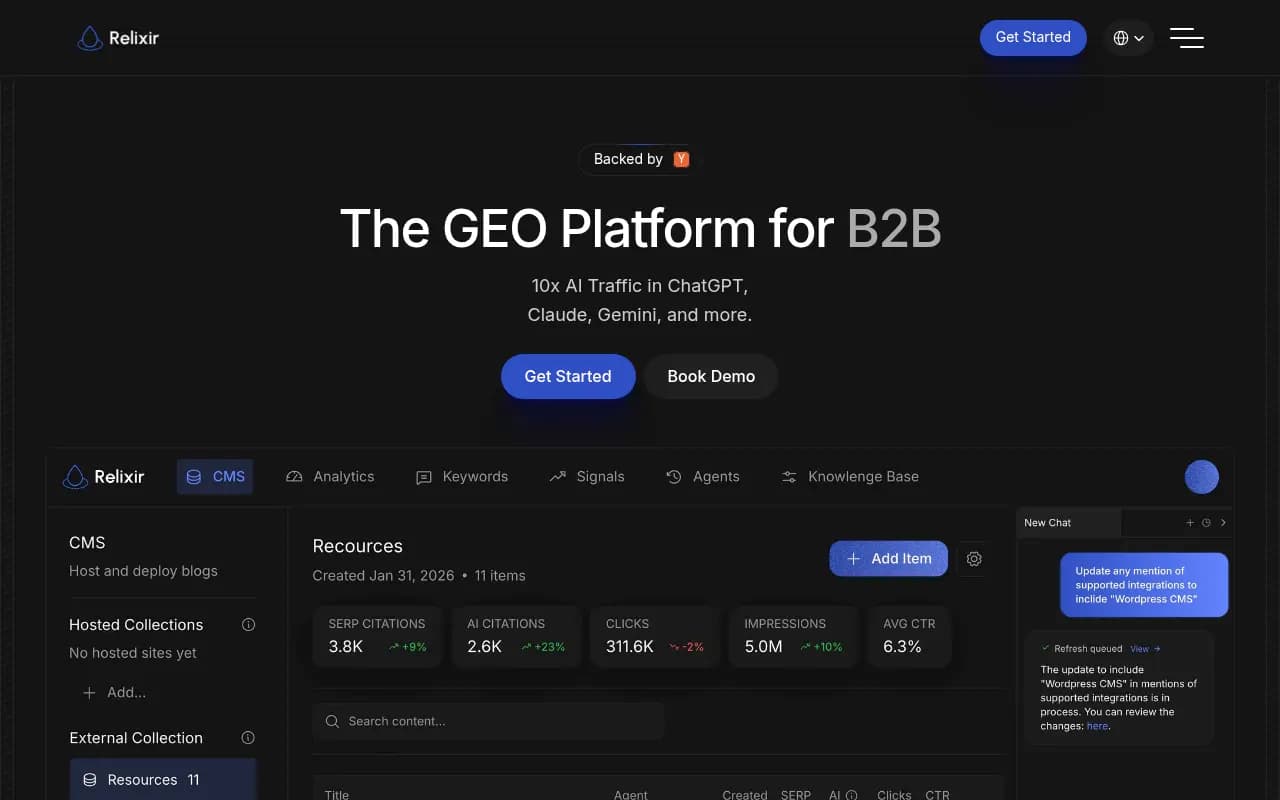
The core proposition is similar to what the market broadly wants: see where you're invisible, understand why, generate content to fix it. Relixir covers that loop reasonably well. Its content generation is grounded in prompt data, which is the right approach -- generic AI content doesn't get cited, but content built around the specific questions AI models are already answering does.
Where Relixir is still catching up: crawler log visibility, traffic attribution, and the depth of prompt intelligence (volume estimates, difficulty scoring, query fan-outs). These aren't nice-to-haves at the enterprise level -- they're what separates a platform that shows you a dashboard from one that helps you prioritize and prove impact.
Relixir's pricing is more accessible than AirOps or Evertune, which makes it worth evaluating for mid-market enterprise teams or agencies managing multiple clients. It's a credible option, especially if you're earlier in your GEO maturity and need to build the case internally before committing to a larger platform investment.
Best for: Teams that want monitoring and content generation in one place, at a price point that doesn't require a lengthy procurement process.
Evertune
Evertune markets itself as the enterprise GEO platform for Fortune 500 brands, and that positioning is accurate in at least one sense: it's built for large organizations with complex brand monitoring needs.
Evertune's strongest area is brand perception and sentiment tracking across AI models. It goes beyond "are we mentioned?" to "how are we described?" -- which matters for enterprise brands where narrative control is as important as visibility. If your brand is being cited but described inaccurately or negatively by AI models, Evertune will surface that.
The platform covers multiple AI models and offers solid citation tracking. It's also built with the kind of enterprise infrastructure (SSO, dedicated support, custom reporting) that large procurement teams expect.
The limitation is the same one that affects most monitoring-focused platforms: Evertune shows you the problem but doesn't help you fix it. There's no native content generation, no crawler log analysis, no traffic attribution connecting AI visibility to revenue. For a Fortune 500 brand with a large in-house team that can act on data independently, that's manageable. For teams that need the platform to do more of the heavy lifting, it's a gap.
Pricing is enterprise-tier and requires a demo. Expect a longer sales cycle.
Best for: Large enterprise brands that prioritize brand perception monitoring and sentiment analysis across AI models, and have separate content and technical teams to act on findings.
Promptwatch
Promptwatch is the platform that comes closest to closing the full loop for enterprise GEO -- and that's not a marketing claim, it's a structural observation about what the platform actually does versus what the others do.

The core difference is the action loop. Most platforms stop at step one: they show you where you're invisible. Promptwatch adds steps two and three. Answer Gap Analysis shows exactly which prompts competitors are visible for but you're not -- not just "you're missing coverage here" but the specific content your site is missing. Content Agents then generate articles, listicles, and comparisons grounded in real prompt data, citation data, and competitor analysis. And page-level tracking shows when your new content gets crawled, when it starts getting cited, and which AI models are picking it up.
A few capabilities that matter specifically for enterprise teams:
AI Crawler Logs are real-time logs of when ChatGPT, Claude, Perplexity, and other AI crawlers hit your site -- which pages they read, how often they return, and when pages move from crawl to citation. This is the layer that explains why you're being cited or not, and most competitors don't have it at all.
Traffic attribution connects AI visibility to actual revenue. You can see which AI-driven visits converted, not just which prompts mentioned your brand.
Prompt Intelligence includes volume estimates and difficulty scores, so enterprise teams can prioritize high-value, winnable prompts instead of spreading effort across everything.
The platform monitors 10 AI models (ChatGPT, Perplexity, Google AI Overviews, Google AI Mode, Claude, Gemini, Meta/Llama, DeepSeek, Grok, Mistral, Copilot), tracks Reddit and YouTube as citation sources, and includes ChatGPT Shopping tracking -- a channel most competitors ignore entirely.
Pricing is more transparent than AirOps or Evertune: Professional at $249/month covers 2 sites, 150 prompts, and 15 articles with crawler logs included. Business at $579/month scales to 5 sites and 350 prompts. Enterprise and agency pricing is available on request.
Best for: Enterprise and mid-market teams that need the full cycle -- gap identification, content generation, and revenue attribution -- without stitching together multiple tools.
Feature comparison
| Feature | AirOps | Relixir | Evertune | Promptwatch |
|---|---|---|---|---|
| AI model coverage | 5+ | 5+ | 8+ | 10 |
| Prompt tracking | Yes | Yes | Yes | Yes |
| Citation analytics | Partial | Yes | Yes | Yes |
| AI crawler logs | No | No | No | Yes |
| Content generation | Yes (Quill agent) | Yes | No | Yes (Content Agents) |
| Answer gap analysis | Yes | Yes | No | Yes |
| Traffic attribution | Partial | No | No | Yes |
| ChatGPT Shopping tracking | No | No | No | Yes |
| Reddit/YouTube insights | No | No | No | Yes |
| Page-level visibility tracking | No | Partial | No | Yes |
| Multi-language/region | Yes | Partial | Yes | Yes |
| Prompt volume & difficulty scoring | No | No | No | Yes |
| Offsite citation analysis | No | No | Partial | Yes |
| API access | Yes | Yes | Yes | Yes |
| Transparent public pricing | No | Partial | No | Yes |
| Free trial | Yes | Yes | No | Yes |
How to choose
The right platform depends on where your team is in the GEO maturity curve and what you need the platform to do.
If you're just starting to build the case internally and need to show leadership that AI search visibility is a real problem, any of these platforms will generate the data you need. Relixir or Promptwatch's Essential tier are reasonable starting points.
If you have a large content team and your primary need is scaling content production in response to AI search data, AirOps is worth evaluating -- especially if you already have monitoring infrastructure elsewhere.
If brand perception and sentiment monitoring is the priority (think: a regulated industry where how AI describes your brand matters as much as whether it mentions you), Evertune is built for that.
If you need the full loop -- find the gaps, generate the content, prove the revenue impact -- Promptwatch is the only platform in this comparison that delivers all three without requiring you to stitch together additional tools. The crawler logs alone are a meaningful differentiator: knowing that a page was crawled but not cited, and understanding why, is the kind of signal that turns a monitoring dashboard into an optimization system.
The question worth asking before you buy
Before signing any contract, ask each vendor this: "Show me a customer who was invisible in AI search, used your platform to fix it, and can point to the specific revenue impact."
The answer will tell you more than any feature matrix. Platforms that can answer it with specifics -- named customers, documented timelines from gap identification to citation to revenue -- are the ones worth investing in. Platforms that pivot to dashboard screenshots and coverage numbers are still in the monitoring business.
Enterprise GEO in 2026 isn't about knowing you have a problem. It's about fixing it and proving the fix worked. That's the standard worth holding every platform to.