Topify Review 2026
Tracks brand and content visibility across top AI search engines including ChatGPT, Gemini, and Perplexity, providing ranked performance comparisons across platforms.
Key takeaways
- Topify tracks brand visibility across 4 AI platforms: ChatGPT, Gemini, Perplexity, and Google AI Overviews -- a narrower model coverage than some competitors
- Monitoring-only gap vs. Promptwatch: Topify lacks AI crawler logs, AI traffic attribution, Reddit/YouTube tracking, ChatGPT Shopping monitoring, prompt volume/difficulty scoring, query fan-outs, and the 880M+ citation dataset that Promptwatch uses to power its content generation engine
- Includes a one-click content generation feature, which is a step beyond pure monitoring tools, but the depth of the underlying data powering it is unclear
- Trusted by 200+ brands including Zoom, TCL, and Midea -- a reasonable early-stage customer base
- Pricing details are not publicly listed on the main site, though a free trial is available
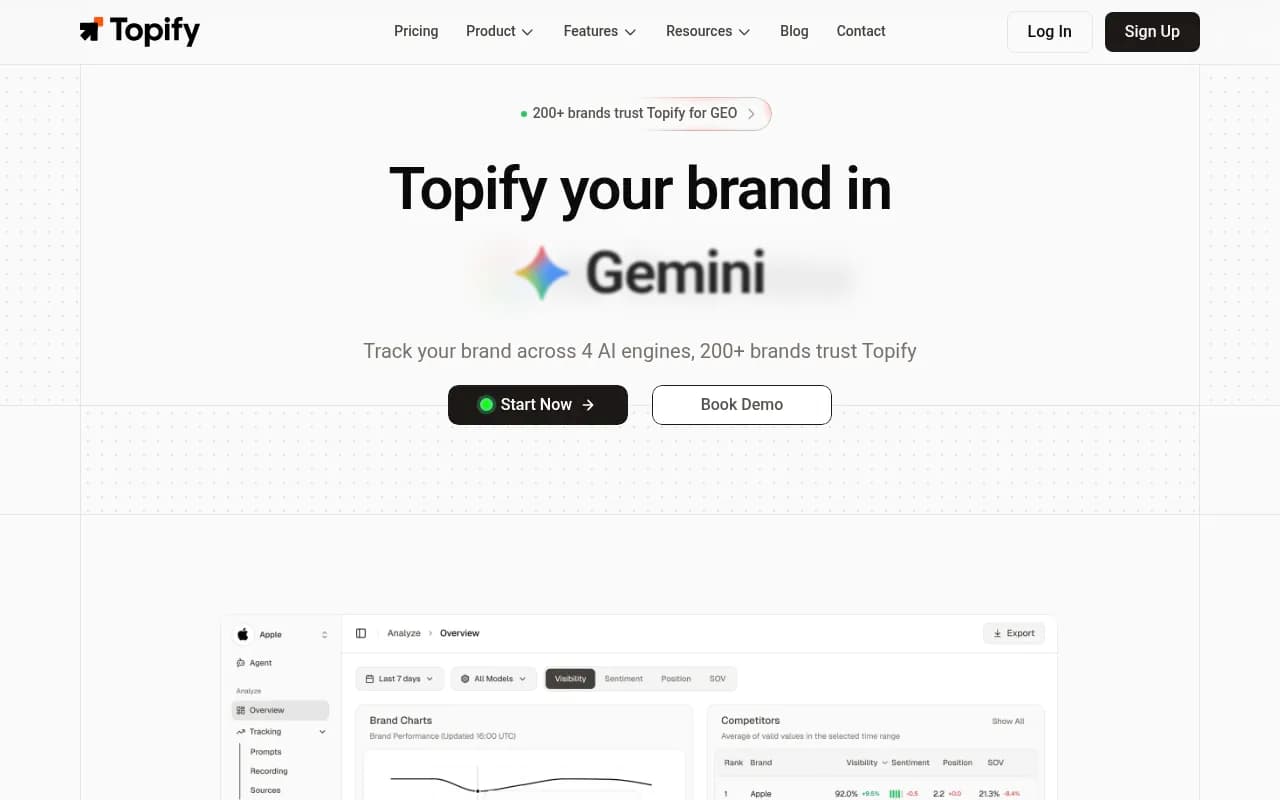
Topify is a Generative Engine Optimization (GEO) platform that helps brands track and improve how they appear in AI-generated search responses. The product monitors four major AI platforms -- ChatGPT, Gemini, Perplexity, and Google AI Overviews -- and gives marketing teams a dashboard to see where their brand shows up, how it's described, and how it stacks up against competitors.
The tool is aimed at marketing teams, SEO agencies, and startups that are starting to take AI search seriously. The pitch is straightforward: traditional SEO metrics don't explain why your brand gets cited (or ignored) by AI models, and Topify is supposed to fill that gap. The customer list includes recognizable names like Zoom, TCL, and Midea, which suggests the platform has found some traction in the B2B and consumer tech space.
Topify appears to be a relatively young product -- the blog content is dated from 2026, and the 200+ brand count suggests it's still in early growth mode. The platform is built around a four-step workflow: enter your brand, get GEO metrics and popular prompts, monitor your dashboard, and optimize with content and agents. That last step -- the "one-click execution" -- is what separates Topify from pure monitoring tools, though how deep that optimization layer actually goes is worth examining.
Key features
Brand visibility tracking across 4 AI platforms Topify monitors how your brand appears in responses from ChatGPT, Gemini, Perplexity, and Google AI Overviews. For each platform, it tracks whether your brand is mentioned, how often, and in what context. This gives teams a cross-platform view rather than having to manually query each AI engine. The platform covers the four most commercially relevant AI search surfaces for most brands right now, though it doesn't extend to Claude, Grok, DeepSeek, Meta AI, Copilot, or Mistral.
AI Visibility score The core metric is an AI Visibility percentage -- the share of relevant AI-generated responses that mention your brand. This gives teams a single number to track over time, which is useful for reporting to stakeholders who don't want to dig into raw data. The score is calculated across the prompts you're tracking, so the quality of your prompt set directly affects how meaningful the number is.
Sentiment scoring Topify assigns a sentiment score from 0 to 100 that reflects how AI models describe your brand when they mention it. A higher score means more favorable language. This is a useful layer beyond simple mention tracking -- being mentioned negatively or in a neutral context is very different from being recommended. The FAQ confirms the score is based on how AI describes the brand, though the methodology for calculating it isn't detailed publicly.
Position tracking Beyond just tracking whether your brand appears, Topify shows where it appears relative to competitors. A position of #1 means your brand is mentioned first in AI responses. This ranking dimension is genuinely useful -- being the third brand mentioned in a list is meaningfully different from being first, especially for purchase-intent queries.
High-value prompt discovery The platform surfaces prompts that are relevant to your brand and category, including an "AI Volume" metric that estimates monthly search volume for each prompt across AI tools. This is the AI equivalent of keyword volume in traditional SEO. You can also add custom prompts at any time, which gives teams flexibility to track niche or brand-specific queries that the system might not surface automatically.
Dynamic competitor benchmarking Topify lets you track competitor brands alongside your own, showing how your AI visibility compares across platforms and prompts. The "competitor heatmap" style view helps teams identify where competitors are winning and where there might be gaps to exploit. This is one of the more practically useful features for teams that need to justify GEO investment internally.
One-click content optimization This is Topify's attempt to go beyond monitoring. The platform generates content recommendations based on your visibility data, and you can approve them with a single click to auto-generate content designed to improve LLM citation rates. The concept is solid -- the gap between "here's your data" and "here's what to do about it" is where most GEO tools fall short. How well this works in practice depends heavily on the quality of the underlying citation data and the content generation model, neither of which Topify discloses in detail.
GEO analytics dashboard The main dashboard aggregates visibility metrics, prompt performance, sentiment trends, and competitor comparisons in one place. The setup process is described as fast -- enter your URL and brand name, and the system starts pulling data. The interface appears designed for non-technical users, with the FAQ and marketing copy emphasizing ease of use over depth.
Who is it for
Topify fits best for marketing teams and SEO professionals who are just starting to think about AI search visibility and want a relatively low-friction way to get started. A B2B SaaS company with a small marketing team that wants to know whether ChatGPT recommends them when someone asks about their category is a good fit. Same for a consumer electronics brand (the Midea and TCL logos on the homepage suggest this is a real use case) that wants to track AI mentions across multiple platforms without building a custom monitoring setup.
For SEO and GEO agencies, Topify positions itself as a way to scale GEO services across clients with less manual work. The multi-brand tracking and competitor benchmarking features support this use case reasonably well, though agencies managing 20+ client accounts would want to verify that the platform's prompt limits and reporting capabilities can handle that volume before committing.
Small startups are explicitly called out as a target audience, and the pitch -- "pro-level GEO optimization, no learning curve, cheaper than hiring an agency" -- makes sense for early-stage companies that can't afford dedicated GEO consultants but want to understand their AI search presence.
Who should probably look elsewhere: teams that need deep technical data (AI crawler logs, traffic attribution, Reddit/YouTube citation tracking), brands operating in multiple languages or regions, and anyone who needs to monitor more than four AI platforms. Enterprise marketing teams with complex reporting needs or large prompt sets may also find the platform's depth limiting compared to more established alternatives.
Integrations and ecosystem
Topify's integration story is thin based on available information. The platform doesn't publicly advertise connections to Google Search Console, Slack, Zapier, or other common marketing stack tools. There's no mention of an API, browser extension, or mobile app on the main site.
The content generation feature implies some kind of publishing or export workflow, but the specifics aren't documented publicly. The platform does support custom prompt input, which is a basic but important form of flexibility.
For teams that need to pipe GEO data into their existing analytics stack or reporting tools, the lack of documented integrations is a real limitation. Most enterprise and agency workflows require data to flow somewhere -- a Looker Studio connector, a CSV export, or an API -- and Topify doesn't appear to offer these publicly.
Pricing and value
Topify's pricing is not listed on the main homepage, though the site references a dedicated pricing page and mentions a free trial. The FAQ notes that enterprise plans support custom limits, suggesting there are multiple tiers. Without specific numbers, it's hard to assess value directly.
The free trial is a reasonable entry point for teams that want to test the platform before committing. The positioning as "cheaper than hiring an agency" for startups suggests the lower tiers are priced accessibly, but without published numbers, this is hard to verify.
For context, comparable GEO monitoring tools in the market range from around $49/month at the entry level to $500+/month for more capable platforms. Promptwatch, for example, starts at $99/month for a single site with 50 prompts and scales to $579/month for five sites with 350 prompts and full feature access including crawler logs and content generation.
Strengths and limitations
What Topify does well
Simple onboarding: The four-step setup process and emphasis on getting started in minutes is a genuine differentiator for teams that don't want to spend days configuring a new tool. If you just want to know where your brand stands in AI search, Topify gets you there quickly.
Cross-platform comparison: Tracking visibility across ChatGPT, Gemini, Perplexity, and Google AI Overviews in a single dashboard is genuinely useful. Most teams don't have time to manually query four different AI engines and compare results.
Sentiment and position metrics: Going beyond simple mention tracking to include sentiment scores and position rankings gives teams more nuanced data. Knowing you're mentioned third with a neutral sentiment is more actionable than knowing you're mentioned at all.
Content optimization layer: The one-click content generation feature puts Topify ahead of pure monitoring tools. The intent to close the gap between data and action is the right instinct.
Limitations worth knowing
Narrow model coverage: Four AI platforms is a meaningful limitation. Claude, Grok, DeepSeek, Meta AI, Copilot, and Mistral are all growing in usage, and brands that only track four models are missing a significant portion of the AI search landscape. Promptwatch monitors 10+ AI models by comparison.
Missing technical depth: There's no mention of AI crawler logs (which show how AI bots are actually crawling your site), AI traffic attribution (connecting AI visibility to actual website visits and revenue), or Reddit/YouTube tracking (which directly influences what AI models cite). These aren't nice-to-haves for serious GEO work -- they're how you understand why your visibility is what it is and how to actually move the needle. Promptwatch covers all of these; Topify does not appear to.
No prompt intelligence depth: Topify mentions "AI Volume" estimates, but there's no indication of prompt difficulty scoring, query fan-outs (how one prompt branches into sub-queries), or the kind of citation dataset analysis (Promptwatch has analyzed 880M+ citations) that would make content recommendations genuinely data-driven rather than generic.
Opaque pricing: Not publishing pricing tiers creates friction for teams doing vendor comparisons. It's a minor point but worth noting.
Unverifiable testimonials: The testimonials on the homepage reference companies like "Vellum Studio," "Arklo," and "Crestline Labs" that don't appear to be publicly known brands. This doesn't mean they're fabricated, but it does make the social proof harder to evaluate than logos from recognizable companies.
Bottom line
Topify is a reasonable starting point for teams that want a quick, low-friction way to understand their brand's presence in AI search. The cross-platform dashboard, sentiment scoring, and one-click content generation are all steps in the right direction, and the onboarding simplicity is a genuine advantage for smaller teams.
That said, teams that need to go beyond basic monitoring -- understanding how AI crawlers interact with their site, attributing AI visibility to actual traffic and revenue, tracking citations across Reddit and YouTube, or monitoring more than four AI models -- will hit Topify's ceiling quickly. For that level of depth, Promptwatch is the stronger option, with broader model coverage, AI crawler logs, traffic attribution, and a content generation engine grounded in 880M+ analyzed citations.
Best for: Marketing teams and startups that want a simple, fast way to start tracking AI search visibility across the four major platforms without a steep learning curve.
Frequently asked questions
What is Topify and what does it do?
Which AI platforms does Topify monitor?
Is there a free trial for Topify?
Who is Topify best suited for?
How does Topify's content optimization work?
How does Topify compare to Promptwatch?
Similar and alternative tools to Topify