Key takeaways
- Claude Code and Codex don't just mention tools, they install them. A recommendation becomes an
npm install, and replacing it later costs the developer time. - The two agents disagree a lot. In a September 2026 study by Armature, Claude Code, Codex and Cursor picked the same tool in only 42% of cases, so tracking one agent leaves a blind spot.
- Most GEO tools track ChatGPT, Perplexity and Gemini. Very few track coding agents. Promptwatch tracks Claude Code and Codex on every plan, which is the main reason it leads this list for developer-tool companies.
- For software prompts, docs and help centers earn the biggest share of ChatGPT citations. Crawlable docs, a public GitHub presence and current G2 and Capterra profiles come before any tooling decision.
Why developer-tool companies need a different GEO approach
Most GEO advice is written for consumer brands or B2B marketing sites. Developer tools have a stranger problem. Your buyer increasingly delegates the choice to an agent.
When a developer types "set up the backend for my SaaS app" into Claude Code, the agent picks a database, writes the install command and builds around it. Nobody opens a comparison page. Nobody reads your pricing table. The decision happens inside a terminal, and you only find out if you were chosen when the usage numbers move, if then.
There is also a compounding effect. Code built around your SDK produces tutorials, repos and forum threads, and future agents learn from those. A pick today makes the next pick more likely. The reverse is also true, which is what makes this uncomfortable.
What the data says about how coding agents choose
Two pieces of independent research are worth knowing before you buy anything.
The first is Amplifying's "What Claude Code Actually Chooses" study from February 2026. It ran 2,430 open-ended prompts through Claude Code across 20 tool categories and 3 Claude models, without naming any tool. In 12 of the 20 categories, the most common pick was a custom-built solution rather than any vendor. Where agents did choose vendors, they were decisive: GitHub Actions took 93.8% of CI/CD picks, Stripe 91.4% of payments, shadcn/ui 90.1% of UI components, and Vercel 100% of JavaScript deployment picks.
The second is Armature's study from September 3, 2026. Beyond the 42% agreement rate, it found Claude Code built in-house solutions in 19% of sessions, versus 10% for Codex and Cursor. Stripe won 90% of payments picks and Neon 66% of database picks. And mentions are not selections: PayPal was mentioned 139 times and never selected, and LangChain was mentioned 194 times and selected 4 times.
That last point changes what you should measure. A mention counter tells you very little. You want to know whether the agent chose you.
Why Codex and Claude Code behave differently
Armature found Codex used web search in 94% of sessions, often with site-specific operators. Claude Code searched in about 30% of sessions overall, and closer to 80% in newer sectors.
Promptwatch's reading of this, and it is an inference rather than a measured result, is that Codex's picks track live web content like docs and recent comparisons, while Claude Code leans on model knowledge and shifts more slowly. If that is right, the fix for Codex is mostly about what is on the web right now, and the fix for Claude Code is about what was in the training data and what shows up in the minority of sessions that do search.
Either way, you can't treat them as one channel.
What to look for in a GEO tool as a developer-tool company
Before the list, here is the checklist I would use. Most tools fail on the first item.
- Coding agent coverage. Does it track Claude Code and Codex, or only chat assistants?
- Selection, not just mention. Can you see whether you were in the plan, the default, a passing alternative, or replaced by a custom build?
- Crawler visibility. Can you see which AI bots hit your docs, and whether they hit errors?
- Docs and GitHub awareness. Developer discovery runs through docs, repos and review sites, not blog posts.
- A path from insight to fix. Dashboards don't ship docs updates.
- Prompt realism. Developer prompts are technical and often don't name a brand, so you need non-branded prompt sets.
The best GEO tools for developer-tool companies in 2026
1. Promptwatch
Promptwatch is the one I would start with if coding agents matter to your funnel. It tracks Claude Code and Codex on every plan, using the same visibility, mention, sentiment and competitor metrics it applies to ChatGPT, Gemini and Perplexity. It also tracks OpenCode as an API model, which matters if your audience skews toward model-flexible tooling.

The framing it uses for coding agent visibility maps neatly onto the problem: is your product in the plan, is it the default, does the agent build instead of buy, and how does the agent describe you. Most coding-agent prompts land in the Transactional intent type even when no brand is named, which fits what you see in practice.
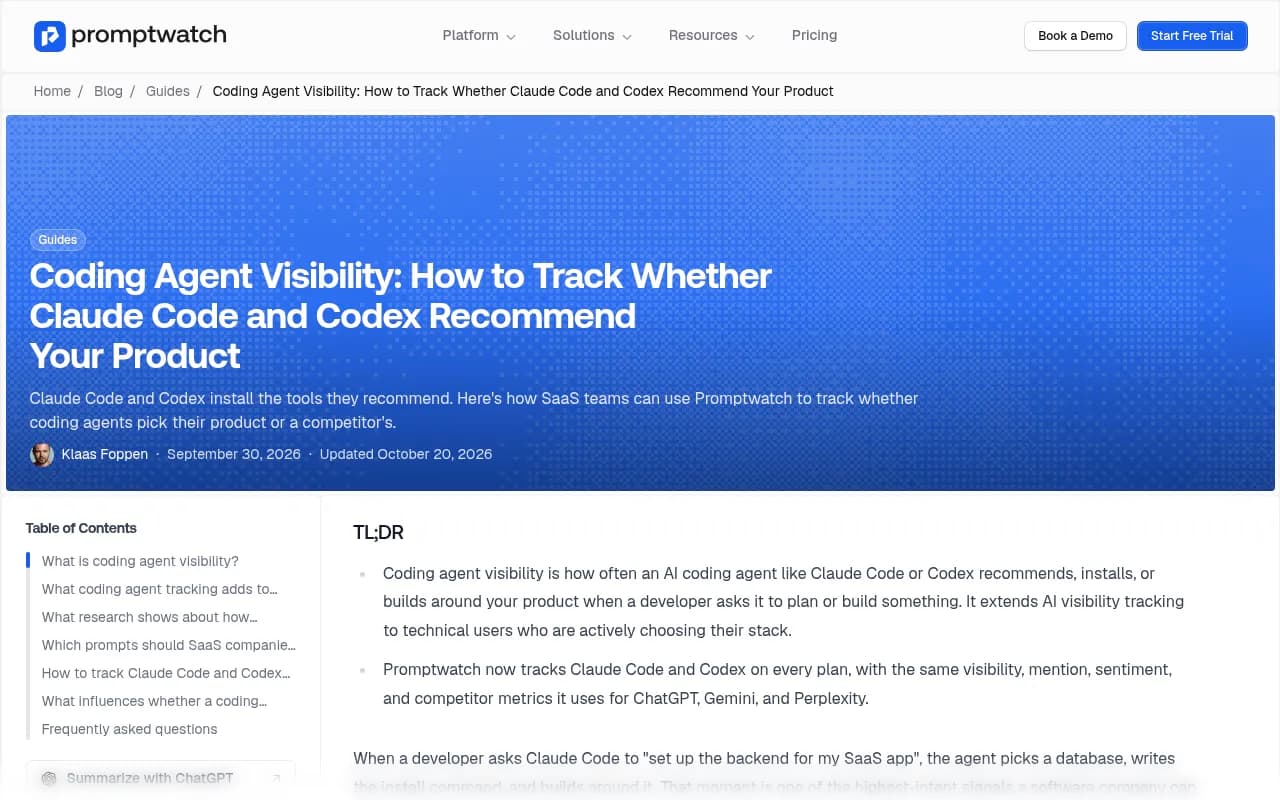
Where it pulls ahead of pure trackers is on the "why" side. IP-verified AI crawler logs show whether GPTBot, ClaudeBot, PerplexityBot and others reach your docs and what errors they hit. Page-level tracking and citation analytics show which of your pages get cited. Weekly site audits catch the technical problems that keep agents from reading your site. Then the Action Board and Content Agent turn gaps into prioritized work and publish content to WordPress, Webflow or Framer, with performance tracked afterwards.
Pricing starts free (Explore, 10 prompts, ChatGPT only). Essential is $95/mo with all AI models, and the Business plan at $579/mo adds the automated Content Agent. Confirm current numbers at promptwatch.com/pricing. Because Claude Code and Codex tracking is on every plan, you can test it on the entry tier.
Honest caveat: it is built around marketing and SEO workflows. If you want raw LLM observability for your own application, that is a different category.
2. Profound
Profound is an enterprise AI visibility platform with strong monitoring and a polished reporting layer. It suits larger teams with budget who mainly want to benchmark share of voice across chat assistants.

For developer tools, the gap is on the agentic side. I could not find independent confirmation of coding-agent tracking, so check directly with the vendor. Pricing sits higher than most alternatives.
3. Scrunch
Scrunch monitors how assistants like ChatGPT and Claude describe your brand, and it adds an optimization angle for how your site is served to AI.

It is a reasonable pick if your main worry is brand description accuracy in chat answers. Verify coding-agent support before committing.
4. Otterly.AI
Otterly.AI is an affordable prompt tracker. It answers "was I mentioned?" cleanly and cheaply.

For a developer-tool company it works as a starting baseline for chat assistants. It lacks crawler logs and visitor analytics, so you will not learn why you are or aren't cited.
5. Peec AI
Peec AI is monitoring without the optimization layer. Clean interface, good for teams that already have a content engine and just want a scoreboard.

6. Gauge
Gauge publishes a fair amount of content aimed at AI visibility for developer-tool companies, and it tracks across ChatGPT, Claude, Gemini and more.
Note that its resource pages are vendor content. Treat any "best tools for dev tool companies" ranking from a vendor, including this site's picks, as a starting point for your own trial.
7. BrandViz.AI
BrandViz.AI is a GEO platform purpose-built for B2B SaaS teams, which overlaps with many developer-tool go-to-market motions.

If you want more options in this category, the GEO software directory at bestgeosoftware.com lists far more trackers than fit here.
Comparison table
| Tool | Tracks Claude Code and Codex | AI crawler logs | Content creation and publishing | Best for |
|---|---|---|---|---|
| Promptwatch | Yes, on every plan | Yes, IP-verified | Yes, Content Agent with CMS publishing | Dev-tool teams that want to track and fix |
| Profound | Confirm with vendor | Confirm with vendor | Limited | Enterprise monitoring |
| Scrunch | Confirm with vendor | Partial | Some | Brand description accuracy |
| Otterly.AI | No | No | No | Cheap baseline tracking |
| Peec AI | No | No | No | Scoreboard for teams with content engines |
| Gauge | Confirm with vendor | Confirm with vendor | Varies | Teams exploring dev-tool visibility |
| BrandViz.AI | Confirm with vendor | Confirm with vendor | Varies | B2B SaaS marketing teams |
I did not find independent comparisons of coding-agent support across these vendors, so the "confirm with vendor" cells are deliberate. Ask for a live demo using a non-branded prompt like "set up auth for a Next.js app".
How to set up coding agent tracking
Build a non-branded prompt set
Developers asking agents to build things rarely name a vendor. Start with tasks, not brands:
- "Set up the backend for a SaaS app with auth and payments"
- "Add background job processing to this Node service"
- "Pick a database for a multi-tenant app on Vercel"
- "Add observability to this FastAPI project"
Cover each category where you compete, and include a few branded and comparison prompts for contrast. Tag them by category and persona so you can see where you win and where you vanish.
Read the metrics together
A few combinations tell you where the problem lives:
- Low share of voice means a coverage problem: agents don't think of you for the task.
- Late position means a prominence problem: you appear but as an afterthought.
- Mentions without selections means the agent knows you but prefers something else, or builds custom.
- Strong in Codex, weak in Claude Code (or the reverse) points at web content versus model knowledge, per the inference above.
Check that agents can actually read your docs
This is the most boring step and the one that most often explains a bad result. Promptwatch Data's AI crawler traffic report covers verified requests from June 8 to September 6, 2026. OpenAI accounted for 79.8% of verified AI crawler requests in the week of August 31 to September 6, down from 94.8% in the week of June 8. Only IP-verified requests count, so spoofed user agents are excluded.
The report's practical advice applies directly: check robots.txt, CDN and WAF rules for every provider, and compare your own logs to the overall mix. A provider that is large in the report but near zero in your logs suggests you are blocked. Developer sites behind aggressive bot protection get hit by this more than most.
Also worth knowing: Promptwatch Data found ChatGPT Search started using the site: operator at scale on August 8, 2026, jumping from about 0.4% to about 17% of fanout queries (report). If agents search your domain directly, your own docs' internal structure and titles matter more than they used to.
What actually gets developer tools cited
Tooling only measures. The levers are content and presence. Promptwatch Data's software prompts report covers organic software prompts in ChatGPT from September 28 to October 4, 2026:
| Source type | Share of software citations |
|---|---|
| Docs and help centers | 2.64% |
| Vendor sites | 2.01% |
| Review sites and analysts | 1.57% |
| GitHub | 1.2% |
| App stores | 0.47% |
GitHub is the single most cited domain at 1.2%, followed by learn.microsoft.com at 0.98% and G2 at 0.73%. G2, Gartner, Capterra and Software Advice together earn 1.57%, more than any single vendor including Microsoft. The shares look small because they are spread across a huge number of domains, but the ordering is what matters.
The practical read for a developer-tool company:
- Publish docs that are crawlable, fast and not locked behind JavaScript walls or logins.
- Keep a public GitHub presence with a clear README, examples and active repos.
- Keep G2 and Capterra profiles current, because review sites outrank most vendors.
- Publish the content type that lasts. Promptwatch Data's content half-life report found landing pages and docs stay cited longest, while news loses half its pages within 36 days.
Also keep in mind the content-type report: product pages are the most cited type in ChatGPT at 22.4% of citations (September 28 to October 4, 2026). A thin product page is a missed opportunity.
One caution on Markdown. Promptwatch Data found markdown files make up just 0.05% of AI search citations. Markdown serves agents reading your repo, not AI search, so don't swap your HTML docs for .md exports and expect citations.
The "build instead of buy" problem
If you take one thing from the research, take this: in 12 of 20 categories in the Amplifying study, the top answer was a custom build. Your competitor isn't always another vendor. Sometimes it is a hundred lines the agent writes itself.
That changes the content you need. Pages that say "why use a library for this" matter. So do docs that show the integration is smaller than the DIY version, with copy-pasteable snippets. If an agent can see your SDK collapses forty lines into three, build-vs-buy tilts your way.
Track this explicitly. A good coding-agent setup should show you how often the answer is no vendor at all.
Should you hire an agency instead?
There are agencies specializing in GEO for developer tools. One Medium roundup, "Top 7 GEO Agencies for Developer Tools" by Parinita Kapoor, lists several and covers Claude Code, Cursor and Copilot. It is a self-published list, and its date is inconsistent between the snippet and the page, so treat it as a lead generator for your own research rather than a ranking.
If you want a team to run the program, 1001 SEO Media is the agency behind this site and works with Promptwatch as its GEO platform. Whichever route you pick, own the measurement. An agency without access to your crawler logs and prompt data is guessing.
A 30-day plan
- Week 1: Start with the free Explore tier or a trial of Essential. Build 30 to 50 non-branded prompts across your categories. Turn on Claude Code and Codex tracking.
- Week 1: Connect crawler logs through your CDN (Cloudflare, Vercel, Fastly and others are supported) and check which AI bots reach your docs.
- Week 2: Read the first results by agent. Note where you are in the plan, where you are the default, and where agents build custom.
- Week 3: Fix the cheap stuff: blocked bots, thin product pages, outdated G2 profile, docs with no examples.
- Week 4: Publish or refresh content against your biggest gaps, then re-check the same prompts. Track whether the new pages get crawled, cited and clicked.
For broader background on how AI assistants build answers and which tools exist, the Promptwatch Data hub collects the first-party research cited above.
The bottom line
Coding agents are a distribution channel that has no search results page, no ad slot and no click. You are either in the plan or you aren't. The tools on this list differ mainly in whether they can see that moment at all. If they can't track Claude Code and Codex, they are measuring the old funnel. Start with a platform that covers both agents and gives you crawler data, then spend most of your effort on the docs, GitHub and review-site presence that agents actually draw from.