Contify Review 2026
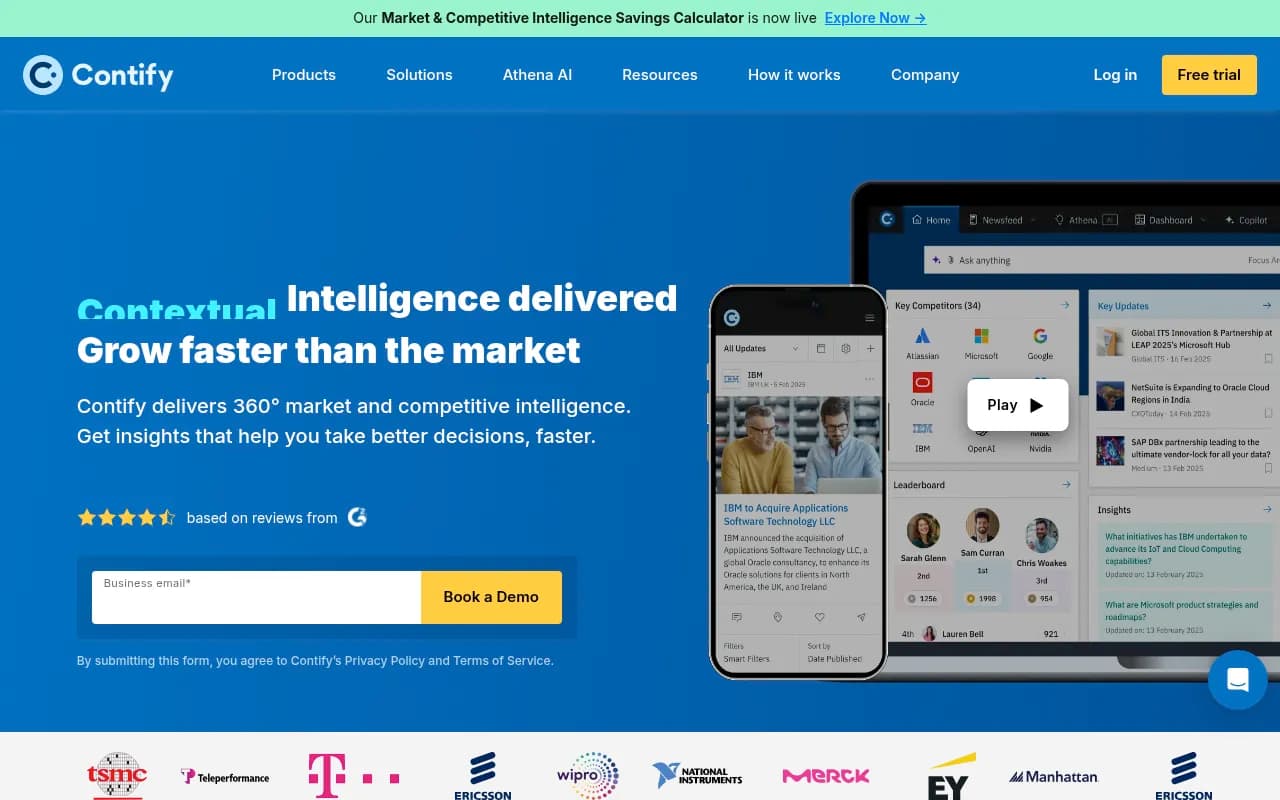
Contify is an AI-powered market and competitive intelligence platform used by enterprises like Cisco, EY, and Lenovo. It monitors 1M+ sources, auto-generates battlecards, and delivers decision-ready insights for strategy, product, marketing, and sales teams.
Key takeaways
- Contify is a mature, enterprise-grade competitive intelligence platform with 15+ years of history, used by large organizations like Cisco, EY, Lenovo, and Accenture.
- Strong at aggregating and filtering signal from 1M+ sources -- news, SEC filings, social, company websites -- and surfacing it in role-specific dashboards.
- The Athena AI engine auto-updates battlecards, answers ad-hoc questions, and extracts structured facts from unstructured content without hallucinations (per their claims).
- Pricing is not publicly listed; enterprise sales-led model means smaller teams may find it inaccessible or slow to evaluate.
- Best suited for mid-to-large enterprises with dedicated CI/MI functions, not lean startup teams or solo researchers.
Contify has been in the market intelligence space since around 2010, which makes it one of the older players in a category that's recently gotten crowded with AI-native startups. The company is based in India and has quietly built a customer base that includes some genuinely impressive logos -- Cisco, EY, Boston Consulting Group, Merck, Ericsson, Lenovo. That's not a list you build by accident. It suggests the platform has real depth, even if it doesn't get the same press coverage as newer entrants.
The core problem Contify solves is one that every strategy, product, and marketing team eventually hits: there's too much information out there, most of it irrelevant, and manually tracking competitors and markets doesn't scale. Contify positions itself as the layer that collects, filters, and delivers only what matters -- structured, contextualized intelligence that teams can actually act on. The pitch is 360° coverage: competitors, markets, accounts, industries, all in one place.
The target audience is clearly enterprise. The platform is built for organizations that have dedicated competitive intelligence or market intelligence functions -- teams that need to serve multiple internal stakeholders (strategy, product, sales, marketing) with different information needs. That said, the product tour and case studies suggest it's also used by mid-market companies with smaller CI teams who need to punch above their weight.
Key features
Athena AI -- the agentic intelligence engine
This is the centerpiece of Contify's current product story. Athena AI is described as purpose-built to deliver "verified, context-rich, and decision-ready intelligence" without hallucinations or manual effort. In practice, it does a few specific things:
- Extracts structured business facts from articles, reports, and internal documents
- Answers ad-hoc business questions with context-aware responses grounded in Contify's content universe
- Auto-updates dashboards, battlecards, and competitive timelines in real time
- Handles high-volume MI/CI requests from multiple internal teams
The anti-hallucination claim is notable. Most AI tools in this space struggle with fabricating citations or misattributing facts. Contify's approach appears to ground responses in its verified source database rather than relying on a general LLM's parametric knowledge. Whether that holds up in practice depends heavily on source coverage for your specific industry.
Source coverage and signal filtering
Contify monitors over 1 million vetted sources. These include:
- News publications and trade press
- Company websites (product pages, press releases, blog posts)
- SEC filings and regulatory documents
- Social media
- Forums and community discussions
- Job postings (useful for inferring competitor hiring priorities)
The filtering layer is where Contify earns its keep. Raw news aggregation is easy; surfacing only the 5% that's actually relevant to your competitive situation is hard. Contify uses a combination of AI classification and configurable relevance filters to reduce noise. Users can set up custom taxonomies and topic categories to match their specific intelligence needs.
Role-specific intelligence delivery
One thing Contify does well is acknowledging that a VP of Strategy and a Sales Director need different things from the same underlying data. The platform is organized around use cases:
- Strategy teams get M&A monitoring, partnership tracking, and emerging competitor alerts
- Product teams get competitor feature launch tracking, customer review analysis, and technology trend monitoring
- Marketing teams get competitor website change detection, messaging shift alerts, and event/sponsorship tracking
- Sales teams get battlecard automation, account trigger alerts (leadership changes, funding rounds), and deal win/loss intelligence
- MI/CI professionals get a full research environment with access to the complete content universe
This role-based framing is more than just marketing. The dashboards and alert configurations are actually differentiated by function, which matters when you're trying to get adoption across a large organization.
Battlecard automation
Sales battlecards are one of the highest-value outputs of any CI program, and also one of the most time-consuming to maintain. Contify automates the update cycle -- when a competitor announces a new product, changes pricing, or wins a notable deal, the relevant battlecard sections update automatically. Sales reps get current information without waiting for the CI team to manually refresh a deck. This is a meaningful workflow improvement for organizations running active competitive programs.
Account intelligence for sales
Beyond general competitive tracking, Contify offers account-level intelligence that's specifically useful for sales teams. This includes:
- Leadership change alerts (a new CTO at a target account is a classic trigger for outreach)
- Funding and investment news
- Partnership and expansion announcements
- Competitor activity at specific named accounts
This account intelligence layer blurs the line between competitive intelligence and sales intelligence, which is a smart product decision. It gives sales teams a reason to use the platform daily, not just when they're prepping for a specific deal.
Competitive website monitoring
Contify tracks changes to competitor websites -- not just new blog posts, but changes to product pages, pricing pages, and positioning language. This is genuinely useful for marketing teams who want early warning when a competitor repositions or launches a new message. The platform can alert you when a competitor quietly updates their homepage headline or adds a new product category to their navigation.
Newsletter and report generation
The platform can generate executive-ready intelligence newsletters automatically. One of their case studies specifically covers this -- moving from lengthy manual updates to concise "strategic one-liners" that executives actually read. The AI summarization layer handles the heavy lifting of distilling a week's worth of competitive signals into a digestible briefing. This is a real time-saver for CI teams that spend hours every week writing internal newsletters.
API access
Contify offers a News Data Feeds API that lets organizations pipe structured, filtered intelligence into their own applications -- CRM systems, ERP platforms, internal portals, or custom dashboards. This is important for enterprise customers who want to embed intelligence into existing workflows rather than asking employees to log into yet another tool.
Who is it for
Contify's sweet spot is mid-to-large enterprises with a formal competitive or market intelligence function. Think a 500-person B2B software company with a 2-3 person CI team serving strategy, product, and sales stakeholders. Or a professional services firm like EY or Accenture where analysts need to quickly build competitive context for client engagements. The platform's depth and configurability reward organizations that invest time in setting it up properly.
Industries where Contify appears to have particular traction include technology (Cisco, National Instruments, TSMC), professional services (EY, BCG, Accenture), manufacturing (the industrial manufacturer case study), and financial services. These are all sectors with complex competitive landscapes, lots of public information to track, and internal teams sophisticated enough to operationalize intelligence.
Smaller companies -- say, a 50-person SaaS startup with one person wearing the "competitive intelligence" hat alongside three other jobs -- will probably find Contify over-engineered for their needs. The platform is built for volume and complexity. If you're tracking 3 competitors and reading their blogs manually, you don't need this. If you're tracking 30 competitors across 12 markets and trying to serve 5 internal stakeholder groups, you might.
Solo researchers, freelance analysts, and small agencies should also look elsewhere. The enterprise sales model, lack of public pricing, and minimum contract sizes (inferred from the customer profile) suggest this isn't designed for individual users or small teams on tight budgets.
Integrations and ecosystem
Contify's integration story centers on the API. The News Data Feeds API is the primary mechanism for connecting Contify's intelligence to external systems. Documented use cases include feeding data into CRM platforms, ERP systems, and custom internal portals. This is a developer-friendly approach that gives enterprise IT teams flexibility in how they embed intelligence into existing workflows.
Beyond the API, Contify supports standard enterprise integration patterns -- email delivery for newsletters and alerts, and presumably SSO/SAML for enterprise authentication (common for platforms at this price point, though not explicitly documented on the public site).
The platform doesn't appear to have a native Slack integration or Zapier connector listed prominently, which is a gap compared to some newer competitors. For teams that live in Slack and want competitive alerts delivered there directly, this might require custom API work.
There's no mention of a mobile app on the website, which is a minor limitation for executives who want to check intelligence on the go. The platform appears to be primarily web-based.
Pricing and value
Contify does not publish pricing on its website. This is a deliberate choice that signals enterprise positioning -- pricing is negotiated based on the number of users, tracked entities, source coverage, and contract length. Based on third-party sources like Vendr, Contify contracts typically land in the range that requires a formal procurement process, not a credit card signup.
There is a 7-day free trial available, which is useful for evaluation but short for a platform that takes time to configure properly. There's also a free trial for the News Data Feeds API specifically.
For comparison, platforms like Crayon and Klue (direct competitors in the CI space) also use sales-led pricing in similar ranges. Newer, lighter tools like Kompyte or even some features within Semrush offer lower entry points but with less depth.
The value proposition is clearest for organizations where the alternative is hiring additional analysts. If Contify saves a 2-person CI team 10 hours per week each, the ROI math works at almost any reasonable enterprise price point. The Lenovo and Biocatalysts testimonials both specifically mention time savings as the primary value driver.
Strengths and limitations
What Contify does well:
- Source breadth and filtering quality. 1M+ vetted sources with AI-powered relevance filtering is genuinely impressive. The signal-to-noise ratio appears to be a consistent theme in customer reviews.
- Role-based intelligence delivery. The platform actually differentiates between what a sales rep needs vs. what a strategy director needs, rather than dumping everything into one feed.
- Battlecard automation. Auto-updating battlecards from live competitive signals is a real workflow improvement that sales teams will notice immediately.
- Enterprise maturity. 15+ years in the market means the platform has been stress-tested by large organizations. The customer list (Cisco, EY, BCG) is a credibility signal that newer entrants can't match.
- Athena AI's grounded approach. Anchoring AI responses to verified source content rather than general LLM knowledge reduces the hallucination risk that plagues many AI intelligence tools.
Honest limitations:
- No public pricing. The sales-led model creates friction for teams trying to evaluate quickly. You can't self-serve your way to a decision.
- Setup complexity. The platform's depth is also its barrier. Getting maximum value requires significant configuration time -- defining taxonomies, setting up relevance filters, training the system on what matters. Smaller teams may not have the bandwidth.
- Integration gaps. No native Slack integration or Zapier connector is a real gap for teams that want alerts in their existing communication tools without custom API work.
- Short free trial. Seven days is not enough time to properly evaluate a platform this complex. Competitors like Crayon offer longer evaluation periods.
Bottom line
Contify is a serious competitive intelligence platform for serious CI programs. If your organization has a dedicated MI/CI function, serves multiple internal stakeholder groups, and needs to track a complex competitive landscape at scale, it's worth a demo. The combination of broad source coverage, AI-powered filtering, role-specific delivery, and battlecard automation addresses the real pain points of enterprise CI teams.
For teams that want a lighter-weight tool, self-serve pricing, or faster time-to-value, look at alternatives like Crayon, Klue, or Kompyte. For organizations that specifically want to track how their brand appears in AI search engines like ChatGPT or Perplexity -- a distinct but related need -- that's a different category entirely, better served by dedicated AI visibility platforms.
Best use case in one sentence: Contify is the right choice for enterprise strategy and CI teams that need to aggregate, filter, and distribute competitive intelligence across multiple internal functions at scale.
Tags:
Frequently asked questions
What is Contify?
Who uses Contify?
How much does Contify cost?
What is Athena AI in Contify?
Does Contify have an API?
How does Contify compare to Crayon or Klue?
Similar and alternative tools to Contify