SEObot Review 2026
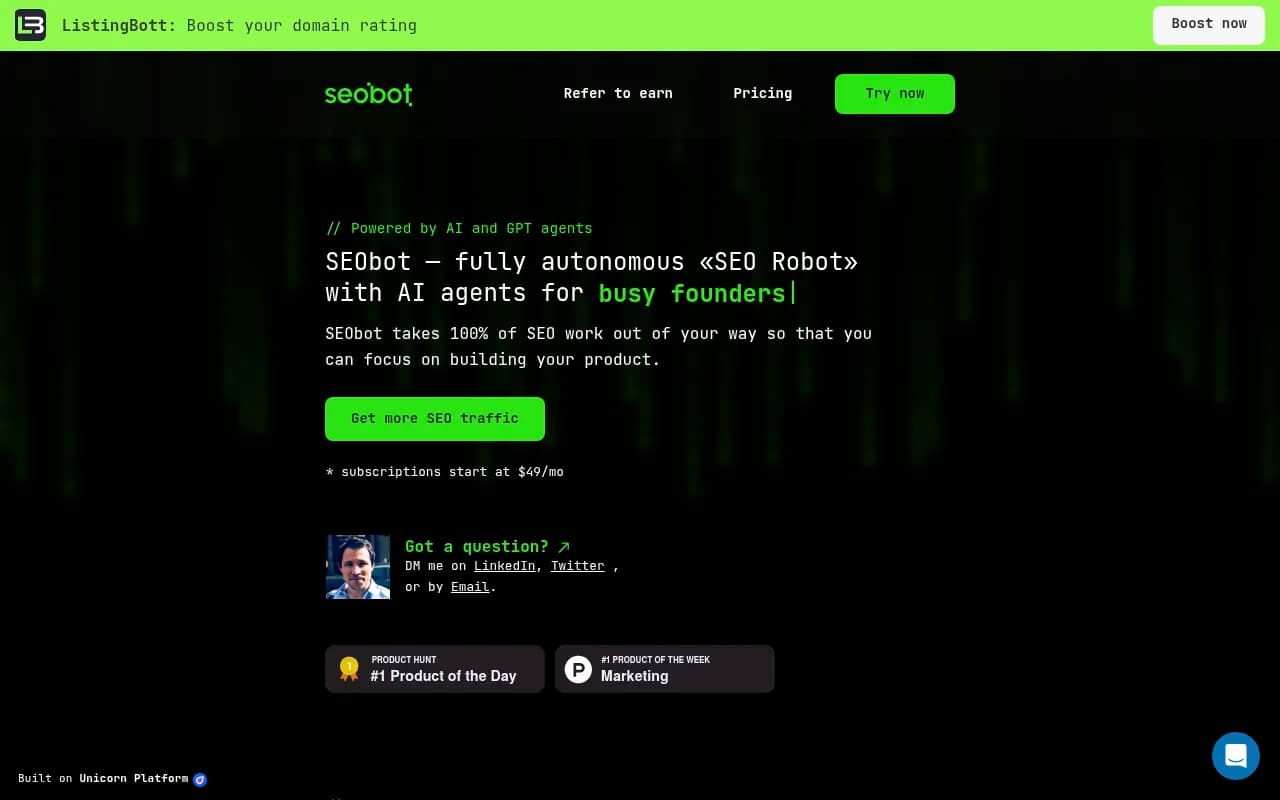
SEObot is an AI agent that researches keywords, plans a content calendar, writes 3,000-word articles and publishes them to your CMS on autopilot. Built by John Rush for indie founders and small SaaS teams, with plans from $49/month and 50+ languages.
Key takeaways
- SEObot is an autonomous blog engine. Enter your URL and it researches your site, plans topics, writes roughly 3,000-word articles and publishes them to your CMS, with optional approval.
- Plans start at $49/month (9 articles per the secondhand research), and there is a full refund on that plan if you ask after the first article.
- It publishes to 12 surfaces, including WordPress, Webflow, Ghost, Shopify, Framer, HubSpot and a REST API, and writes in 50+ languages.
- Quality is variable. The vendor itself says output sometimes matches human writers, sometimes falls short, and occasionally exceeds them.
- No rank tracking, analytics or quality gates are documented, and independent reviews are thin. Best for indie makers and directories, a poor fit for brands with strict editorial standards.
SEObot is an AI SEO agent from John Rush, the indie founder behind Unicorn Platform, ListingBott and MarsX. It began as an internal tool for his own projects (he says he runs it across 11 SaaS products and 20 directories) and was turned into a product around 2024. The pitch is simple: SEO for founders who don't want to think about SEO. You paste in a URL, press go, and articles start appearing on your blog every week.
The target audience is clear from the marketing. Solo founders, indie hackers, small SaaS teams and directory owners who need a steady content feed but have no writer, no editor and no appetite for a content calendar. It is less a writing assistant and more a robot content department. That distinction matters, because it determines both what you like about it and where it frustrates you.
The homepage claims 200,000+ articles produced, 1.2 billion impressions and 30 million clicks across customer sites. Those are the vendor's own numbers and I couldn't verify them. A figure from TrustMRR, quoted on a competitor's comparison page, puts the business at about $53.6K MRR with 727 active subscriptions as of July 2026. Treat that as secondhand too, but it suggests a real, paying user base rather than vapor.
Key features
Automated onboarding and content planning. The setup is the selling point. You provide your website URL and SEObot crawls the site, works out your audience and product, runs keyword research and builds a content plan. No keyword tool subscription, no brief templates. It then produces articles on a weekly cadence. For someone who has stared at an empty editorial calendar for three months, this is the main draw.
Long-form article generation. Articles average around 3,000 words, with plans advertising up to 4,000. Output includes tables, lists, AI-generated images, Google Image insertions and related YouTube embeds. The article examples on the site cover listicles, how-tos, checklists, versus pieces, roundups, ultimate guides and Q&A formats, so it varies structure by search intent rather than stamping one template.
Research, fact checking and anti-hallucination. SEObot scrapes Google for each topic and says its agents run hundreds of tasks per article, including a fact-checking pass with source citations and an anti-hallucination reflection step. That is a sensible architecture. Whether it fully works is another matter, and the company's own FAQ admits quality is uneven. Read every article that matters before trusting the machinery.
Internal linking and monthly re-linking. The tool scans your content for anchor text opportunities and links to your key pages, then revisits older posts as your library grows. This is one of the more practical features. Manual internal link audits are tedious, and most basic AI writers skip them entirely.
Programmatic SEO. SEObot builds data-driven templates, collects data and publishes pages at scale through your CMS. Directory owners and comparison sites can use this to spin up hundreds of structured pages. It is flagged as new on the site, so expect it to be less mature than the core blog workflow.
Interactive SEO mini-tools. It can generate small calculators, analyzers and generators that you link from a footer, sidebar or resources page. The site demos a Keyword Difficulty Checker built this way. Free tools are a classic link and traffic magnet, and bundling them into a content subscription is a smart touch that rivals rarely match.
YouTube-to-article and news. Give it a YouTube URL and it turns the video into an SEO article. A separate news module finds stories, drafts headlines and publishes to your CMS. Both are useful if you already produce video or want fresh topical content, though news publishing on autopilot carries obvious risk if nobody is checking accuracy.
AI backlinks. The marketing says SEObot searches for link opportunities in your niche and helps secure them to raise Domain Rating. The mechanism isn't documented anywhere I could find, and the research notes flag it as unclear. I would treat this as a feature to test with low expectations, and keep your own outreach going if links matter to you.
Multilingual output. More than 50 languages are supported, from Arabic and Hindi to Japanese, Portuguese and Turkish. For small teams trying to reach non-English markets without hiring translators, this is a real advantage.
Optional moderation. By default it runs on 100% autopilot. You can ask for an email listing articles to accept or decline, and you can edit articles inside SEObot before they go to your CMS. Review is opt-in, which is the opposite of what cautious teams want.
Who is it for
The sweet spot is a solo founder or two-person SaaS team with a handful of products and a rough instinct that blog traffic would help. Think an indie maker running a niche directory, a Next.js starter kit, or a small e-commerce store who wants hundreds of long-tail pages. The case studies on the site are all in this territory: DevHunt, FilmGrail, NextJSStarter, LLMModels. One user on X, Santiago Poli, reported roughly 500 clicks a day from a side project, about $1,000 spent on articles, and a $6,500 client closed before the business was even operational. Anecdotes, yes, but they match the profile.
It also suits people running many small sites. At a few dollars per article, you can test demand across niches without a content team. Directory and programmatic builders get extra value from the pSEO and mini-tools modules.
Who should skip it? Brands where every word is reviewed by legal or an editor. Agencies promising clients a defined quality bar. Companies in YMYL topics like health and finance, where a single hallucinated claim is expensive. Because publishing is the default and no quality gates are documented, variable articles can go live under your name. John Rush himself has said some niches are too competitive for it to work. And anyone wanting adult or explicit content should note that the underlying LLM safety filters may refuse or soften it, which the company says it cannot guarantee around.
Integrations and ecosystem
SEObot lists 12 publishing routes: WordPress, Webflow, Ghost, Shopify, Wix, Framer, Notion, HubSpot, Unicorn Platform, Next.js, webhooks and a REST API. The FAQ also mentions Zapier and Make. That covers nearly every CMS an indie founder uses, plus a custom path for anyone on a bespoke stack.
Quality of integration varies. One Shopify user on X said formatting through the standard integration was hard to get right, though he blamed Shopify's blog editor. Expect to spend a little time checking how articles render on your theme, especially tables and embeds.
There is an app at app.seobotai.com for onboarding and management, and documentation reportedly lives at docs.seobotai.com. I couldn't confirm the docs. There is no official GitHub repository, no browser extension and no mobile app that I found. Export is mostly a function of your CMS, since the articles live there once published. Rank tracking, analytics and AI-visibility measurement are not documented, so you will need Google Search Console and your own analytics to see whether any of this works.
Pricing and value
The homepage confirms that subscriptions start at $49/month, and there is no public /pricing page (it returns a 404). The full plan list reportedly appears after onboarding. A competitor's comparison page, SEOTakeoff, lists these tiers, which you should verify yourself:
- $49/month for 9 articles (about $5.44 each)
- $99/month for 20 articles
- $199/month for 50 articles
- $499/month for 100 articles plus 20 directory listings
- $570/month for 150 articles
- $1,050/month for 300 articles
- Custom agency pricing for 300+ articles, with a $3.50 per-article floor
One listing disagrees on the entry price ($19 versus $49), another reason to check the signup flow. There is no traditional free trial. Instead, the company offers a full refund on the $49 plan if you contact them after the first article and are unhappy.
On value, the per-article cost is low next to freelancers, who often charge $100 to $300 for a 3,000-word piece, and competitive with other AI article tools. But cheap output isn't cheap if it needs heavy editing or hurts rankings. The honest framing is that you are buying volume and consistency, and paying with your own review time. Start on the smallest plan, read the first batch critically, and use the refund window.
Strengths and limitations
What it does well
- The zero-setup workflow. URL in, articles out, with research, planning, linking and publishing handled in one pass.
- Breadth of formats, including programmatic pages, mini-tools, news and video-to-article, which most pure writing tools lack.
- Wide CMS coverage and 50+ languages at a low entry price.
- Automatic internal linking that gets refreshed as the site grows.
- A founder who uses the product on his own portfolio and is reachable directly on X, LinkedIn and email.
Limitations
- Quality is inconsistent by the company's own admission, and nothing documented stops weak articles from publishing by default.
- No built-in rank tracking, traffic analytics or AI-visibility measurement, so proving ROI means stitching together other tools.
- Independent validation is thin. Capterra shows zero reviews, there is no Trustpilot page, and I found no dedicated G2 listing. A single-review 1.0/5 on aiagentsdirectory.com is too small a sample to mean much, and a Reddit thread reportedly mentions an error and an unresponsive chat bot, which I couldn't confirm. Glowing testimonials on the homepage are curated. Also note it is not the same product as seobot.bot or SEOBOTS.io, which review sites often confuse.
- The backlink feature is undocumented, and pricing transparency is poor with no public plan page.
Bottom line
SEObot makes sense for founders and small teams who want a hands-off blog engine and are willing to sample the output before committing. The $49 entry point with a refund option makes it a cheap experiment. If you care about brand voice, accuracy or measurable reporting, you will want to turn on moderation, read everything and add your own tracking.
Best use case in one sentence: a solo founder or directory owner who needs a steady stream of long-tail blog content across several sites and has no writer to hire.
Tags:
Frequently asked questions
What is SEObot?
How much does SEObot cost?
Is there a free trial or refund?
Which CMS platforms does SEObot support?
Can I review articles before they go live?
How good is the content quality?
Similar and alternative tools to SEObot